2025 Report: US$490 Million Is 3rd Highest To Cuba Since 2001; US$173.6 Million (See List) In PYME/Cuban Citizen Exports Including Vehicles- US$148.3 Million. Donations Up 116.7% To US$147 Million

NOTE: The total value of all exports in 2025 from the United States to the Republic of Cuba- products paid and products donated, was US$810,776,711.00

ECONOMIC EYE ON CUBA©
March 2025

December 2025 Ag/Food Exports To Cuba Increase 10.8% -
Year-To-Year Increase 13.0%
46th Of 222 December 2025 U.S. Food/Ag Export Markets- 2
For 2025 Cuba Ranked 49th Of 222 U.S. Ag/Food Export Markets – 2
2025 Was Third-Highest Export Value Since First Exports In 2001
Re-Emerging Private Sector Exports Continue To Increase - 3
December 2025 CDA Healthcare Product Exports US$98,824.00 - 6
December 2025 Humanitarian Donations US$16,034,654.00 – 7
2025 Humanitarian Donations- US$147,027,544.00- 7
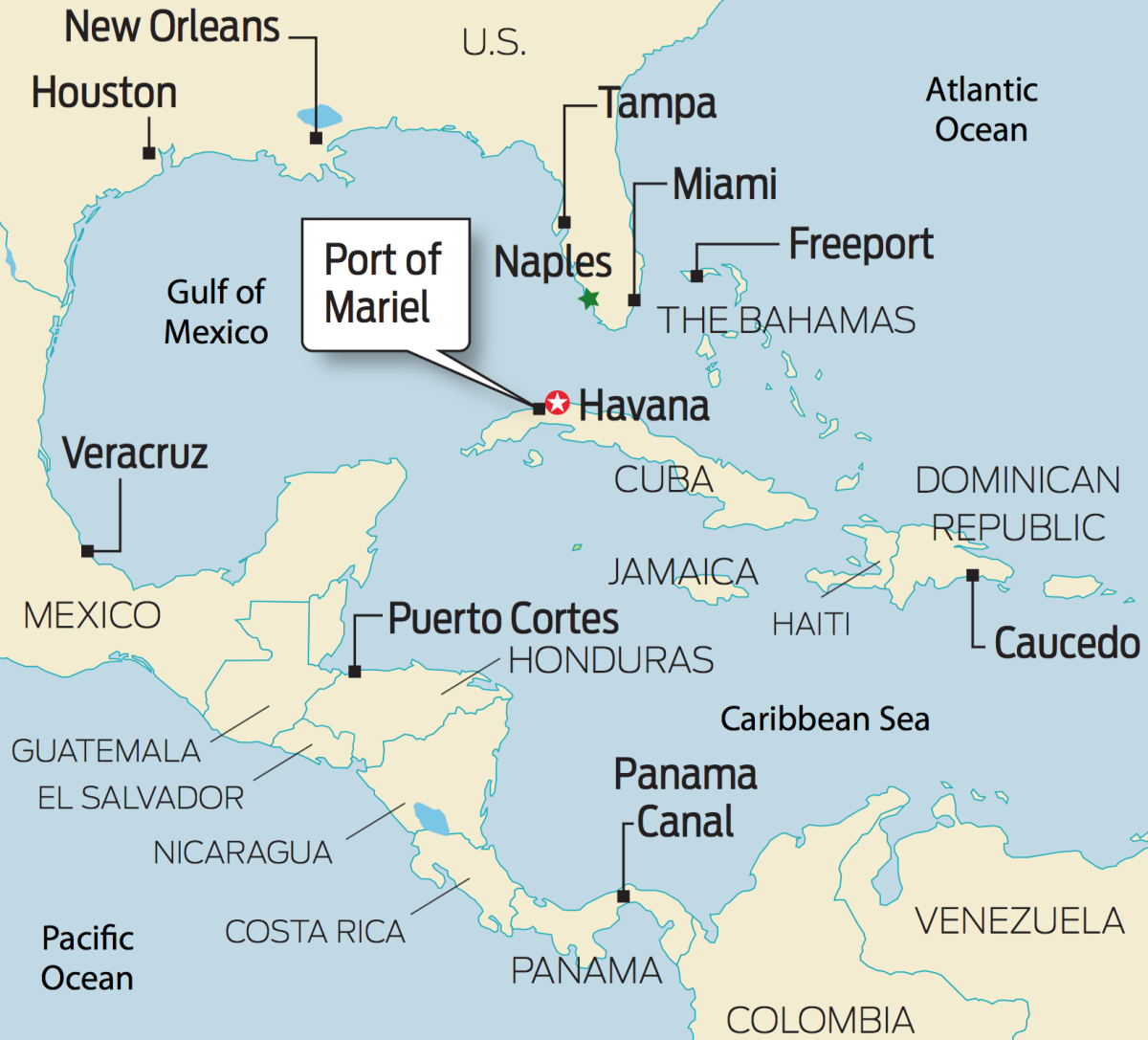
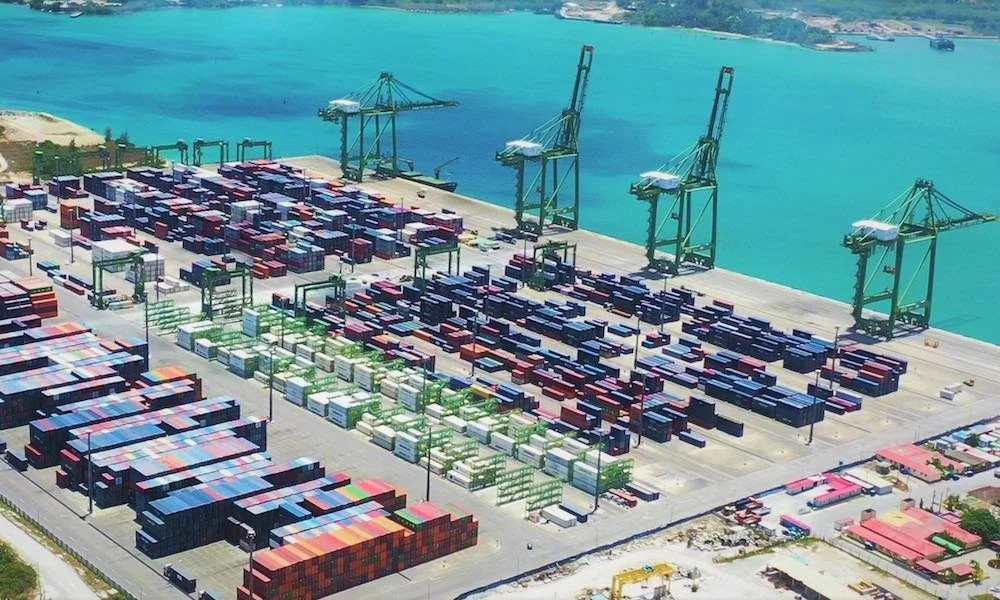
U.S. Port Export Data- 20


DECEMBER 2025 AG/FOOD EXPORTS TO CUBA INCREASE 10.8%- Exports of food products and agricultural commodities from the United States to the Republic of Cuba in December 2025 were US$46,221,085.00 compared to US$41,700,049.00 in December 2024 and US$45,229,570.00 in December 2023.  

US$490,111,943.00 for 2025 compared to US$433,662,216.00 in 2024 representing an 13.0% increase year-to-year. The year 2025 represents the third-highest US Dollar value in exports since the first TSREEA exports in December 2001.

Since 2022, when the first BIS license was issued for the export of vehicles to Republic of Cuba nationals and to private companies in the Republic of Cuba, the cumulative export value of the initiatives in place during the Obama-Biden Administration, Trump-Pence Administration, Biden-Harris Administration, and Trump-Vance Administration exceeds US$394 million of which electric and gasoline-powered new and used vehicles, bicycles, trucks, motorcycles and mopeds, and parts, exceeds US$227 million (Year 2025: US$149,413,031.00; Year 2024: US$67,241,234.00; Year 2023: US$10,546,419.00; Year 2022: US$89,848.00), and purchases (equipment and products) for use by the re-emerging private sector in the Republic of Cuba driving the growth.

The data contains information on exports from the United States to the Republic of Cuba- products within the Trade Sanctions Reform and Export Enhancement Act (TSREEA) of 2000, Cuban Democracy Act (CDA) of 1992, and regulations implemented (1992 to present) for other products by the Office of Foreign Assets Control (OFAC) of the United States Department of the Treasury, Bureau of Industry and Security (BIS) of the United States Department of Commerce, and United States Department of State.

The TSREEA re-authorized the direct commercial (on a cash basis) export of food products (including branded food products) and agricultural commodities from the United States to the Republic of Cuba, irrespective of purpose. The TSREEA does not include healthcare products, which remain authorized and regulated by the CDA.

The data represents the U.S. Dollar value of product exported from the United States to the Republic of Cuba under the TSREEA, CDA, and other regulations, specifically including products exported from the United States to the re-emerging private sector in the Republic of Cuba.

The data does not include transportation charges, bank charges, or other costs associated with exports; the government of the Republic of Cuba reports unverifiable data that includes transportation charges, bank charges, and other costs.

LINK TO COMPLETE REPORT IN PDF FORMAT

LINK TO U.S. PORT EXPORT DATA

LINK TO COMPLETE LIST OF PRODUCTS IN 2025 EXPORTED FROM THE UNITED STATES TO CUBA

LINK TO COMPLETE LIST OF PRODUCTS IN 2024 EXPORTED FROM THE UNITED STATES TO CUBA

LINK TO COMPLETE LIST OF PRODUCTS IN 2023 EXPORTED FROM THE UNITED STATES TO CUBA

McGraw Center For Business Journalism

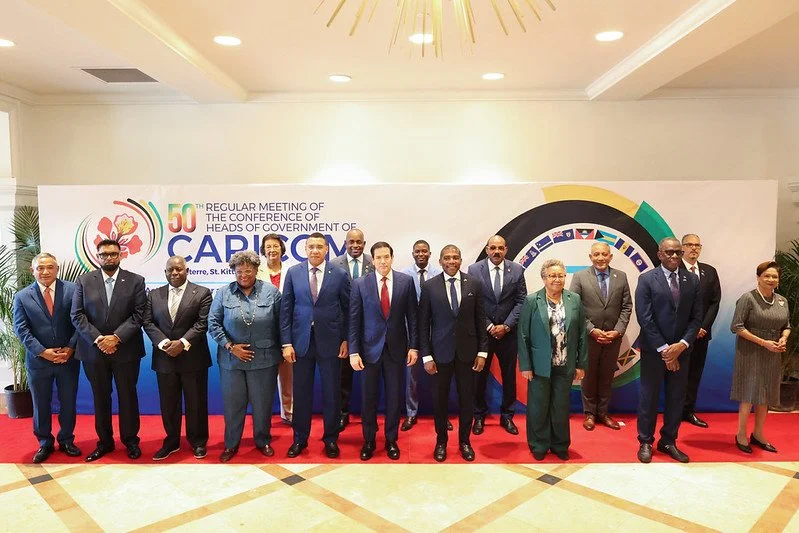
At CARICOM Meeting, U.S. Secretary Of State Rubio Discusses Cuba- Engagement Remains Focused First On Commercial, Economic, Financial Changes In Cuba

United States Department of State
Washington DC
25 February 2026

Frigate Bay, Saint Kitts and Nevis
St. Kitts Marriott Beach Resort

Secretary of State Marco Rubio Remarks to Press


QUESTION:  Can I ask you about the oil announcement today by the Treasury Department about Venezuelan oil to Cuba that for humanitarian reasons – for private companies?  Is this a shift in policy?  What is the motivation?

SECRETARY RUBIO:  No, it’s always been legal to sell to the private sector in Cuba, okay?  These are – these would not be sales to the government.  These would not be sales to the military-owned GAESA, the company.  These would be sales to a very small private sector that exists in Cuba, and that’s always been legal.  I mean, there are people that have a license to do that now.  This would just expand to the numbers that could do it.  Again, it would go to the private sector.  The private sector in Cuba is quite small.  It exists, but it’s small.  And it certainly in and of itself does not have the capacity to deal with the scale and scope of the challenges they’re facing. 

But if the Cuban economy were a functioning economy, it would have a much larger private sector.  And so what’s clear is that – and I would say this, that the people of Cuba are suffering today.  They’ve been suffering for a long time.  They’re suffering now, perhaps more than at any time in recent memory, perhaps in the history since 1959.  This is the worst economic climate that Cuba has faced, and it is the authorities there in that government who are responsible for that.  They are the ones that have made decisions that have left Cuba vulnerable to the situation they’re now in. 

Understand that Cuba has largely survived on the basis of subsidies.  The Soviet Union gave them free things.  When the Soviet Union collapsed, they went into a special period which was disastrous for them.  And then along came Hugo Chávez and bailed them out for a long time.  When that sort of died off a little bit, the Maduro regime was providing them fuel – or they were providing them actually crude oil.  Some percentage of that was refined and used domestically, and a large percentage of that never even made it to Cuba.  It was sold in the open market for cash to fund the regime and to fund the military-owned company. 

So the reason why Cuba’s electricity grid was already in collapse – before Maduro was captured it was already in collapse – the reason why things are as bad as they are is because they have an economic model that does not exist, that does not work.  It doesn’t exist anywhere in the world.  It is not functional.  And the only way Cuba is going to have a better future is if it has a different economic model.  Now, if you go back to President Trump’s 2017 or 2018 executive orders on a new policy in Cuba, that policy was entirely designed in many ways to put the private sector and individual private Cubans – not affiliated with the government, not affiliated with the military – in a privileged position. 

The reason why those industries have not flourished in Cuba is because the regime has not allowed them to flourish.  So now that they’re in a crisis, there is an opportunity for them to import fuel – in small quantities, granted – through a private sector.  If we catch the private sector there playing games and diverting it to the regime or to the military company, if we find that they’re moving that stuff around in ways that violate the spirit and the scope of these permissions, those licenses will be canceled. 

But it’s the same reason why we’ve provided humanitarian assistance.  We’ve provided humanitarian assistance in Cuba in the aftermath of the hurricane; we provided it through the Catholic Church, not through the government.  And we’re prepared to do something similar when it comes to fuel through the private sector, the small private sector.  But that alone will not solve Cuba’s very dramatic problems that have been caused by 60-some-odd years of mismanagement, ineptitude, and a failed economic model. 

QUESTION:  Mr. Secretary, can you confirm or comment on reports that you’ve spoken with Raúl Castro’s grandson?

SECRETARY RUBIO:  I won’t comment on any conversations we’ve had.  Suffice it to say that the United States is always prepared for – prepared to talk to officials from any government that have information to share with us or viewpoints they want to share with the United States, and that’s my job to do that.  So whether it’s someone in Cuba or potentially one day someone in North Korea or right now in Iran, we are always open to listen.  That’s different from a negotiation obviously, but we’re prepared to listen to viewpoints that other people say. 

Cuba is a country located 90 miles off the coast of the United States.  It has a very severe and catastrophic economic crisis on its hands.  And if someone in their system has information to share with us about changes they’re open to making or moves they’re prepared to accept, we would certainly listen to that.  And I would probably do that not in a setting in front of the media because I think it would be more productive that way, but ultimately actions will be important in something like that.

QUESTION:  I mean, can they negotiate a new system in Cuba?  I mean, are you hopeful that there might be reformists inside who could have (inaudible)?

SECRETARY RUBIO:  Well, I mean, the status quo is unsustainable.  I had – we had a meeting here today with all the leaders of CARICOM, and it was one of the points I raised, and I think virtually everyone in the room agreed that Cuba’s status quo is unacceptable.  Cuba needs to change.  It needs to change.  And it doesn’t have to change all at once.  It doesn’t have to change from one day to the next.  Everyone is mature and realistic here.  We’re seeing that process play out, for example, in Venezuela.  Many in the – many of the countries represented at the CARICOM conference today were themselves countries that went through transitions at some point in their history.

But Cuba needs to change.  It needs to change dramatically because it is the only chance that it has to improve the quality of life for its people and not lose 15 percent of its population since 2021.  Fifteen percent of the people of Cuba have left since 2021.  That is not a system that’s working.  That’s a system that’s in collapse, and they need to make dramatic reforms.  And if they want to make those dramatic reforms that open the space for both economic and eventually political freedom for the people of Cuba, obviously the United States would love to see that.  We’d be helpful.  If they decide they’re going to dig in and just continue forward, then I think they’re going to continue to experience failure and the people of the country are going to continue to suffer.  It’ll be the regime’s fault.

QUESTION:  To come back to Cuba, some of the countries you met today have raised concerns about spillover and instability caused by the humanitarian crisis there.  Is the move today on oil sales a sort of recognition that the humanitarian crisis is getting out of hand, that the U.S. blocking oil shipments —

SECRETARY RUBIO:  No – I mean, no, first of all, forget about today.  The humanitarian crisis is getting out of hand because the Cubans don’t know how to run an economy.  They’re incompetent.  They have a military-controlled holding company named GAESA which controls 40 percent of their GDP, and none of the money that that company has generated flows to the coffers of the government.  None of that money goes to schools.  None of that money goes to roads.  None of that money goes to feeding the population.  You have a country that has fertile farmland that imports sugar.  This was one of the world’s leading exporters of sugar; now they import sugar.  They import almost all their food.  They – it’s a dysfunction.  It’s just not even an economy.  It’s a total dysfunction.  That’s their fault.

As far as spillover effect, they’re not more concerned than we are.  We’re 90 miles away, and the U.S. has experienced mass migration from Cuba in the past, certainly in the early ’90s with the rafter crisis, but as recently as 2021 and ’22 we were having people show up in the Florida Keys and stranded in the Bahamas.  So we don’t want to see it, either.  And ultimately, as far as the move today with oil, this is existing – the law allows us to do business like fuel and even telecommunications with the Cuban private sector.  The problem is the Cuban private sector is very small.  If they want to open the gates and allow the Cuban private sector – independent of the military, independent of the government – to grow, that solution is there.

What the Cuban people should know is this: that if they are hungry and they are suffering, it’s not because we’re not prepared to help them.  We are.  It’s that the people standing in the way of us helping them is the regime, is the Communist Party. That’s who’s standing in the way.  If they move out of the way, we’re more than happy to work with individual Cubans so they can have an opportunity to feed their families and build their economy.  But we are not the impediment.  They are.

Politico Canada

“CUBA — Oil and food.  That’s what Cuba’s ambassador to Canada says his country needs to survive the stepped-up American pressure under President DONALD TRUMP to break the back of Cuba’s government.  — Rock and a hard place: But RODRIGO MALMIERCA DÍAZ told the House of Commons foreign affairs committee on Tuesday that he gets the realpolitik countries like Canada are facing.  “I understand that many friends of Cuba are trying to be, maybe discreet, about their positions. They don't want to create more trouble with the U.S. than they already have.”  — Please help, anyway: “Without energy, every aspect of life in the country is affected,” the envoy said, pointing to food distribution, public health, transportation and education.”  

Trump Administration Executive Order On Changes To Tariffs To Comply With SCOTUS Decision

In the Supreme Court of the United States 
DONALD J. TRUMP, PRESIDENT OF THE UNITED STATES, ET AL., PETITIONERS v. V.O.S. SELECTIONS, INC., ET AL. ON PETITION FOR A WRIT OF CERTIORARI TO THE UNITED STATES COURT OF APPEALS FOR THE FEDERAL CIRCUIT PETITION FOR A WRIT OF CERTIORARI
 

QUESTIONS PRESENTED 

1. Whether the International Emergency Economic Powers Act (IEEPA), Pub. L. No. 95-223, Tit. II, 91 Stat. 1626, authorizes the tariffs imposed by President Trump pursuant to the national emergencies declared or con-tinued in Proclamation 10,886 and Executive Orders 14,157, 14,193, 14,194, 14,195, and 14,257, as amended.  2. If IEEPA authorizes the tariffs, whether the statute unconstitutionally delegates legislative authority to the President.

Link To SCOTUS Filing

Federal Register/Vol. 91, No. 37
Wednesday, February 25, 2026
Presidential Documents
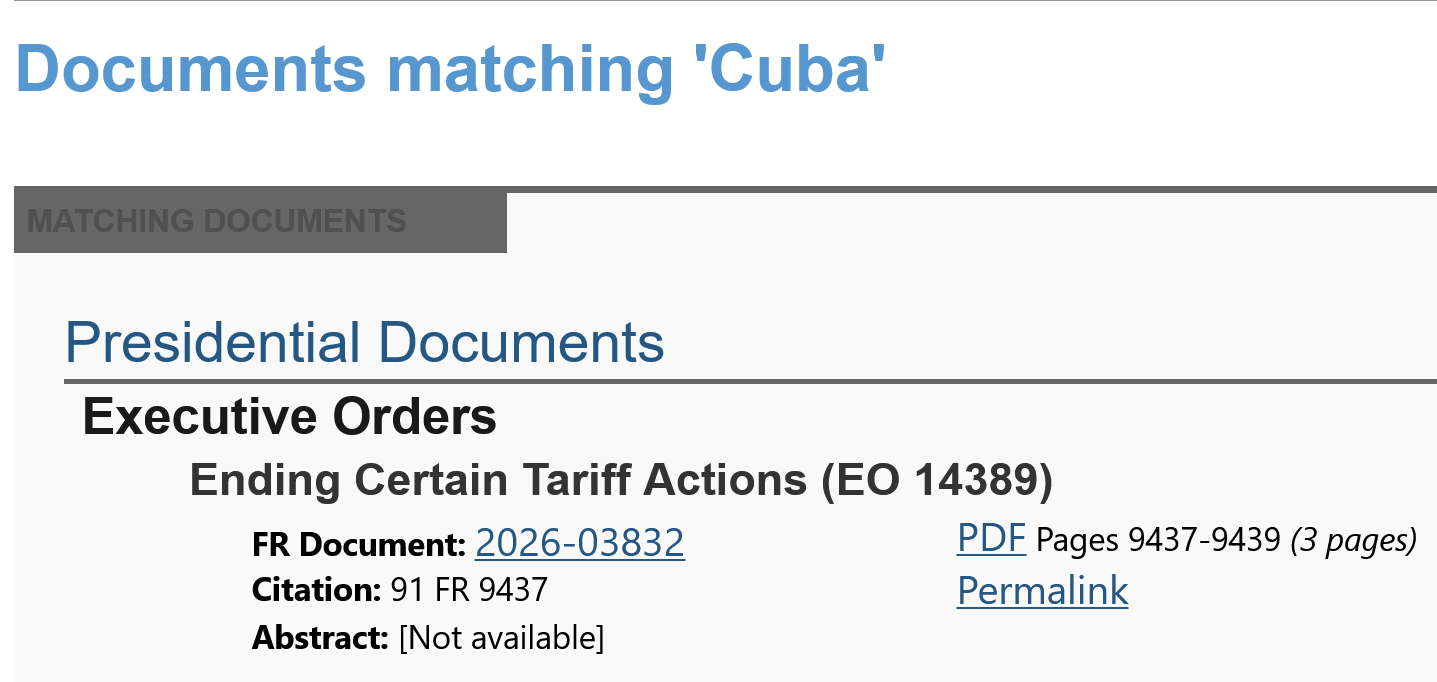
Executive Order 14389 of February 20, 2026


By the authority vested in me as President by the Constitution and the laws of the United States of America, including the International Emergency Economic Powers Act (50 U.S.C. 1701 et seq.) (IEEPA), the National Emergencies Act (50 U.S.C. 1601 et seq.), section 604 of the Trade Act of 1974, as amended (19 U.S.C. 2483), and section 301 of title 3, United States Code, it is hereby ordered: 

Section 1. Background. In Executive Order 14193 of February 1, 2025 (Imposing Duties To Address the Flow of Illicit Drugs Across Our Northern Border), as amended; Executive Order 14194 of February 1, 2025 (Imposing Duties To Address the Situation at Our Southern Border), as amended; Executive Order 14195 of February 1, 2025 (Imposing Duties To Address the Synthetic Opioid Supply Chain in the People’s Republic of China), as amended; Executive Order 14245 of March 24, 2025 (Imposing Tariffs on Countries Importing Venezuelan Oil); Executive Order 14257 of April 2, 2025 (Regulating Imports With a Reciprocal Tariff To Rectify Trade Practices That Contribute to Large and Persistent Annual United States Goods Trade Deficits), as amended; Executive Order 14323 of July 30, 2025 (Addressing Threats to the United States by the Government of Brazil), as amended; Executive Order 14329 of August 6, 2025 (Addressing Threats to the United States by the Government of the Russian Federation), as amended; Executive Order 14380 of January 29, 2026 (Addressing Threats to the United States by the Government of Cuba); and Executive Order 14382 of February 6, 2026 (Addressing Threats to the United States by the Government of Iran), I declared or described national emergencies with respect to unusual and extraordinary threats to the national security, foreign policy, or economy of the United States and took actions to deal with those threats, including by imposing, pursuant to IEEPA, additional ad valorem duties on certain imports of certain foreign trading partners. 

In light of recent events, the additional ad valorem duties imposed pursuant to IEEPA in Executive Order 14193, as amended; Executive Order 14194, as amended; Executive Order 14195, as amended; Executive Order 14245; Executive Order 14257, as amended; Executive Order 14323, as amended; Executive Order 14329, as amended; Executive Order 14380; and Executive Order 14382 shall no longer be in effect and, as soon as practicable, shall no longer be collected. All other actions, including any other action taken to address the national emergencies declared or described in Executive Order 14193, Executive Order 14194, Executive Order 14195, Executive Order 14245, Executive Order 14257, Executive Order 14323, Executive Order 14329, Executive Order 14380, and Executive Order 14382, that do not impose additional ad valorem duties under IEEPA or involve steps necessary to implement the imposition of additional ad valorem duties imposed under IEEPA shall not be affected by this order. The national emergencies declared or described in Executive Order 14193, Executive Order 14194, Executive Order 14195, Executive Order 14245, Executive Order 14257, Executive Order 14323, Executive Order 14329, Executive Order 14380, and Executive Order 14382 or subsequent orders remain in effect and shall not be affected by this order. 

Sec. 2. Implementation. (a) To effectuate the terminations of the actions described in section 1 of this order, the head of each executive department and agency (agency) is authorized to and shall take all appropriate steps to end the additional ad valorem duties imposed under IEEPA in Executive Order 14193, as amended; Executive Order 14194, as amended; Executive Order 14195, as amended; Executive Order 14245; Executive Order 14257, as amended; Executive Order 14323, as amended; Executive Order 14329, as amended; Executive Order 14380; and Executive Order 14382. The head of each agency shall immediately begin taking steps to effectuate this order and, as soon as practicable, terminate the collection of the additional ad valorem duties described in section 1 of this order. The head of each agency may, consistent with applicable law, including section 301 of title 3, United States Code, redelegate the authority to take such appropriate steps within the agency.  (b) The Secretary of Commerce, the Secretary of Homeland Security, and the United States Trade Representative, as appropriate and in consultation with the Commissioner of U.S. Customs and Border Protection, the Chair of the United States International Trade Commission, and any other senior official they deem appropriate, shall determine whether modifications to the Harmonized Tariff Schedule of the United States are necessary to effectuate this order and may make such modifications through notice in the Federal Register.  (c) The Executive Order of February 20, 2026 (Continuing the Suspension of Duty-Free De Minimis Treatment for All Countries), and the Proclamation of February 20, 2026 (Imposing a Temporary Import Surcharge to Address Fundamental International Payments Problems), are unaffected by this order.  (d) This order affects only the additional ad valorem duties imposed under IEEPA pursuant to the Executive Orders described in section 1 of this order. This order does not affect any other duties, including duties imposed under section 232 of the Trade Expansion Act of 1962, as amended, 19 U.S.C. 1862, and section 301 of the Trade Act of 1974, as amended, 19 U.S.C. 2411. 

Sec. 3. General Provisions. (a) Nothing in this order shall be construed to impair or otherwise affect: (i) the authority granted by law to an executive department or agency, or the head thereof; or (ii) the functions of the Director of the Office of Management and Budget relating to budgetary, administrative, or legislative proposals. (b) This order shall be implemented consistent with applicable law and subject to the availability of appropriations.  (c) This order is not intended to, and does not, create any right or benefit, substantive or procedural, enforceable at law or in equity by any party against the United States, its departments, agencies, or entities, its officers, employees, or agents, or any other person. (d) The costs for publication of this order shall be borne by the Department of Homeland Security.

Donald J. Trump

OFAC To Implement "Favorable Licensing Policy" For Licenses To Export Oil From Venezuela To Cuba Private Companies And Cuban Citizens

United States Department of the Treasury
Washington DC
25 February 2026

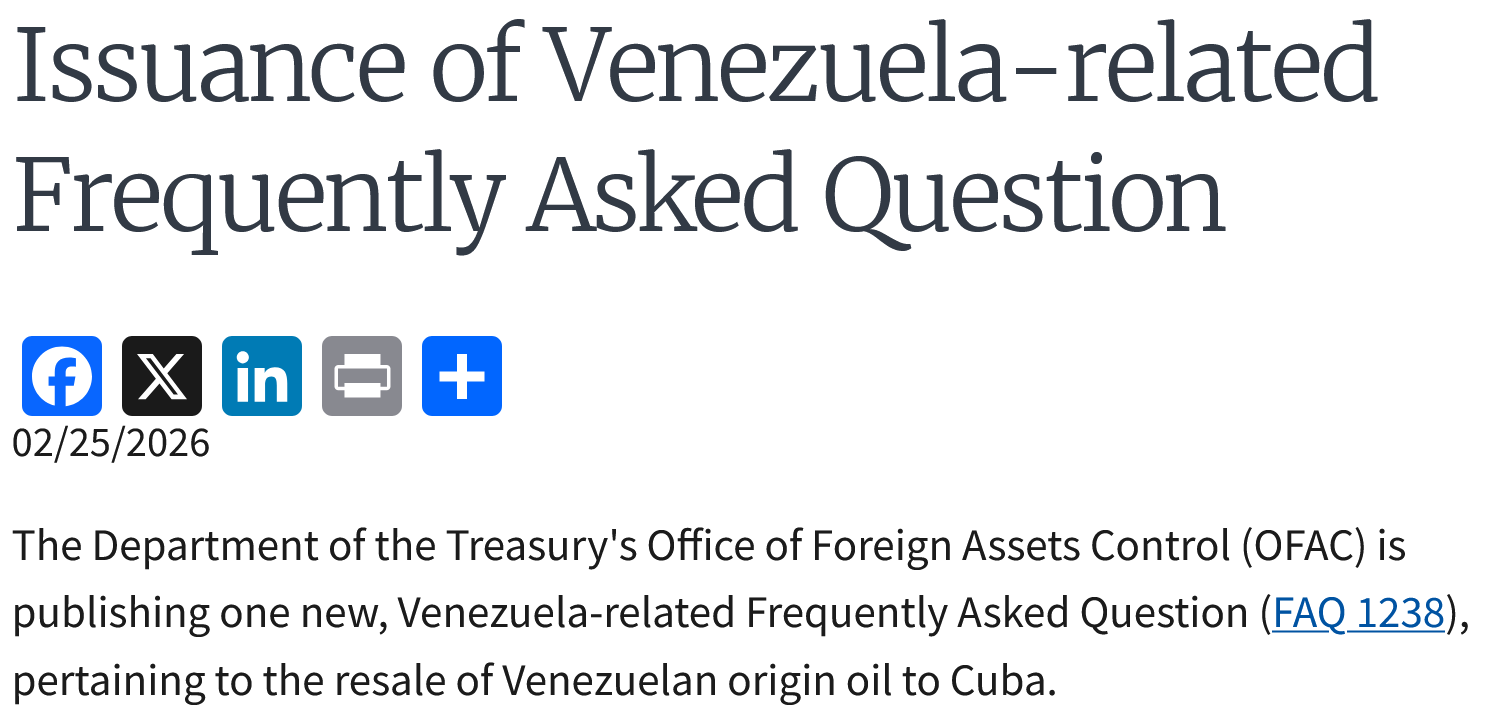
Issuance of Venezuela-related Frequently Asked Question


The Department of the Treasury's Office of Foreign Assets Control (OFAC) is publishing one new, Venezuela-related Frequently Asked Question (FAQ 1238), pertaining to the resale of Venezuelan origin oil to Cuba. 

Venezuela Sanctions

1238. Would OFAC approve the resale of Venezuelan origin oil to Cuba?

Answer

In accordance with the United States' support and solidarity for the Cuban people, OFAC would implement a favorable licensing policy toward specific license applications seeking authorization for the resale of Venezuelan origin oil for use in Cuba. To qualify for this favorable licensing policy, the requested transactions would need to be consistent with the terms and conditions of Venezuela General License (GL) 46A, though applicants need not necessarily have an established U.S. entity and the limitations in GL 46A with respect to Cuba would not apply. This favorable licensing policy is directed towards transactions that support the Cuban people, including the Cuban private sector (e.g., exports for commercial and humanitarian use in Cuba). Consistent with applicable U.S. law and policy, transactions involving, or for the benefit, of any persons or entities associated with the Cuban military, intelligence services, or other government institutions, including entities listed on the U.S. State Department's Cuba Restricted List, see 31 C.F.R. § 515.209, would not be covered by this favorable licensing policy.

As a reminder, the U.S. Department of Commerce primarily regulates the export or reexport of U.S.-origin oil to Cuba, as well as all other items subject to the Export Administration Regulations (EAR, 15 C.F.R. parts 730-774). Treasury's Cuban Assets Control Regulations generally authorize U.S. persons to engage in transactions ordinarily incident to the export of oil from the United States to Cuba, or the reexport of U.S.-origin oil from a third country to Cuba, where that export or reexport has been authorized by the Commerce Department. See 31 C.F.R. § 515.533(a). This authorization applies to transactions covered by applicable Commerce Department license exceptions, including License Exception Support for the Cuban People (SCP), 15 C.F.R. § 740.21, which authorizes exports and reexports of gas and other petroleum products to improve living conditions and support independent economic activity. In other words, U.S.-origin oil exports, as well as other gas and petroleum products covered by License Exception SCP, do not require separate OFAC authorizations. Exporters and reexporters are responsible for reviewing current Commerce Department guidance, see here, and ensuring that any transaction undertaken pursuant to License Exception SCP or any other license exception meet all applicable terms and conditions.

See FAQ 1226 for the definition of "Venezuelan-origin oil," which includes petroleum products.

Date Released
February 25, 2026

With New BIS Guidance For Fuel, Gas, Petroleum Product Exports To Cuba, Trump Administration Confirms There Is A Private Sector In Cuba And U.S. Companies May Engage. Members Of Congress Not Pleased.

United States Department of Commerce
Washington DC
24 February 2026

Exports of U.S.-Origin Gas and Petroleum Products to Cuba
 

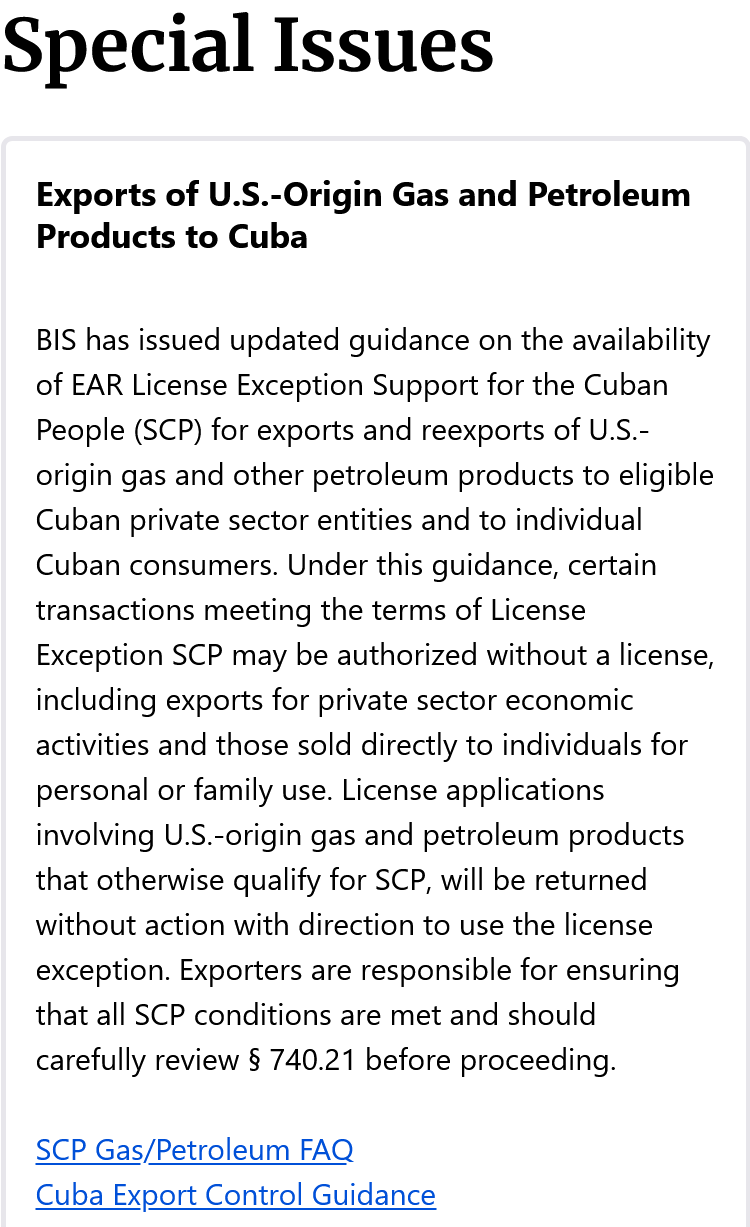
BIS has issued updated guidance on the availability of EAR License Exception Support for the Cuban People (SCP) for exports and reexports of U.S.-origin gas and other petroleum products to eligible Cuban private sector entities and to individual Cuban consumers. Under this guidance, certain transactions meeting the terms of License Exception SCP may be authorized without a license, including exports for private sector economic activities and those sold directly to individuals for personal or family use. License applications involving U.S.-origin gas and petroleum products that otherwise qualify for SCP, will be returned without action with direction to use the license exception. Exporters are responsible for ensuring that all SCP conditions are met and should carefully review § 740.21 before proceeding. 

LINK: SCP Gas/Petroleum FAQ
LINK: Cuba Export Control Guidance

Updated Guidance Regarding Available EAR License Exceptions for Exports of U.S. origin gas and petroleum products to Cuban Private Sector Entities and Activities  

The Bureau of Industry and Security (BIS) has been receiving questions from potential exporters on the EAR requirements and potential EAR authorizations that may be available to authorize exports and reexports of U.S. origin gas and petroleum products for private sector use, including for addressing humanitarian needs in Cuba.

• In general, a license is required to export and reexport gas and other petroleum products that are subject to the EAR to Cuba pursuant to § 746.2(a). However, as with any export or reexport that is subject to a license requirement, the exporter or reexporter should first evaluate whether a license exception is available to authorize the export or reexport.

• In particular, exporters and reexporters of gas and petroleum products to the Cuban private sector should review the general restrictions under § 740.2 and § 740.21 License Exception Support for the Cuban People (SCP). As explained below, gas and other petroleum products exported and reexported to Cuban private sector entities or individuals for personal use may be authorized under License Exception SCP.

• Exporters and reexporters are advised that if a license application is submitted to BIS that otherwise meets the terms and conditions of License Exception SCP, those applications will be returned without action (RWA’d) by BIS with a direction to the applicant to export or reexport the items pursuant to License Exception SCP. 

• BIS provides the following FAQ to further assist public understanding:

Q.1: Would License Exception Support for the Cuban People (SCP) (§ 740.21 of the EAR) allow an exporter or reexporter to export or reexport gas and other petroleum products to Cuban private sector entities for private sector use, or directly to individual Cubans for their personal or family use?

A.1: Yes, provided that all the applicable terms and conditions of License Exception SCP are met. Specifically, there are two authorizing paragraphs under License Exception SCP under paragraph (b) (Improving living conditions and supporting independent economic activity), which may be available to authorize these types of exports and reexports of gas and other petroleum products to Cuba. License Exception SCP provides a general authorization for exports under certain applicable conditions, as explained below, and does not contain any specific limitations on applicability based on quantity, or value of the items, or exporter or reexporter.

§ 740.21(b)(1).

Exports to private sector for private sector use.  If the gas and other petroleum products are being exported for use by the Cuban private sector for private sector use, then paragraph (b)(1) of License Exception SCP, which authorizes items for use by the Cuban private sector for private sector economic activities, may be available to authorize these types of exports and reexports.  To qualify, exports must be both (1) for use by the Cuban private sector, (2) for private sector economic activities, including those addressing humanitarian needs in Cuba. Per §740.21(b)(1)(i) and (ii), License Exception SCP does not apply to any transactions, whether to Cuban private sector entities or otherwise, which primarily generate revenue for the state; or contribute to the operation of the state, including through the construction or renovation of state-owned buildings.

§ 740.21(b)(2).

Exports sold directly to individuals in Cuba for their personal use. If the gas and other petroleum products are sold directly to individuals in Cuba for their personal use, then paragraph (b)(2) of SCP, which authorizes items sold directly to individuals in Cuba for their personal use or their immediate family's personal use, may be available to authorize exports and reexports of gas and other petroleum products.  Paragraph (b)(2) does not require the gas and other petroleum products to be exported or reexported directly; the gas and other petroleum products must ultimately be destined for these eligible end users and their families for their personal use.  This authorization applies only if the gas or other petroleum products are sold directly to individual Cubans for their personal use or the use of their immediate family. It does not aapply if any of the products are sold or transferred to proscribed persons or entities in Cuba, including employees of the Ministry of Defense or Ministry of the Interior, senior officials of certain Cuban government organizations, labor unions, and other Cuban government affiliated organizations, including entities listed on the U.S. State Department’s Cuba Restricted List, see 31 CFR 515.209.

Note: Exporters and reexporters are responsible for ensuring that all of the applicable terms and conditions of License Exception SCP are met. Please review EAR § 740.21 --License Exception Support for Cuban People (SCP) -- carefully to ensure that your transaction meets all the criteria for use of the license exception.

Links To Related Analyses 

Trump Administration Opens Diplomatic Door To Cuba: First, Change The Economy. Second, Invite U.S. Companies. Third, For Now, Type Of Government Not Important- Just Make It Work Like China, Vietnam Feb 15, 2026

Trump’s Message To Cuba To “Make A Deal” May Not Be A Bad Deal For Cuba. Witkoff And Kushner Add Another Assignment. 23 February 2026 Is Consequential. January 14, 2026

Biden-Harris Administration Approves First Equity Investment Since 1960 In A Private Cuban Company May 10, 2022

With U.S. Government Authorization For First Direct Equity Investment Into A Private Company In Cuba, Here Is Important Context And Details.  About The Parties; About The Message. May 16, 2022

Now The Hard Part For Cuba: Implementing Quickly Transparent, Equal-For-All, MSME Investment & Financing Regulations. No Limitations. No Selectivity. No Orwellian Process. August 04, 2022

Cuba Government Delaying Private Company Investment/Financing Regulations Is Costing Earning Potential For U.S. And Other Country Sources. Success Should Not Be Feared. September 25, 2023

Transcripts And Recordings Of SCOTUS Libertad Act Title III Arguments: Havana Docks And Exxon Mobil

Link To Recording Of Oral Arguments- Havana Docks

Link To Transcript Of Oral Arguments- Havana Docks

Link To Recording Of Oral Arguments- Exxon Mobil

Link To Transcript Of Oral Arguments- Exxon Mobil

Supreme Court of the United States
October Term, 2025
HEARING LIST
For the Session Beginning February 23, 2026
(The Court convenes at 10 a.m.; afternoon arguments begin at 1 p.m.)


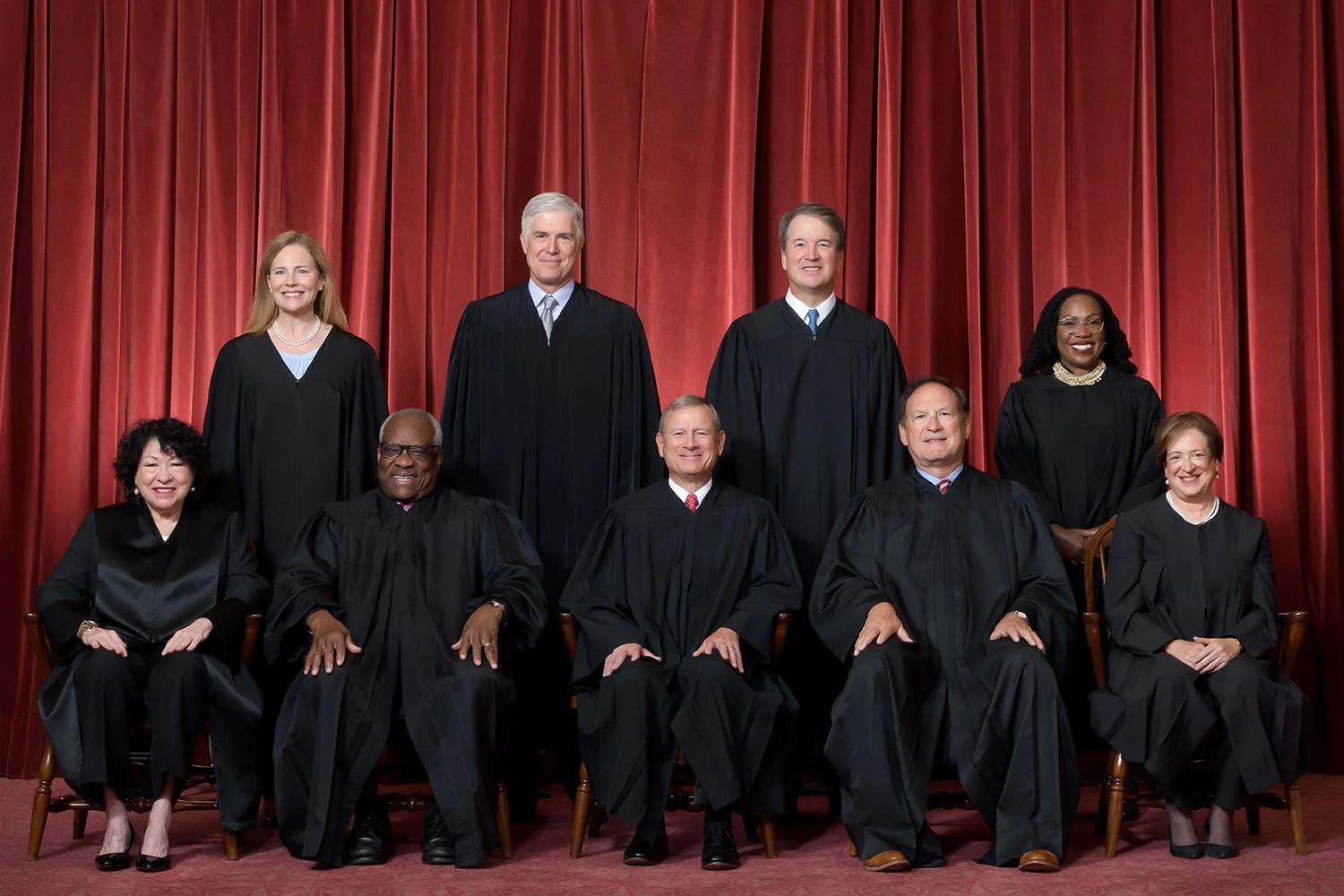
Justices of the Supreme Court:
Hon. Chief Justice John G. Roberts, Jr.
Hon. Clarence Thomas Hon. Neil M. Gorsuch
Hon. Samuel A. Alito, Jr. Hon. Brett M. Kavanaugh
Hon. Sonia Sotomayor Hon. Amy Coney Barrett
Hon. Elena Kagan Hon. Ketanji Brown Jackson

Officers of the Court:
Scott S. Harris, Clerk
Rebecca Womeldorf, Reporter of Decisions
Gail A. Curley, Marshal
David S. Mao, Librarian

HEARING LIST
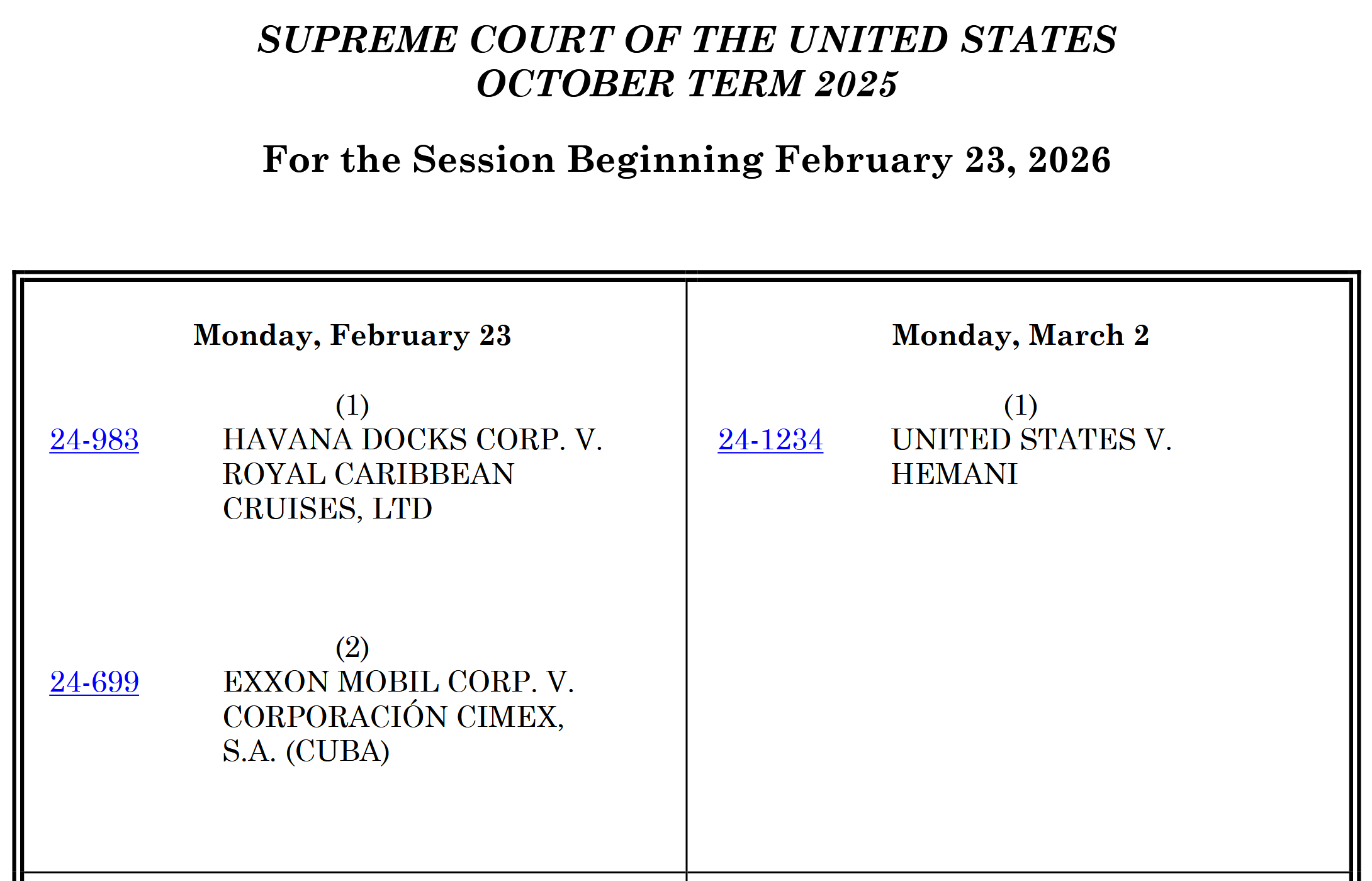
Monday, February 23, 2026

No. 24–983. Havana Docks Corporation v. Royal Caribbean Cruises, Ltd., et al.
Certiorari to the C. A. 11th Circuit.
For petitioner: Richard D. Klingler, Washington, D. C.; and Aimee Brown, Assistant to the Solicitor General, Department of Justice, Washington, D. C. (for United States, as amicus curiae.)  For respondents: Paul D. Clement, Alexandria, Va.  (1 hour for argument.) 

No. 24–699. Exxon Mobil Corporation v. Corporación Cimex, S.A. (Cuba), et al.
Certiorari to the C. A. District of Columbia Circuit.
For petitioner: Morgan L. Ratner, Washington, D. C.; and Curtis E. Gannon, Deputy Solicitor General, Department of Justice, Washington, D. C. (for United States, as amicus curiae.)  For respondents: Jules L. Lobel, Pittsburgh, Pa.  (1 hour for argument.)

24-983 HAVANA DOCKS CORP. V. ROYAL CARIBBEAN CRUISES
DECISION BELOW: 119 F.4th 1276
CERT. GRANTED 10/3/2025
QUESTION PRESENTED:
The LIBERTAD Act is an essential pillar of United States foreign policy toward Cuba's hostile and anti-American regime. Title III of that Act creates a private right of action for United States nationals who have a claim to property confiscated by that regime against persons who traffic in that property. 22 U.S.C. § 6082(a)(1). The Act specifies that such trafficking "undermines the foreign policy of the United States" by, among other things, "provid[ing] badly needed financial benefit" to the Cuban regime. Id. § 6081(6).  The question presented here applies in every case brought under Title III, and will determine whether that provision continues to advance U.S. foreign policy toward Cuba: whether a plaintiff must prove that the defendant trafficked in property confiscated by the Cuban government as to which the plaintiff owns a claim (as the statute requires), or instead that the defendant trafficked in property that the plaintiff would have continued to own at the time of trafficking in a counterfactual world "as if there had been no expropriation" (as the divided Eleventh Circuit panel held below).  LOWER COURT CASE NUMBER: 23-10151, 23-10171

24-699 EXXON MOBIL CORP. V. CORPORACION CIMEX
DECISION BELOW: 111 F.4th 12
CERT. GRANTED 10/3/2025
QUESTION PRESENTED:
In 1960, the Cuban government confiscated the property of American nationals and transferred it to state-owned enterprises. After years without a diplomatic resolution, Congress enacted the Helms-Burton Act, which created a damages action for American nationals against "any person ... that traffics in" such confiscated property. 22 U.S.C. § 6082(a)(1). The Act defines "person" to include "any agency or instrumentality of a foreign state," id. § 6023(11), and expressly contemplates "judgment[s] against an agency or instrumentality of the Cuban Government," id. § 6082(d). The question presented is: Whether the Helms-Burton Act abrogates foreign sovereign immunity in cases against Cuban instrumentalities, or whether parties proceeding under that Act must also satisfy an exception under the Foreign Sovereign Immunities Act.  LOWER COURT CASE NUMBER: 21-7127, 22-7019, 22-7020

Today SCOTUS Hears Two 60-Minute Arguments In Libertad Act Lawsuits: Exxon Mobil Suing Two Cuba Government Companies And Havana Docks Suing Four Cruise Lines. Cuba Government Watching Closely

Link To Recording Of Oral Arguments- Havana Docks

Link To Transcript Of Oral Arguments- Havana Docks

Link To Recording Of Oral Arguments- Exxon Mobil

Link To Transcript Of Oral Arguments- Exxon Mobil

Link To Live Feed

Supreme Court of the United States
October Term, 2025
HEARING LIST
For the Session Beginning February 23, 2026
(The Court convenes at 10 a.m.; afternoon arguments begin at 1 p.m.)


Justices of the Supreme Court:
Hon. Chief Justice John G. Roberts, Jr.
Hon. Clarence Thomas Hon. Neil M. Gorsuch
Hon. Samuel A. Alito, Jr. Hon. Brett M. Kavanaugh
Hon. Sonia Sotomayor Hon. Amy Coney Barrett
Hon. Elena Kagan Hon. Ketanji Brown Jackson

Officers of the Court:
Scott S. Harris, Clerk
Rebecca Womeldorf, Reporter of Decisions
Gail A. Curley, Marshal
David S. Mao, Librarian

HEARING LIST
Monday, February 23, 2026

No. 24–983. Havana Docks Corporation v. Royal Caribbean Cruises, Ltd., et al.
Certiorari to the C. A. 11th Circuit.
For petitioner: Richard D. Klingler, Washington, D. C.; and Aimee Brown, Assistant to the Solicitor General, Department of Justice, Washington, D. C. (for United States, as amicus curiae.)  For respondents: Paul D. Clement, Alexandria, Va.  (1 hour for argument.) 

No. 24–699. Exxon Mobil Corporation v. Corporación Cimex, S.A. (Cuba), et al.
Certiorari to the C. A. District of Columbia Circuit.
For petitioner: Morgan L. Ratner, Washington, D. C.; and Curtis E. Gannon, Deputy Solicitor General, Department of Justice, Washington, D. C. (for United States, as amicus curiae.)  For respondents: Jules L. Lobel, Pittsburgh, Pa.  (1 hour for argument.)

24-983 HAVANA DOCKS CORP. V. ROYAL CARIBBEAN CRUISES
DECISION BELOW: 119 F.4th 1276
CERT. GRANTED 10/3/2025
QUESTION PRESENTED:
The LIBERTAD Act is an essential pillar of United States foreign policy toward Cuba's hostile and anti-American regime. Title III of that Act creates a private right of action for United States nationals who have a claim to property confiscated by that regime against persons who traffic in that property. 22 U.S.C. § 6082(a)(1). The Act specifies that such trafficking "undermines the foreign policy of the United States" by, among other things, "provid[ing] badly needed financial benefit" to the Cuban regime. Id. § 6081(6).  The question presented here applies in every case brought under Title III, and will determine whether that provision continues to advance U.S. foreign policy toward Cuba: whether a plaintiff must prove that the defendant trafficked in property confiscated by the Cuban government as to which the plaintiff owns a claim (as the statute requires), or instead that the defendant trafficked in property that the plaintiff would have continued to own at the time of trafficking in a counterfactual world "as if there had been no expropriation" (as the divided Eleventh Circuit panel held below).  LOWER COURT CASE NUMBER: 23-10151, 23-10171

24-699 EXXON MOBIL CORP. V. CORPORACION CIMEX
DECISION BELOW: 111 F.4th 12
CERT. GRANTED 10/3/2025
QUESTION PRESENTED:
In 1960, the Cuban government confiscated the property of American nationals and transferred it to state-owned enterprises. After years without a diplomatic resolution, Congress enacted the Helms-Burton Act, which created a damages action for American nationals against "any person ... that traffics in" such confiscated property. 22 U.S.C. § 6082(a)(1). The Act defines "person" to include "any agency or instrumentality of a foreign state," id. § 6023(11), and expressly contemplates "judgment[s] against an agency or instrumentality of the Cuban Government," id. § 6082(d). The question presented is: Whether the Helms-Burton Act abrogates foreign sovereign immunity in cases against Cuban instrumentalities, or whether parties proceeding under that Act must also satisfy an exception under the Foreign Sovereign Immunities Act.  LOWER COURT CASE NUMBER: 21-7127, 22-7019, 22-7020

Argument Audio:  The audio recordings of all oral arguments heard by the Supreme Court of the United States are posted on this website (https://www.supremecourt.gov/) on the same day an argument is heard by the Court.  The public may either download the audio files or listen to the recordings on the Court’s website. The audio recordings are listed by case name, docket number, and the date of oral argument.

Cuba; Continuation of National Emergency and Emergency Authority With Respect to Regulation of Anchorage and Movement of Vessels (Notice of February 13, 2026)

Notice of February 13, 2026 Continuation of the National Emergency With Respect to Cuba and of the Emergency Authority Relating to the Regula tion of the Anchorage and Movement of Vessels On March 1, 1996, by Proclamation 6867, a national emergency was declared to address the disturbance or threatened disturbance of international relations caused by the February 24, 1996, destruction by the Cuban government of two unarmed, United States-registered civilian aircraft in international airspace north of Cuba. On February 26, 2004, by Proclamation 7757, the national emergency was expanded to deny monetary and material support to the Cuban government. On February 24, 2016, by Proclamation 9398, and on February 22, 2018, by Proclamation 9699, the national emergency was further modified based on continued disturbances or threatened disturb ances of the international relations of the United States related to Cuba. The Cuban government has not demonstrated that it will refrain from the use of excessive force against United States vessels or aircraft that may engage in memorial activities or peaceful protest north of Cuba. Further, the unauthorized entry of any United States-registered vessel into Cuban territorial waters continues to be detrimental to the foreign policy of the United States because such entry could facilitate a mass migration from Cuba. It continues to be United States policy that a mass migration from Cuba would endanger United States national security by posing a disturbance or threatened disturbance of the international relations of the United States.

Therefore, in accordance with section 202(d) of the National Emergencies Act (50 U.S.C. 1622(d)), I am continuing the national emergency with respect to Cuba and the emergency authority relating to the regulation of the anchor age and movement of vessels set out in Proclamation 6867, as amended by Proclamation 7757, Proclamation 9398, and Proclamation 9699. This notice shall be published in the Federal Register and transmitted to the Congress.

Trump Administration Opens Diplomatic Door To Cuba: First, Change The Economy. Second, Invite U.S. Companies. Third, For Now, Type Of Government Not Important- Just Make It Work Like China, Vietnam

The Trump-Vance Administration (2015-2025) as anticipated is not requiring from the government of the Republic of Cuba a change to its political operating system as the condition of a rapprochement.

Donald Trump, President of the United States (2017-2021 and 2025-2029), remains focused on how a government manages its commercial, economic, and financial infrastructure rather than the type of government in place. 

The People’s Republic of China and Socialist Republic of Vietnam are each governed by a Communist Party.  Each country has embraced ideological decision-making which creates an economy operating in the black rather than an economy operating in the red.  Each country provides opportunities for United States-based companies. 

Regardless of whether a country has an authoritarian, democratic, dictatorship, junta, military, monarchy, oligarchy, parliamentary, participatory, presidential, theocracy, totalitarian, or some other system of governance, President Trump is focused upon what opportunities exist for United States-based companies: exporting products, importing products, and provision of services.   

Nicolas Maduro, President of the Bolivarian Republic of Venezuela (2013-2025), was removed through an operation conducted by the armed forces of the United States.  The Trump-Vance Administration then engaged with the individuals and the institutions remaining in place rather than requiring changes in personnel and to structures.  The focus was first upon recreating in Venezuela opportunities for United States-based companies. 

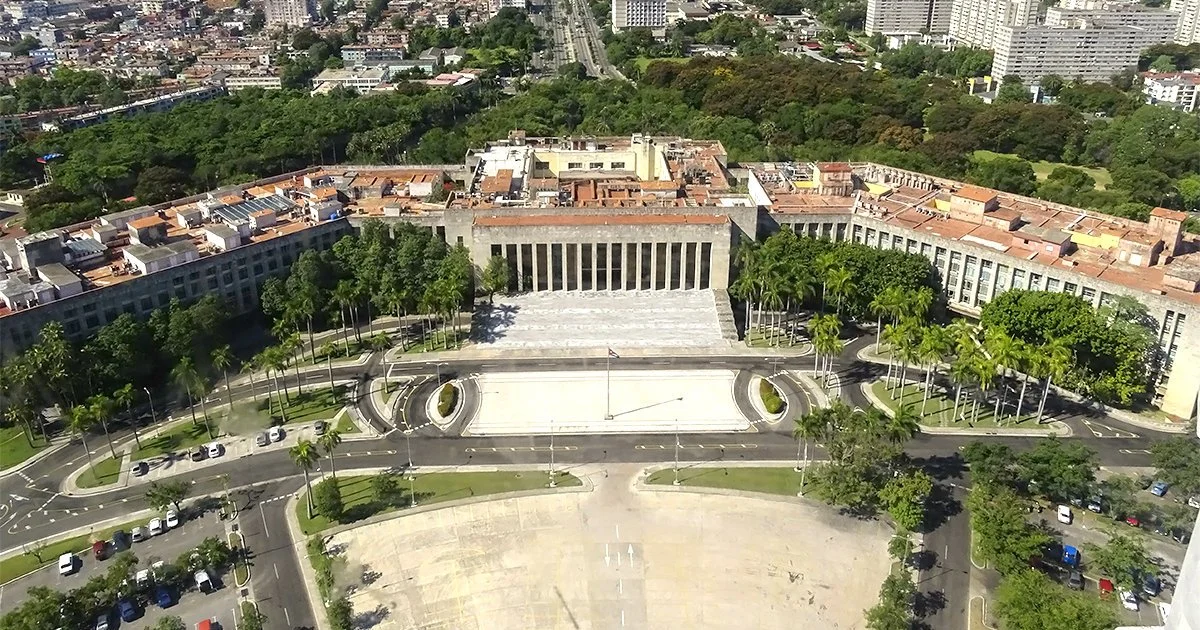
There is not a required optic for the armed forces of the United States to conduct an operation to extract Miquel Diaz-Canel, President of the Republic of Cuba (2019- ), from the Palacio de la Revolución in the city of Havana.   

President Maduro was viewed as the optical and personality problem to implementing changes in Venezuela.  President Diaz-Canel is not viewed similarly.  He is not viewed in control of the government of the Republic of Cuba in the same way as President Maduro was viewed as in control of the government of Venezuela.  President Maduro was a symbol whose replacement had political value to President Trump.  President Diaz-Canel is neither a personality nor a symbol in the same manner as President Maduro.   

The Diaz-Canel-Valdes Mesa Administration (2019- ) in the Republic of Cuba is not for some in the Trump-Vance Administration the problem.  The problem is the manner the government of the Republic of Cuba uses its chosen political system to manage its economy. 

Policies, regulations, and statutes implemented by the government of the United States do impact negatively the commercial, economic, and financial functionality of the government of the Republic of Cuba.   

Ironically, some of the policies, regulations, and statutes if accepted could strengthen the government of the Republic of Cuba by providing additional capital, additional markets, and additional bilateral political connectivity. 

Within those policies, regulations, and statutes are opportunities the government of the Republic of Cuba has avoided which have contributed to the corrosion and decay of the commercial, economic, and financial infrastructure in the Republic of Cuba. 

In May 2022, the Biden-Harris Administration (2021-2025) authorized direct investment and direct financing into a privately-owned company located in the Republic of Cuba owned by a Republic of Cuba national.  Nearing four years later, the government of the Republic of Cuba has not issued the necessary guidance and regulations.  One page to be filed by the Republic of Cuba-based company with its Republic of Cuba government-operated financial institution; similar to a Know Your Customer form, authorizing officially the direct investment and direct financing.   

The lack of guidance and regulations from the government of the Republic of Cuba has also impacted sources of capital from every other country- including those with whom the government of the Republic of Cuba embraces- China and Russia, along with the twenty-seven-member country Brussels, Belgium-based European Union (EU) among others. 

The Trump-Vance Administration would permit the Diaz-Canel-Valdes Mesa Administration to implement changes to its commercial, economic, and financial infrastructure while maintaining most of its political infrastructure.   

However, the infrastructure needs to transition quickly from what did not work in the second half of the twentieth century to what can work in the beginning of the second quarter of the twenty-first century.  

President Trump is enticed and impressed by opportunity.  The New York, New York-based The Trump Organization did have an interest in tourism-related opportunities in the Republic of Cuba.  For the government of the Republic of Cuba, that sector can be the basis for re-engagement with the Trump-Vance Administration. 

Link To Related Analysis 

Munich, Germany
Hotel Bayerischer Hof
14 February 2026

Secretary of State Marco Rubio with John Micklethwait of Bloomberg News  

excerpts 

QUESTION:  What about a country with which you’ve had a long interest: Cuba?  You mentioned it obliquely in the speech talking about the Cuban Missile Crisis.  How long do you think the regime can last without oil? 

SECRETARY RUBIO:  Yeah, I think the regime in Cuba is – look, the revolution in Cuba ended a long time ago and – Cuba’s fundamental problem is that it has no economy and its economic model is one that has never been tried and has never worked anywhere else in the world, okay?  It just – it doesn’t have a real economic policy.  It doesn’t have a real economy.  Now, forget – put aside for a moment the fact that it has no freedom of expression, no democracy, no respect for human rights.  The fundamental problem Cuba has it is has no economy, and the people who are in charge of that country, in control of that country, they don’t know how to improve the everyday life of their people without giving up power over sectors that they control.  They want to control everything.  They don’t want the people of Cuba to control anything.  So they don’t know how to get themselves out of this.  And to the extent that they have been offered opportunities to do it, they don’t seem to be able to comprehend it or accept it in any ways.  They would much rather be in charge of the country than allow it to prosper. 

QUESTION:  Is there any kind of off-ramp for the regime?  I mean, previous ones – when you negotiated with Venezuela, you said if they agreed with various things it would be possible to continue. 

SECRETARY RUBIO:  Sure.  I mean, there is.  I mean, look, I think you have to — 

QUESTION:  What could – what could the Cuban regime do to — 

SECRETARY RUBIO:  Well, I’m not going to tell you or announce this in an interview here because obviously these things require space and time to do in the right way.  But I will say this, that that is that it is important for the people of Cuba to have more freedom, not just political freedom but economic freedom.  The people of Cuba – and that’s what this regime has not been willing to give them because they’re afraid that if the people of Cuba can provide for themselves, they lose control over them, they lose power over them.  So I think there has to be that opening and it has to happen, and I think now Cuba is faced with such a dire situation.  Remember this is a regime that has survived almost entirely on subsidies – first from the Soviet Union, then from Hugo Chavez, and how for the first time it has no subsidies coming in from anyone, and the model has been laid bare.  And it’s not just – look, multiple countries have gone in and helped, but the problem is that you lose money in Cuba.  They never pay their bills.  They never end up paying.  It never ends up working out.  There were European countries that went to Cuba and made what they thought were investments in certain sectors, only to have them – the contracts canceled and get themselves kicked out because the Cuban regime has no fundamental understanding of what business and industry looks like, and the people are suffering as a result of it.  So I think certainly their willingness to begin to make openings in this regard is one potential way forward.  I would also say – and this has not been really talked about a lot, but the United States has been providing humanitarian assistance directly to the Cuban people via the Catholic Church.  We did it after the hurricane.  We actually just recently announced an increase in the amount we’re willing to give.  And that’s something we’re willing to continue to explore, but obviously that’s not a long-term solution to the problems on the island. 

Secretary Rubio’s Meeting with G7 Foreign Ministers 
United States Department of State
Washington DC
14 February 2026

The below is attributable to Principal Deputy Spokesperson Tommy Pigott: 

Secretary of State Marco Rubio met today with G7 foreign ministers in Munich, Germany.  The leaders discussed pressing issues such as ongoing conflicts threatening peace and stability in Africa, Europe, and the Middle East, as well as challenges to regional security in the Indo-Pacific and the Western Hemisphere.  The Secretary reiterated the United States’ commitment to promoting stability in Venezuela and negotiating an end to the Russia-Ukraine war.  Secretary Rubio and his counterparts reaffirmed the importance of strengthening G7 cooperation to address global threats to international peace and security. 

LINK TO COMPLETE ANALYSIS IN PDF FORMAT

UK Government Updates Travel Advisory For Cuba- Aviation Fuel Shortages, Hospital Care, Power Outages

Warnings and insurance

Still current at: 11 February 2026 
Updated: 10 February 2026 

Latest update: Update to information on aviation fuel shortages and availability of care at hospitals ('Warnings and insurance page') 

Power outages and fuel shortages

Cuba is experiencing serious issues with its national power grid and fuel supply. Prolonged power outages – over 24 hours in some instances – are a daily occurrence across the country, affecting water supply, lighting, refrigeration and communications.  Take precautions by conserving fuel, water, food and mobile phone charge, and be prepared for significant disruption.

There are long queues at petrol stations. The Cuban government has imposed strict limitations on the purchase of fuel  from 7 February 2026. Diesel sales have been temporarily discontinued. Petrol is currently limited to a maximum purchase of 20 litres. This will impact travel within Cuba and you should factor this into planning for any journey.

Resorts and businesses which often rely on oil/diesel-powered generators are also impacted. We understand that some tourists are being relocated to different hotels to maximise fuel consumption.  You should contact your tour operator for further details.

Aviation fuel shortages in Cuba’s airports are leading some airlines to review their schedules and consider refuelling in other nearby destinations. Three Canadian airlines have temporarily cancelled travel to Cuba but will return their existing customers from Cuba. European airlines are operating but making plans to refuel elsewhere. You should contact your airline or tour operator for further details.

Some hospitals have postponed routine medical treatment but are continuing to provide services for urgent care.

U.S. Exports To Cuba Up 12.1% In November 2025; Up 13.2% Year-To-Year; US$19.2 Million Used Gasoline Vehicles, US$705,824.00 Motorcycles, US$326,960.00 Lithium Batteries, US$17.5 Million Donations

ECONOMIC EYE ON CUBA©
February 2025

November 2025 Ag/Food Exports To Cuba Increase 12.1% -
Year-To-Year Increase 13.2%
51st Of 221 November 2025 U.S. Food/Ag Export Markets- 2
Cuba Ranked 49th Of 221 U.S. Ag/Food Export Markets – 2
Re-Emerging Private Sector Exports - 3
November 2025 CDA Healthcare Product Exports US$12,840.00 - 6
November 2025 Humanitarian Donations US$17,554,811.00 - 7
U.S. Port Export Data- 20

NOVEMBER 2025 AG/FOOD EXPORTS TO CUBA INCREASE 12.1%- Exports of food products and agricultural commodities from the United States to the Republic of Cuba in November 2025 were US$44,173,906.00 compared to US$39,384,920.00 in November 2024 and US$28,643,992.00 in November 2023.

US$443,890,858.00 for the period January 2025 through November 2025 compared to US$391,962,167.00 for the period January 2024 through November 2024, representing an 13.2% increase year-to-year.

Since 2022, when the first BIS license was issued for the export of vehicles to Republic of Cuba nationals and to private companies in the Republic of Cuba, the cumulative export value of the initiatives in place during the Obama-Biden Administration, Trump-Pence Administration, Biden-Harris Administration, and Trump-Vance Administration exceeds US$382 million of which electric and gasoline-powered new and used vehicles, bicycles, trucks, motorcycles and mopeds, and parts, exceeds US$217 million (Year 2025: January through November US$139,686,992.00; Year 2024: US$67,241,234.00; Year 2023: US$10,546,419.00; Year 2022: US$89,848.00), and purchases (equipment and products) for use by the re-emerging private sector in the Republic of Cuba driving the growth.

The data contains information on exports from the United States to the Republic of Cuba- products within the Trade Sanctions Reform and Export Enhancement Act (TSREEA) of 2000, Cuban Democracy Act (CDA) of 1992, and regulations implemented (1992 to present) for other products by the Office of Foreign Assets Control (OFAC) of the United States Department of the Treasury, Bureau of Industry and Security (BIS) of the United States Department of Commerce, and United States Department of State.

The TSREEA re-authorized the direct commercial (on a cash basis) export of food products (including branded food products) and agricultural commodities from the United States to the Republic of Cuba, irrespective of purpose. The TSREEA does not include healthcare products, which remain authorized and regulated by the CDA.

The data represents the U.S. Dollar value of product exported from the United States to the Republic of Cuba under the TSREEA, CDA, and other regulations, specifically including products exported from the United States to the re-emerging private sector in the Republic of Cuba.

The data does not include transportation charges, bank charges, or other costs associated with exports; the government of the Republic of Cuba reports unverifiable data that includes transportation charges, bank charges, and other costs.

LINK TO COMPLETE REPORT IN PDF FORMAT

U.S. PORT EXPORT DATA

LINK TO JANUARY 2025 THROUGH NOVEMBER 2025 PRODUCTS EXPORTED FROM THE UNITED STATES TO CUBA

LINK TO COMPLETE LIST OF PRODUCTS IN 2024 EXPORTED FROM THE UNITED STATES TO CUBA

LINK TO COMPLETE LIST OF PRODUCTS IN 2023 EXPORTED FROM THE UNITED STATES TO CUBA

UK Government Updates Cuba Travel Advice: "Take precautions by conserving fuel, water, food and mobile phone charge, and be prepared for significant disruption."

Foreign Travel Advice
Cuba
Contents
Warnings And Insurance
Entry Requirements
Safety And Security
Health
Getting Help

Get Email Alerts 

Warnings And Insurance

Still current at: 31 January 2026 
Updated: 30 January 2026 
Latest update: Update to information on power outages and fuel shortages ('Warnings and insurance page'). 

Power outages and fuel shortages

Cuba is experiencing serious issues with its national power grid and fuel supply. Prolonged power outages – over 24 hours in some instances – are a daily occurrence across the country, affecting water supply, lighting, refrigeration and communications.  There is also a shortage of fuel affecting transportation and resulting in long queues at petrol stations. The fuel shortage also impacts resorts and businesses which often rely on oil/diesel-powered generators. Take precautions by conserving fuel, water, food and mobile phone charge, and be prepared for significant disruption.

LINK To UK Travel Advice

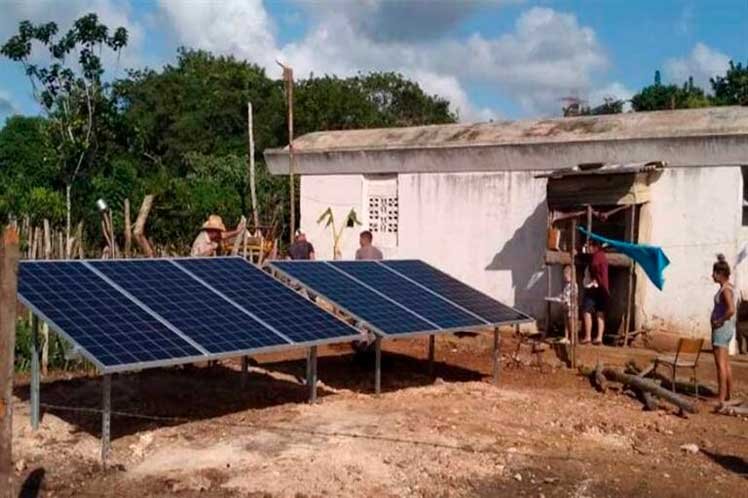
U.S. Exports Solar Panels To Cuba: US$15,141.00 In 2024 Compared With US$482,335.00 From January 2025 To October 2025

January 2025 through October 2025
8541420000 Solar Cells, Not Made Into Panels Or Modules (no), Miami, FL- US$20,958.00
8541430000 Solar Cells, Assembled Into Modules Or Panels (no), Miami, FL US$482,335.00

Calendar Year 2024
8541420000 Solar Cells, Not Made Into Panels Or Modules (no), Miami, FL- US$18,584.00
8541430000 Solar Cells, Assembled Into Modules Or Panels (no), Miami, FL- US$15,141.00

Prensa latina news agency

Tariffs On Countries Facilitating Oil Sales To Cuba: White House Issues Executive Order Addressing Threats To The United States By The Government Of Cuba

EXECUTIVE ORDER
ADDRESSING THREATS TO THE UNITED STATES BY THE GOVERNMENT OF CUBA

  
By the authority vested in me as President by the Constitution and the laws of the United States of America, including the International Emergency Economic Powers Act (50 U.S.C. 1701 et seq.) (IEEPA), the National Emergencies Act (50 U.S.C. 1601 et seq.) (NEA), and section 301 of title 3, United States Code, I hereby determine and order:

Section 1.  National Emergency.  As President of the United States, I have an imperative duty to protect the national security and foreign policy of this country.  I find that the policies, practices, and actions of the Government of Cuba constitute an unusual and extraordinary threat, which has its source in whole or substantial part outside the United States, to the national security and foreign policy of the United States.

The Government of Cuba has taken extraordinary actions that harm and threaten the United States.  The regime aligns itself with -- and provides support for -- numerous hostile countries, transnational terrorist groups, and malign actors adverse to the United States, including the Government of the Russian Federation (Russia), the People's Republic of China (PRC), the Government of Iran, Hamas, and Hezbollah.  For example, Cuba blatantly hosts dangerous adversaries of the United States, inviting them to base sophisticated military and intelligence capabilities in Cuba that directly threaten the national security of the United States.  Cuba hosts Russia's largest overseas signals intelligence facility, which tries to steal sensitive national security information of the United States.  Cuba continues to build deep intelligence and defense cooperation with the PRC.  Cuba welcomes transnational terrorist groups, such as Hezbollah and Hamas, creating a safe environment for these malign groups so that these transnational terrorist groups can build economic, cultural, and security ties throughout the region and attempt to destabilize the Western Hemisphere, including the United States.  Cuba has long provided defense, intelligence, and security assistance to adversaries in the Western Hemisphere, attempting to thwart United States and international sanctions designed to enforce the stability of the region, uphold the rule of law, and safeguard the national security and foreign policy of the United States.  Cuba continues to try to thwart United States efforts to address threats to the United States posed by hostile countries, transnational terrorist groups, and malign actors, including in the Western Hemisphere. 

Further, contrary to the interests and foreign policy of the United States, the Cuban communist regime supports terrorism and destabilizes the region through migration and violence.  The communist regime persecutes and tortures its political opponents; denies the Cuban people free speech and press; corruptly profits from their misery; and commits other human-rights violations.  For example, families of political prisoners face retaliation for peacefully protesting the improper confinement of their loved ones.  Cuban authorities harass worshippers, block free association by civil society organizations, prohibit free press, and deny the ability to speak freely, including on the internet.  The Cuban regime continues to spread its communist ideas, policies, and practices around the Western Hemisphere, threatening the foreign policy of the United States.  

The United States has zero tolerance for the depredations of the communist Cuban regime.  The United States will act to protect the foreign policy, national security, and national interests of the United States, including by holding the Cuban regime accountable for its malign actions and relationships, while also remaining committed to supporting the Cuban people's aspirations for a free and democratic society.

I find that the policies, practices, and actions of the Government of Cuba directly threaten the safety, national security, and foreign policy of the United States.  The policies, practices, and actions of the Government of Cuba are designed to harm the United States and support hostile countries, transnational terrorist groups, and malign actors that seek to destroy the United States.  The policies, practices, and actions of the Government of Cuba are also repugnant to the moral and political values of democratic and free societies and conflict with the foreign policy of the United States to encourage peaceful change in Cuba and to promote democracy, the principle of free expression and press, the rule of law, and respect for human rights throughout the world.

NOW, THEREFORE, I, DONALD J. TRUMP, President of the United States of America, find that the situation with respect to Cuba constitutes an unusual and extraordinary threat, which has its source in whole or substantial part outside the United States, to the national security and foreign policy of the United States and hereby declare a national emergency with respect to that threat. 

To deal with the national emergency declared in this order, I determine that it is necessary and appropriate to establish a tariff system, as described below.  Under this system, an additional ad valorem duty may be imposed on imports of goods that are products of a foreign country that directly or indirectly sells or otherwise provides any oil to Cuba.  In my judgment, the tariff system, as described below, is necessary and appropriate to address the national emergency declared in this order.

Sec. 2.  Imposition of Tariffs.  (a)  Beginning on the effective date of this order, an additional ad valorem rate of duty may be imposed on goods imported into the United States that are products of any other country that directly or indirectly sells or otherwise provides any oil to Cuba, in accordance with subsections (b) and (c) of this section.  (b)(i)  The Secretary of Commerce, in consultation with the Secretary of State and any senior official the Secretary of Commerce deems appropriate, shall determine whether, after the effective date of this order, a foreign country directly or indirectly sells or otherwise provides any oil to Cuba.  After the Secretary of Commerce finds that a foreign country directly or indirectly sells or otherwise provides any oil to Cuba, the Secretary of Commerce shall inform the Secretary of State of his finding, including any information relevant to that finding.  (ii)  The Secretary of Commerce may issue rules, regulations, and guidance necessary or appropriate to implement this order.  The Secretary of Commerce may also make any other determinations or take any other actions necessary or appropriate to implement this order.  (c)(i)  After the Secretary of Commerce makes an affirmative finding pursuant to subsection (b)(i) of this section and informs the Secretary of State of his finding, the Secretary of State, in consultation with the Secretary of the Treasury, the Secretary of Commerce, the Secretary of Homeland Security, and the United States Trade Representative, shall determine whether and to what extent an additional ad valorem rate of duty should be imposed on goods that are products of the foreign country found to directly or indirectly sell or otherwise provide any oil to Cuba.  (ii)   If the Secretary of State determines that an additional ad valorem rate of duty should be imposed on goods that are products of the country found to directly or indirectly sell or otherwise provide any oil to Cuba, the Secretary of State shall inform me of his recommendation, and the Secretary of Commerce shall inform me of his finding related to that recommendation.  I will then consider the recommendation and finding, among other relevant things, in determining whether and to what extent to impose an additional ad valorem rate of duty on goods that are products of the country in question.  (iii)  The Secretary of State may issue rules, regulations, and guidance necessary or appropriate to implement this order.  The Secretary of State may also make any other determinations or take any other actions necessary or appropriate to implement this order.

Sec. 3.  Modification Authority.  (a)  To ensure that the national emergency declared in this order is dealt with, I may modify this order, including in light of additional information, recommendations from senior officials, or changed circumstances.  (b)  Should a foreign country retaliate against the United States in response to this order or any action taken pursuant to this order, I may modify this order or actions taken pursuant to this order to ensure the efficacy of this order and the actions taken pursuant to this order to deal with the national emergency declared in this order.  (c)  Should the Government of Cuba or another foreign country affected by this order take significant steps to address the national emergency declared in this order and align sufficiently with the United States on national security and foreign policy matters, I may modify this order.  

Sec. 4.  Monitoring and Recommendations.  (a)  The Secretary of State, in consultation with any senior official the Secretary of State deems appropriate, shall monitor the circumstances involving the national emergency declared in this order.  The Secretary of State shall inform me of any circumstance that, in his opinion, might indicate the need for further Presidential action to deal with the national emergency declared in this order.  (b)  The Secretary of State, in consultation with the Secretary of the Treasury, the Secretary of Commerce, the Secretary of Homeland Security, the United States Trade Representative, and any other senior official the Secretary of State deems appropriate, shall recommend to me additional action, if necessary, if the actions in this order or taken pursuant to this order are not effective in dealing with the national emergency declared in this order.  (c)  The Secretary of Commerce shall monitor whether a foreign country directly or indirectly sells or otherwise provides any oil to Cuba.  The Secretary of Commerce shall continue such monitoring after a foreign country has been found to do so.

Sec. 5.  Delegation.  Consistent with applicable law, the Secretary of State and the Secretary of Commerce are directed and authorized to take all actions necessary to implement and effectuate this order -- including through temporary suspension or amendment of regulations or through notices in the Federal Register and by adopting rules, regulations, or guidance -- and to employ all powers granted to the President, including by IEEPA, as may be necessary to implement this order.  The head of each executive department and agency (agency) is authorized to and shall take all appropriate measures within the agency's authority to implement this order.  The head of each agency may, consistent with applicable law, including section 301 of title 3, United States Code, redelegate the authority to take such appropriate measures within the agency.

Sec. 6.  Reporting Directives.  The Secretary of State, in consultation with any senior official he deems appropriate, is hereby authorized and directed to submit recurring and final reports to the Congress on the national emergency declared in, and authorities exercised by, this order, consistent with section 401 of the NEA (50 U.S.C. 1641) and section 204(c) of IEEPA (50 U.S.C. 1703(c)).

Sec. 7.  Definitions.  For the purposes of this order:  (a)  The term "oil" means crude oil or petroleum products.  (b)  The term "indirectly" includes selling to or otherwise providing oil to Cuba through intermediaries or third countries, with knowledge that such oil may be provided to Cuba, as determined by the Secretary of Commerce.  (c) Cuba through intermediaries or third countries, with knowledge that such oil may be provided to Cuba, as determined by the Secretary of Commerce.  The term "Cuba" means the territory of Cuba and any other territory or marine area, including the exclusive economic zone and continental shelf, over which the Government of Cuba claims sovereignty, sovereign rights, or jurisdiction, provided that the Government of Cuba exercises partial or total de facto control over the area or derives a benefit from economic activity in the area pursuant to international agreements.  (d)  The term "Government of Cuba" includes the Government of Cuba, any political subdivision, agency, or instrumentality thereof, and any person owned or controlled by, or acting for or on behalf of, the Government of Cuba.

Sec. 8.  Effective Date.  This order is effective at 12:01 a.m. eastern standard time on January 30, 2026.

Sec. 9.  Interaction With Other Presidential Actions.  Any provision of previous proclamations and Executive Orders that is inconsistent with the actions directed in this order is superseded to the extent of such inconsistency. 

Sec. 10.  Severability.  If any provision of this order or the application of any provision of this order to any individual or circumstance is held to be invalid, the remainder of this order and the application of its provisions to any other individuals or circumstances shall not be affected.  If the action in this order or any action taken pursuant to this order is held invalid, the other actions imposed to deal with the national emergencies declared with respect to the Government of Cuba shall not be affected and shall remain in effect.

Sec. 11.  General Provisions.  (a)  Nothing in this order shall be construed to impair or otherwise affect:  (i)   the authority granted by law to an executive department or agency, or the head thereof; or(ii)  the functions of the Director of the Office of Management and Budget relating to budgetary, administrative, or legislative proposals.  (b)  This order shall be implemented consistent with applicable law and subject to the availability of appropriations.  (c)  This order is not intended to, and does not, create any right or benefit, substantive or procedural, enforceable at law or in equity by any party against the United States, its departments, agencies, or entities, its officers, employees, or agents, or any other person.  (d)  The costs for publication of this order shall be borne by the Department of State.

DONALD J. TRUMP

LINK TO WHITE HOUSE FACT SHEET
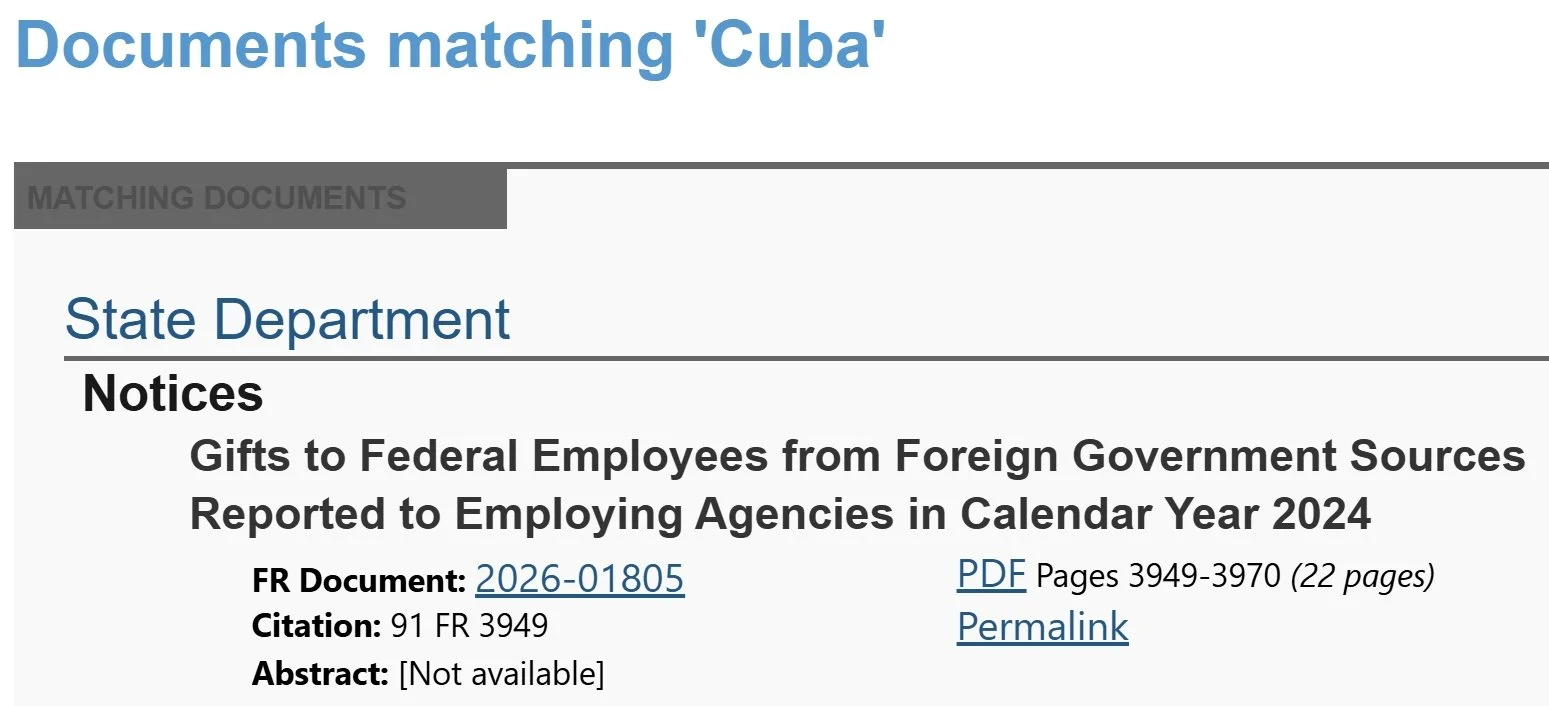
Day Before 2024 U.S. Presidential Election, Employee Of CIA Accepted Box Of Cuba-Origin Cigars

DEPARTMENT OF STATE [Public Notice: 12937] Office of the Chief of Protocol; Gifts to Federal Employees From Foreign Government Sources Reported to Employing Agencies in Calendar Year 2024

All information reported to the Office of the Chief of Protocol, including gift appraisal and donor information, is the responsibility of the employing agency, in accordance with applicable law and GSA regulations. The Office of the Chief of Protocol, Department of State, submits the following comprehensive listing of the statements which, as required by law, federal employees filed with their employing agencies during calendar year 2024 concerning gifts received from foreign government sources. The compilation includes reports of both tangible gifts and gifts of travel or travel expenses of more than minimal value, as defined in 5 U.S.C. 7432 and GSA regulations. For calendar year 2024 (January 1, 2024 through December 31, 2024), minimal value is $480.00. Consistent with Title 22 of the Code of Federal Regulations Section 3.4, the report includes all reported gifts given on a single occasion when the aggregate value of those gifts exceeds minimal the State Department’s Office of the Chief of Protocol’s request for data. The U.S. Senate maintains an internal minimal value of $100; therefore, all gifts over the $100 limit are furnished in the U.S. Senate report. value. Also included are one gift from 2017, one gift from 2021, three gifts from 2022, and nineteen gifts from 2023. These latter gifts are being reported in this year’s report for calendar year 2024 because the Office of the Chief of Protocol, Department of State, did not receive the relevant information at the time of reporting to include them in earlier reports. Agencies not listed in this report either did not receive relevant gifts during the calendar year, did not transmit a listing to the Secretary of State of all statements filed during the preceding year by the employees of that agency pursuant to 5 U.S.C. 7432(f)(1), or did not respond to Authority: Section 7342(f) of Title 5, United States Code, as added by Section 515(a)(1) of the Foreign Relations Authorization Act, Fiscal Year 1978 (Pub. L. 95–105, August 17, 1977, 91 Stat. 865). Jason S. Evans, Under Secretary for Management, U.S. Department of State.

AGENCY: THE WHITE HOUSE—EXECUTIVE OFFICE OF THE PRESIDENT [Report of Tangible Gifts Furnished by the White House—Executive Office of the President]

“An Agency [Central Intelligence Agency] Employee.  Box of Swedish/Cuban Cigars. Rec’d- 11/4/2024. Est. Value- $543.00.  Disposition- Official Use.  5 U.S.C. 7342(f)(4).  Non-acceptance would cause embarrassment to donor and U.S.”

Seaboard Marine Of Florida Settles Cuba Libertad Act Port Use Lawsuit

UNITED STATES DISTRICT COURT 
SOUTHERN DISTRICT OF FLORIDA 
Case No. 20-cv-25176-BLOOM 
ODETTE BLANCO DE FERNANDEZ née BLANCO ROSELL, Plaintiff, v. SEABOARD MARINE, LTD., Defendant.
 

JOINT NOTICE OF CONFIDENTIAL SETTLEMENT AND JOINT STIPULATION REGARDING STAY OF DEADLINES 

Pursuant to the Court’s Amended Order Scheduling Trial and Order of Instructions Before Calendar Call, ECF No. [356] and S.D. Fla. L.R. 16.4, Plaintiff Odette Blanco de Fernandez née Blanco Rosell (“Plaintiff”) and Defendant Seaboard Marine, Ltd. (“Defendant”) (collectively, "Parties"), by and through their respective undersigned counsel, hereby notify the Court as follows: 1. The Parties participated in a mediation with William S. Ohlemeyer, Esq., Phillips ADR Enterprises. 2. 3. On January 25, 2026, the Parties reached a settlement in principle.  Having reached a settlement, the Parties will prepare and execute a settlement agreement with the assistance of Mediator Ohlemeyer on or before February 6, 2026. 4. Having agreed to a settlement, the Parties agree, stipulate, and respectfully request that the Court enter an Order staying all deadlines in this case pending execution of the settlement agreement or upon such further order of the Court.  A proposed Order is submitted herewith.  Date: January 26, 2026    
 
UNITED STATES DISTRICT COURT SOUTHERN DISTRICT OF FLORIDA 
Case No. 20-cv-25176-BLOOM
 

ODETTE BLANCO DE FERNANDEZ née BLANCO ROSELL, Plaintiff, v. SEABOARD MARINE, LTD., Defendant. 
[PROPOSED] ORDER THIS CAUSE came before the Court upon the Parties’ Joint Notice of Settlement and Joint Stipulation Regarding Stay of Deadlines informing the Court that the Parties have reached an agreement to settle.  Upon due consideration and for good cause shown, IT IS HEREBY ORDERED as follows: All deadlines for all parties in the litigation are stayed and tolled pending execution of the Parties’ definitive settlement agreement or upon such further Order of the Court.  DONE AND ORDERED in Chambers at Miami, Florida, this  day of , 2026.  BETH BLOOM, UNITED STATES DISTRICT JUDGE

ORDER ADMINISTRATIVELY CLOSING CASE

JOINT NOTICE OF CONFIDENTIAL SETTLEMENT AND JOINT STIPULATION REGARDING STAY OF DEADLINES

Elderneedslaw

CMA CGM Of France Settles Cuba Libertad Act Port Use Lawsuit

U.S. District Court
Southern District of Florida (Miami)
CIVIL DOCKET FOR CASE #: 1:21-cv-22778-MD

JOINT NOTICE OF SETTLEMENT AND JOINT STIPULATION REGARDING STAY OF DEADLINES 

Pursuant to the Court’s Order Setting Pretrial Schedule and Trial (D.E. 217) and S.D. Fla. L.R. 16.4, Plaintiff Odette Blanco de Fernandez née Blanco Rosell (“Plaintiff”) and Defendants CMA CGM S.A. and CMA CGM (America) LLC (“Defendants”) (collectively, "Parties"), by and through their respective undersigned counsel, hereby notify the Court as follows: 1. Pursuant to the Court’s Order Granting Joint Motion to Modify Mediation Orders (ECF No. 266), the Parties participated in a mediation with Hon. Michael Hanzman (rtd.). 2. 3. On November 29, 2025, the Parties reached a settlement. Having reached a settlement, the Parties will prepare and execute a settlement agreement with the assistance of Mediator Hanzman on or before December 15, 2025 4. Having agreed to a settlement, the Parties agree, stipulate, and respectfully request that the Court enter an Order staying all deadlines in this case pending execution of the settlement agreement or upon such further order of the Court. A proposed Order is submitted herewith.

De Fernandez et al v. CMA CGM S.A. et al
Assigned to: Judge Melissa Damian
Referred to: Magistrate Judge Panayotta D. Augustin-Birch
Cause: 22:6082 Cuban Liberty and Democratic Solidarity Act of 1996    
Date Filed: 07/30/2021
Date Terminated: 12/01/2025
Jury Demand: Plaintiff
Nature of Suit: 890 Other Statutory Actions
Jurisdiction: Federal Question

12/30/2025- PAPERLESS SUA SPONTE ORDER Extending Deadline to file Stipulation of Dismissal. As set forth in this Court's Administrative Order on Notice of Settlement 442 , the current deadline to submit a stipulation for dismissal is December 31, 2025. It is hereby ORDERED that the deadline to submit a stipulation for dismissal as set forth in ECF Number 442 is EXTENDED to January 20, 2026. Accordingly, the parties shall submit a Stipulation for Dismissal, as set forth in ECF Number 442, by January 20, 2026. Signed by Judge Melissa Damian on 12/30/2025. (MD)
12/01/2025- ORDER ON JOINT NOTICE OF SETTLEMENT. Closing Case for ADMINISTRATIVE purposes. Signed by Judge Melissa Damian on 12/1/2025. See attached document for full details. (gqa) 
12/01/2025- Joint NOTICE of Settlement and Joint Stipulation Regarding Stay of Deadlines by Odette Blanco De Fernandez (Attachments: # 1 Text of Proposed Order) (Gaebe, John)

LINK TO SETTLEMENT FILING

LINK TO ORDER ON JOINT NOTICE OF SETTLEMENT

From the company: Present in 177 countries through more than 400 offices, 1,000 warehouses and 160,000 staff members, equipped with a modern fleet of more than 700 vessels, [Marseille, France-based] CMA CGM [2025 revenue approximately US$52 billion] serves 420 of the world's 521 commercial ports and operates on more than 250 shipping lines."

US Supreme Court Permits US Solicitor General To Deliver Ten Minute Argument On 23 February 2026 Supporting Exxon Mobil Corporation Against Cuba Government In Libertad Act Lawsuit

IN THE SUPREME COURT OF THE UNITED STATES No. 24-699
EXXON MOBIL CORPORATION, PETITIONER v. CORPORACIÓN CIMEX, S.A. (CUBA), ET AL. ON WRIT OF CERTIORARI TO THE UNITED STATES COURT OF APPEALS FOR THE DISTRICT OF COLUMBIA CIRCUIT.  MOTION OF THE UNITED STATES FOR LEAVE TO PARTICIPATE IN ORAL ARGUMENT AS AMICUS CURIAE AND FOR DIVIDED ARGUMENT


Pursuant to Rules 21, 28.4, and 28.7 of the Rules of this Court, the Solicitor General, on behalf of the United States, respectfully moves for leave to participate in the oral argument in this case as amicus curiae and requests that the United States be allowed ten minutes of argument time. Petitioner has agreed to cede ten minutes of argument time to the United States and consents to this motion. Accordingly, if this motion were granted, the argument would be divided as follows: 20 minutes for petitioner, 10 minutes for the United States, and 30 minutes for respondents.  This case concerns the interaction between the Cuban Liberty and Democratic Solidarity (LIBERTAD) Act of 1996, 22 U.S.C. 6021 et seq., and the Foreign Sovereign Immunities Act of 1976 (FSIA), 28 U.S.C. 1330, 1391(f), 1441(d), 1602 et seq. As relevant here, Title III of the LIBERTAD Act allows a private party to bring suits against “any person” who traffics in property confiscated by the Cuban government. 22 U.S.C. 6082(a)(1)(A). The Act also defines “person” as “any person or entity, including any agency or instrumentality of a foreign state.” 22 U.S.C. 6023(11). The question presented here is whether the LIBERTAD Act permits suits against Cuban agencies and instrumentalities, or whether such claims are barred by foreign sovereign immunity unless they also satisfy an exception to foreign sovereign immunity codified in the FSIA.  The United States’ brief as amicus curiae supporting petitioner argues that Title III’s text -- including the definition of “person” and other provisions that specifically contemplate that Cuban agencies and instrumentalities could be liable for trafficking -- clearly abrogates Cuban agencies’ and instrumentalities’ immunity from suit. The brief further argues that contrary to the court of appeals’ decision below, a Title III plaintiff need not separately satisfy an FSIA exception to foreign sovereign immunity to sue a Cuban agency or instrumentality.  The United States has a substantial interest in the resolution of the question presented. The United States has significant foreign-policy interests in encouraging democracy in Cuba by promoting accountability for the Cuban government’s wrongful seizures and in supporting compensation for U.S. victims of unlawful Castro-era expropriations. The United States also has a substantial interest in the proper interpretation of the FSIA. Civil litigation against foreign sovereigns in U.S. courts can have significant foreign-relations implications and can affect the reciprocal treatment of the United States in other nations’ courts.  The United States has participated in oral argument as amicus curiae in numerous cases concerning the interpretation and application of the FSIA. See, e.g., CC/Devas (Mauritius) Ltd. v. Antrix Corp. Ltd., 605 U.S. 223 (2025); Republic of Hungary v. Simon, 604 U.S. 115 (2025); Cassirer v. Thyssen-Bornemisza Collection Found., 596 U.S. 107 (2022); Federal Republic of Germany v. Philipp, 592 U.S. 169 (2021); Republic of Hungary v. Simon, 592 U.S. 207 (2021); Opati v. Republic of Sudan, 590 U.S. 418 (2020); Republic of Sudan v. Harrison, 587 U.S. 1 (2019); Rubin v. Islamic Republic of Iran, 583 U.S. 202 (2018). The United States’ participation in oral argument in this case could therefore materially assist the Court. Respectfully submitted.  D. JOHN SAUER.  Solicitor General.  Counsel of Record.  JANUARY 2026

No. 24A330 
Title: Exxon Mobil Corporation, Applicant v. Corporación Cimex, S.A. (Cuba), et al. 
Docketed: October 7, 2024
Linked with: 24-699
Lower Ct: United States Court of Appeals for the District of Columbia Circuit Case Numbers: (21-7127, 22-7019, 22-7020)


No. 24-699 
Title: Exxon Mobil Corporation, Petitioner v. Corporación Cimex, S.A. (Cuba), et al. 
Docketed: December 31, 2024
Linked with: 24A330
Lower Ct: United States Court of Appeals for the District of Columbia Circuit Case Numbers: (21-7127, 22-7019, 22-7020)
Decision Date: July 30, 2024
 

24-699 EXXON MOBIL CORP. V. CORPORACION CIMEX
DECISION BELOW: 111 F.4th 12
CERT. GRANTED 10/3/2025

PLAINTIFF QUESTION PRESENTED: In 1960, the Cuban government confiscated the property of American nationals and transferred it to state-owned enterprises. After years without a diplomatic resolution, Congress enacted the Helms-Burton Act, which created a damages action for American nationals against "any person ... that traffics in" such confiscated property. 22 U.S.C. § 6082(a)(1). The Act defines "person" to include "any agency or instrumentality of a foreign state," id. § 6023(11), and expressly contemplates "judgment[s] against an agency or instrumentality of the Cuban Government," id. § 6082(d). The question presented is: Whether the Helms-Burton Act abrogates foreign sovereign immunity in cases against Cuban instrumentalities, or whether parties proceeding under that Act must also satisfy an exception under the Foreign Sovereign Immunities Act.

DEFENDANT QUESTION PRESENTED: Petitioner mistakenly frames the Question Presented as pertaining only to Cuban agencies and instrumentalities.  Title III of the Cuban Liberty and Democratic Solidarity (LIBERTAD) Act of 1996, including its provision establishing liability for trafficking in confiscated property, is expressly applicable to “any agency or instrumentality of a foreign state.” See 22 U.S.C. § 6023(11); 22 U.S.C. § 6082(a)(1).  Accordingly, the Question Presented is properly framed as follows: Whether Title III of the Cuban Liberty and Democratic Solidarity (LIBERTAD) Act of 1996 abrogates the immunity from suit provisions of the Foreign Sovereign Immunities Act (“FSIA”), 28 U.S.C. §§ 1604-1605, and replaces 28 U.S.C. § 1330 with 28 U.S.C. § 1331, thereby allowing a Title III action against any agency or instrumentality of a foreign state (whether Cuban or third-country) regardless of whether the action satisfies any of the FSIA’s enumerated exceptions to immunity.

Jan 02 2026    SET FOR ARGUMENT on Monday, February 23, 2026. 
Jan 05 2026    Record requested from the United States Court of Appeals for the District of Columbia Circuit. 
Jan 06 2026    Record received electronically from the United States Court of Appeals for the District of Columbia Circuit and available with the Clerk. 
Jan 06 2026    Record received from the United States District Court for the District of Columbia. The record is electronic and is available on PACER. 
Jan 09 2026    Brief of respondents Corporación CIMEX, S.A. (Cuba), et al. filed. 
Jan 12 2026    Motion of the Solicitor General for leave to participate in oral argument as amicus curiae and for divided argument filed.
Jan 16 2026    Brief amici curiae of Foreign Relations and Separation of Powers Scholars filed. 
Jan 16 2026    Brief amici curiae of Foreign International Law Scholars, et al. filed. 
Jan 16 2026    Brief amici curiae of Foreign Sovereign Immunity Scholars filed. 
Jan 21 2026    CIRCULATED 
Jan 26 2026    Motion of the Solicitor General for leave to participate in oral argument as amicus curiae and for divided argument GRANTED.

LINK To Plaintiff Filing
LINK To Defendant Filing