
Today SCOTUS Hears Two 60-Minute Arguments In Libertad Act Lawsuits: Exxon Mobil Suing Two Cuba Government Companies And Havana Docks Suing Four Cruise Lines. Cuba Government Watching Closely
/Link To Recording Of Oral Arguments- Havana Docks
Link To Transcript Of Oral Arguments- Havana Docks
Link To Recording Of Oral Arguments- Exxon Mobil
Link To Transcript Of Oral Arguments- Exxon Mobil
Supreme Court of the United States
October Term, 2025
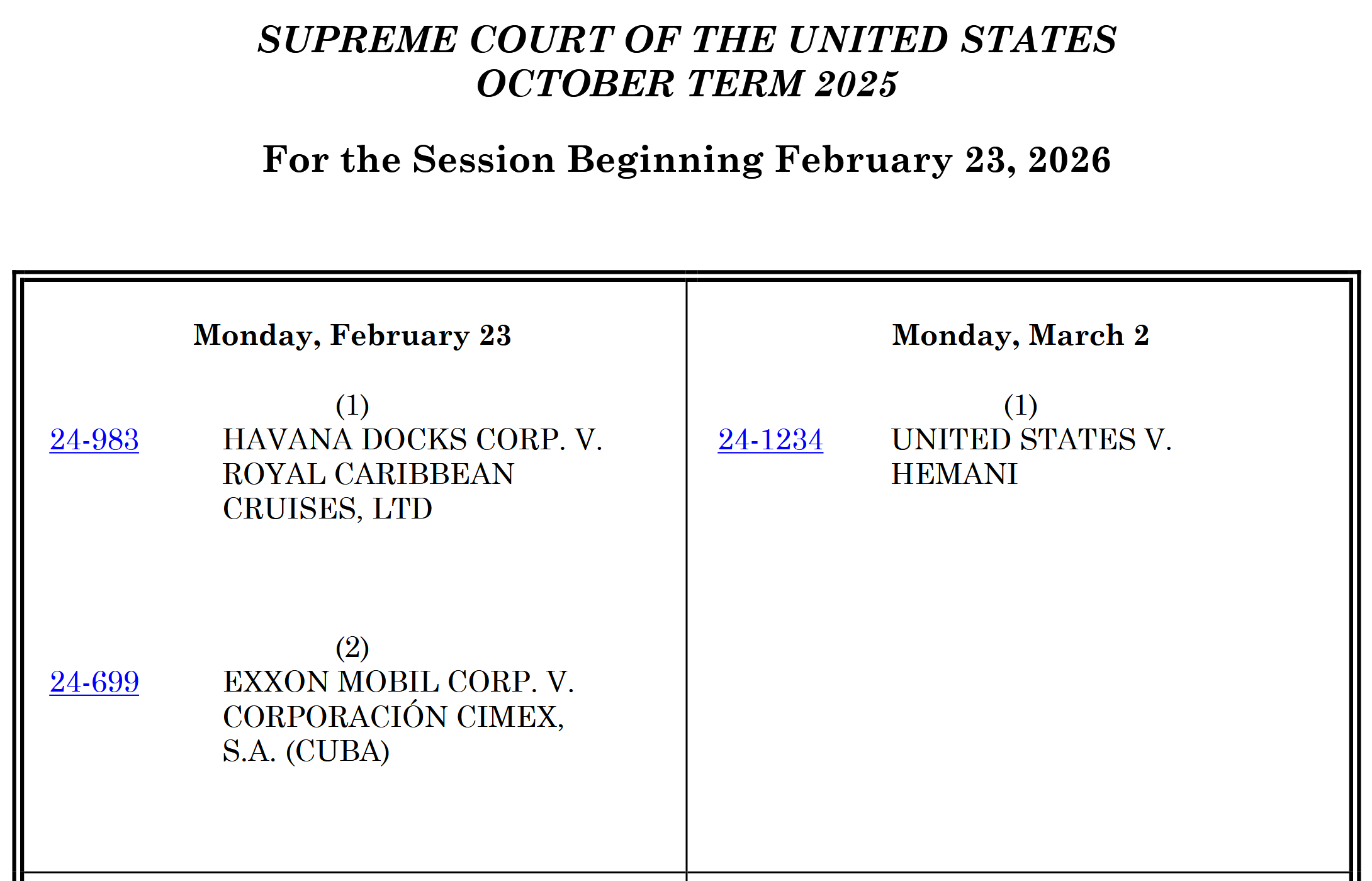
HEARING LIST
For the Session Beginning February 23, 2026
(The Court convenes at 10 a.m.; afternoon arguments begin at 1 p.m.)
Justices of the Supreme Court:
Hon. Chief Justice John G. Roberts, Jr.
Hon. Clarence Thomas Hon. Neil M. Gorsuch
Hon. Samuel A. Alito, Jr. Hon. Brett M. Kavanaugh
Hon. Sonia Sotomayor Hon. Amy Coney Barrett
Hon. Elena Kagan Hon. Ketanji Brown Jackson
Officers of the Court:
Scott S. Harris, Clerk
Rebecca Womeldorf, Reporter of Decisions
Gail A. Curley, Marshal
David S. Mao, Librarian
HEARING LIST
Monday, February 23, 2026
No. 24–983. Havana Docks Corporation v. Royal Caribbean Cruises, Ltd., et al.
Certiorari to the C. A. 11th Circuit.
For petitioner: Richard D. Klingler, Washington, D. C.; and Aimee Brown, Assistant to the Solicitor General, Department of Justice, Washington, D. C. (for United States, as amicus curiae.) For respondents: Paul D. Clement, Alexandria, Va. (1 hour for argument.)
No. 24–699. Exxon Mobil Corporation v. Corporación Cimex, S.A. (Cuba), et al.
Certiorari to the C. A. District of Columbia Circuit.
For petitioner: Morgan L. Ratner, Washington, D. C.; and Curtis E. Gannon, Deputy Solicitor General, Department of Justice, Washington, D. C. (for United States, as amicus curiae.) For respondents: Jules L. Lobel, Pittsburgh, Pa. (1 hour for argument.)
24-983 HAVANA DOCKS CORP. V. ROYAL CARIBBEAN CRUISES
DECISION BELOW: 119 F.4th 1276
CERT. GRANTED 10/3/2025
QUESTION PRESENTED: The LIBERTAD Act is an essential pillar of United States foreign policy toward Cuba's hostile and anti-American regime. Title III of that Act creates a private right of action for United States nationals who have a claim to property confiscated by that regime against persons who traffic in that property. 22 U.S.C. § 6082(a)(1). The Act specifies that such trafficking "undermines the foreign policy of the United States" by, among other things, "provid[ing] badly needed financial benefit" to the Cuban regime. Id. § 6081(6). The question presented here applies in every case brought under Title III, and will determine whether that provision continues to advance U.S. foreign policy toward Cuba: whether a plaintiff must prove that the defendant trafficked in property confiscated by the Cuban government as to which the plaintiff owns a claim (as the statute requires), or instead that the defendant trafficked in property that the plaintiff would have continued to own at the time of trafficking in a counterfactual world "as if there had been no expropriation" (as the divided Eleventh Circuit panel held below). LOWER COURT CASE NUMBER: 23-10151, 23-10171
24-699 EXXON MOBIL CORP. V. CORPORACION CIMEX
DECISION BELOW: 111 F.4th 12
CERT. GRANTED 10/3/2025
QUESTION PRESENTED: In 1960, the Cuban government confiscated the property of American nationals and transferred it to state-owned enterprises. After years without a diplomatic resolution, Congress enacted the Helms-Burton Act, which created a damages action for American nationals against "any person ... that traffics in" such confiscated property. 22 U.S.C. § 6082(a)(1). The Act defines "person" to include "any agency or instrumentality of a foreign state," id. § 6023(11), and expressly contemplates "judgment[s] against an agency or instrumentality of the Cuban Government," id. § 6082(d). The question presented is: Whether the Helms-Burton Act abrogates foreign sovereign immunity in cases against Cuban instrumentalities, or whether parties proceeding under that Act must also satisfy an exception under the Foreign Sovereign Immunities Act. LOWER COURT CASE NUMBER: 21-7127, 22-7019, 22-7020
Argument Audio: The audio recordings of all oral arguments heard by the Supreme Court of the United States are posted on this website (https://www.supremecourt.gov/) on the same day an argument is heard by the Court. The public may either download the audio files or listen to the recordings on the Court’s website. The audio recordings are listed by case name, docket number, and the date of oral argument.