
President Trump Has Carrots & Sticks To Influence Cuba. Making It Better? He Gets To Correct What Biden And Obama Could Not And Did Not Make Happen. And Time For Our Man In Havana.
/Trump-Vance Administration Has Carrots And Sticks To Influence Diaz-Canel-Valdes Mesa Administration
Making It Better? President Trump Can Correct What President Obama Failed To Understand And Force Government Of Cuba To Implement What President Biden Could Not
“The Lord [President] giveth, and the Lord [President][can] taketh away.”
Libertad Act Permits President Trump Elasticity For Carrots
President Trump Should Appoint An Ambassador
Donald Trump, President of the United States (2017-2021 and 2025-2029), has featured elasticity as a hallmark, perhaps even trademark of his style of governance. This is particularly true in his management of bilateral relationships with governments- both allies and foes. He defines and redefines in real time similar to Artificial Intelligence (AI) algorithms.
There are carrots and sticks available to the Trump-Vance Administration (2025-2029) for deployment to influence and impact the Diaz-Canel-Valdes Mesa Administration (2019- ) in the Republic of Cuba.
Important for United States-based companies that a United States Embassy to have an ambassador extraordinaire and plenipotentiary. In this instance, an individual in the Republic of Cuba who is the personal representative of the president of the United States. President Trump can do what his most recent two predecessors did not do. The United States Senate will confirm his nominee.
Installing a United States Ambassador to the Republic of Cuba is an important operational tool for the Trump-Vance Administration to manage the bilateral relationship with the United States. The presence of an ambassador elevates the on-the-ground connectivity with citizens of the Republic of Cuba. For the re-emerging private sector in the Republic of Cuba, interacting with an ambassador projects gravitas that a Charge d’Affaires does not possess. An ambassador visiting the team at a privately-owned company is a big deal- this is the representative of the president. It gets attention.
A bank-shot result could be support by other governments for those carrots and sticks, particularly those with commercial, economic, financial, military, political, and societal connectivity with the government of the Republic of Cuba and its approximately ten million residents.
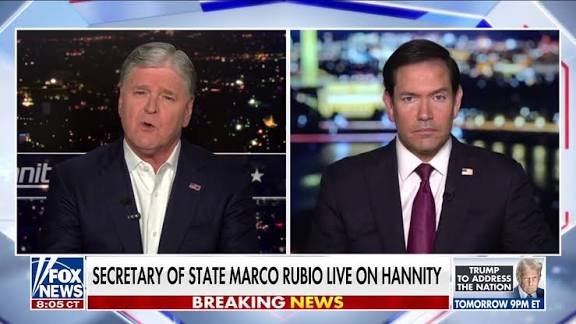
“The reason why Cuba is a disaster is because their economic system doesn’t work. It’s a nonsensical system and the people of Cuba are suffering because of the decisions, because of the unwillingness of the people who govern that country to make the changes that need to be made so they can join the 21st century. You need to change the people in charge. You need to change the system that runs the country, and you need to change the economic model that it’s following. That’s the only way forward if Cuba wants a better future.” Marco Rubio, United States Secretary of State
For President Trump, the two carrots most attractive, most easily achievable, and most consequential are focused upon commerce.
What makes two carrots politically catnip-like is the Trump-Vance Administration can correct initiatives the Obama-Biden Administration (2007-2017) and Biden-Harris Administration (2021-2025) failed to either implement or have the government of the Republic of Cuba accept.
For the government of the Republic of Cuba, accepting the two carrots do not present an existential threat as each carrot has already been either partially authorized and implemented, or verbally accepted. Each would require Havana to commercially dot the i and cross the t for statements already in the public domain.
The Obama-Biden Administration famously (more accurately, infamously) authorized United States-based financial institutions to have correspondent accounts with Republic of Cuba-based financial institutions, but refused to permit Republic of Cuba-based financial institutions to have accounts with United States-based financial institutions.
The result continued a payment system which enables third-country financial institutions to receive a fee for each transaction from the United States to the Republic of Cuba and from the Republic of Cuba to the United States.
For perspective, since December 2001 when the first agricultural commodities were exported from the United States to the Republic of Cuba using the cash-in-advance payment requirement of the Trade Sanctions Reform and Export Enhancement Act (TSREEA) of 2000, third-country financial institutions have received fees on more than US$8.3 billion.
Requiring the government of the Republic of Cuba to use correspondent accounts will result in transactions for United States-based companies that are more cost-effective, more efficient, and most importantly, more transparent as Republic of Cuba-based financial institutions are subject to United States-standard certified audits and requirements to implement and maintain Know Your Customer (KYC) procedures.
In 2022, the Biden-Harris Administration authorized United States-based companies to provide direct investment in and direct financing to privately-owned companies in the Republic of Cuba owned by Republic of Cuba nationals.
This precedent-setting initiative, in response to entreaties from United States-based companies, had the potential to create the re-emerging private sector landscape in the Republic of Cuba embraced by the Trump-Vance Administration, and thus far visibly supported through its fuel export authorization. Creating opportunities for United States-based companies to engage with the re-emerging private sector in the Republic of Cuba.
Unfortunately, nearing four years later, the government of the Republic of Cuba has not issued the regulations authorizing direct investment in and direct financing to privately-owned companies in the Republic of Cuba owned by a Republic of Cuba nationals. The Trump-Vance Administration could condition further changes in policies and regulations focused upon the re-emerging private sector in the Republic of Cuba to the issuance of the regulations.
“The Support for the Cuban People (SCP) License Exception, outlined in Section 740.21 of the Export Administration Regulations (EAR), is a key mechanism. Managed by the Bureau of Industry and Security (BIS) within the Department of Commerce, it permits exporting non-controlled items (classified as EAR99) to Cuba for purposes like improving living conditions, supporting independent economic activity, strengthening civil society, and facilitating free information flow. These licenses typically stipulate that exported goods must be designated for the Cuban people, cannot be re-exported, should not primarily generate income for the Cuban government, and cannot be sold directly to the government.”
Sec. 109 of the Cuban Liberty and Democratic Solidarity (Libertad) Act of 1996 “[a]uthorizes the President to furnish assistance and other support for individuals and independent nongovernmental organizations to support democracy-building efforts for Cuba.”
Libertad Act Opportunities
The Cuban Liberty and Democratic Solidarity (Libertad) Act of 1996 provides the Trump-Vance Administration with carrots and sticks to encourage the government of the Republic of Cuba to implement commercial, economic, financial, military, political, and societal changes and to re-engage with international financial institutions and regional political organizations.
While the statue text has requirements, it provides the executive branch with opportunities that should be attractive to the government of the Republic of Cuba. Even if those opportunities are not received fulsomely in Havana, governments with connectivity to the Republic of Cuba, particularly those whose companies and taxpayers are owed substantial sums by the government of the Republic of Cuba and Republic of Cuba government-operated companies may become advocates and allies of the Trump-Vance Administration. The message to Havana would be simple: Do what is necessary to pay what is owed.
President Trump has the authority to define and redefine “transition” relating to the government of the Republic of Cuba. And if he does make a determination which commences certain changes to statutes, regulations, and policies relating to the Republic of Cuba, he can always reverse course.
In some respects, providing the government of the Republic of Cuba with the taste of a deal could provide the type of flexibility preferred by President Trump- matching action with action and inaction with inaction; and preserving punishment: “the Lord [President] giveth, and the Lord [President] can] taketh away.”
(Sec. 204) Authorizes the President to take steps to: (1) suspend the U.S. economic embargo and application of certain other action against Cuba upon determining to the appropriate congressional committees that a transition government is in power in Cuba;
The Trump-Vance Administration could also support the return of the government of the Republic of Cuba to programs managed by the World Bank Group, the International Monetary Fund (IMF), International Finance Corporation (IFC), and membership in the Organization of American States (OAS). Each opportunity would require the government of the Republic of Cuba to re-engage with accountability and transparency.
Authorizes the Secretary to instruct the U.S. executive directors of the international financial institutions to support loans or other assistance to Cuba only if it will contribute to a stable foundation for a democratically-elected government there.
(Sec. 104) Directs the Secretary to instruct the U.S. executive directors of the international financial institutions to oppose the admission of Cuba as a member of such institutions until the President determines that a democratically-elected government is in power in Cuba. Urges the President to support Cuba's application for membership in such institutions during the period that a transition government is in power, subject to the membership's taking effect after a democratically-elected government is in power.
(Sec. 105) Urges the President to instruct the U.S. Permanent Representative to the Organization of American States (OAS) to oppose and vote against any termination of the suspension of Cuba from the OAS until the President determines that a democratically-elected government is in power there.
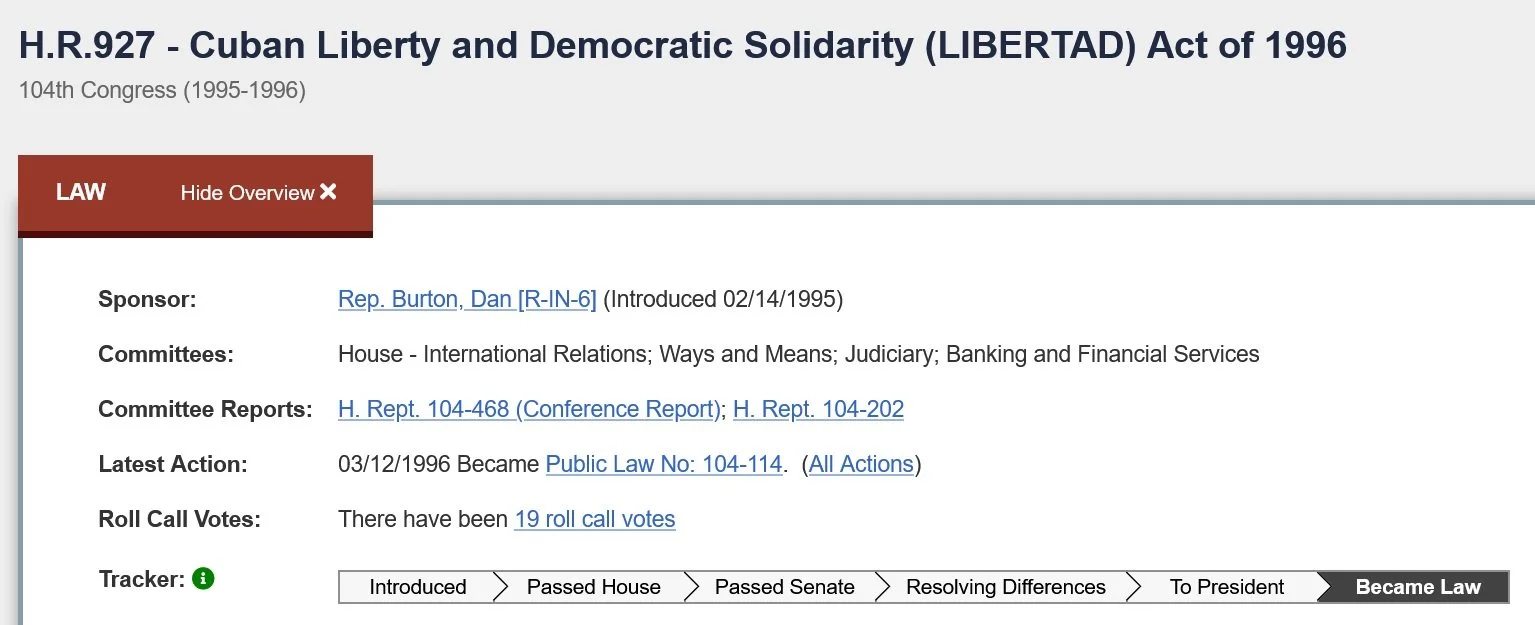
Libertad Act Text (italic and bold added)
Cuban Liberty and Democratic Solidarity (LIBERTAD) Act of 1996 - Title I: Strengthening International Sanctions Against the Castro Government - Expresses the sense of the Congress that: (1) the acts of the Castro government, including systematic human rights violations, are a threat to international peace; (2) the President should instruct the U.S. Permanent Representative to the United Nations to seek within the Security Council a mandatory international embargo against the Cuban Government; (3) efforts by any independent state of the former Soviet Union to make operational any nuclear facility in Cuba, and any continuation by such state of intelligence activities from Cuba targeted at the United States and its citizens, will have a detrimental impact on U.S. assistance to such state; and (4) the completion of any nuclear facility, or the political manipulation of the desire of Cubans to escape that results in mass migration to the United States, will be considered an act of aggression against the United States which will be met with an appropriate response.
(Sec. 102) Reaffirms a provision of the Cuban Democracy Act of 1992 that states that the President should encourage foreign countries to restrict trade and credit relations with Cuba. Urges the President to take steps to apply sanctions described by such Act against countries assisting Cuba.
Requires the President to instruct the Secretary of the Treasury and the Attorney General to enforce the Cuban Assets Control Regulations.
Amends the Trading with the Enemy Act to repeal the exemption from its civil penalties for news gathering, research, export and import of informational materials, certain educational or religious activities, and certain activities of human rights organizations.
Expresses the sense of the Congress that the President should instruct the Secretary of State and the Attorney General to enforce existing regulations that deny visas to Cuban Government employees or Cuban members of the Communist Party of Cuba.
Amends the Cuban Democracy Act of 1992, with respect to sanctions against a country that provides assistance to Cuba, to include as such assistance any exchange, reduction, or forgiveness of Cuban debt owed to a country in return for a grant of an equity interest in a property, investment, or operation of the Cuban Government or a Cuban national (debt-for-equity swap).
Declares that nothing in this Act shall be construed to authorize investment (including donations and loans) by any U.S. person in the domestic telecommunications network in Cuba. Requires the President to report semiannually to the Congress with respect to payments made to Cuba by any U.S. person as a result of the provision of telecommunications services.
(Sec. 103) Prohibits any U.S. national, permanent resident alien, or U.S. agency from knowingly extending any loan or other financing to any person in order to finance transactions involving property confiscated by the Cuban Government, the claim to which is owned by a U.S. national. Excepts from this prohibition any financing by the owner of the claim for a transaction permitted by U.S. law. Authorizes the President to terminate such prohibition upon: (1) installation of a transition government in Cuba; or (2) termination of the economic embargo of Cuba. Sets forth penalties for violation of such prohibition.
(Sec. 104) Directs the Secretary to instruct the U.S. executive directors of the international financial institutions to oppose the admission of Cuba as a member of such institutions until the President determines that a democratically-elected government is in power in Cuba. Urges the President to support Cuba's application for membership in such institutions during the period that a transition government is in power, subject to the membership's taking effect after a democratically-elected government is in power.
Authorizes the Secretary to instruct the U.S. executive directors of the international financial institutions to support loans or other assistance to Cuba only if it will contribute to a stable foundation for a democratically-elected government there. Requires the Secretary to withhold U.S. payments for specified portions of the increase in their capital stock from institutions that approve assistance to Cuba over U.S. opposition.
(Sec. 105) Urges the President to instruct the U.S. Permanent Representative to the Organization of American States (OAS) to oppose and vote against any termination of the suspension of Cuba from the OAS until the President determines that a democratically-elected government is in power there.
(Sec. 106) Directs the President to report to the appropriate congressional committees on progress towards the withdrawal of personnel of any independent state of the former Soviet Union from the Cienfuegos nuclear facility.
Amends the Foreign Assistance Act of 1961 to make ineligible for assistance (except assistance under the secondary school exchange program administered by the United States Information Agency (USIA)) any independent state that is providing assistance for, or engaging in nonmarket based trade with, Cuba.
Expresses strong disapproval of Russia's extension of credits equivalent to $200 million in support of the intelligence facility at Lourdes, Cuba.
Directs the President to withhold from assistance provided for an independent state of the former Soviet Union an amount equal to the assistance and credits provided by such state in support of intelligence facilities in Cuba, including the one at Lourdes. Authorizes the President to waive the requirement to withhold such assistance if specified conditions are met, including certification that the Russian Government is not sharing with the Cuban Government intelligence data collected at Lourdes.
Requires the President to report to the appropriate congressional committees on the intelligence activities of Russia in Cuba.
(Sec. 107) Requires the Director of the USIA to convert television broadcasting to Cuba under the Television Marti Service to ultra high frequency (UHF) broadcasting. Repeals the Television Broadcasting to Cuba Act and the Radio Broadcasting to Cuba Act upon the election of a democratically-elected government in Cuba.
(Sec. 108) Directs the President to report annually to the appropriate congressional committees on commerce with, and assistance to, Cuba from other foreign countries.
(Sec. 109) Authorizes the President to furnish assistance and other support for individuals and independent nongovernmental organizations to support democracy-building efforts for Cuba.
Directs the President to take steps to encourage the OAS to create a special emergency fund for the purpose of deploying human rights observers, election support, and election observation in Cuba. Urges the President to instruct the U.S. Permanent Representative to the OAS to encourage other OAS member states to join in calling for the Cuban Government to allow the immediate deployment of independent OAS human rights monitors throughout Cuba and on-site visits to Cuba by the Inter-American Commission on Human Rights. Urges the President to provide not less than $5 million of the U.S. voluntary contribution to the OAS solely for the purposes of the special fund. Requires the President to ensure that no assistance be provided to the Cuban Government.(Sec. 110) Declares that the Congress notes: (1) the prohibition on the entry of, and dealings outside the United States in, Cuban-origin merchandise; (2) that the U.S. accession to the North American Free Trade Agreement (NAFTA) does not alter the U.S. sanctions against Cuba; and (3) that the Food Security Act of 1985 requires the President not to allocate any of the sugar import quota to a country that is a net importer of sugar unless that country can verify to the President that it does not import Cuban sugar for re- export to the United States.
(Sec. 111) Directs the President to withhold the allocation of assistance, with specified exceptions, for any country in an amount equal to the sum of assistance and credits, if any, provided by such country in support of the completion of the Cuban nuclear facility at Juragua, near Cienfuegos, Cuba.
(Sec. 112) Expresses the sense of the Congress with respect to conditions for the reinstitution of general licenses for family remittances and travel to Cuba.
(Sec. 113) Directs the President to instruct all U.S. Government officials who engage in official contacts with the Cuban Government to raise on a regular basis the extradition of or rendering to the United States all persons residing in Cuba who are sought by the U.S. Department of Justice for crimes committed in the United States.
(Sec. 114) Authorizes the President to establish an exchange of news bureaus between the United States and Cuba if certain conditions exist.
(Sec. 115) Declares that nothing in this Act prohibits any lawfully authorized investigation, protective, or intelligence activity of a U.S. law enforcement agency or intelligence agency.
(Sec. 116) Condemns the act of terrorism by the Castro Regime in shooting down the Brothers to the Rescue aircraft on February 24, 1996. Extends Congress' condolences to the victims' families. Urges the President to seek an indictment in the International Court of Justice for this act of terrorism by Fidel Castro.
Title II: Assistance to a Free and Independent Cuba - Requires the President to develop a plan for providing economic assistance to Cuba at such time that a transition government or democratically- elected government is in power. Limits assistance for a transition government to humanitarian assistance, assistance essential to the successful transition to democracy, and military adjustment assistance. Expands assistance to include development and agricultural assistance and export financing (as well as other specified assistance) when a democratically-elected government is in power.
(Sec. 202) Requires the President to take steps to obtain the agreement of other countries, international financial institutions, and multilateral organizations to provide comparable assistance to Cuba. Requires the President, upon transmittal to specified congressional committees of a determination that a democratically- elected government is in power, to report on: (1) Cuban acts, policies, and practices which constitute barriers to, or distortions of, U.S. trade or foreign direct investment with Cuba; (2) U.S. policy objectives regarding trade relations with a democratically-elected government in Cuba; (3) specific U.S. trade negotiating objectives with Cuba, including specific objectives of NAFTA; and (4) proposed actions to be undertaken to achieve such policies and objectives.
(Sec. 203) Requires the President, upon determining that a democratically-elected government is in power in Cuba, to designate a United States-Cuba Council to: (1) ensure coordination between the U.S. Government and the private sector in responding to change and promoting market-based development in Cuba; and (2) establish periodic meetings between the U.S. and Cuban private sectors for the purpose of facilitating bilateral trade.
Requires the President, once he has sent the Congress a determination that a transition or a democratically-elected government is in power in Cuba, to report to appropriate congressional committees on the assistance provided to Cuba.
(Sec. 204) Authorizes the President to take steps to: (1) suspend the U.S. economic embargo and application of certain other action against Cuba upon determining to the appropriate congressional committees that a transition government is in power in Cuba; and (2) terminate the embargo when a democratically-elected government is installed. Declares that any suspension or termination of the embargo shall cease to be effective upon enactment of a joint resolution disapproving such action.
(Sec. 205) Sets forth conditions under which a government in Cuba will be considered transitional or democratically-elected.
(Sec. 207) Directs the Secretary of State to report to appropriate congressional committees an assessment with respect to settlement of outstanding U.S. claims to confiscated property in Cuba. Expresses the sense of the Congress that the satisfactory resolution of such property claims by Cuba remains a condition for the resumption of economic and diplomatic relations between the United States and Cuba.
Title III: Protection of Property Rights of United States Nationals - Makes any person that traffics in property confiscated by the Cuban Government on or after January 1, 1959, liable for money damages to any U.S. national who owns the claim to such property. Grants U.S. district courts jurisdiction over such actions where the amount in controversy exceeds $50,000.
(Sec. 303) Requires district courts to accept as conclusive proof of ownership a certification of a claim to ownership that has been made by the Foreign Claims Settlement Commission pursuant to the International Claims Settlement Act of 1949.
Amends such Act to authorize district courts, for fact-finding purposes, to refer to the Commission questions of the amount and ownership of a claim by a U.S. national resulting from the confiscation of property by Cuba, whether or not the U.S. national qualified as such at the time of the confiscation.
(Sec. 304) Bars certain ineligible U.S. nationals (including eligible nationals who fail to file timely claims), or Cuban nationals, from having a claim to or participating in the compensation proceeds or nonmonetary compensation paid or allocated to a U.S. national by virtue of a claim certified by the Commission.
(Sec. 305) Sets forth a two year statute of limitations for an action under this title.
Title IV: Exclusion of Certain Aliens - Directs the Secretary of State to deny a visa to, and the Attorney General to exclude from the United States, aliens (including their spouses, minor children, or agents) involved in the confiscation of property, or the trafficking in confiscated property, owned by a U.S. national. Provides for a case-by-case waiver of this exclusion for medical reasons or for purposes of litigation of a claim.
LINK TO COMPLETE ANALYSIS IN PDF FORMAT
Six Sigma Business solutions