Four Years Late: Do Not Get Orgasmic About Cuba Government Private Sector Announcements

Four Years Late: Do Not Get Orgasmic About Cuba Government Private Sector Announcements 

Is There Commitment? 

Demand Correspondent Banking Because It Would Require Transparency For Cuba Banks

Fact Check:  

Important not to get too orgasmic

  • Cuba is open to having a fluid commercial relationship with U.S. companies and also with Cubans residing in the United States and their descendants.  This extends beyond the commercial sphere.  It also applies to investments- not only small investments, but also large investments, particularly in infrastructure.  The blockade deprives us of access to financing, access to technology, access to markets, and in recent years, it has specifically been aimed at depriving our country of access to fuel.”  Pérez-Oliva Fraga, Deputy Prime Minister of the Republic of Cuba 

Reality will be painful… 

A reminder to the Diaz-Canel-Valdes Mesa Administration (2019- ) in Havana that since 1994 almost all of the first licenses issued by the Bureau of Industry and Security (BIS) of the United States Department of Commerce and Office of Foreign Assets Control (OFAC) of the United States Department of the Treasury for Republic of Cuba-related commercial, economic, and financial initiatives originated from companies located outside of the State of Florida and from individuals not of Cuban descent.  “Cuban-Americans” made use of the effort and landscape created first primarily by others. 

On 10 March 2022 the Biden-Harris Administration (2021-2025) directed the OFAC to issue the first license authorizing direct investment in and direct financing to a privately-owned company in the Republic of Cuba owned by a Republic of Cuba national. 

Yes, the government of the Republic of Cuba is only now authorizing what could have been implemented four years ago- and resulted in meaningful capital flows and direct foreign investment.  They refused. 

That refusal has for nearing four years also impacted direct investment and direct financing into the re-emerging private sector in the Republic of Cuba not only from the United States, but from all countries- including those the government of the Republic of Cuba professes to have connectivity- Canada, China, European Union members, Russia, Spain, Mexico, etc.  

The Trump-Vance Administration (2025-2029) should “trump” the decision by the government of the Republic of Cuba. 

The “trump” card should be for the Trump-Vance Administration to require direct correspondent banking for all transactions into and out of a privately-owned company located in the Republic of Cuba.  This means Republic of Cuba government-operated financial institutions would need to establish correspondent accounts with United States-based financial institutions.  A requirement of would be Republic of Cuba government-operated financial institutions “open their books” to audits by United States-based accounting firms.   

The use of correspondent accounts rather than funds flowing through third countries would ensure a cost-effective, efficient, and transparent financial landscape. 

Links To Related Analyses 

Link: Biden-Harris Administration Re-Engagement With Cuba’s Re-Emerging Private Sector Brings Urgency To Re-Authorization Of Direct Correspondent Banking, U-Turn Transactions. One-Way Does Not Work.  October 06, 2022 

Link: Cuba Government Delaying Private Company Investment/Financing Regulations Is Costing Earning Potential For U.S. And Other Country Sources. Success Should Not Be Feared. September 25, 2023  

Link: Now The Hard Part For Cuba: Implementing Quickly Transparent, Equal-For-All, MSME Investment & Financing Regulations. No Limitations. No Selectivity. No Orwellian Process. August 04, 2022   

Link: Biden-Harris Administration Approves First Equity Investment Since 1960 In A Private Cuban Company May 10, 2022 

Link: With U.S. Government Authorization For First Direct Equity Investment Into A Private Company In Cuba, Here Is Important Context And Details.  About The Parties; About The Message. May 16, 2022   

Link: Mr. de Cossio At MINREX In Cuba Not Quite Accurate With His Comments About Biden-Harris Administration Efforts With MSMEs And Remittances  December 20, 2022  

Link: State Department, NSC, OFAC, BIS, USDA Don't Understand Requirements For Financial Plumbing To Function Efficiently.  They Excel In Creating, Maintaining, And Defending Clogs. May 16, 2023  

LinkLogic From U.S. Department Of State:  If We Permit It, Cuba Might Not Use It, So We Won’t Permit It.  And, Yes, No One Asked Cuba. And, No One Asked U.S. Banks, Companies.  May 01, 2023  

LINK TO COMPLETE ANALYSIS IN PDF FORMAT

undark magazine

U.S. Embassy In Cuba May Reduce Operations Due To Energy Issues. U.S. Company Previously Offered EVs And EV Charging Stations. ASAP: U.S. Companies Need BIS, OFAC, OLA, FAS, FCSC, DOJ In Havana

United States Company Offered Biden-Harris Administration Free EV Chargers For United States Embassy And Ambassador’s Residence In Havana And Availability Of Electric Vehicles 

United States Department Of State Refused- Preferred To Rent China-Built Vehicles From Cuba Government-Operated Company  

BIS, FAS, DOJ, OLA, And OFAC Representatives Need To Be Pre-Positioned In Havana 

The United States Department of State confirms energy availability is impacting operations of the United States Embassy, United States Consulate, and Ambassador’s Residence in Havana, Republic of Cuba. 

Associated Press
New York, New York
13 March 2026

  • “The U.S. State Department has weighed potentially drawing down staffing at the U.S. Embassy in Havana as the fuel shortages caused by the American blockade could affect day-to-day diplomatic operations, according to three U.S. officials.  The officials stressed that there is still time to solve the problem and that the embassy and the State Department were looking at potential solutions, including possibly importing fuel from private sources if the Cubans allow it.  A reduction in staffing at the embassy in Havana would likely lead to a U.S. demand for a similar reduction in staffing at the Cuban embassy in Washington, the officials said.” 

With the Trump-Vance Administration (2025-2029) re-engaging with the government of the Republic of Cuba and re-engaging with citizens of the Republic of Cuba, essential for United States-based companies and United States-based entrepreneurs to have available to them a robust senior-level agency and department representation in place as soon as possible at the United States Embassy in Havana and United States Consulate in Havana.   

Since focus will include re-engagement commercially, economically, and financially, with the re-emerging private sector in the Republic of Cuba, essential for personnel representing the Bureau of Industry and Security (BIS) of the United States Department of Commerce, Office of Foreign Assets Control (OFAC) of the United States Department of the Treasury, Foreign Claims Settlement Commission (FCSC) of the United States Department of Justice (representing the interests of the 5,911 certified claimants), Office of the Legal Advisor (OLA) of the United States Department of State (to support FCSC), and Foreign Agricultural Service (FAS) of the United States Department of Agriculture.   

In 2025, total exports (sold and donated) from the United States to the Republic of Cuba were approximately US$810.6 million.  That value placed the Republic of Cuba easily among the top 40% of United States product export markets.  For agricultural commodity exports and food product exports, the Republic of Cuba ranked 49th of 222 United States export markets.  Since December 2001, the total agricultural commodity and food product exports to the Republic of Cuba exceed US$8.2 billion on a cash-in-advance payment basis as required by the Trade Sanctions Reform and Export Enhancement Act (TSREEA) of 2000. 

EV Decision 

Had the Biden-Harris Administration (2021-2025) chose differently relating to electric vehicles for use by the United States Embassy in Havana, part of the energy issue(s) encountered today by Trump-Vance Administration would have been mitigated. 

A Maryland-based company repeatedly offered to provide and install solar-powered electric vehicle charging stations at the embassy and ambassador’s residence at no cost to United States taxpayers.  In addition, as the company had a license from the BIS to export electric vehicles from the United States to the Republic of Cuba, the company offered to deliver (lease, rent, sale) electric vehicles to augment the existing gasoline/diesel vehicle fleet.  The company received the following initial response: 

  • 3 December 2021: United States Department of State: “The Biden Administration has clearly articulated the United States’ goal to accelerate and deploy electric vehicles and charging stations, create good-paying, union jobs, and enable a clean transportation future to combat climate change.  However, the United States Embassy in Cuba does not operate any electric vehicles nor has any solar power charging stations at our Embassy compound or residences in Havana.  At this time, it would be unlikely that the United States Embassy consider importing one or more electric vehicles for use in Cuba in the near future due to impediments in the electrical infrastructure and lack of trained mechanics on the island to service electric vehicles.”    

On 17 November 2022, the Biden-Harris Administration approved a license application submitted on 22 October 2022 by Columbia, Maryland-based Premier Automotive Export, Ltd. (PAE) to the BIS to export electric vehicles and chargers to republic of cuba nationals with the “ULTIMATE CONSIGNEE: Privately owned companies in the Republic of Cuba owned by Cuba Nationals.”  The BIS license is valid until 30 November 2026.  PAE received six BIS licenses since 2017 including the first BIS license to export an electric vehicle to an embassy located in the Republic of Cuba.       

  • 8 May 2023: United States Department of State: “The Embassy is facing an emergency fuel crisis and is renting various electric vehicles from a local car rental agency until the crisis subsides.  There are no American made electric vehicles available to rent in Cuba.”   

  • 9 May 2023: United States Department of State: “As noted in our previous response, the Embassy is facing an emergency fuel crisis and has taken temporary measures to ensure continuity of operations.  Because of the fluid situation regarding fuel, the details you request change on a daily basis.  The rental agency is not listed on the Cuba Restricted List.  There is nothing more to share at this time.”  

  • 22 May 2023: To AP from United States Department of State: “There is a fuel crisis currently in Cuba.  In order to maintain operations, the U.S. Embassy in Havana rented numerous electric cars that are available for rent in Havana.  They will continue to do so until the crisis abates.  There are no American-made electric cars in Cuba available for rent.   The U.S. Embassy Havana currently does not operate any electric vehicles in its motor pool in Havana. All Department of State vehicles have a lifecycle and the Embassy is currently in the process of transitioning a large percentage of its vehicles to American-made electric vehicles and expects to have that process completed sometime in 2024. The vehicle needs of Embassy Havana vary daily as does the availability of various models of electric rental vehicles, their cost, and the Embassy offices which  are in need of a vehicle.” 

Link: AP and NBC News Also Want To Know Why U.S. Embassy In Havana Is Renting Electric Vehicles Made In China May 22, 2023 

United States Department of State
Washington DC
22 May 2023

Briefing With Matthew Miller, Spokesperson 

MR. MILLER: Matt, you want to close us off?\

QUESTION (Matt Lee, Associated Press):  Yeah, I just – and these will be extremely brief because I think you’ll only have a five-second answer for both.  One, do you know anything about the U.S. embassy in Cuba renting Cuban Government EV cars that are made by China?

MR MILLER:  I do not.   As I think you —

QUESTION:  Okay.  Could you —

MR MILLER:  As you seemed to anticipate.

QUESTION:  Could you – yeah.  Well, I just heard about it, so I didn’t think you would have anything, but I wanted to get it out there on the record.

MR MILLER:  Thank you.

QUESTION:  Can you – could you – or maybe not you, someone look into this and find out if it’s true and what the deal is?  I mean, it might be completely innocent.

Subsequent statement delivered later on 22 May 2023 to AP from the United States Department of State: “There is a fuel crisis currently in Cuba.  In order to maintain operations, the U.S. Embassy in Havana rented numerous electric cars that are available for rent in Havana.  They will continue to do so until the crisis abates.  There are no American-made electric cars in Cuba available for rent.   The U.S. Embassy Havana currently does not operate any electric vehicles in its motor pool in Havana. All Department of State vehicles have a lifecycle and the Embassy is currently in the process of transitioning a large percentage of its vehicles to American-made electric vehicles and expects to have that process completed sometime in 2024. The vehicle needs of Embassy Havana vary daily as does the availability of various models of electric rental vehicles, their cost, and the Embassy offices which  are in need of a vehicle.”

QUESTION (Andrea Mitchell, NBC News):  Can I just – can I just follow up on something that Matt had asked?

MR MILLER:  What – yeah.

QUESTION:  There was apparently a license, an export license, issued more than a year ago to a Maryland-based company to export an electric car and a charger to the embassy, and that four were supposed to be sent, and for some reason, apparently, Brian Nichols did not approve that. So —

MR MILLER:  I will say I’m not aware of these reports, and I think I will make it a practice not to comment on things that broke while I was at this podium that I have not had a chance to look into.

QUESTION:  Understood. 

Links To Related Analyses 

BIS "Returned Without Action" License Application To Donate EV Chargers To U.S. Embassy In Havana Because "Ultimate Consignee" Cancelled Transaction March 07, 2022 

Surprise Decision: Biden-Harris Administration Renews Trump-Pence Administration License To Export EVs To Embassies In Cuba. Company Offers To Donate EV Chargers To U.S. Embassy/Ambassador Residence January 25, 2022 

Why Is U.S. Embassy In Havana Renting Chinese-Built Electric Vehicles From A Cuba Government Company Rather Than Renting EVs From A U.S. Company? Company Offered To Donate Chargers. Rebuffed. May 22, 2023 

Is EV Data Really SCI? If U.S. Department Of State Wants U.S. Companies To Shift From Incredulousness To Embracing, Then Be Practical And Transparent Rather Than Secretive And Woefully Unprepared May 29, 2023

LINK TO COMPLETE ANALYSIS IN PDF FORMAT

Might New OFAC General License 134 Open Door (A Crack) For Russian Oil Exports To Cuba Until 11 April 2026?

On 29 January 2026, Donald Trump, President of the United States (2027-2021, 2025-2029), signed Executive Order 14380 which authorized and “imposes a new tariff system that allows the United States to impose additional tariffs on imports from any country that directly or indirectly provides oil to Cuba.” 

To date, there are no announcements from the United States Department of State, United States Department of the Treasury, or United States Department of Commerce that a tariff was imposed on a country specifically for an oil transaction relating to the government of the Republic of Cuba.   

On 12 March 2026, to mitigate global commodity price fluctuations since the 28 February 2026 attack upon the Islamic Republic of Iran by the Israel Defense Forces (IDF) and the armed forces of the United States, the Trump-Vance Administration (2025-2029) authorized the purchase of oil sourced from the Russian Federation which was loaded onto vessels prior to 12 March 2026.  The Office of Foreign Assets Control (OFAC) of the United States Department of the Treasury reported the purchase authorization will remain in force until 11 April 2026. 

Question: Given no country is specifically sanctioned by provisions of Executive Order 14380 for engaging in oil-related transactions with the government of the Republic of Cuba and certain oil sourced from the Russian Federation may now until 11 April 2026 be purchased absent Trump-Vance Administration sanctions, could (and would) a government or company deliver oil to the government of the Republic of Cuba? 

Might the government of the Russian Federation seek to use OFAC General License 134 for oil in vessels prior to 12 March 2026, using vessels registered within the Russian Federation, and vessels insured by Russian Federation-based companies to deliver oil to the Republic of Cuba- whether the end-user is the government of the Republic of Cuba, a Republic of Cuba government-operated company(s), or one of the re-emerging private companies located in the Republic of Cuba. 

If the end-user is the re-emerging private sector in the Republic of Cuba, the government of the Russian Federation could provide substantial long-term payment terms, which might be an inducement to the Trump-Vance Administration to authorize the transaction.

United States Department of the Treasury
Washington DC
13 March 2026

Russian Harmful Foreign Activities Sanctions Regulations, 31 CFR part 587; Ukraine-/Russia-Related Sanctions Regulations, 31 CFR part 589; Iranian Transactions and Sanctions Regulations, 31 CFR part 560; Weapons of Mass Destruction Proliferators Sanctions Regulations, 31 CFR part 544; Iranian Financial Sanctions Regulations, 31 CFR part 561; Iranian Sector and Human Rights Abuses Sanctions Regulations, 31 CFR part 562; Global Terrorism Sanctions Regulations, 31 CFR part 594; Executive Order 13876 of June 24, 2019 (“Imposing Sanctions With Respect to Iran”);

Executive Order 13902 of January 10, 2020 (“Imposing Sanctions With Respect to Additional Sectors of Iran”); Executive Order 13949 of September 21, 2020 (“Blocking Property of Certain Persons with Respect to the Conventional Arms Activities of Iran”) 

GENERAL LICENSE 134 

Authorizing the Delivery and Sale of Crude Oil and Petroleum Products of Russian Federation Origin Loaded on Vessels as of March 12, 2026 

(a) Except as provided in paragraph (b) of this general license, all transactions prohibited by the above-listed authorities that are ordinarily incident and necessary to the sale, delivery, or offloading of crude oil or petroleum products of Russian Federation origin loaded on any vessel, including vessels blocked under the above listed authorities, on or before 12:01 a.m. eastern daylight time, March 12, 2026 are authorized through 12:01 a.m. eastern daylight time, April 11, 2026.  Note 1 to paragraph (a). Transactions that are ordinarily incident and necessary to the sale, delivery, or offloading of such crude oil or petroleum products include transactions for the safe docking and anchoring of vessels carrying such crude oil or petroleum products; the preservation of the health or safety of the crew of any such vessel; emergency repairs or environmental mitigation or protection activities relating to any such vessel; and services such as vessel management, crewing, bunkering, piloting, registration, flagging, insurance, classification, and salvage. Russian Federation-origin crude oil and petroleum products subject to this general license include those produced by entities sanctioned under the Russian Harmful Foreign Activities Sanctions Regulations, 31 CFR part 587, or the Ukraine-/Russia-Related Sanctions Regulations, 31 CFR part 589.  (b) This general license does not authorize any other transactions or activities prohibited by any other Executive order or by any part of 31 CFR chapter V not referenced in this general license, including any transaction or activity involving Iran, the Government of Iran, or Iranian-origin goods or services that is prohibited by the Iranian Transactions and Sanctions Regulations (31 CFR part 560), except as authorized by paragraph (a). 

Link: https://ofac.treasury.gov/media/935191/download?inline

The White House
Washington DC
29 January 2026
 

CONFRONTING THE CUBAN REGIME: Today, President Donald J. Trump signed an Executive Order declaring a national emergency and establishing a process to impose tariffs on goods from countries that sell or otherwise provide oil to Cuba, protecting U.S. national security and foreign policy from the Cuban regime’s malign actions and policies.  The Order imposes a new tariff system that allows the United States to impose additional tariffs on imports from any country that directly or indirectly provides oil to Cuba.  The Order authorizes the Secretary of State and Secretary of Commerce to take all necessary actions, including issuing rules and guidance, to implement the tariff system and related measures.  The President may modify the Order if Cuba or affected countries take significant steps to address the threat or align with U.S. national security and foreign policy objectives. 

LINK TO COMPLETE ANALYSIS IN PDF FORMAT

Revisionism: In USA Today Cuba Interview, Biden Administration White House And State Department Official "Forgets" Opposing Critical Private Sector Banking Need

Embracing Revisionism 

Biden-Harris Administration White House And State Department Official Forgets His Lack Of Support For Critical U.S. Company And Cuba Private Sector Engagement Issue 

If He Was Not An Advocate, He Was An Obstacle 

Make Sense? Moving More Than US$8.2 Billion Through Third Country Banks- Where They Take A Fee For Every Transaction 

Remember NSC From Obama-Biden Administration: “We’ve gone as far as we can go.” 

Nothing For 5,911 Certified Claimants- The Embargo Began Because Of Them 

Good News: Trump-Vance Administration Which Is Robust With Private Sector Experience Appreciates Tools Required For Re-Engagement By United States-Based Companies: Direct Correspondent Banking 

USA Today
Washington DC
6 March 2026

“Eric Jacobstein, former deputy assistant secretary of state for western hemisphere affairs in the Biden administration [2023-2025; and 2022-2023 as special advisor to the vice president for the western hemisphere and national security council director for Central America and Cuba], traveled to the island repeatedly to meet with Cuban entrepreneurs and encourage them to connect with U.S. businesses.  For Trump’s strategy to take root, Cuba’s private sector will need increased help from American businesses, particularly the banking sector, he said.  “It's critical to engage this independent Cuban private sector,” Jacobstein said. “They're independent, they're entrepreneurial … It's a group that has embraced capitalism within a failing communist system.”  Link To Article: Inside Trump's plan to win Cuba with American oil 

Mr. Jacobstein met with owners of the re-emerging private sector in the Republic of Cuba to encourage them to connect with United States-based companies.  News flash- they did not need convincing.  Engaging with those who agree with you is no diplomatic feat.   

Who did need convincing? The government of the Republic of Cuba.  Why did Mr. Jacobstein not meet “repeatedly” with senior-level officials of the government of the Republic of Cuba to encourage them to issue the regulations to authorize direct investment in and direct financing to privately-owned companies located in the Republic of Cuba?  The investment and financing were authorized on 10 March 2022 by the Biden-Harris Administration (2021-2025).  And, what about meeting with officials of the government of the Republic of Cuba to advocate for a settlement of the 5,911 claims certified by the Foreign Claims Settlement Commission (FCSC) within the United States Department of Justice?  There is no record of efforts by Mr. Jacobstein to advocate directly to those who were decisionmakers. 

Mr. Jacobstein was never employed in the private sector according to his LinkedIn profile.  He could not and would not appreciate the burdensome, cost-ineffective, and unnecessary costs with moving funds for commercial purposes through third countries- meaning a triangle.  Rather than a cost-effective, efficient, secure, timely, and transparent moving of funds for commercial purposes directly, meaning a straight line. 

When described as advocating for the re-emerging private sector in the Republic of Cuba to “connect with” United States-based companies and stressing the importance of the “banking sector” Mr. Jacobstein has conveniently forgotten his remark to representatives of United States-based companies. 

The Biden-Harris Administration did authorize private companies located in the Republic of Cuba to establish accounts with United States-based financial institutions.  That was important.  However, that did not address the critical problem- moving money. 

During his tenure, Mr. Jacobstein did not indicate support for correcting a mistake by the Obama-Biden Administration (2009-2017).  Its failure to authorize direct correspondent banking for authorized commercial transactions from the United States to the Republic of Cuba and from the Republic of Cuba to the United States. 

  • Infamously, Mark Feierstein, Senior Director for Western Hemisphere Affairs at the National Security Council from 2015 to 2017 during the Obama-Biden Administration, said to representatives of United States-based companies, “We’ve gone as far as we can go” when asked to support direct correspondent banking.  While simultaneously seeking re-engagement, the most important protocol required for commerce was ignored.  The government of the Republic of Cuba was not required to permit widespread on-the-ground opportunities for United States-based companies to employee thousands of Republic of Cuba nationals.  Mr. Feierstein presided over a tepid landscape and what would be a roadmap for the Trump-Pence Administration (2017-2021) to roll-up some of the most visible examples of United States-based company presence in the Republic of Cuba. 

The Obama-Biden Administration authorized United States-based financial institutions to establish correspondent accounts with Republic of Cuba-based financial institutions, including those operated by the government of the Republic of Cuba. 

Inexplicably, at the direction of the National Security Council (NSC) at The White House, Republic of Cuba government-operated financial institutions were not permitted to have correspondent accounts with United States-based financial institutions.  One such financial institution was vetted and approved for a United States-based financial institution to maintain a correspondent account.  The Office of Foreign Assets Control (OFAC) of the United States Department of the Treasury did not approve the Republic of Cuba government-operated financial institution to maintain a correspondent account with the United States-based financial institution. 

Thus, absent bilateral correspondent accounts, funds for authorized financial transactions continued then and continue now to move through third countries.   

The result is third country financial institutions receiving a fee for every United States Dollar transaction using a financial institution.   

For perspective, since December 2001 when the first agricultural commodity and food product exports from the United States to the Republic of Cuba were re-authorized within provisions of the Trade Sanctions Reform and Export Enhancement Act (TSREEA) of 2000, more than US$8.2 billion in authorized commercial payments have moved from the Republic of Cuba to United States-based companies through third country financial institutions- and a fee is paid each time.  

Every United States Dollar to a third-country financial institution is a burdensome and unnecessary fee to United States-based companies and one less United States Dollar directed to additional product exports from the United States to the Republic of Cuba. 

Continuation of the indirect payment process is partly a legacy of Mr. Jacobstein. 

Was Mr. Jacostein, along with his colleagues, incapable of understanding direct correspondent banking or did not care enough to want to learn of its importance because of his and their lack of private sector experience?  Why ignore an essential component for the movement of global capital investment- efficient, cost-effective funds transfers.  

For United States-based companies and financial institutions, Mr. Jacobstein should have been an advocate rather than in impediment.   

Eric Jacobstein 
Deputy Assistant Secretary For Central America
Bureau of Western Hemisphere Affairs 
United States Department of State
Washington DC

Eric Jacobstein currently serves as a Deputy Assistant Secretary in the Bureau of Western Hemisphere Affairs (June 2023 to January 2025) covering Central America, Cuba and regional migration. He previously served at the White House as the Special Advisor to the Vice President for the Western Hemisphere and as National Security Council Director for Central America and Cuba (February 2022 to June 2023). In 2021, Mr. Jacobstein joined the Biden-Harris Administration as a Senior Advisor in the U.S. Agency for International Development’s Bureau for Latin America and the Caribbean and as Staff Director of the Northern Triangle Task Force. Before that, Mr. Jacobstein worked in the United States Congress for 15 years, including as a Senior Policy Advisor on the House Committee on Foreign Affairs managing the Western Hemisphere portfolio for Chairman Eliot Engel and Committee Democrats. In this role, he was the lead Democratic advisor handling issues related to Latin America and the Caribbean in the House of Representatives. Mr. Jacobstein also served as the Staff Director of the Senate Caucus on International Narcotics Control working for Senator Dianne Feinstein. In addition, he has worked for the House Subcommittee on the Western Hemisphere, Representative Jim Kolbe and the Inter-American Dialogue. He holds a M.A. in Latin American Studies from the Georgetown University School of Foreign Service and a B.A. in Political Science from Haverford College. 

5,911 Certified Claimants 

Neither the Obama-Biden Administration, the Trump-Pence Administration, nor the Biden-Harris Administration focused upon seeking a settlement with the government of the Republic of Cuba on behalf of the 5,911 United States-based companies with claims certified by the Foreign Claims Settlement Commission (FCSC) within the United States Department of Justice in Washington DC.  The value of the certified claims at date of certification was US$1,902,202,284.95 with simple interest of 6% annually permitted, with the current estimated value at approximately US$9.2 billion. 

The “embargo” commenced in 1960 during the Eisenhower-Nixon Administration (1953-1961) and was a direct result of the seizure of an asset owned by a United States-based company.  Ending the “embargo” should require first a settlement on behalf of the 5,911 certified claimants. 

The first asset (along with 382 enterprises the same day) to be expropriated by the Republic of Cuba was an oil refinery on 6 August 1960 owned by White Plains, New York-based Texaco, Inc., now a subsidiary of San Ramon, California-based Chevron Corporation (USFCSC: CU-1331/CU-1332/CU-1333 valued at US$56,196,422.73).  

The Trump-Vance Administration (2025-2029) has an opportunity to complete what the Obama-Biden Administration, Trump-Pence Administration, and Biden-Harris Administration partially succeeded in doing- secure the viability of the re-emerging private sector in the Republic of Cuba.  Specifically, to provide them with access to the same business operational tools commonplace in other countries.   

These tools include in Havana- implementing regulations permitting direct investment and direct financing into private companies, and requesting Republic of Cuba-government-operated financial institutions to seek correspondent accounts with United States-based financial institutions. 

Those tools include in Washington DC- permitting Republic of Cuba-based financial institutions to have correspondent accounts with United States-based financial institutions. 

If companies are unable to move funds cost-effectively (particularly for small values), efficiently, and transparently, then all other authorizations become more about optics than performance.

LINK TO COMPLETE ANALYSIS IN PDF FORMAT

Missing From Shield Of The Americas Summit Are President Trump's Two Works-In-Progress And Three Heads Of State Who Could Influence One Of Them To Do What President Trump Wants It To Do

This morning, Donald Trump, President of the United States (2017-2021 and 2025-2029), will host at his property in Doral, Florida, the Shield of the Americas Summit for heads of state and heads of government from selected countries. 

The heads of state representing his two most visible works-in-progress, one more advanced than the other, will not be participating: Delcy Rodriguez, Interim President of the Bolivarian Republic of Venezuela (2026- ), and Miguel Diaz-Canel, President of the Republic of Cuba (2019- ). 

Unknown is will President Trump use the forum to seek from those in the room with him support for his efforts to re-engage commercially, economically, financially, and politically with the government of the Republic of Cuba.  If he does, there is then the question as to what leverage they have in Havana and if they have leverage in Havana, to what level will they agree to use it. 

Three heads of state who might have the most expansive leverage in Havana will not be participating in the Shield of the Americas Summit.   

They represent the largest by Gross Domestic Product (GDP) and population, Brazil, and second-largest by GDP and population, Mexico, and the fourth-largest by GDP, and third-largest by population, Colombia. 

  • “On March 7, 2026, Secretary of State Marco Rubio will join President Donald J. Trump at the Shield of the Americas Summit in Doral, Florida. The United States will welcome our strongest likeminded allies in our hemisphere to promote freedom, security, and prosperity in our region. This historic coalition of nations will work together to advance strategies that stop foreign interference in our hemisphere, criminal and narco-terrorist gangs and cartels, and illegal and mass immigration.” United States Department of State 

Expected to participate: Argentine Republic President Javier Milei; Bolivian President Rodrigo Paz Pereira; Chile President-elect José Antonio Kast; Costa Rican President Rodrigo Chaves Robles; Dominican Republic President Luis Abinader; Ecuadorian Constitutional President Daniel Noboa; El Salvadoran President Nayib Bukele; Guyanese President Mohamed Irfaan Ali; Honduran President Nasry "Tito" Asfura; Panamanian President José Raúl Mulino Quintero; Paraguayan President Santiago Peña; Trinidad and Tobago Prime Minister Kamla Persad-Bissessar. 

Links To Related Analyses 

Trump Administration Opens Diplomatic Door To Cuba: First, Change The Economy. Second, Invite U.S. Companies. Third, For Now, Type Of Government Not Important- Just Make It Work Like China, Vietnam Feb 15, 2026

Trump’s Message To Cuba To “Make A Deal” May Not Be A Bad Deal For Cuba. Witkoff And Kushner Add Another Assignment. 23 February 2026 Is Consequential. January 14, 2026

With New BIS Guidance For Fuel, Gas, Petroleum Product Exports To Cuba, Trump Administration Confirms There Is A Private Sector In Cuba And U.S. Companies May Engage. Members Of Congress Not Pleased. Feb 25, 2026

President Trump Interested In "Friendly Takeover" Of Cuba Rather Than "Hostile Takeover" Of Cuba. What About Plebiscite? Feb 28, 2026

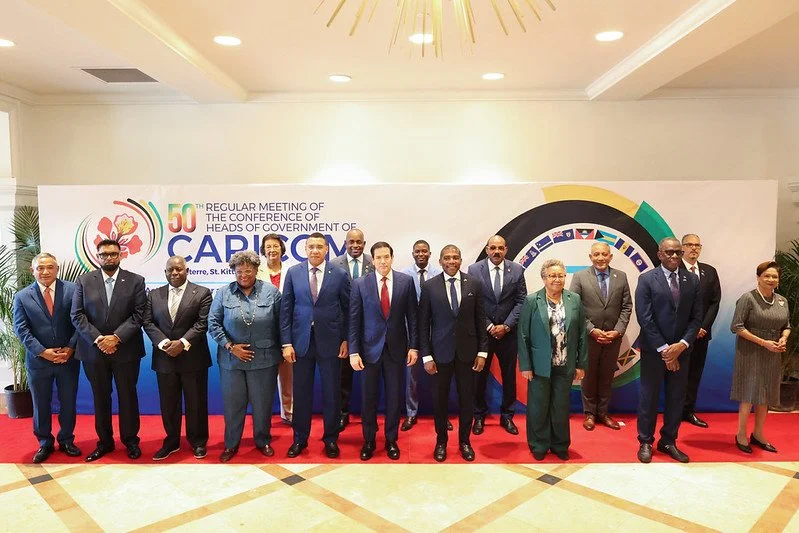
At CARICOM Meeting, U.S. Secretary Of State Rubio Discusses Cuba- Engagment Remains Focused First On Commercial, Economic, Financial Changes In Cuba Feb 26, 2026

2025 Report: US$490 Million Is 3rd Highest To Cuba Since 2001; US$173.6 Million (See List) In PYME/Cuban Citizen Exports Including Vehicles- US$148.3 Million. Donations Up 116.7% To US$147 Million Feb 26, 2026

At SPIEF’25 Russia-Cuba Dialogue, One Side Talks Dreams, Other Talks Reality. “Reliable Partner”- “Science Fiction” Or Reality? Russia Says Entrepreneurs Important. Cuba Not So Enthusiastic June 19, 2025  

Cuba Good News? “[A]chieving this depends a lot on the performance of the business system” Said President Diaz-Canel. Can He Deliver? Does He Want To Deliver? Will Washington Accept The Effort? Mar 3, 2026

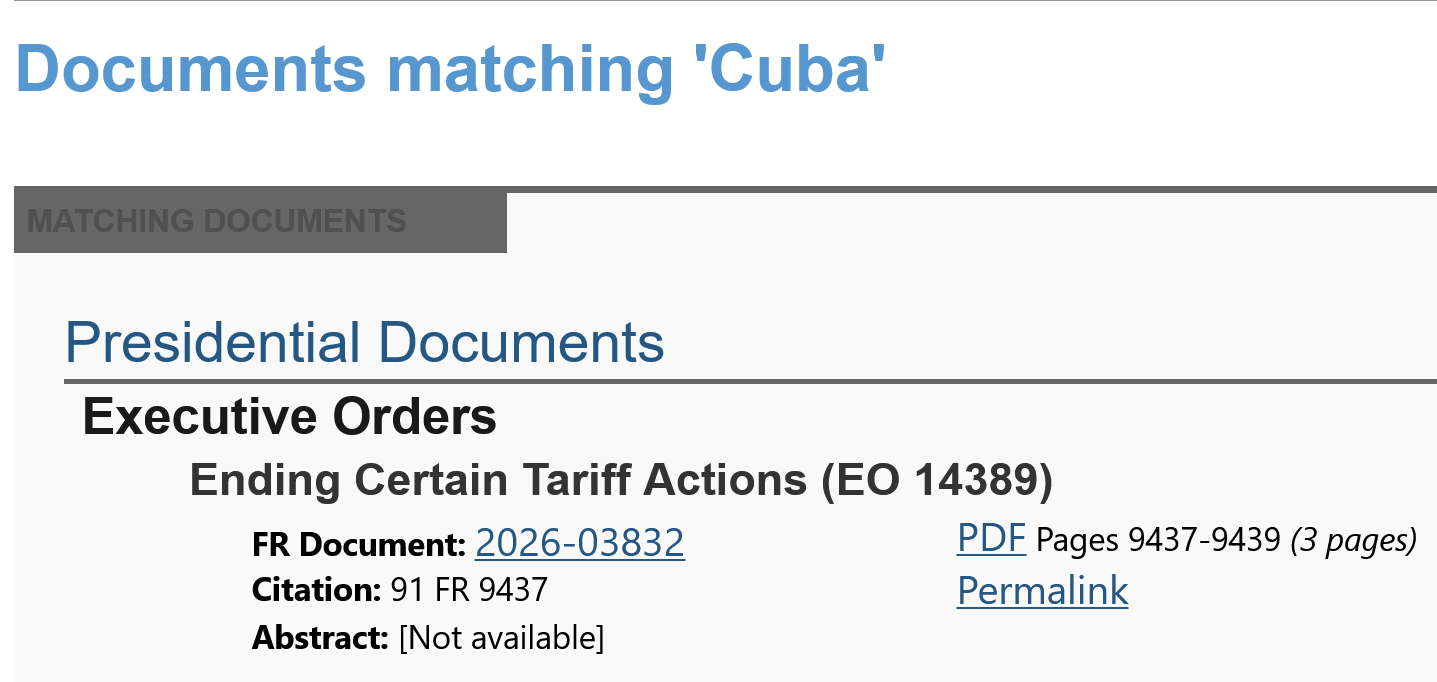
Trump Administration Executive Order On Changes To Tariffs To Comply With SCOTUS Decision Feb 25, 2026

OFAC To Implement "Favorable Licensing Policy" For Licenses To Export Oil From Venezuela To Cuba Private Companies And Cuban Citizens Feb 25, 2026

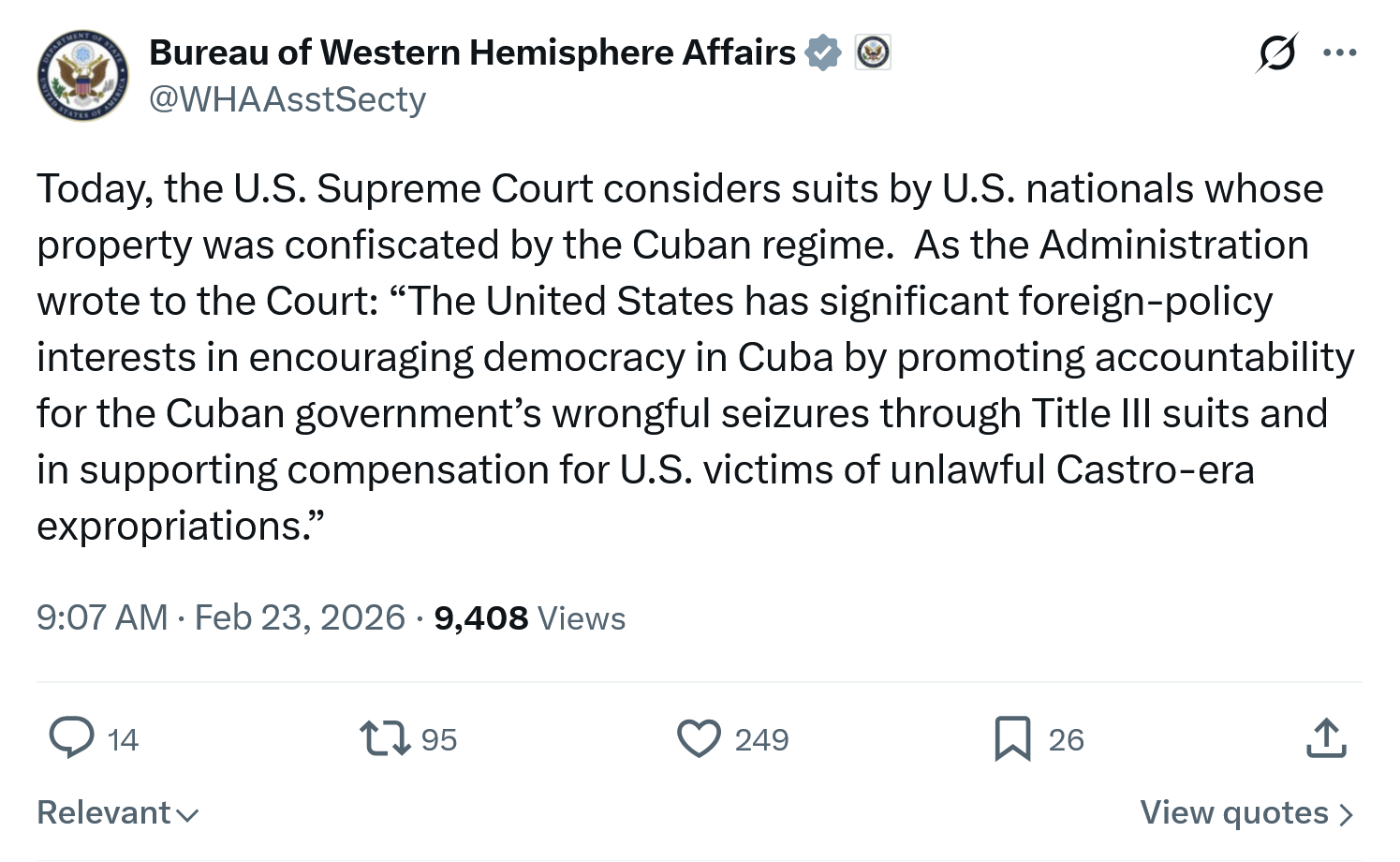
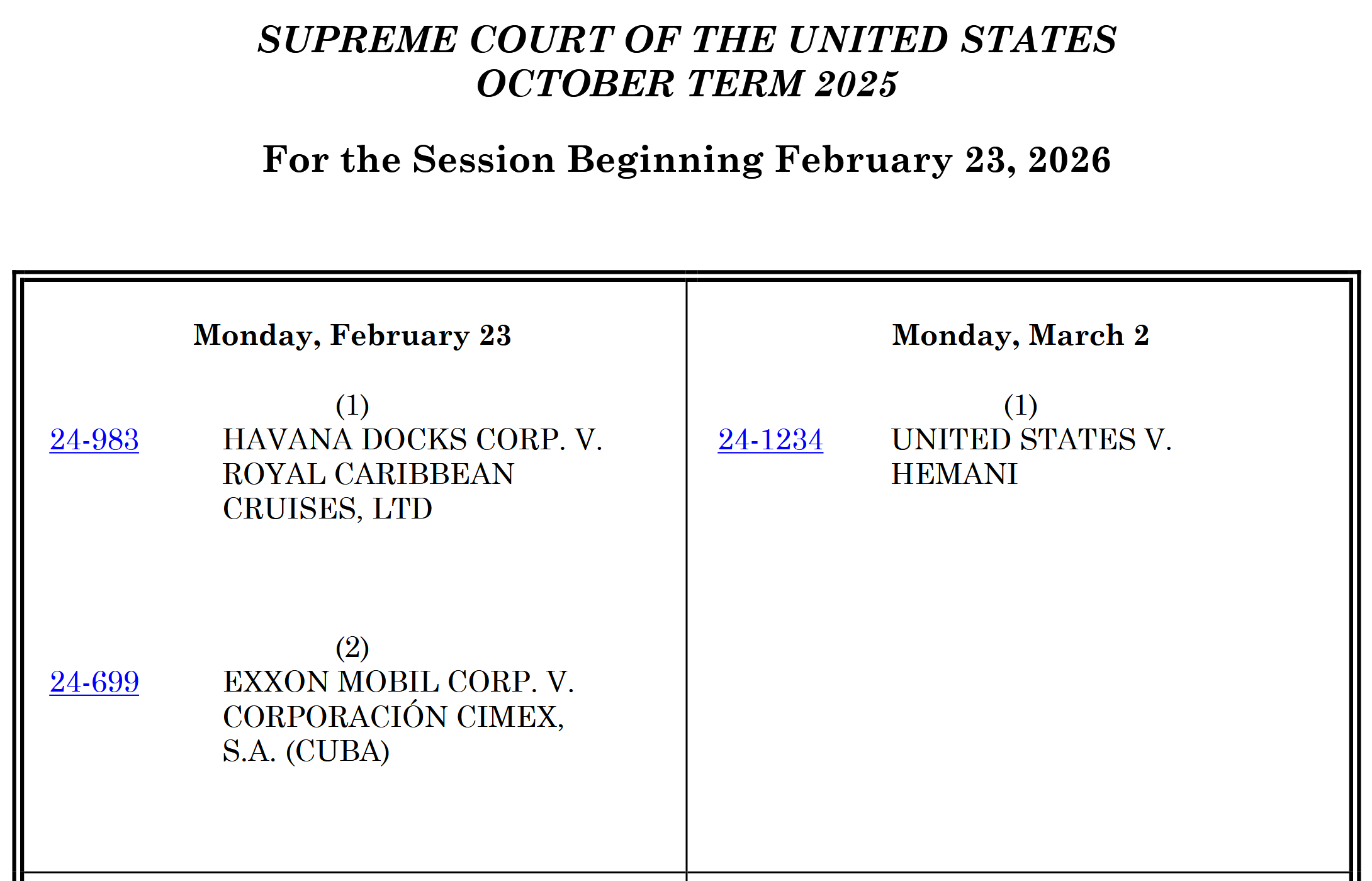
Transcripts And Recordings Of SCOTUS Libertad Act Title III Arguments: Havana Docks And Exxon Mobil Feb 18, 2026

Background 

On 10 May 2022, the Biden-Harris Administration (2021-2025) authorized the first direct investment and the first direct financing into a privately-owned company located in the Republic of Cuba owned by a Republic of Cuba national.  The expectation was the government of the Republic of Cuba would quickly embrace the opportunity for engagement.   

Nearing four years later, the government of the Republic of Cuba has not issued the necessary guidance and regulations.   

The Diaz-Canel-Valdes Mesa Administration (2019- ) in the Republic of Cuba is not for some in the Trump-Vance Administration (2025-2029) the problem.  The problem is the manner the government of the Republic of Cuba uses its chosen political system to manage its economy.  

Policies, regulations, and statutes implemented by the government of the United States do impact negatively the commercial, economic, and financial functionality of the government of the Republic of Cuba.    

Ironically, some of the policies, regulations, and statutes if accepted by the government of the Republic of Cuba could strengthen the government of the Republic of Cuba by providing additional capital, additional markets, and additional bilateral political connectivity.  

Within those policies, regulations, and statutes are opportunities the government of the Republic of Cuba has avoided which have contributed to the corrosion and decay of the commercial, economic, and financial infrastructure in the Republic of Cuba.  

The Trump-Vance Administration will permit the Diaz-Canel-Valdes Mesa Administration to implement changes to commercial, economic, and financial infrastructure while maintaining most political infrastructure.    

However, the infrastructure needs to transition quickly from what did not work in the second half of the twentieth century to what can work in the beginning of the second quarter of the twenty-first century.   

Cigar Emporium aruba

BIS Update Prohibits Use Of Cuba Government Banks For Gas And Petroleum Product Transactions With Re-Emerging Private Sector. Third-Country Banks Permitted.

United States Department of Commerce
Washington DC
4 March 2026

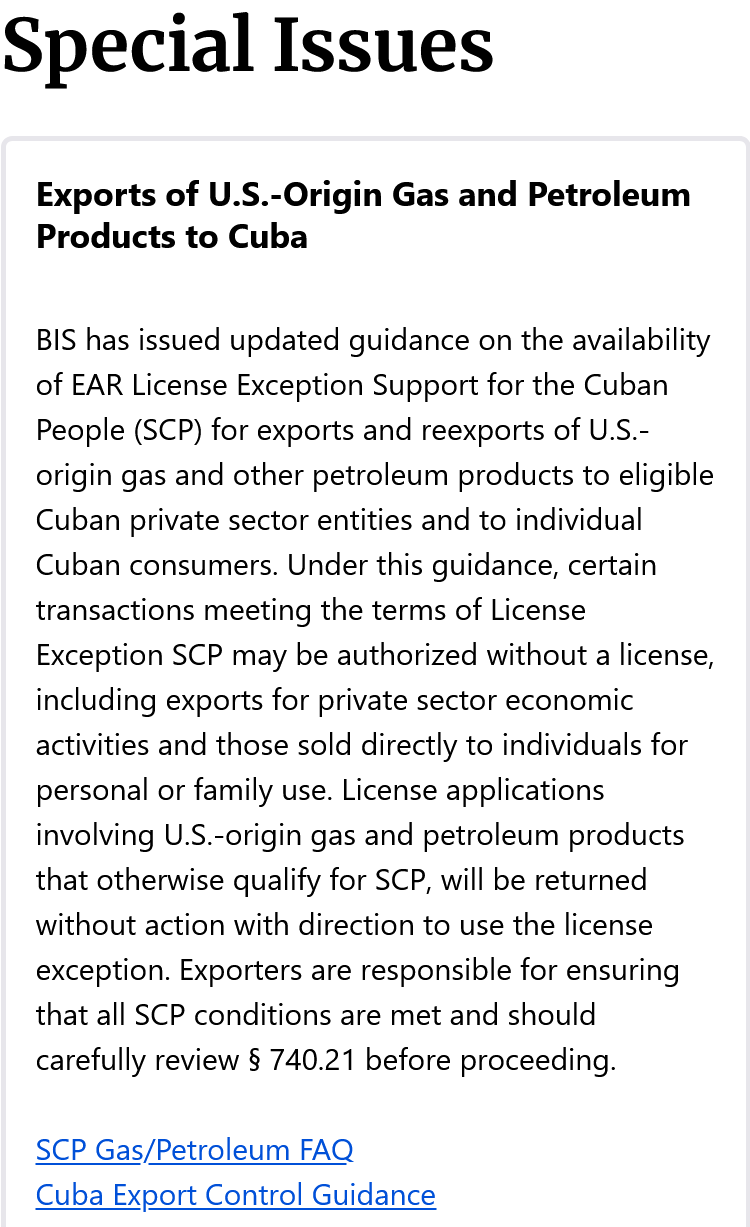
Exports of U.S.-Origin Gas and Petroleum Products to Cuba


BIS has issued updated guidance on the availability of EAR License Exception Support for the Cuban People (SCP) for exports and reexports of U.S.-origin gas and other petroleum products to eligible Cuban private sector entities and to individual Cuban consumers. Under this guidance, certain transactions meeting the terms of License Exception SCP may be authorized without a license, including exports for private sector economic activities and those sold directly to individuals for personal or family use. License applications involving U.S.-origin gas and petroleum products that otherwise qualify for SCP, will be returned without action with direction to use the license exception. Exporters are responsible for ensuring that all SCP conditions are met and should carefully review § 740.21 before proceeding. 

SCP Gas/Petroleum FAQ
Cuba Export Control Guidance

BIS determination to suspend the availability of License Exception SCP under § 740.21(b)(1) for any export, reexport, or transfer (in-country) involving a Cuban owned bank

• There are longstanding and documented issues of diversion and fees associated with Cuban banks. The Cuban banks form the basis of the regime’s financial infrastructure, and many are designated on the Cuba Restricted List due to being under the control of, or acting for or on behalf of, the Cuban military, intelligence, or security services or personnel. It is well established that it is not the policy of the United States to permit transactions that significantly benefit the Cuban government or its designated military institutions.

• Accordingly, transactions involving the deposit of foreign funds into Cuban government banks, including those on the Cuba Restricted List or associated with the military and intelligence services, may serve to primarily generate revenue for or contribute to the operation of the Cuban state.

• Taking these considerations above into account and the need to protect U.S. national security and foreign policy interests, BIS has determined that there is an unacceptable risk that transactions involving Cuban banks may primarily benefit the Cuban government, contrary to the purpose of License Exception SCP of supporting independent economic activity in Cuba.

• Pursuant to § 740.2(b) of the EAR, which specifies that “all License Exceptions are subject to revision, suspension, or revocation, in whole or in part, without notice to protect U.S. national security or foreign policy interests,” BIS is informing all exporters, reexporters, and transferors that License Exception Support for the Cuban People (SCP), § 740.21(b)(1), is suspended as of March 4, 2026, for any export, reexport, or transfer (in-country) involving the deposit of foreign funds into a Cuban owned bank.

• This BIS suspension does not apply to exports, reexports, or transfers (in-country) that do not involve Cuban banks, e.g., involving third country banks or other financial payment systems that do not involve the deposit of foreign funds into Cuban banks. This BIS suspension also does not apply to any export or reexport that was en route aboard a carrier to a port of export or reexport on March 4, 2026, pursuant to actual orders for export or reexport to Cuba, provided that the export or reexport is completed no later than April 3, 2026. 

Updated Guidance Regarding Available EAR License Exceptions for Exports of Gas and Petroleum Products to Cuban Private Sector Entities and Activities

• The Bureau of Industry and Security (BIS) has been receiving questions from potential exporters on the EAR requirements and potential EAR authorizations that may be available to authorize exports of gas and petroleum products and reexports of U.S.-origin gas and petroleum products for private sector use, including for addressing humanitarian needs in Cuba.

• In general, a license is required to export and reexport gas and other petroleum products that are subject to the EAR to Cuba pursuant to § 746.2(a). However, as with any export or reexport that is subject to a license requirement, the exporter or reexporter should first evaluate whether a license exception is available to authorize the export or reexport.

• In particular, exporters and reexporters of gas and petroleum products subject to the EAR to the Cuban private sector should review the general restrictions under § 740.2 and § 740.21. As explained below, gas and other petroleum products exported and reexported to Cuban private sector entities or individuals for personal use (or their fa may be authorized under License Exception SCP.

• Exporters and reexporters are advised that if a license application is submitted to BIS that otherwise meets the terms and conditions of License Exception SCP, those applications will be returned without action (RWA’d) by BIS with a direction to the applicant to export or reexport the items pursuant to License Exception SCP.

• BIS provides the following FAQ to further assist public understanding:

Q.1: Would License Exception Support for the Cuban People (SCP) (§ 740.21 of the EAR) allow an exporter or reexporter to export or reexport gas and other petroleum products to Cuban private sector entities for private sector use, or directly to individual Cubans for their personal or family use?

A.1: Yes, provided that all the applicable terms and conditions of License Exception SCP are met. Specifically, there are two authorizing paragraphs under License Exception SCP under paragraph (b) (Improving living conditions and supporting independent economic activity), which may be available to authorize these types of exports and reexports of gas and other petroleum products to Cuba. License Exception SCP provides a general authorization for exports under certain applicable conditions, as explained below, and does not contain any specific limitations on applicability based on quantity or value of the items, or exporter or reexporter.

§ 740.21(b)(1). Exports to private sector for private sector use. 

If the gas and other petroleum products are being exported (or reexported) for use by the Cuban private sector for private sector use, then paragraph (b)(1) of License Exception SCP, which authorizes items for use by the Cuban private sector for private sector economic activities, may be available to authorize these types of exports and reexports. To qualify, exports must be both (1) for use by the Cuban private sector, and (2) for private sector economic activities, including those addressing humanitarian needs in Cuba. Per § 740.21(b)(1)(i) and (ii), License Exception SCP does not apply to any transactions, whether to Cuban private sector entities or otherwise, which primarily generate revenue for the state; or contribute to the operation of the state, including through the construction or renovation of state-owned buildings.

§ 740.21(b)(2). Exports sold directly to individuals in Cuba for their personal use.

If the gas and other petroleum products are sold directly to individuals in Cuba for their personal use, then paragraph (b)(2) of SCP, which authorizes items sold directly to individuals in Cuba for their personal use (or their immediate family's personal use), may be available to authorize exports and reexports of such products. Paragraph (b)(2) does not require the products to be exported or reexported directly to the individuals; however, the products must ultimately be destined for these eligible end users (and/or their families) for their personal use. This authorization applies only if the gas or other petroleum products are sold directly to individual Cubans for their personal use or the use of their immediate family. It does not apply if any of the products are sold or transferred to proscribed persons or entities in Cuba, including employees of the Ministry of Defense or Ministry of the Interior, senior officials of certain Cuban government organizations, labor unions, and other Cuban government affiliated organizations, including entities listed on the U.S. State Department’s Cuba Restricted List, see 31 CFR 515.209.

Note: Exporters and reexporters are responsible for ensuring that all of the applicable terms and conditions of License Exception SCP are met. Please review EAR § 740.21 -- License Exception Support for Cuban People (SCP) -- carefully to ensure that your transaction meets all the criteria for use of the license exception. Exporters who are unable to determine if they can satisfy all terms and conditions of License Exception SCP should submit an application for an individual validated license.

Cuba Good News? “[A]chieving this depends a lot on the performance of the business system” Said President Diaz-Canel. Can He Deliver? Does He Want To Deliver? Will Washington Accept The Effort?

“achieving this depends a lot on the performance of the business system” Miguel Diaz-Canel, President of the Republic of Cuba (2019- ) 

From 10 May 2022
Good News: President Miguel Diaz-Canel Publicly Recognizing The Problem
Bad News: His Track Record For Solving The Problem Has Been Dismal


Granma
Havana, Republic of Cuba
2 March 2026

emphasis added 

“"We must focus immediately on implementing the most urgent and necessary transformations to the economic and social model," stated Miguel Díaz-Canel Bermúdez, First Secretary of the Central Committee of the Communist Party and President of the Republic, during his address to the Council of Ministers.

The president added that these transformations "are fundamentally related to business autonomy; municipal autonomy; the resizing of the state apparatus, the government, and institutions; national food production, with municipal balance sheets; the shift in the energy matrix, which includes not only renewable sources but also everything related to domestic crude oil; exports, linking them to the flexibilities approved for foreign direct investment; leveraging economic partnerships between the state and private sectors, especially at the municipal level; and promoting business with Cubans residing abroad." 

All of this, the Head of State added, must contribute to the macroeconomic stabilization of the country, to increasing foreign exchange earnings, and to developing national production, with an emphasis on food. 

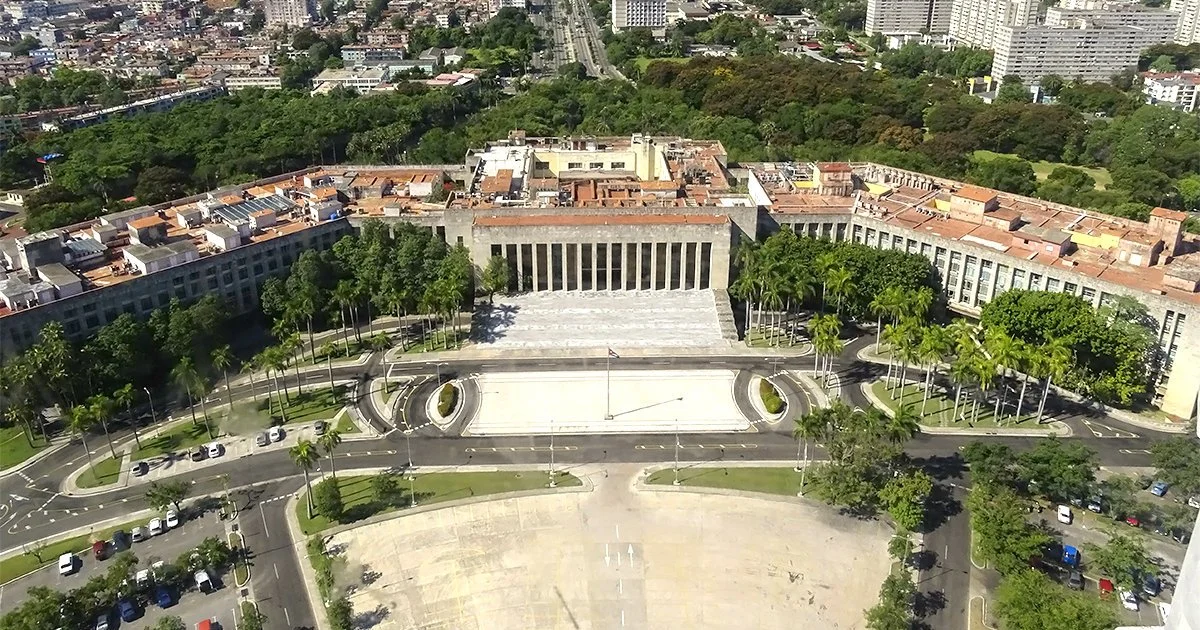
At the meeting of the highest governing body on the Island, which is led by Prime Minister Manuel Marrero Cruz every month from the Palace of the Revolution and via videoconference with all the provinces, the president stressed that "achieving this depends a lot on the performance of the business system, and also on the behavior of the municipalities." 

Businesses, he said, must be prepared to use all the powers that have been granted. Many measures regarding business autonomy have been approved, but they are not yet being utilized; some are even unknown, he noted. 

Díaz-Canel added that "municipalities must prepare themselves, as these processes we are opening will increasingly be implemented there." 

"Municipalities must manage foreign direct investment; municipalities must manage their own closed-loop systems in foreign currency; municipalities must manage economic partnerships between the state and non-state sectors; municipalities must design and propose their local production systems; and they must manage investments from Cubans residing abroad," he explained. 

We must prepare ourselves, he said, so that together we can contribute to national production, together we can boost food production, together we can contribute to macroeconomic stabilization, together we can contribute more foreign exchange earnings to the country, more exports, better use of productive capacities, the realization of the change in the energy matrix, and an adequate relationship between the state and non-state sectors. 

The Cuban President called on the members of the Council of Ministers to work intensively, intelligently, with oversight, deeper analysis, high standards, and discipline, leveraging potential and questioning anything that isn't progressing.” 

Link (3/3/26)- CONSEJO DE ESTADO: Decreto-Ley 114/2025 “De la asociación entre entidades empresariales estatales y no estatales” (GOC-2026-215-O24).  MINISTERIO: Ministerio de Economia y Planificación Resolución 8/2026 “Procedimiento para la evaluación y aprobación de la asociación entre entidades empresariales estatales y no estatales” (GOC-2026-216-O24)

Background 

On 10 May 2022, the Biden-Harris Administration (2021-2025) authorized the first direct investment and the first direct financing into a privately-owned company located in the Republic of Cuba owned by a Republic of Cuba national.  The expectation was the government of the Republic of Cuba would quickly embrace the opportunity for engagement.   

Nearing four years later, the government of the Republic of Cuba has not issued the necessary guidance and regulations.   

What is required? One page to be filed by the Republic of Cuba-based company with its Republic of Cuba government-operated financial institution; similar to a Know Your Customer (KYC) form, authorizing officially the direct investment and direct financing.    

  • “A KYC form is a mandatory document used by financial institutions, banks, and businesses to verify a client's identity, address, and legitimacy.  It requires personal details (name, DOB), contact information, and government-issued documents (passport, driver's license, etc.) to prevent fraud, money laundering, and illegal activities.” 

The lack of guidance and regulations from the government of the Republic of Cuba has also impacted sources of capital from every other country- including those with whom the government of the Republic of Cuba embraces- China and Russia, along with the twenty-seven-member country Brussels, Belgium-based European Union (EU) among others.  

The Diaz-Canel-Valdes Mesa Administration (2019- ) in the Republic of Cuba is not for some in the Trump-Vance Administration (2025-2029) the problem.  The problem is the manner the government of the Republic of Cuba uses its chosen political system to manage its economy.  

Policies, regulations, and statutes implemented by the government of the United States do impact negatively the commercial, economic, and financial functionality of the government of the Republic of Cuba.    

Ironically, some of the policies, regulations, and statutes if accepted by the government of the Republic of Cuba could strengthen the government of the Republic of Cuba by providing additional capital, additional markets, and additional bilateral political connectivity.  

Within those policies, regulations, and statutes are opportunities the government of the Republic of Cuba has avoided which have contributed to the corrosion and decay of the commercial, economic, and financial infrastructure in the Republic of Cuba.  

The Trump-Vance Administration will permit the Diaz-Canel-Valdes Mesa Administration to implement changes to commercial, economic, and financial infrastructure while maintaining most political infrastructure.    

However, the infrastructure needs to transition quickly from what did not work in the second half of the twentieth century to what can work in the beginning of the second quarter of the twenty-first century.   

To date, successive governments in the Republic of Cuba embrace private sector-related formulas guaranteeing failure.   

The government of the Republic of Cuba must, and quickly, adopt and adapt to formulas targeting the re-emerging private sector in the Republic of Cuba which transition systemically from a focus on surviving to a focus on thriving.  

Links To Related Analyses  

LINK TO COMPLETE ANALYSIS IN PDF FORMAT

President Trump Interested In "Friendly Takeover" Of Cuba Rather Than "Hostile Takeover" Of Cuba. What About Plebiscite?

The White House
Washington DC
27 February 2026

Donald Trump, President of the United States (2017-2021, 2025-2029)


“The Cuban government is talking with us.” 

“They have no money.  They have no anything right now.  But they’re talking to us, and maybe we’ll have a friendly takeover of Cuba.”

“We could very well end up having a friendly takeover of Cuba.”

“is, to put it mildly, a failed nation” 

“they want our help.”

“We’ve had a lot of years of dealing with Cuba.  I’ve been hearing about Cuba since I’m a little boy.  But they’re in big trouble.” 

“I think (is) very positive for the people that were expelled, or worse, from Cuba and live here.” 

2025 Report: US$490 Million Is 3rd Highest To Cuba Since 2001; US$173.6 Million (See List) In PYME/Cuban Citizen Exports Including Vehicles- US$148.3 Million. Donations Up 116.7% To US$147 Million

NOTE: The total value of all exports in 2025 from the United States to the Republic of Cuba- products paid and products donated, was US$810,776,711.00

ECONOMIC EYE ON CUBA©
March 2025

December 2025 Ag/Food Exports To Cuba Increase 10.8% -
Year-To-Year Increase 13.0%
46th Of 222 December 2025 U.S. Food/Ag Export Markets- 2
For 2025 Cuba Ranked 49th Of 222 U.S. Ag/Food Export Markets – 2
2025 Was Third-Highest Export Value Since First Exports In 2001
Re-Emerging Private Sector Exports Continue To Increase - 3
December 2025 CDA Healthcare Product Exports US$98,824.00 - 6
December 2025 Humanitarian Donations US$16,034,654.00 – 7
2025 Humanitarian Donations- US$147,027,544.00- 7
U.S. Port Export Data- 20


DECEMBER 2025 AG/FOOD EXPORTS TO CUBA INCREASE 10.8%- Exports of food products and agricultural commodities from the United States to the Republic of Cuba in December 2025 were US$46,221,085.00 compared to US$41,700,049.00 in December 2024 and US$45,229,570.00 in December 2023.  

US$490,111,943.00 for 2025 compared to US$433,662,216.00 in 2024 representing an 13.0% increase year-to-year. The year 2025 represents the third-highest US Dollar value in exports since the first TSREEA exports in December 2001.

Since 2022, when the first BIS license was issued for the export of vehicles to Republic of Cuba nationals and to private companies in the Republic of Cuba, the cumulative export value of the initiatives in place during the Obama-Biden Administration, Trump-Pence Administration, Biden-Harris Administration, and Trump-Vance Administration exceeds US$394 million of which electric and gasoline-powered new and used vehicles, bicycles, trucks, motorcycles and mopeds, and parts, exceeds US$227 million (Year 2025: US$149,413,031.00; Year 2024: US$67,241,234.00; Year 2023: US$10,546,419.00; Year 2022: US$89,848.00), and purchases (equipment and products) for use by the re-emerging private sector in the Republic of Cuba driving the growth.

The data contains information on exports from the United States to the Republic of Cuba- products within the Trade Sanctions Reform and Export Enhancement Act (TSREEA) of 2000, Cuban Democracy Act (CDA) of 1992, and regulations implemented (1992 to present) for other products by the Office of Foreign Assets Control (OFAC) of the United States Department of the Treasury, Bureau of Industry and Security (BIS) of the United States Department of Commerce, and United States Department of State.

The TSREEA re-authorized the direct commercial (on a cash basis) export of food products (including branded food products) and agricultural commodities from the United States to the Republic of Cuba, irrespective of purpose. The TSREEA does not include healthcare products, which remain authorized and regulated by the CDA.

The data represents the U.S. Dollar value of product exported from the United States to the Republic of Cuba under the TSREEA, CDA, and other regulations, specifically including products exported from the United States to the re-emerging private sector in the Republic of Cuba.

The data does not include transportation charges, bank charges, or other costs associated with exports; the government of the Republic of Cuba reports unverifiable data that includes transportation charges, bank charges, and other costs.

LINK TO COMPLETE REPORT IN PDF FORMAT

LINK TO U.S. PORT EXPORT DATA

LINK TO COMPLETE LIST OF PRODUCTS IN 2025 EXPORTED FROM THE UNITED STATES TO CUBA

LINK TO COMPLETE LIST OF PRODUCTS IN 2024 EXPORTED FROM THE UNITED STATES TO CUBA

LINK TO COMPLETE LIST OF PRODUCTS IN 2023 EXPORTED FROM THE UNITED STATES TO CUBA

McGraw Center For Business Journalism

At CARICOM Meeting, U.S. Secretary Of State Rubio Discusses Cuba- Engagement Remains Focused First On Commercial, Economic, Financial Changes In Cuba

United States Department of State
Washington DC
25 February 2026

Frigate Bay, Saint Kitts and Nevis
St. Kitts Marriott Beach Resort

Secretary of State Marco Rubio Remarks to Press


QUESTION:  Can I ask you about the oil announcement today by the Treasury Department about Venezuelan oil to Cuba that for humanitarian reasons – for private companies?  Is this a shift in policy?  What is the motivation?

SECRETARY RUBIO:  No, it’s always been legal to sell to the private sector in Cuba, okay?  These are – these would not be sales to the government.  These would not be sales to the military-owned GAESA, the company.  These would be sales to a very small private sector that exists in Cuba, and that’s always been legal.  I mean, there are people that have a license to do that now.  This would just expand to the numbers that could do it.  Again, it would go to the private sector.  The private sector in Cuba is quite small.  It exists, but it’s small.  And it certainly in and of itself does not have the capacity to deal with the scale and scope of the challenges they’re facing. 

But if the Cuban economy were a functioning economy, it would have a much larger private sector.  And so what’s clear is that – and I would say this, that the people of Cuba are suffering today.  They’ve been suffering for a long time.  They’re suffering now, perhaps more than at any time in recent memory, perhaps in the history since 1959.  This is the worst economic climate that Cuba has faced, and it is the authorities there in that government who are responsible for that.  They are the ones that have made decisions that have left Cuba vulnerable to the situation they’re now in. 

Understand that Cuba has largely survived on the basis of subsidies.  The Soviet Union gave them free things.  When the Soviet Union collapsed, they went into a special period which was disastrous for them.  And then along came Hugo Chávez and bailed them out for a long time.  When that sort of died off a little bit, the Maduro regime was providing them fuel – or they were providing them actually crude oil.  Some percentage of that was refined and used domestically, and a large percentage of that never even made it to Cuba.  It was sold in the open market for cash to fund the regime and to fund the military-owned company. 

So the reason why Cuba’s electricity grid was already in collapse – before Maduro was captured it was already in collapse – the reason why things are as bad as they are is because they have an economic model that does not exist, that does not work.  It doesn’t exist anywhere in the world.  It is not functional.  And the only way Cuba is going to have a better future is if it has a different economic model.  Now, if you go back to President Trump’s 2017 or 2018 executive orders on a new policy in Cuba, that policy was entirely designed in many ways to put the private sector and individual private Cubans – not affiliated with the government, not affiliated with the military – in a privileged position. 

The reason why those industries have not flourished in Cuba is because the regime has not allowed them to flourish.  So now that they’re in a crisis, there is an opportunity for them to import fuel – in small quantities, granted – through a private sector.  If we catch the private sector there playing games and diverting it to the regime or to the military company, if we find that they’re moving that stuff around in ways that violate the spirit and the scope of these permissions, those licenses will be canceled. 

But it’s the same reason why we’ve provided humanitarian assistance.  We’ve provided humanitarian assistance in Cuba in the aftermath of the hurricane; we provided it through the Catholic Church, not through the government.  And we’re prepared to do something similar when it comes to fuel through the private sector, the small private sector.  But that alone will not solve Cuba’s very dramatic problems that have been caused by 60-some-odd years of mismanagement, ineptitude, and a failed economic model. 

QUESTION:  Mr. Secretary, can you confirm or comment on reports that you’ve spoken with Raúl Castro’s grandson?

SECRETARY RUBIO:  I won’t comment on any conversations we’ve had.  Suffice it to say that the United States is always prepared for – prepared to talk to officials from any government that have information to share with us or viewpoints they want to share with the United States, and that’s my job to do that.  So whether it’s someone in Cuba or potentially one day someone in North Korea or right now in Iran, we are always open to listen.  That’s different from a negotiation obviously, but we’re prepared to listen to viewpoints that other people say. 

Cuba is a country located 90 miles off the coast of the United States.  It has a very severe and catastrophic economic crisis on its hands.  And if someone in their system has information to share with us about changes they’re open to making or moves they’re prepared to accept, we would certainly listen to that.  And I would probably do that not in a setting in front of the media because I think it would be more productive that way, but ultimately actions will be important in something like that.

QUESTION:  I mean, can they negotiate a new system in Cuba?  I mean, are you hopeful that there might be reformists inside who could have (inaudible)?

SECRETARY RUBIO:  Well, I mean, the status quo is unsustainable.  I had – we had a meeting here today with all the leaders of CARICOM, and it was one of the points I raised, and I think virtually everyone in the room agreed that Cuba’s status quo is unacceptable.  Cuba needs to change.  It needs to change.  And it doesn’t have to change all at once.  It doesn’t have to change from one day to the next.  Everyone is mature and realistic here.  We’re seeing that process play out, for example, in Venezuela.  Many in the – many of the countries represented at the CARICOM conference today were themselves countries that went through transitions at some point in their history.

But Cuba needs to change.  It needs to change dramatically because it is the only chance that it has to improve the quality of life for its people and not lose 15 percent of its population since 2021.  Fifteen percent of the people of Cuba have left since 2021.  That is not a system that’s working.  That’s a system that’s in collapse, and they need to make dramatic reforms.  And if they want to make those dramatic reforms that open the space for both economic and eventually political freedom for the people of Cuba, obviously the United States would love to see that.  We’d be helpful.  If they decide they’re going to dig in and just continue forward, then I think they’re going to continue to experience failure and the people of the country are going to continue to suffer.  It’ll be the regime’s fault.

QUESTION:  To come back to Cuba, some of the countries you met today have raised concerns about spillover and instability caused by the humanitarian crisis there.  Is the move today on oil sales a sort of recognition that the humanitarian crisis is getting out of hand, that the U.S. blocking oil shipments —

SECRETARY RUBIO:  No – I mean, no, first of all, forget about today.  The humanitarian crisis is getting out of hand because the Cubans don’t know how to run an economy.  They’re incompetent.  They have a military-controlled holding company named GAESA which controls 40 percent of their GDP, and none of the money that that company has generated flows to the coffers of the government.  None of that money goes to schools.  None of that money goes to roads.  None of that money goes to feeding the population.  You have a country that has fertile farmland that imports sugar.  This was one of the world’s leading exporters of sugar; now they import sugar.  They import almost all their food.  They – it’s a dysfunction.  It’s just not even an economy.  It’s a total dysfunction.  That’s their fault.

As far as spillover effect, they’re not more concerned than we are.  We’re 90 miles away, and the U.S. has experienced mass migration from Cuba in the past, certainly in the early ’90s with the rafter crisis, but as recently as 2021 and ’22 we were having people show up in the Florida Keys and stranded in the Bahamas.  So we don’t want to see it, either.  And ultimately, as far as the move today with oil, this is existing – the law allows us to do business like fuel and even telecommunications with the Cuban private sector.  The problem is the Cuban private sector is very small.  If they want to open the gates and allow the Cuban private sector – independent of the military, independent of the government – to grow, that solution is there.

What the Cuban people should know is this: that if they are hungry and they are suffering, it’s not because we’re not prepared to help them.  We are.  It’s that the people standing in the way of us helping them is the regime, is the Communist Party. That’s who’s standing in the way.  If they move out of the way, we’re more than happy to work with individual Cubans so they can have an opportunity to feed their families and build their economy.  But we are not the impediment.  They are.

Politico Canada

“CUBA — Oil and food.  That’s what Cuba’s ambassador to Canada says his country needs to survive the stepped-up American pressure under President DONALD TRUMP to break the back of Cuba’s government.  — Rock and a hard place: But RODRIGO MALMIERCA DÍAZ told the House of Commons foreign affairs committee on Tuesday that he gets the realpolitik countries like Canada are facing.  “I understand that many friends of Cuba are trying to be, maybe discreet, about their positions. They don't want to create more trouble with the U.S. than they already have.”  — Please help, anyway: “Without energy, every aspect of life in the country is affected,” the envoy said, pointing to food distribution, public health, transportation and education.”  

Trump Administration Executive Order On Changes To Tariffs To Comply With SCOTUS Decision

In the Supreme Court of the United States 
DONALD J. TRUMP, PRESIDENT OF THE UNITED STATES, ET AL., PETITIONERS v. V.O.S. SELECTIONS, INC., ET AL. ON PETITION FOR A WRIT OF CERTIORARI TO THE UNITED STATES COURT OF APPEALS FOR THE FEDERAL CIRCUIT PETITION FOR A WRIT OF CERTIORARI
 

QUESTIONS PRESENTED 

1. Whether the International Emergency Economic Powers Act (IEEPA), Pub. L. No. 95-223, Tit. II, 91 Stat. 1626, authorizes the tariffs imposed by President Trump pursuant to the national emergencies declared or con-tinued in Proclamation 10,886 and Executive Orders 14,157, 14,193, 14,194, 14,195, and 14,257, as amended.  2. If IEEPA authorizes the tariffs, whether the statute unconstitutionally delegates legislative authority to the President.

Link To SCOTUS Filing

Federal Register/Vol. 91, No. 37
Wednesday, February 25, 2026
Presidential Documents
Executive Order 14389 of February 20, 2026


By the authority vested in me as President by the Constitution and the laws of the United States of America, including the International Emergency Economic Powers Act (50 U.S.C. 1701 et seq.) (IEEPA), the National Emergencies Act (50 U.S.C. 1601 et seq.), section 604 of the Trade Act of 1974, as amended (19 U.S.C. 2483), and section 301 of title 3, United States Code, it is hereby ordered: 

Section 1. Background. In Executive Order 14193 of February 1, 2025 (Imposing Duties To Address the Flow of Illicit Drugs Across Our Northern Border), as amended; Executive Order 14194 of February 1, 2025 (Imposing Duties To Address the Situation at Our Southern Border), as amended; Executive Order 14195 of February 1, 2025 (Imposing Duties To Address the Synthetic Opioid Supply Chain in the People’s Republic of China), as amended; Executive Order 14245 of March 24, 2025 (Imposing Tariffs on Countries Importing Venezuelan Oil); Executive Order 14257 of April 2, 2025 (Regulating Imports With a Reciprocal Tariff To Rectify Trade Practices That Contribute to Large and Persistent Annual United States Goods Trade Deficits), as amended; Executive Order 14323 of July 30, 2025 (Addressing Threats to the United States by the Government of Brazil), as amended; Executive Order 14329 of August 6, 2025 (Addressing Threats to the United States by the Government of the Russian Federation), as amended; Executive Order 14380 of January 29, 2026 (Addressing Threats to the United States by the Government of Cuba); and Executive Order 14382 of February 6, 2026 (Addressing Threats to the United States by the Government of Iran), I declared or described national emergencies with respect to unusual and extraordinary threats to the national security, foreign policy, or economy of the United States and took actions to deal with those threats, including by imposing, pursuant to IEEPA, additional ad valorem duties on certain imports of certain foreign trading partners. 

In light of recent events, the additional ad valorem duties imposed pursuant to IEEPA in Executive Order 14193, as amended; Executive Order 14194, as amended; Executive Order 14195, as amended; Executive Order 14245; Executive Order 14257, as amended; Executive Order 14323, as amended; Executive Order 14329, as amended; Executive Order 14380; and Executive Order 14382 shall no longer be in effect and, as soon as practicable, shall no longer be collected. All other actions, including any other action taken to address the national emergencies declared or described in Executive Order 14193, Executive Order 14194, Executive Order 14195, Executive Order 14245, Executive Order 14257, Executive Order 14323, Executive Order 14329, Executive Order 14380, and Executive Order 14382, that do not impose additional ad valorem duties under IEEPA or involve steps necessary to implement the imposition of additional ad valorem duties imposed under IEEPA shall not be affected by this order. The national emergencies declared or described in Executive Order 14193, Executive Order 14194, Executive Order 14195, Executive Order 14245, Executive Order 14257, Executive Order 14323, Executive Order 14329, Executive Order 14380, and Executive Order 14382 or subsequent orders remain in effect and shall not be affected by this order. 

Sec. 2. Implementation. (a) To effectuate the terminations of the actions described in section 1 of this order, the head of each executive department and agency (agency) is authorized to and shall take all appropriate steps to end the additional ad valorem duties imposed under IEEPA in Executive Order 14193, as amended; Executive Order 14194, as amended; Executive Order 14195, as amended; Executive Order 14245; Executive Order 14257, as amended; Executive Order 14323, as amended; Executive Order 14329, as amended; Executive Order 14380; and Executive Order 14382. The head of each agency shall immediately begin taking steps to effectuate this order and, as soon as practicable, terminate the collection of the additional ad valorem duties described in section 1 of this order. The head of each agency may, consistent with applicable law, including section 301 of title 3, United States Code, redelegate the authority to take such appropriate steps within the agency.  (b) The Secretary of Commerce, the Secretary of Homeland Security, and the United States Trade Representative, as appropriate and in consultation with the Commissioner of U.S. Customs and Border Protection, the Chair of the United States International Trade Commission, and any other senior official they deem appropriate, shall determine whether modifications to the Harmonized Tariff Schedule of the United States are necessary to effectuate this order and may make such modifications through notice in the Federal Register.  (c) The Executive Order of February 20, 2026 (Continuing the Suspension of Duty-Free De Minimis Treatment for All Countries), and the Proclamation of February 20, 2026 (Imposing a Temporary Import Surcharge to Address Fundamental International Payments Problems), are unaffected by this order.  (d) This order affects only the additional ad valorem duties imposed under IEEPA pursuant to the Executive Orders described in section 1 of this order. This order does not affect any other duties, including duties imposed under section 232 of the Trade Expansion Act of 1962, as amended, 19 U.S.C. 1862, and section 301 of the Trade Act of 1974, as amended, 19 U.S.C. 2411. 

Sec. 3. General Provisions. (a) Nothing in this order shall be construed to impair or otherwise affect: (i) the authority granted by law to an executive department or agency, or the head thereof; or (ii) the functions of the Director of the Office of Management and Budget relating to budgetary, administrative, or legislative proposals. (b) This order shall be implemented consistent with applicable law and subject to the availability of appropriations.  (c) This order is not intended to, and does not, create any right or benefit, substantive or procedural, enforceable at law or in equity by any party against the United States, its departments, agencies, or entities, its officers, employees, or agents, or any other person. (d) The costs for publication of this order shall be borne by the Department of Homeland Security.

Donald J. Trump

OFAC To Implement "Favorable Licensing Policy" For Licenses To Export Oil From Venezuela To Cuba Private Companies And Cuban Citizens

United States Department of the Treasury
Washington DC
25 February 2026

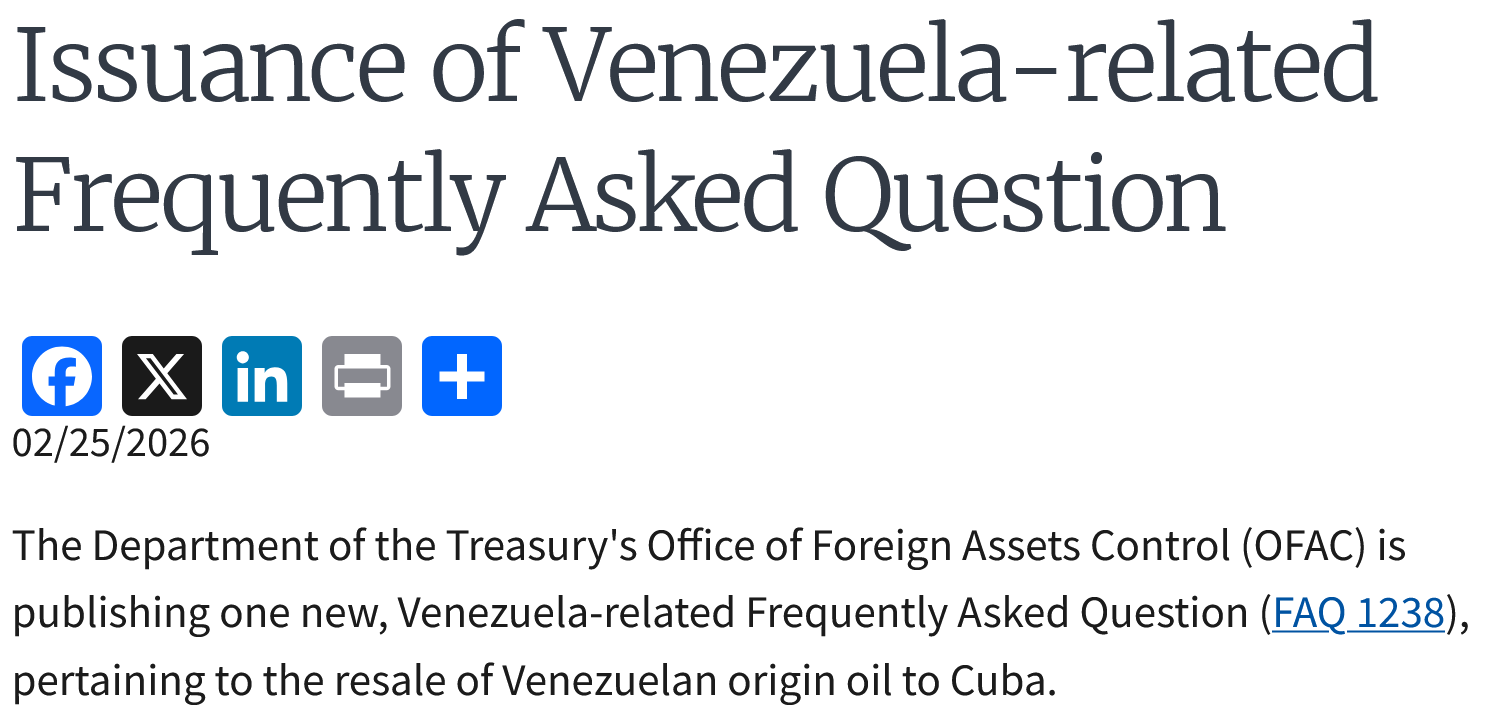
Issuance of Venezuela-related Frequently Asked Question


The Department of the Treasury's Office of Foreign Assets Control (OFAC) is publishing one new, Venezuela-related Frequently Asked Question (FAQ 1238), pertaining to the resale of Venezuelan origin oil to Cuba. 

Venezuela Sanctions

1238. Would OFAC approve the resale of Venezuelan origin oil to Cuba?

Answer

In accordance with the United States' support and solidarity for the Cuban people, OFAC would implement a favorable licensing policy toward specific license applications seeking authorization for the resale of Venezuelan origin oil for use in Cuba. To qualify for this favorable licensing policy, the requested transactions would need to be consistent with the terms and conditions of Venezuela General License (GL) 46A, though applicants need not necessarily have an established U.S. entity and the limitations in GL 46A with respect to Cuba would not apply. This favorable licensing policy is directed towards transactions that support the Cuban people, including the Cuban private sector (e.g., exports for commercial and humanitarian use in Cuba). Consistent with applicable U.S. law and policy, transactions involving, or for the benefit, of any persons or entities associated with the Cuban military, intelligence services, or other government institutions, including entities listed on the U.S. State Department's Cuba Restricted List, see 31 C.F.R. § 515.209, would not be covered by this favorable licensing policy.

As a reminder, the U.S. Department of Commerce primarily regulates the export or reexport of U.S.-origin oil to Cuba, as well as all other items subject to the Export Administration Regulations (EAR, 15 C.F.R. parts 730-774). Treasury's Cuban Assets Control Regulations generally authorize U.S. persons to engage in transactions ordinarily incident to the export of oil from the United States to Cuba, or the reexport of U.S.-origin oil from a third country to Cuba, where that export or reexport has been authorized by the Commerce Department. See 31 C.F.R. § 515.533(a). This authorization applies to transactions covered by applicable Commerce Department license exceptions, including License Exception Support for the Cuban People (SCP), 15 C.F.R. § 740.21, which authorizes exports and reexports of gas and other petroleum products to improve living conditions and support independent economic activity. In other words, U.S.-origin oil exports, as well as other gas and petroleum products covered by License Exception SCP, do not require separate OFAC authorizations. Exporters and reexporters are responsible for reviewing current Commerce Department guidance, see here, and ensuring that any transaction undertaken pursuant to License Exception SCP or any other license exception meet all applicable terms and conditions.

See FAQ 1226 for the definition of "Venezuelan-origin oil," which includes petroleum products.

Date Released
February 25, 2026

With New BIS Guidance For Fuel, Gas, Petroleum Product Exports To Cuba, Trump Administration Confirms There Is A Private Sector In Cuba And U.S. Companies May Engage. Members Of Congress Not Pleased.

United States Department of Commerce
Washington DC
24 February 2026

Exports of U.S.-Origin Gas and Petroleum Products to Cuba
 

BIS has issued updated guidance on the availability of EAR License Exception Support for the Cuban People (SCP) for exports and reexports of U.S.-origin gas and other petroleum products to eligible Cuban private sector entities and to individual Cuban consumers. Under this guidance, certain transactions meeting the terms of License Exception SCP may be authorized without a license, including exports for private sector economic activities and those sold directly to individuals for personal or family use. License applications involving U.S.-origin gas and petroleum products that otherwise qualify for SCP, will be returned without action with direction to use the license exception. Exporters are responsible for ensuring that all SCP conditions are met and should carefully review § 740.21 before proceeding. 

LINK: SCP Gas/Petroleum FAQ
LINK: Cuba Export Control Guidance

Updated Guidance Regarding Available EAR License Exceptions for Exports of U.S. origin gas and petroleum products to Cuban Private Sector Entities and Activities  

The Bureau of Industry and Security (BIS) has been receiving questions from potential exporters on the EAR requirements and potential EAR authorizations that may be available to authorize exports and reexports of U.S. origin gas and petroleum products for private sector use, including for addressing humanitarian needs in Cuba.

• In general, a license is required to export and reexport gas and other petroleum products that are subject to the EAR to Cuba pursuant to § 746.2(a). However, as with any export or reexport that is subject to a license requirement, the exporter or reexporter should first evaluate whether a license exception is available to authorize the export or reexport.

• In particular, exporters and reexporters of gas and petroleum products to the Cuban private sector should review the general restrictions under § 740.2 and § 740.21 License Exception Support for the Cuban People (SCP). As explained below, gas and other petroleum products exported and reexported to Cuban private sector entities or individuals for personal use may be authorized under License Exception SCP.

• Exporters and reexporters are advised that if a license application is submitted to BIS that otherwise meets the terms and conditions of License Exception SCP, those applications will be returned without action (RWA’d) by BIS with a direction to the applicant to export or reexport the items pursuant to License Exception SCP. 

• BIS provides the following FAQ to further assist public understanding:

Q.1: Would License Exception Support for the Cuban People (SCP) (§ 740.21 of the EAR) allow an exporter or reexporter to export or reexport gas and other petroleum products to Cuban private sector entities for private sector use, or directly to individual Cubans for their personal or family use?

A.1: Yes, provided that all the applicable terms and conditions of License Exception SCP are met. Specifically, there are two authorizing paragraphs under License Exception SCP under paragraph (b) (Improving living conditions and supporting independent economic activity), which may be available to authorize these types of exports and reexports of gas and other petroleum products to Cuba. License Exception SCP provides a general authorization for exports under certain applicable conditions, as explained below, and does not contain any specific limitations on applicability based on quantity, or value of the items, or exporter or reexporter.

§ 740.21(b)(1).

Exports to private sector for private sector use.  If the gas and other petroleum products are being exported for use by the Cuban private sector for private sector use, then paragraph (b)(1) of License Exception SCP, which authorizes items for use by the Cuban private sector for private sector economic activities, may be available to authorize these types of exports and reexports.  To qualify, exports must be both (1) for use by the Cuban private sector, (2) for private sector economic activities, including those addressing humanitarian needs in Cuba. Per §740.21(b)(1)(i) and (ii), License Exception SCP does not apply to any transactions, whether to Cuban private sector entities or otherwise, which primarily generate revenue for the state; or contribute to the operation of the state, including through the construction or renovation of state-owned buildings.

§ 740.21(b)(2).

Exports sold directly to individuals in Cuba for their personal use. If the gas and other petroleum products are sold directly to individuals in Cuba for their personal use, then paragraph (b)(2) of SCP, which authorizes items sold directly to individuals in Cuba for their personal use or their immediate family's personal use, may be available to authorize exports and reexports of gas and other petroleum products.  Paragraph (b)(2) does not require the gas and other petroleum products to be exported or reexported directly; the gas and other petroleum products must ultimately be destined for these eligible end users and their families for their personal use.  This authorization applies only if the gas or other petroleum products are sold directly to individual Cubans for their personal use or the use of their immediate family. It does not aapply if any of the products are sold or transferred to proscribed persons or entities in Cuba, including employees of the Ministry of Defense or Ministry of the Interior, senior officials of certain Cuban government organizations, labor unions, and other Cuban government affiliated organizations, including entities listed on the U.S. State Department’s Cuba Restricted List, see 31 CFR 515.209.

Note: Exporters and reexporters are responsible for ensuring that all of the applicable terms and conditions of License Exception SCP are met. Please review EAR § 740.21 --License Exception Support for Cuban People (SCP) -- carefully to ensure that your transaction meets all the criteria for use of the license exception.

Links To Related Analyses 

Trump Administration Opens Diplomatic Door To Cuba: First, Change The Economy. Second, Invite U.S. Companies. Third, For Now, Type Of Government Not Important- Just Make It Work Like China, Vietnam Feb 15, 2026

Trump’s Message To Cuba To “Make A Deal” May Not Be A Bad Deal For Cuba. Witkoff And Kushner Add Another Assignment. 23 February 2026 Is Consequential. January 14, 2026

Biden-Harris Administration Approves First Equity Investment Since 1960 In A Private Cuban Company May 10, 2022

With U.S. Government Authorization For First Direct Equity Investment Into A Private Company In Cuba, Here Is Important Context And Details.  About The Parties; About The Message. May 16, 2022

Now The Hard Part For Cuba: Implementing Quickly Transparent, Equal-For-All, MSME Investment & Financing Regulations. No Limitations. No Selectivity. No Orwellian Process. August 04, 2022

Cuba Government Delaying Private Company Investment/Financing Regulations Is Costing Earning Potential For U.S. And Other Country Sources. Success Should Not Be Feared. September 25, 2023

Transcripts And Recordings Of SCOTUS Libertad Act Title III Arguments: Havana Docks And Exxon Mobil

Link To Recording Of Oral Arguments- Havana Docks

Link To Transcript Of Oral Arguments- Havana Docks

Link To Recording Of Oral Arguments- Exxon Mobil

Link To Transcript Of Oral Arguments- Exxon Mobil

Supreme Court of the United States
October Term, 2025
HEARING LIST
For the Session Beginning February 23, 2026
(The Court convenes at 10 a.m.; afternoon arguments begin at 1 p.m.)


Justices of the Supreme Court:
Hon. Chief Justice John G. Roberts, Jr.
Hon. Clarence Thomas Hon. Neil M. Gorsuch
Hon. Samuel A. Alito, Jr. Hon. Brett M. Kavanaugh
Hon. Sonia Sotomayor Hon. Amy Coney Barrett
Hon. Elena Kagan Hon. Ketanji Brown Jackson

Officers of the Court:
Scott S. Harris, Clerk
Rebecca Womeldorf, Reporter of Decisions
Gail A. Curley, Marshal
David S. Mao, Librarian

HEARING LIST
Monday, February 23, 2026

No. 24–983. Havana Docks Corporation v. Royal Caribbean Cruises, Ltd., et al.
Certiorari to the C. A. 11th Circuit.
For petitioner: Richard D. Klingler, Washington, D. C.; and Aimee Brown, Assistant to the Solicitor General, Department of Justice, Washington, D. C. (for United States, as amicus curiae.)  For respondents: Paul D. Clement, Alexandria, Va.  (1 hour for argument.) 

No. 24–699. Exxon Mobil Corporation v. Corporación Cimex, S.A. (Cuba), et al.
Certiorari to the C. A. District of Columbia Circuit.
For petitioner: Morgan L. Ratner, Washington, D. C.; and Curtis E. Gannon, Deputy Solicitor General, Department of Justice, Washington, D. C. (for United States, as amicus curiae.)  For respondents: Jules L. Lobel, Pittsburgh, Pa.  (1 hour for argument.)

24-983 HAVANA DOCKS CORP. V. ROYAL CARIBBEAN CRUISES
DECISION BELOW: 119 F.4th 1276
CERT. GRANTED 10/3/2025
QUESTION PRESENTED:
The LIBERTAD Act is an essential pillar of United States foreign policy toward Cuba's hostile and anti-American regime. Title III of that Act creates a private right of action for United States nationals who have a claim to property confiscated by that regime against persons who traffic in that property. 22 U.S.C. § 6082(a)(1). The Act specifies that such trafficking "undermines the foreign policy of the United States" by, among other things, "provid[ing] badly needed financial benefit" to the Cuban regime. Id. § 6081(6).  The question presented here applies in every case brought under Title III, and will determine whether that provision continues to advance U.S. foreign policy toward Cuba: whether a plaintiff must prove that the defendant trafficked in property confiscated by the Cuban government as to which the plaintiff owns a claim (as the statute requires), or instead that the defendant trafficked in property that the plaintiff would have continued to own at the time of trafficking in a counterfactual world "as if there had been no expropriation" (as the divided Eleventh Circuit panel held below).  LOWER COURT CASE NUMBER: 23-10151, 23-10171

24-699 EXXON MOBIL CORP. V. CORPORACION CIMEX
DECISION BELOW: 111 F.4th 12
CERT. GRANTED 10/3/2025
QUESTION PRESENTED:
In 1960, the Cuban government confiscated the property of American nationals and transferred it to state-owned enterprises. After years without a diplomatic resolution, Congress enacted the Helms-Burton Act, which created a damages action for American nationals against "any person ... that traffics in" such confiscated property. 22 U.S.C. § 6082(a)(1). The Act defines "person" to include "any agency or instrumentality of a foreign state," id. § 6023(11), and expressly contemplates "judgment[s] against an agency or instrumentality of the Cuban Government," id. § 6082(d). The question presented is: Whether the Helms-Burton Act abrogates foreign sovereign immunity in cases against Cuban instrumentalities, or whether parties proceeding under that Act must also satisfy an exception under the Foreign Sovereign Immunities Act.  LOWER COURT CASE NUMBER: 21-7127, 22-7019, 22-7020

Today SCOTUS Hears Two 60-Minute Arguments In Libertad Act Lawsuits: Exxon Mobil Suing Two Cuba Government Companies And Havana Docks Suing Four Cruise Lines. Cuba Government Watching Closely

Link To Recording Of Oral Arguments- Havana Docks

Link To Transcript Of Oral Arguments- Havana Docks

Link To Recording Of Oral Arguments- Exxon Mobil

Link To Transcript Of Oral Arguments- Exxon Mobil

Link To Live Feed

Supreme Court of the United States
October Term, 2025
HEARING LIST
For the Session Beginning February 23, 2026
(The Court convenes at 10 a.m.; afternoon arguments begin at 1 p.m.)


Justices of the Supreme Court:
Hon. Chief Justice John G. Roberts, Jr.
Hon. Clarence Thomas Hon. Neil M. Gorsuch
Hon. Samuel A. Alito, Jr. Hon. Brett M. Kavanaugh
Hon. Sonia Sotomayor Hon. Amy Coney Barrett
Hon. Elena Kagan Hon. Ketanji Brown Jackson

Officers of the Court:
Scott S. Harris, Clerk
Rebecca Womeldorf, Reporter of Decisions
Gail A. Curley, Marshal
David S. Mao, Librarian

HEARING LIST
Monday, February 23, 2026

No. 24–983. Havana Docks Corporation v. Royal Caribbean Cruises, Ltd., et al.
Certiorari to the C. A. 11th Circuit.
For petitioner: Richard D. Klingler, Washington, D. C.; and Aimee Brown, Assistant to the Solicitor General, Department of Justice, Washington, D. C. (for United States, as amicus curiae.)  For respondents: Paul D. Clement, Alexandria, Va.  (1 hour for argument.) 

No. 24–699. Exxon Mobil Corporation v. Corporación Cimex, S.A. (Cuba), et al.
Certiorari to the C. A. District of Columbia Circuit.
For petitioner: Morgan L. Ratner, Washington, D. C.; and Curtis E. Gannon, Deputy Solicitor General, Department of Justice, Washington, D. C. (for United States, as amicus curiae.)  For respondents: Jules L. Lobel, Pittsburgh, Pa.  (1 hour for argument.)

24-983 HAVANA DOCKS CORP. V. ROYAL CARIBBEAN CRUISES
DECISION BELOW: 119 F.4th 1276
CERT. GRANTED 10/3/2025
QUESTION PRESENTED:
The LIBERTAD Act is an essential pillar of United States foreign policy toward Cuba's hostile and anti-American regime. Title III of that Act creates a private right of action for United States nationals who have a claim to property confiscated by that regime against persons who traffic in that property. 22 U.S.C. § 6082(a)(1). The Act specifies that such trafficking "undermines the foreign policy of the United States" by, among other things, "provid[ing] badly needed financial benefit" to the Cuban regime. Id. § 6081(6).  The question presented here applies in every case brought under Title III, and will determine whether that provision continues to advance U.S. foreign policy toward Cuba: whether a plaintiff must prove that the defendant trafficked in property confiscated by the Cuban government as to which the plaintiff owns a claim (as the statute requires), or instead that the defendant trafficked in property that the plaintiff would have continued to own at the time of trafficking in a counterfactual world "as if there had been no expropriation" (as the divided Eleventh Circuit panel held below).  LOWER COURT CASE NUMBER: 23-10151, 23-10171

24-699 EXXON MOBIL CORP. V. CORPORACION CIMEX
DECISION BELOW: 111 F.4th 12
CERT. GRANTED 10/3/2025
QUESTION PRESENTED:
In 1960, the Cuban government confiscated the property of American nationals and transferred it to state-owned enterprises. After years without a diplomatic resolution, Congress enacted the Helms-Burton Act, which created a damages action for American nationals against "any person ... that traffics in" such confiscated property. 22 U.S.C. § 6082(a)(1). The Act defines "person" to include "any agency or instrumentality of a foreign state," id. § 6023(11), and expressly contemplates "judgment[s] against an agency or instrumentality of the Cuban Government," id. § 6082(d). The question presented is: Whether the Helms-Burton Act abrogates foreign sovereign immunity in cases against Cuban instrumentalities, or whether parties proceeding under that Act must also satisfy an exception under the Foreign Sovereign Immunities Act.  LOWER COURT CASE NUMBER: 21-7127, 22-7019, 22-7020

Argument Audio:  The audio recordings of all oral arguments heard by the Supreme Court of the United States are posted on this website (https://www.supremecourt.gov/) on the same day an argument is heard by the Court.  The public may either download the audio files or listen to the recordings on the Court’s website. The audio recordings are listed by case name, docket number, and the date of oral argument.

Cuba; Continuation of National Emergency and Emergency Authority With Respect to Regulation of Anchorage and Movement of Vessels (Notice of February 13, 2026)

Notice of February 13, 2026 Continuation of the National Emergency With Respect to Cuba and of the Emergency Authority Relating to the Regula tion of the Anchorage and Movement of Vessels On March 1, 1996, by Proclamation 6867, a national emergency was declared to address the disturbance or threatened disturbance of international relations caused by the February 24, 1996, destruction by the Cuban government of two unarmed, United States-registered civilian aircraft in international airspace north of Cuba. On February 26, 2004, by Proclamation 7757, the national emergency was expanded to deny monetary and material support to the Cuban government. On February 24, 2016, by Proclamation 9398, and on February 22, 2018, by Proclamation 9699, the national emergency was further modified based on continued disturbances or threatened disturb ances of the international relations of the United States related to Cuba. The Cuban government has not demonstrated that it will refrain from the use of excessive force against United States vessels or aircraft that may engage in memorial activities or peaceful protest north of Cuba. Further, the unauthorized entry of any United States-registered vessel into Cuban territorial waters continues to be detrimental to the foreign policy of the United States because such entry could facilitate a mass migration from Cuba. It continues to be United States policy that a mass migration from Cuba would endanger United States national security by posing a disturbance or threatened disturbance of the international relations of the United States.

Therefore, in accordance with section 202(d) of the National Emergencies Act (50 U.S.C. 1622(d)), I am continuing the national emergency with respect to Cuba and the emergency authority relating to the regulation of the anchor age and movement of vessels set out in Proclamation 6867, as amended by Proclamation 7757, Proclamation 9398, and Proclamation 9699. This notice shall be published in the Federal Register and transmitted to the Congress.

Trump Administration Opens Diplomatic Door To Cuba: First, Change The Economy. Second, Invite U.S. Companies. Third, For Now, Type Of Government Not Important- Just Make It Work Like China, Vietnam

The Trump-Vance Administration (2015-2025) as anticipated is not requiring from the government of the Republic of Cuba a change to its political operating system as the condition of a rapprochement.

Donald Trump, President of the United States (2017-2021 and 2025-2029), remains focused on how a government manages its commercial, economic, and financial infrastructure rather than the type of government in place. 

The People’s Republic of China and Socialist Republic of Vietnam are each governed by a Communist Party.  Each country has embraced ideological decision-making which creates an economy operating in the black rather than an economy operating in the red.  Each country provides opportunities for United States-based companies. 

Regardless of whether a country has an authoritarian, democratic, dictatorship, junta, military, monarchy, oligarchy, parliamentary, participatory, presidential, theocracy, totalitarian, or some other system of governance, President Trump is focused upon what opportunities exist for United States-based companies: exporting products, importing products, and provision of services.   

Nicolas Maduro, President of the Bolivarian Republic of Venezuela (2013-2025), was removed through an operation conducted by the armed forces of the United States.  The Trump-Vance Administration then engaged with the individuals and the institutions remaining in place rather than requiring changes in personnel and to structures.  The focus was first upon recreating in Venezuela opportunities for United States-based companies. 

There is not a required optic for the armed forces of the United States to conduct an operation to extract Miquel Diaz-Canel, President of the Republic of Cuba (2019- ), from the Palacio de la Revolución in the city of Havana.   

President Maduro was viewed as the optical and personality problem to implementing changes in Venezuela.  President Diaz-Canel is not viewed similarly.  He is not viewed in control of the government of the Republic of Cuba in the same way as President Maduro was viewed as in control of the government of Venezuela.  President Maduro was a symbol whose replacement had political value to President Trump.  President Diaz-Canel is neither a personality nor a symbol in the same manner as President Maduro.   

The Diaz-Canel-Valdes Mesa Administration (2019- ) in the Republic of Cuba is not for some in the Trump-Vance Administration the problem.  The problem is the manner the government of the Republic of Cuba uses its chosen political system to manage its economy. 

Policies, regulations, and statutes implemented by the government of the United States do impact negatively the commercial, economic, and financial functionality of the government of the Republic of Cuba.   

Ironically, some of the policies, regulations, and statutes if accepted could strengthen the government of the Republic of Cuba by providing additional capital, additional markets, and additional bilateral political connectivity. 

Within those policies, regulations, and statutes are opportunities the government of the Republic of Cuba has avoided which have contributed to the corrosion and decay of the commercial, economic, and financial infrastructure in the Republic of Cuba. 

In May 2022, the Biden-Harris Administration (2021-2025) authorized direct investment and direct financing into a privately-owned company located in the Republic of Cuba owned by a Republic of Cuba national.  Nearing four years later, the government of the Republic of Cuba has not issued the necessary guidance and regulations.  One page to be filed by the Republic of Cuba-based company with its Republic of Cuba government-operated financial institution; similar to a Know Your Customer form, authorizing officially the direct investment and direct financing.   

The lack of guidance and regulations from the government of the Republic of Cuba has also impacted sources of capital from every other country- including those with whom the government of the Republic of Cuba embraces- China and Russia, along with the twenty-seven-member country Brussels, Belgium-based European Union (EU) among others. 

The Trump-Vance Administration would permit the Diaz-Canel-Valdes Mesa Administration to implement changes to its commercial, economic, and financial infrastructure while maintaining most of its political infrastructure.   

However, the infrastructure needs to transition quickly from what did not work in the second half of the twentieth century to what can work in the beginning of the second quarter of the twenty-first century.  

President Trump is enticed and impressed by opportunity.  The New York, New York-based The Trump Organization did have an interest in tourism-related opportunities in the Republic of Cuba.  For the government of the Republic of Cuba, that sector can be the basis for re-engagement with the Trump-Vance Administration. 

Link To Related Analysis 

Munich, Germany
Hotel Bayerischer Hof
14 February 2026

Secretary of State Marco Rubio with John Micklethwait of Bloomberg News  

excerpts 

QUESTION:  What about a country with which you’ve had a long interest: Cuba?  You mentioned it obliquely in the speech talking about the Cuban Missile Crisis.  How long do you think the regime can last without oil? 

SECRETARY RUBIO:  Yeah, I think the regime in Cuba is – look, the revolution in Cuba ended a long time ago and – Cuba’s fundamental problem is that it has no economy and its economic model is one that has never been tried and has never worked anywhere else in the world, okay?  It just – it doesn’t have a real economic policy.  It doesn’t have a real economy.  Now, forget – put aside for a moment the fact that it has no freedom of expression, no democracy, no respect for human rights.  The fundamental problem Cuba has it is has no economy, and the people who are in charge of that country, in control of that country, they don’t know how to improve the everyday life of their people without giving up power over sectors that they control.  They want to control everything.  They don’t want the people of Cuba to control anything.  So they don’t know how to get themselves out of this.  And to the extent that they have been offered opportunities to do it, they don’t seem to be able to comprehend it or accept it in any ways.  They would much rather be in charge of the country than allow it to prosper. 

QUESTION:  Is there any kind of off-ramp for the regime?  I mean, previous ones – when you negotiated with Venezuela, you said if they agreed with various things it would be possible to continue. 

SECRETARY RUBIO:  Sure.  I mean, there is.  I mean, look, I think you have to — 

QUESTION:  What could – what could the Cuban regime do to — 

SECRETARY RUBIO:  Well, I’m not going to tell you or announce this in an interview here because obviously these things require space and time to do in the right way.  But I will say this, that that is that it is important for the people of Cuba to have more freedom, not just political freedom but economic freedom.  The people of Cuba – and that’s what this regime has not been willing to give them because they’re afraid that if the people of Cuba can provide for themselves, they lose control over them, they lose power over them.  So I think there has to be that opening and it has to happen, and I think now Cuba is faced with such a dire situation.  Remember this is a regime that has survived almost entirely on subsidies – first from the Soviet Union, then from Hugo Chavez, and how for the first time it has no subsidies coming in from anyone, and the model has been laid bare.  And it’s not just – look, multiple countries have gone in and helped, but the problem is that you lose money in Cuba.  They never pay their bills.  They never end up paying.  It never ends up working out.  There were European countries that went to Cuba and made what they thought were investments in certain sectors, only to have them – the contracts canceled and get themselves kicked out because the Cuban regime has no fundamental understanding of what business and industry looks like, and the people are suffering as a result of it.  So I think certainly their willingness to begin to make openings in this regard is one potential way forward.  I would also say – and this has not been really talked about a lot, but the United States has been providing humanitarian assistance directly to the Cuban people via the Catholic Church.  We did it after the hurricane.  We actually just recently announced an increase in the amount we’re willing to give.  And that’s something we’re willing to continue to explore, but obviously that’s not a long-term solution to the problems on the island. 

Secretary Rubio’s Meeting with G7 Foreign Ministers 
United States Department of State
Washington DC
14 February 2026

The below is attributable to Principal Deputy Spokesperson Tommy Pigott: 

Secretary of State Marco Rubio met today with G7 foreign ministers in Munich, Germany.  The leaders discussed pressing issues such as ongoing conflicts threatening peace and stability in Africa, Europe, and the Middle East, as well as challenges to regional security in the Indo-Pacific and the Western Hemisphere.  The Secretary reiterated the United States’ commitment to promoting stability in Venezuela and negotiating an end to the Russia-Ukraine war.  Secretary Rubio and his counterparts reaffirmed the importance of strengthening G7 cooperation to address global threats to international peace and security. 

LINK TO COMPLETE ANALYSIS IN PDF FORMAT
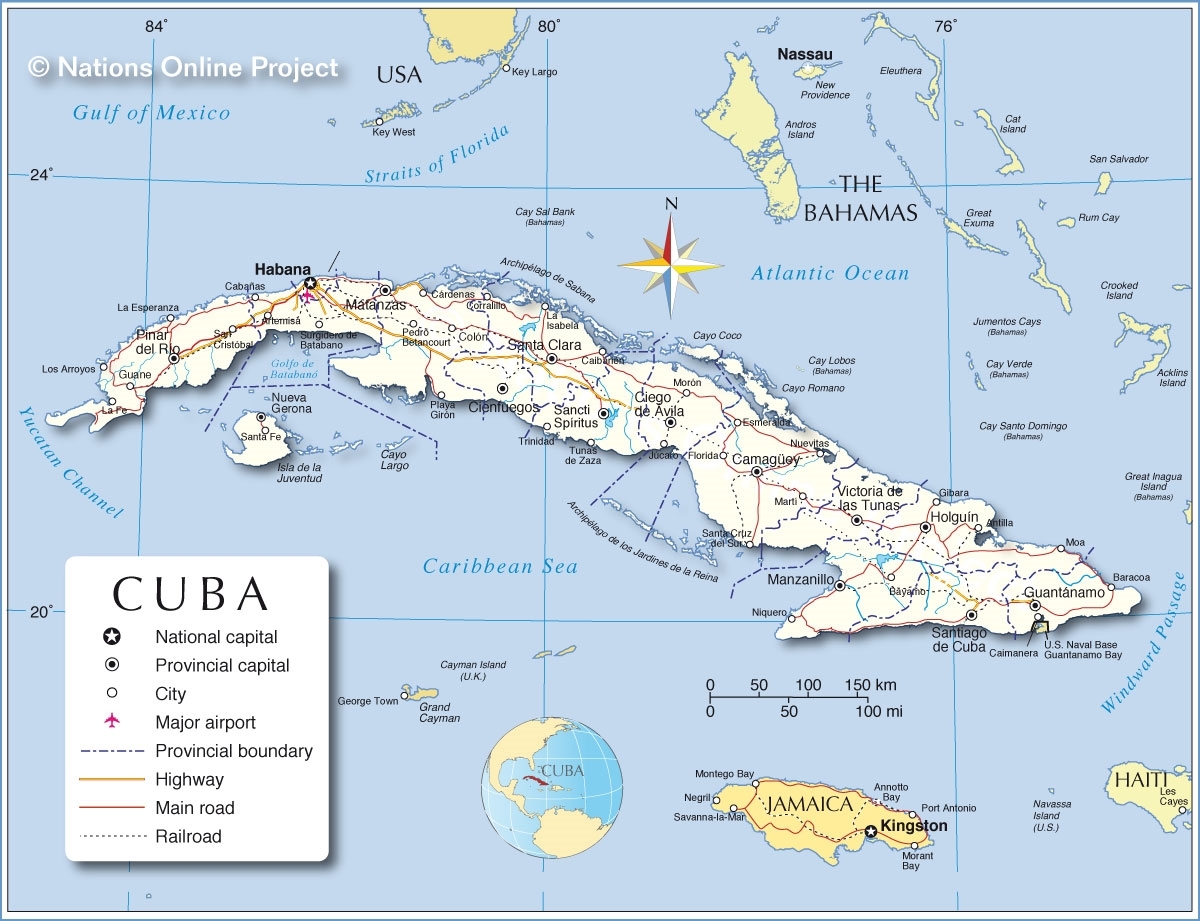
UK Government Updates Travel Advisory For Cuba- Aviation Fuel Shortages, Hospital Care, Power Outages

Warnings and insurance

Still current at: 11 February 2026 
Updated: 10 February 2026 

Latest update: Update to information on aviation fuel shortages and availability of care at hospitals ('Warnings and insurance page') 

Power outages and fuel shortages

Cuba is experiencing serious issues with its national power grid and fuel supply. Prolonged power outages – over 24 hours in some instances – are a daily occurrence across the country, affecting water supply, lighting, refrigeration and communications.  Take precautions by conserving fuel, water, food and mobile phone charge, and be prepared for significant disruption.

There are long queues at petrol stations. The Cuban government has imposed strict limitations on the purchase of fuel  from 7 February 2026. Diesel sales have been temporarily discontinued. Petrol is currently limited to a maximum purchase of 20 litres. This will impact travel within Cuba and you should factor this into planning for any journey.

Resorts and businesses which often rely on oil/diesel-powered generators are also impacted. We understand that some tourists are being relocated to different hotels to maximise fuel consumption.  You should contact your tour operator for further details.

Aviation fuel shortages in Cuba’s airports are leading some airlines to review their schedules and consider refuelling in other nearby destinations. Three Canadian airlines have temporarily cancelled travel to Cuba but will return their existing customers from Cuba. European airlines are operating but making plans to refuel elsewhere. You should contact your airline or tour operator for further details.

Some hospitals have postponed routine medical treatment but are continuing to provide services for urgent care.