
Exxon Prevails At U.S. Supreme Court Against Cuba Government Companies. "We conclude that the Helms-Burton Act itself abrogates the sovereign immunity of Cuban agencies and instrumentalities"
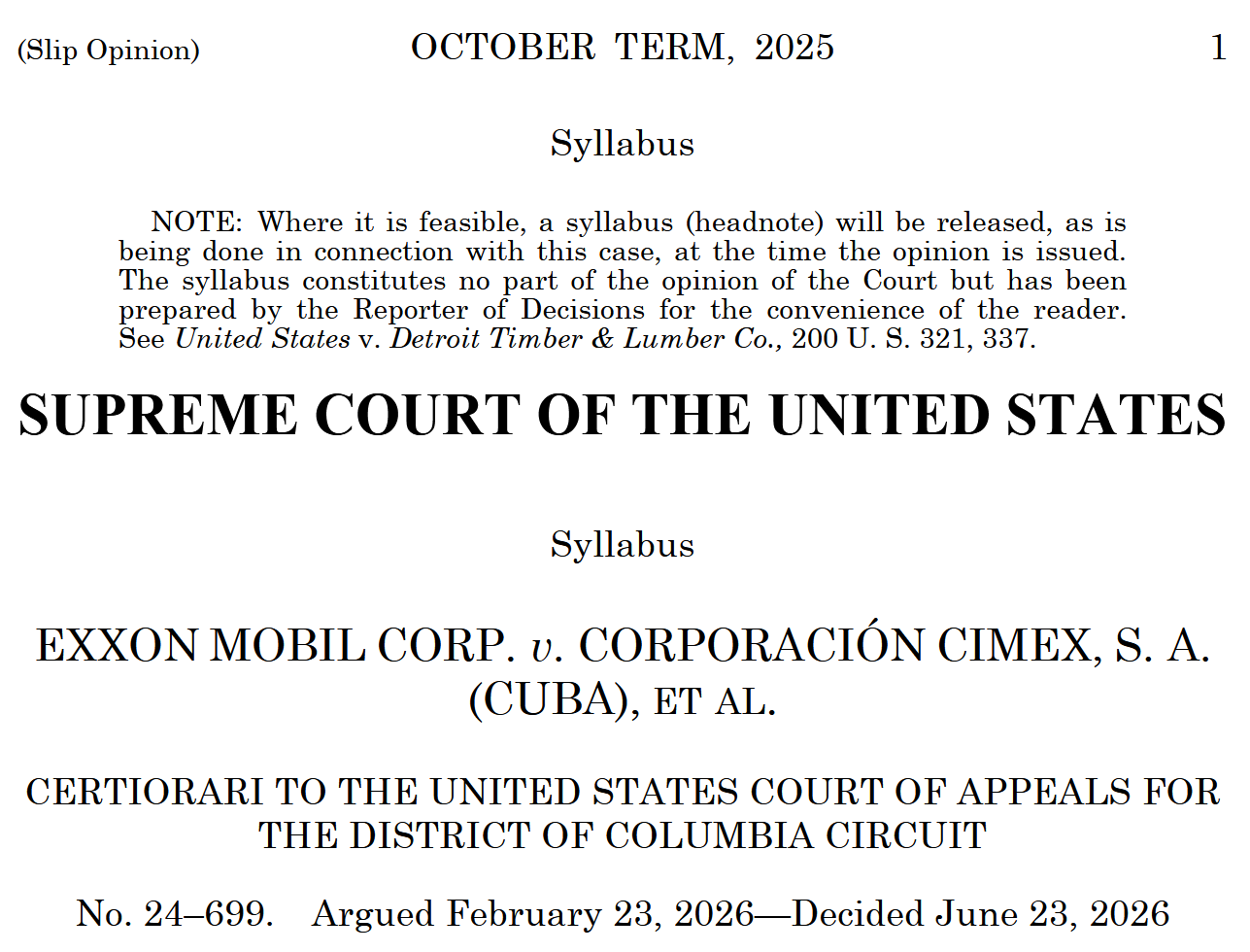
/CERTIORARI TO THE UNITED STATES COURT OF APPEALS FOR THE DISTRICT OF COLUMBIA CIRCUIT
No. 24–699. Argued February 23, 2026—Decided June 23, 2026
In 1960, after Fidel Castro seized power in Cuba, the Cuban Government confiscated many foreign-owned assets, including Exxon’s oil refinery,
terminals, packaging plants, and more than a hundred service stations. Since then, two Cuban government-owned companies—Unión Cuba-Petróleo (CUPET) and Corporación CIMEX, S. A. (Cuba) (CIMEX)—have operated and profited from Exxon’s expropriated assets. Exxon had no good way to sue the Cuban government entities and seek compensation for its confiscated property until Congress passed and President Clinton signed the Helms-Burton Act in 1996.
As relevant here, the Act created a private right of action for U. S. nationals whose property was confiscated by the Cuban Government against “any person that . . . traffics in” the confiscated property, 22 U. S. C. §6082(a)(1)(A), with “person” defined to include “any agency or instrumentality of a foreign state,” §6023(11). Exxon sued CUPET, CIMEX, and later CIMEX’s Panamanian alter ego under the Helms-Burton Act in the U. S. District Court for the District of Columbia, seeking more than $1 billion in damages. The Cuban government-owned companies moved to dismiss, asserting immunity under the generally applicable Foreign Sovereign Immunities Act (FSIA). Exxon countered that the Helms-Burton Act itself waived the defendants’ sovereign immunity. The District Court sided with the Cuban government defendants, and a divided panel of the U. S. Court of Appeals for the D. C. Circuit affirmed. 111 F. 4th 12, 23.
JUSTICE KAVANAUGH delivered the opinion of the Court. In 1960, a year after assuming power in Cuba, Fidel Castro declared that the new Communist government would seize all “Yankee property” in Cuba. Castro made good on that promise. The Cuban Government confiscated a variety of American businesses then operating in Cuba, including Exxon’s oil refinery and service stations. Cuba transferred Exxon’s property to Cuban government-owned companies. In 1996, to afford victims of “Castro’s wrongful seizures” a “judicial remedy in the courts of the United States,”
Congress passed and President Clinton signed the Helms-Burton Act, formally known as the Cuban Liberty and Democratic Solidarity Act. §301, 110 Stat. 815, 22 U. S. C. §6081. That Act created a private right of action for U. S. nationals whose property was unlawfully confiscated: They may sue Cuban agencies and instrumentalities that possess, use, or otherwise traffic in the confiscated property.
Foreign sovereigns, including their agencies and instrumentalities, are presumptively immune from suit in U. S. courts. The question here is whether the Helms-Burton Act abrogates the foreign sovereign immunity of Cuban agencies and instrumentalities—or whether plaintiffs such as Exxon suing under the Act must also satisfy one of the exceptions to immunity in the generally applicable Foreign Sovereign Immunities Act of 1976, or FSIA. 90 Stat. 2891, 28 U. S. C. §§1330, 1602 et seq.
We conclude that the Helms-Burton Act itself abrogates the sovereign immunity of Cuban agencies and instrumentalities. Therefore, plaintiffs who sue Cuban agencies or instrumentalities under the Act are not required to also satisfy an FSIA exception.