Two EU-Based Shipping Companies Suspend Cuba Operations.  One Settled Libertad Act Lawsuit And The Other Owns Florida International Terminal In Port Everglades. Will EU Do Anything?

Two EU-Based Shipping Companies Suspend Cuba Operations.  One Settled Libertad Act Lawsuit And The Other Owns Florida International Terminal In Port Everglades  

What Will EU Do, If Anything? 

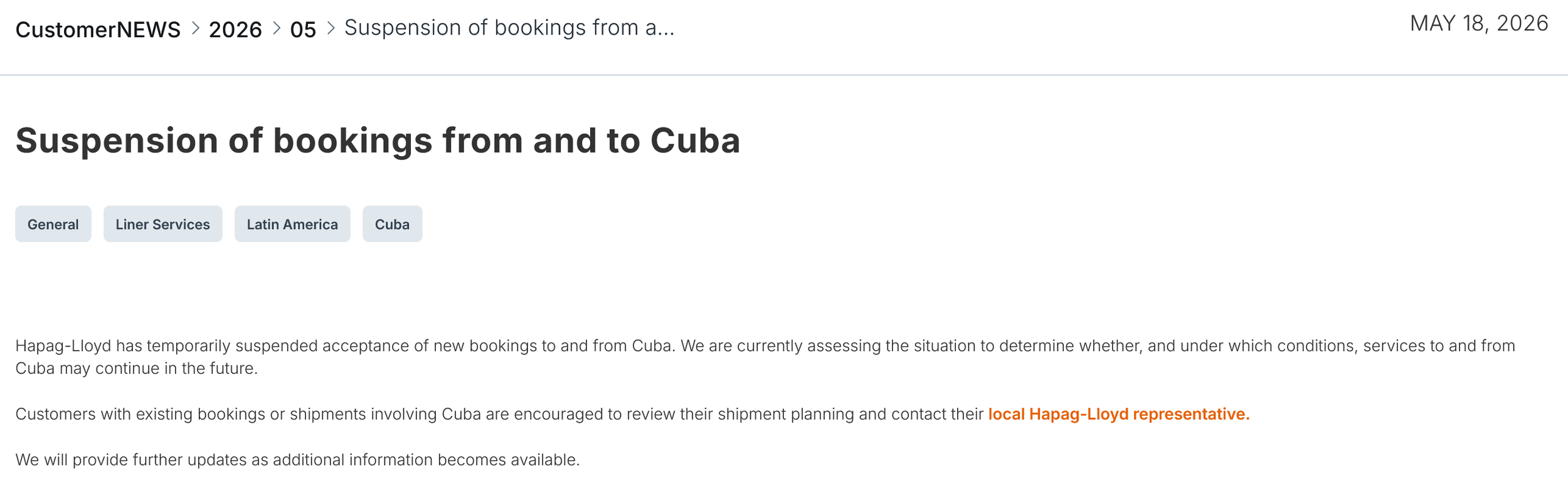
CiberCuba (May 14, 2026): “During the early hours of yesterday, we [Republic of Cuba-based shipping agents] received official communication from the Representation Agencies in Cuba of the shipping companies [Hamburg, Germany-based] Hapag-Lloyd AG [2025 revenue US$21 billion] and [Marseille, France-based] CMA CGM [2025 revenue US$55 billion], notifying us of the implementation of a STOP BOOKING for all origins and destinations of their regular services to and from Cuba.” 

ODETTE BLANCO DE FERNANDEZ née BLANCO ROSELL; EMMA RUTH BLANCO, in her personal capacity, and as Personal Representative of the ESTATE OF ALFREDO BLANCO ROSELL, JR; HEBE BLANCO MIYARES, in her personal capacity, and as Personal Representative of the ESTATE OF BYRON BLANCO ROSELL; SERGIO BLANCO DE LA TORRE, in his personal capacity, and as Administrator Ad Litem of the ESTATE OF ENRIQUE BLANCO ROSELL; EDUARDO BLANCO DE LA TORRE, as Administrator Ad Litem of the ESTATE OF FLORENTINO BLANCO ROSELL; LIANA MARIA BLANCO; SUSANNAH VALENTINA BLANCO; LYDIA BLANCO BONAFONTE; JACQUELINE M. DELGADO; BYRON BLANCO, JR.; MAGDALENA BLANCO MONTOTO; FLORENTINO BLANCO DE LA TORRE; JOSEPH E. BUSHMAN; CARLOS BLANCO DE LA TORRE; and GUILLERMO BLANCO DE LA TORRE; Plaintiffs, v. CMA CGM S.A. (a/k/a CMA CGM THE FRENCH LINE; a/k/a CMA CGM GROUP); CMA CGM (AMERICA) LLC.  [1:21-cv-22778; Southern Florida District].  Case Settled on 2 December 2025. 

Berliner Corcoran & Rowe LLP (plaintiff)
Horr, Novak & Skipp P.A. (plaintiff)
Fields PLLC (plaintiff)
Law Offices of John S. Gaebe P.A. (plaintiff)

Link: CMA CGM Of France Settles Cuba Libertad Act Port Use Lawsuit January 27, 2026

From Hamburg, Germany-based Hapag-Lloyd AG (2025 revenue US$21 billion)

“***Update January 20, 2025*** We have some good news if you're shipping to/from Cuba! Our Cuba Shuttle Service (CUS) has been enhanced with 2 vessels instead of 1, ensuring a weekly rotation between Mariel, Cartagena, and Manzanillo. MV Green Sea will start from Cartagena on January 24th, followed by MV Green Ocean on January 30th.  Please see below for an overview of the first four departure times: MV Green Sea (January 24th), MV Green Ocean (January 30th) MV Green Sea (February 7th), MV Green Ocean (February 13th).  Note: Shipments to/from the USA, Canada, and Mexico are currently restricted for legal reasons.”
Rotterdam | April 8, 2026 – Hanseatic Global Terminals and Grupo Empresas Navieras, through its affiliate Agunsa USA, Inc. (AGUNSA), have completed the capital structure adjustment of Florida International Terminal, LLC (FIT), operator of the Florida International Terminal. With this transaction finalized, Hanseatic Global Terminals has become the sole member of FIT. The transaction also aligns with AGUNSA’s strategic focus on streamlining its portfolio by exiting minority positions.  The Florida International Terminal is strategically located in Port Everglades, South Florida, serving one of the largest consumer markets globally. The terminal specializes in container and general cargo handling and provides direct connectivity to major highways and rail networks, ensuring efficient inland and intermodal transportation and access to the region’s hinterland.  Established in 2023, Hanseatic Global Terminals operates as an independent entity within the Hapag-Lloyd Group, focusing on terminals and infrastructure. With a clear vision for 2030, Hanseatic aims to grow from 21 port terminals to approximately 30 globally, reinforcing its position as a leading terminal operator.

About Hanseatic Global Terminals

Hanseatic Global Terminals (HGT) is a fully owned subsidiary of Hapag-Lloyd. Operating from Rotterdam, HGT manages a portfolio of stakes in 21 port terminals and complementary logistics services across 11 countries and five continents, with plans to expand its stakes to over 30 terminals by 2030. Spanning key regions, its portfolio comprises port terminals and related logistics services operated by Hanseatic Global Terminals Latin America in Latin America and Florida (USA), and, in the booming Indian market, it is present through the container terminals, depots and rail business of J M Baxi, India’s largest integrated terminal and logistics provider. Additionally, HGT’s presence in strategic European hubs, such as Germany, France and the Mediterranean, enhances its global network and allows it to offer seamless, efficient logistics and supply chain solutions to customers worldwide.”

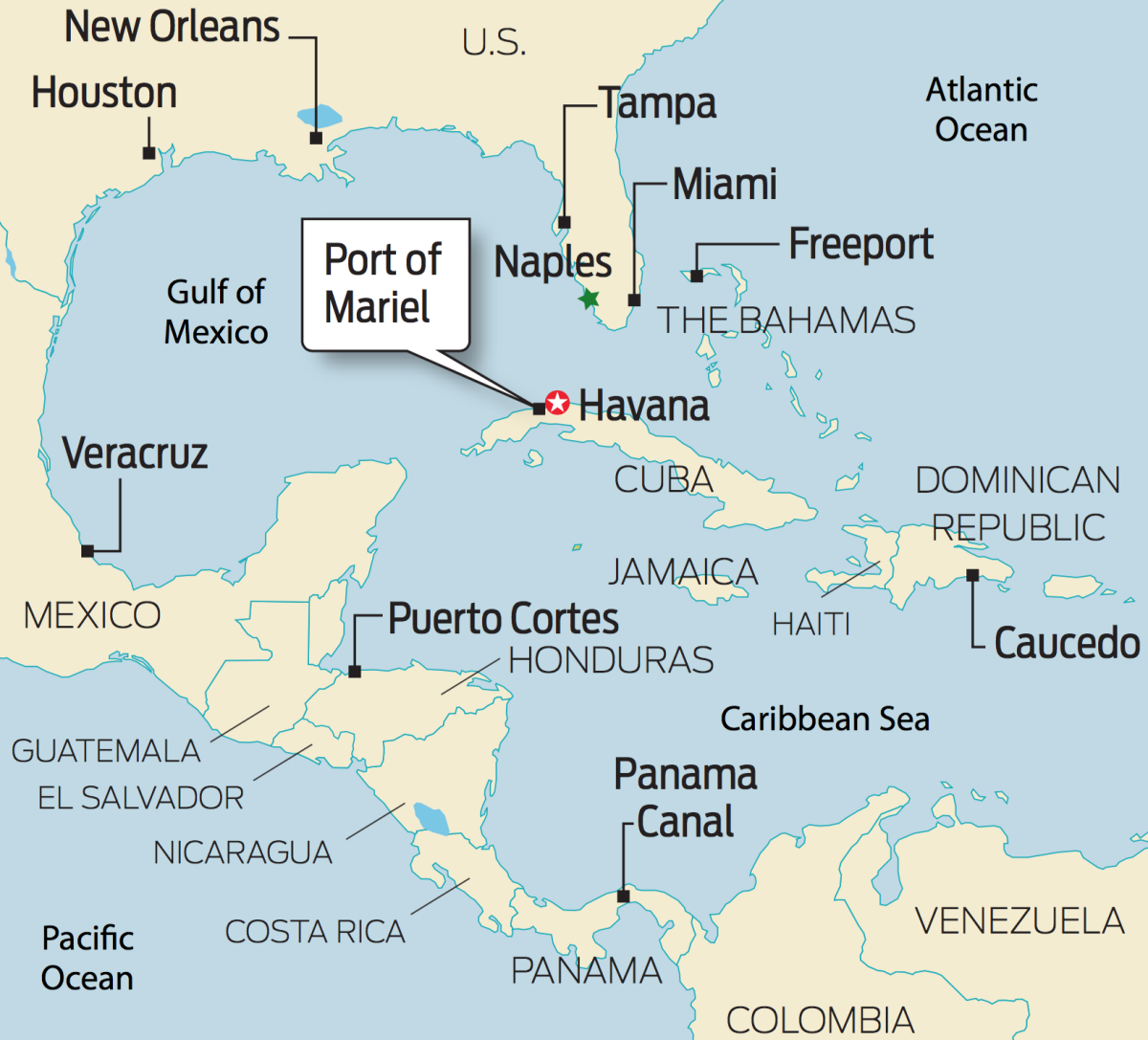
Havana (EFE) 15 May 2026: “The two international shipping companies that maintain operations with Cuba—Germany’s Hapag-Lloyd and France’s CMA CGM—have stopped accepting new orders linked to the island while they await an analysis of the potential consequences of the U.S. Executive Order expanding sanctions against Havana.

Link: https://efe.com/economia/2026-05-15/cuba-sanciones-empresas-navieras-industria-transporte-maritimo/ 

As confirmed to EFE by several industry sources who preferred to remain anonymous, both companies—which do not have a physical presence on the island but instead operate through agents—have taken measures to freeze, at least temporarily, the booking of cargo space. This development was first reported by the Cuban-American media outlet Cibercuba. 

Specifically, Hapag-Lloyd has issued what the industry terms a "stop booking" order. This measure has been in effect since last Wednesday and will remain in place—at the latest—until June 5. This date coincides with the deadline set by U.S. authorities for companies potentially affected by the new Executive Order to cease their activities linked to Cuba.  Industry experts clarify that "stop booking" orders are temporary measures—which can sometimes stem from technical issues (Hapag-Lloyd issued one last January due to congestion at a port)—and should be viewed more as a preventive action than as a precursor to a definitive decision. 

For its part, CMA CGM’s agent in Cuba has not yet received clear instructions from the French shipping line; however, according to industry sources, its operating system currently appears to be rejecting new bookings linked to the island.  Cuba’s maritime transport industry has a direct link to Gaesa—the business conglomerate of the Revolutionary Armed Forces (FAR)—which is responsible for at least 40% of the country's Gross Domestic Product (GDP), according to independent estimates, and was recently sanctioned under the latest U.S. Executive Order targeting Cuba.  In addition to controlling the tourism sector, domestic commerce in foreign currency, a portion of domestic transport, fuel distribution, and telecommunications, Gaesa is also in charge of ports, maritime terminals, customs services, and the Mariel Special Development Zone (ZEDM).”

Link To Related Analysis 

Crowley Maritime Of Jacksonville, Florida, Settles Cuba Libertad Act III Lawsuit For Use Of Port Mariel May 12, 2026
LINK TO COMPLETE ANALYSIS IN PDF FORMAT

Canada's Sherritt Reports That "dissolution [of GNC] is required as a result of a material adverse change that is an immediate change under the MSA and that there is inadequate time for arbitration"

TORONTO – Sherritt International Corporation (“Sherritt” or the “Corporation”) (TSX:S) provides a further update with respect to its decision of May 7, 2026 to suspend its direct participation in joint venture activities in Cuba in light of the Executive Order issued by the U.S. administration on May 1, 2026 expanding its sanctions against Cuba (the “Executive Order”).

Sherritt’s interests in Cuba consist of:

    A 50/50 partnership with General Nickel Company S.A. (“GNC”) of Cuba (the “Moa JV”). The Moa JV is a vertically integrated joint venture that mines, processes and refines nickel and cobalt for sale worldwide (except in the United States). Three corporations, of which Sherritt and GNC each ultimately holds 50%, carry out the operations of the Moa JV with one such entity carrying out mining activities in Cuba and the other such entity arranging for the acquisition and processing of the mined ore and marketing the finished products (collectively, the “Moa JV Cuba Corporations”) and one entity owning and operating the nickel and cobalt refinery in Saskatchewan (the “Canada Refinery Corporation”).

    Power generating assets held through Sherritt’s one-third interest in Energas S.A. (“Energas”), a Cuban joint venture established to process raw natural gas and generate electricity for sale to the Cuban national electrical grid.

    Oil and gas interests in two production-sharing contracts, each in the exploration phase (the “PSCs”), and an ancillary drilling services contract.

The Moa JV is governed by a shareholders’ agreement (the “Moa Shareholders’ Agreement”) which allows Sherritt to dissolve the Moa JV if U.S. sanctions are extended such that Sherritt cannot reasonably carry on a material business activity if it remains part of the Moa JV. The dissolution process under the Moa Shareholders’ Agreement requires the parties to mutually determine the fair market value of each of the Moa JV Cuba Corporations and the Canada Refinery Corporation and, if they cannot agree after three months, to have the matter determined by arbitration. After much deliberation, Sherritt has determined that the only way to preserve its ability to do business is by invoking its dissolution rights under the Moa Shareholders’ Agreement and implementing the related steps without delay.

Accordingly, Sherritt intends to deliver notice to GNC that dissolution is required as a result of a material adverse change that is an immediate change under the Moa Shareholders’ Agreement and that there is inadequate time for arbitration. Given the urgency of the adverse impacts of the Executive Order on the Corporation, Sherritt requires that the dissolution of the Moa JV take place immediately so as to result in Sherritt becoming the sole owner of the Canada Refinery Corporation and in GNC becoming the sole owner of the Moa JV Cuba Corporations. In connection with the foregoing, Sherritt will relinquish its interests in the Moa JV Cuba Corporations. As the value of the Moa JV Cuba Corporation that owns the Moa JV mine is expected to be higher than the value of the Canada Refinery Corporation, the dissolution process is expected to result in a fair market value equalization payment owing from GNC to Sherritt, in addition to the approximately $277 million owed from GNC to Sherritt.

Similarly, the Energas Association Agreement (the “Energas Agreement”) contains a dissolution provision in the event the parties are unable to perform specified obligations under the agreement or upon the occurrence of a force majeure. Sherritt has determined, in the circumstances, to surrender its interest in Energas and to give notice of dissolution pursuant to the Energas Agreement. Sherritt has also determined to surrender its interests in the PSCs and drilling services contract and intends to give notice to the relevant parties of the same. Sherritt anticipates that it will receive no consideration in respect of the foregoing interests.

While both the Moa Shareholders’ Agreement and the Energas Agreement contemplate dissolution, the process contemplated by the agreements will take a minimum of several months and possibly several years. To expedite this process, Sherritt has determined to seek relief from the Alberta Court of King’s Bench to facilitate accelerated dissolution to the extent possible. Sherritt is scheduled to appear before the Court on May 19, 2026 to seek this relief.

The intended outcome of the foregoing actions is to allow Sherritt to most definitively address the Executive Order by eliminating Sherritt’s Cuban interests. Further, the separation from Cuba may assist Sherritt in addressing issues that could arise from the Executive Order such as difficulties in obtaining an auditor or banking services. Sherritt has informed Cuban authorities of its intent to take these steps, and will work with its stakeholders to implement these steps as soon as practicable. There is no certainty however that such outcomes will be achieved.

The Corporation will continue to provide information on material developments to its shareholders and other stakeholders.

About Sherritt

Sherritt is a world leader in using hydrometallurgical processes to mine and refine nickel and cobalt – metals deemed critical for the energy transition. Leveraging its technical expertise and decades of experience in critical minerals processing, Sherritt is committed to expanding domestic refining capacity and reducing reliance on foreign sources. The Corporation operates a strategically important refinery in Alberta, Canada, recognized as the only significant cobalt refinery and one of just three nickel refineries in North America.

Sherritt’s common shares are listed on the Toronto Stock Exchange under the symbol “S”.

Forward-Looking Statements

Certain statements and other information included in this press release may constitute “forward -looking information” or “forward-looking statements” (collectively, “forward-looking statements”) under applicable securities laws (such statements are often accompanied by words such as “anticipate”, “forecast”, “expect”, “believe”, “may”, “will”, “should”, “estimate”, “intend” or other similar words). All statements in this press release, other than those relating to historical information, are forward-looking statements. Forward-looking statements in this press release include, without limitation, statements regarding the impact on Sherritt of the Executive Order; the dissolution of the Moa JV and implementation of related steps, including recovery of amounts from GNC; the dissolution and surrender of the Corporation’s interests in Energas, the PSCs and the drilling services contract and implementation of related steps; the outcome of the relief being sought by the Corporation from the Alberta Court of Kings Bench; and the intended outcome of the actions taken by Sherritt to surrender its Cuban interests.

The Corporation cautions readers of this press release not to place undue reliance on any forward-looking statement as a number of factors could cause actual future results, conditions, actions or events to differ materially from the targets, expectations, estimates or intentions expressed in the forward-looking statements. Such factors include, without limitation, continued risks related to Sherritt’s operations in Cuba and future actions taken by the U.S. government toward Cuba, including with respect to the Executive Order; level of liquidity of Sherritt, including access to capital and financing; the risk to or loss of Sherritt’s entitlements to future distributions (including pursuant to the Cobalt Swap) from the Moa JV; the inability of the Corporation to comply with debt restrictions and covenants; the inability of the Corporation to comply with the listing requirements of the Toronto Stock Exchange or another recognized stock exchange; uncertainty in the ability of the Corporation to enforce legal rights in foreign jurisdictions including as it relates to the intended outcome of dissolving and surrendering the Corporation’s interests in Cuba; uncertainty regarding the interpretation and/or application of the applicable laws in foreign jurisdictions; tax risks, including as it relates to the dissolution and surrender of the Corporation’s interests in Cuba and implementation of related steps; political, economic and other risks of foreign operations; security market fluctuations and price volatility; risks related to environmental liabilities including liability for reclamation costs, tailings facility failures and toxic gas releases; compliance with applicable environment, health and safety legislation and other associated matters; risks associated with governmental regulations regarding climate change and greenhouse gas emissions; risks relating to community relations; maintaining social license to grow and operate; risks associated with the operation of large projects generally; the ability to replace depleted mineral reserves; risks associated with the Corporation’s joint venture partners; risks associated with mining, processing and refining activities; reliance on key personnel and skilled workers; risks related to the Corporation’s corporate structure; foreign exchange and pricing risks; credit risks; future market access; interest rate changes; risks in obtaining insurance; uncertainties in labour relations; legal contingencies; risks related to the Corporation’s accounting policies; uncertainty in the ability of the Corporation to obtain government permits; failure to comply with, or changes to, applicable government regulations. The key risks and uncertainties should be considered in conjunction with the risk factors described in the Corporation’s other documents filed with the Canadian securities authorities, including without limitation the “Managing Risk” section of the Management’s Discussion and Analysis for the three months and year ended December 31, 2025 and the Annual Information Form of the Corporation dated March 23, 2026 for the period ending December 31, 2025, which is available on SEDAR+ at www.sedarplus.ca. The forward-looking information and statements contained in this press release are made as of the date hereof and the Corporation undertakes no obligation to update publicly or revise any oral or written forward-looking information or statements, whether as a result of new information, future events or otherwise, except as required by applicable securities laws. The forward-looking information and statements contained herein are expressly qualified in their entirety by this cautionary statement.

Trump Administration Cuba Sanctions Hits Another Canada-Connected Target: Accounting Firm Deloitte LLP Resigns From Sherritt Account

TORONTO – Sherritt International Corporation (“Sherritt” or the “Corporation”) (TSX:S) announces that Deloitte LLP has formally resigned as the Corporation’s external auditor, effective May 12, 2026. The resignation was not the result of any disagreement between the Corporation and Deloitte on any matter of accounting principles or practices, financial statement disclosure, or auditing scope or procedure. Deloitte’s reports on the Corporation’s previously issued financial statements did not contain any adverse opinion or a disclaimer of opinion, and was not qualified or modified as to uncertainty, audit scope, or accounting principles. Sherritt has commenced a request for proposal process for external audit services to identify a successor auditor. However, the Executive Order (as defined below) may affect the availability of, or willingness of, certain external audit firms to accept an engagement with the Corporation and may lengthen the time required to identify and appoint a successor auditor.

The Corporation also announces that Yasmin Gabriel has resigned as Chief Financial Officer of the Corporation, effective today. The Corporation thanks Ms. Gabriel for her many years of committed service and valued contributions and wishes her well in her future endeavors.

Filing of Quarterly Financial Statements

As a result of the foregoing developments, the Corporation anticipates that it will be unable to file its first quarter 2026 financial statements, management’s discussion and analysis and related officer certifications on May 15, 2026. Accordingly, it anticipates that the Ontario Securities Commission will issue a Failure to File Cease Trade Order (“FFCTO”). The FFCTO would prohibit trading in the Corporation’s securities in Canada, including through the Toronto Stock Exchange, and would remain in effect until the required documents are filed.

Sherritt’s ability to complete its quarterly filings has been constrained by the above-noted resignations and by recent operational and governance disruptions as a result of the U.S. administration’s issuance of an Executive Order on May 1, 2026 expanding sanctions against Cuba (the “Executive Order”).

The Corporation is seeking to mitigate these constraints and will continue to provide information on material developments to its shareholders and other stakeholders.

About Sherritt

Sherritt is a world leader in using hydrometallurgical processes to mine and refine nickel and cobalt – metals deemed critical for the energy transition. Leveraging its technical expertise and decades of experience in critical minerals processing, Sherritt is committed to expanding domestic refining capacity and reducing reliance on foreign sources. The Corporation operates a strategically important refinery in Alberta, Canada, recognized as the only significant cobalt refinery and one of just three nickel refineries in North America.  Sherritt’s common shares are listed on the Toronto Stock Exchange under the symbol “S”.

Forward-Looking Statements

Certain statements and other information included in this press release may constitute “forward -looking information” or “forward-looking statements” (collectively, “forward-looking statements”) under applicable securities laws (such statements are often accompanied by words such as “anticipate”, “forecast”, “expect”, “believe”, “may”, “will”, “should”, “estimate”, “intend” or other similar words). All statements in this press release, other than those relating to historical information, are forward-looking statements. Forward-looking statements in this press release include, without limitation, statements regarding the request for proposal process; the appointment of a new external auditor; the Corporation’s first quarter 2026 financial results; and the issuance of the FFCTO.

The Corporation cautions readers of this press release not to place undue reliance on any forward-looking statement as a number of factors could cause actual future results, conditions, actions or events to differ materially from the targets, expectations, estimates or intentions expressed in the forward-looking statements. The key risks and uncertainties should be considered in conjunction with the risk factors described in the Corporation’s other documents filed with the Canadian securities authorities, including without limitation the “Managing Risk” section of the Management’s Discussion and Analysis for the three months and year ended December 31, 2025 and the Annual Information Form of the Corporation dated March 23, 2026 for the period ending December 31, 2025, which is available on SEDAR+ at www.sedarplus.ca. The forward-looking information and statements contained in this press release are made as of the date hereof and the Corporation undertakes no obligation to update publicly or revise any oral or written forward-looking information or statements, whether as a result of new information, future events or otherwise, except as required by applicable securities laws. The forward-looking information and statements contained herein are expressly qualified in their entirety by this cautionary statement.

Wikipedia: “Deloitte is a multinational professional services network based in London, England. It is the largest professional services network in the world by revenue and number of employees, and is one of the Big Four accounting firms, along with EY, KPMG, and PwC. The Deloitte network is composed of member firms of Deloitte Touche Tohmatsu Limited, a private company limited by guarantee incorporated in England and Wales.”

Subtle Change? U.S. Secretary Of State Rubio About Current Government Of Cuba Officials Implementing Economc Changes Is Not Optimistic, But "We’ll give them a chance." 

United States Department of State
Washington DC
14 May 2026

Aboard Air Force One
Secretary of State Marco Rubio With Sean Hannity of Fox News Channel

QUESTION:  Yeah.  Let’s go to the Western Hemisphere.  And what is the relationship with Venezuela?  And I know it’s got to be an issue near and dear to your heart.

SECRETARY RUBIO:  Yeah.

QUESTION:  I know your family background, and that’s Cuba. 

SECRETARY RUBIO:  Well, on Venezuela it’s been four months, so I think we’ve made some steady progress on improving Venezuela.  Look, we’re trying to normalize that place.  This is a place where – a country of incredible wealth, but all the wealth was being stolen.  It wasn’t going to benefit the Venezuelan people.  So we’ve created mechanisms.  All the money they make on oil now goes into a bank account in New York, and it’s audited by KPMG, and it’s being used to pay the salaries of teachers and firefighters and police officers and university professors.  So for the first time in over a decade, the wealth of the country is actually benefitting the people of Venezuela.  But there’s more work to be done. 

Ultimately, as we work through this process, we will have to reach a stage of transition where you’re going to have to normalize your government.  There’s going to have to be a process that’s legitimate that people look at and say this is – this is a legitimate, permanent government – presidency, elections, things of that nature.  That moment has to arrive, but it has to be – we don’t want to wait too long.  We want to see it happen.  But you don’t want to move too fast either because the whole thing can break.  So it’s a difficult thing to manage, but it’s only four months in, and I’m very – I think we should be pleased.  Venezuela is a better place today than it was four months ago, but it needs to continue to stay on that path.

And the case of Cuba is a very different situation.  There is no economy in Cuba.  To the extent there’s any wealth in Cuba, it doesn’t go – it doesn’t – forget about it doesn’t go to the people.  It doesn’t even go to the government.  The wealth is controlled by a private – by a company owned by military generals.  They take all the money.  They’re sitting on billions of dollars, okay?  This is a country where people are literally now eating garbage from the streets, but they have a company that controls all of the moneymaking there that’s sitting on $15-16 billion.

So it’s a broken, nonfunctional economy, and it’s impossible to change it.  I wish it were different.  But I believe – it’s my personal opinion – you cannot change the economic trajectory of Cuba as long as the people who are in charge of it now are in charge of it.  That’s what’s going to have to change because these people have proven incapable.  I hope I’m wrong.  We’ll give them a chance.  But I don’t think it’s going to happen.  I don’t think we’re going to be able to change the trajectory of Cuba as long as these people are in charge in that regime.

QUESTION:  If these people are not in charge, I mean, I can envision American wealth and companies – it would be – it could become —

SECRETARY RUBIO:  Yeah, I —

QUESTION:  — the destination —

SECRETARY RUBIO:  The one thing Cuba would enjoy is an enormous expatriate community, Cuban Americans that would go back and invest.  But I think there would be interest globally.  Look, they have significant mineral deposits in Cuba.  One of the – and some of the rare earth minerals, some of the best in the world.  They have, obviously, an incredible opportunity with tourism, with agriculture – very rich farmland.  So Cuba should not be a poor country.  Its people should not be starving.  Its people should be prosperous.  And what’s most interesting is you see Cubans everywhere in the world – in the United States, but you see them in Europe, you see them in Panama.  Cubans leave Cuba, they go to other countries, and they become successful.  The only place in the world where Cubans can’t seem to prosper and succeed is in Cuba.

DHS Reminds That Cuba Is On List Of Countries "assessed and not maintaining effective antiterrorism measures"

Department of Homeland Security
Washington DC


[Docket No. USCG-2025-0097]
AGENCY: Coast Guard, DHS.
ACTION: Notice.
SUMMARY: The U.S. Coast Guard announces that it is revoking port facility exemptions from the Port Security Advisory for Equatorial Guinea.
DATES: The policy announced in this notice is effective on May 27, 2026.
FOR FURTHER INFORMATION CONTACT: For information about this document call or email Mr. Edward Munoz, Division Chief, International Port Security Assessments, U.S. Coast Guard, telephone 202-372-2122, HQS-DG-IPSProgramHQs@uscg.mil.
SUPPLEMENTARY INFORMATION: Background and Purpose

The authority for this notice is 5 U.S.C. 552(a) (“Administrative Procedure Act”), 46 U.S.C. 70110 (“Maritime Transportation Security Act”), and Department of Homeland Security Delegation No. 0170.1(II)(97)(f). As delegated, section 70110(a) authorizes the U.S. Coast Guard to impose conditions of entry on vessels arriving in U.S. waters from ports that the U.S. Coast Guard has not found to maintain effective antiterrorism measures.

Effective antiterrorism measures require government oversight and security functions like risk assessments, drills, enforcement, and intelligence sharing cannot be delegated to individual facilities. Without proper oversight, exempted facilities may lack the necessary approvals, enforcement mechanisms, and broader security coordination, increasing vulnerabilities to the marine transportation system. The U.S. Coast Guard has determined that the government of Equatorial Guinea lacks proper oversight of its facilities. Accordingly, the U.S. Coast Guard is revoking port facility exemptions for Equatorial Guinea. With this notice, the current list of countries assessed and not maintaining effective antiterrorism measures is as follows: Cambodia, Cameroon, Comoros, Cuba, Democratic People's Republic of Korea (North Korea), Equatorial Guinea, Gambia (The), Guinea-Bissau, Iran, Iraq, Libya, Madagascar, Micronesia (Federated States of), Nauru, Nigeria, Sao Tome and Principe, Seychelles, Sudan, Suriname, Syria, Timor-Leste, Venezuela, and Yemen. The current Port Security Advisory is available at: http://www.dco.uscg.mil/Our-Organization/Assistant-Commandant-for-Prevention-Policy-CG-5P/International-Domestic-Port-Assessment/.

Nathan A. Moore, Vice Admiral, Deputy Commandant for Operations, U.S. Coast Guard.
[FR Doc. 2026-09503 Filed 5-12-26; 8:45 am] BILLING CODE 9110-04-P

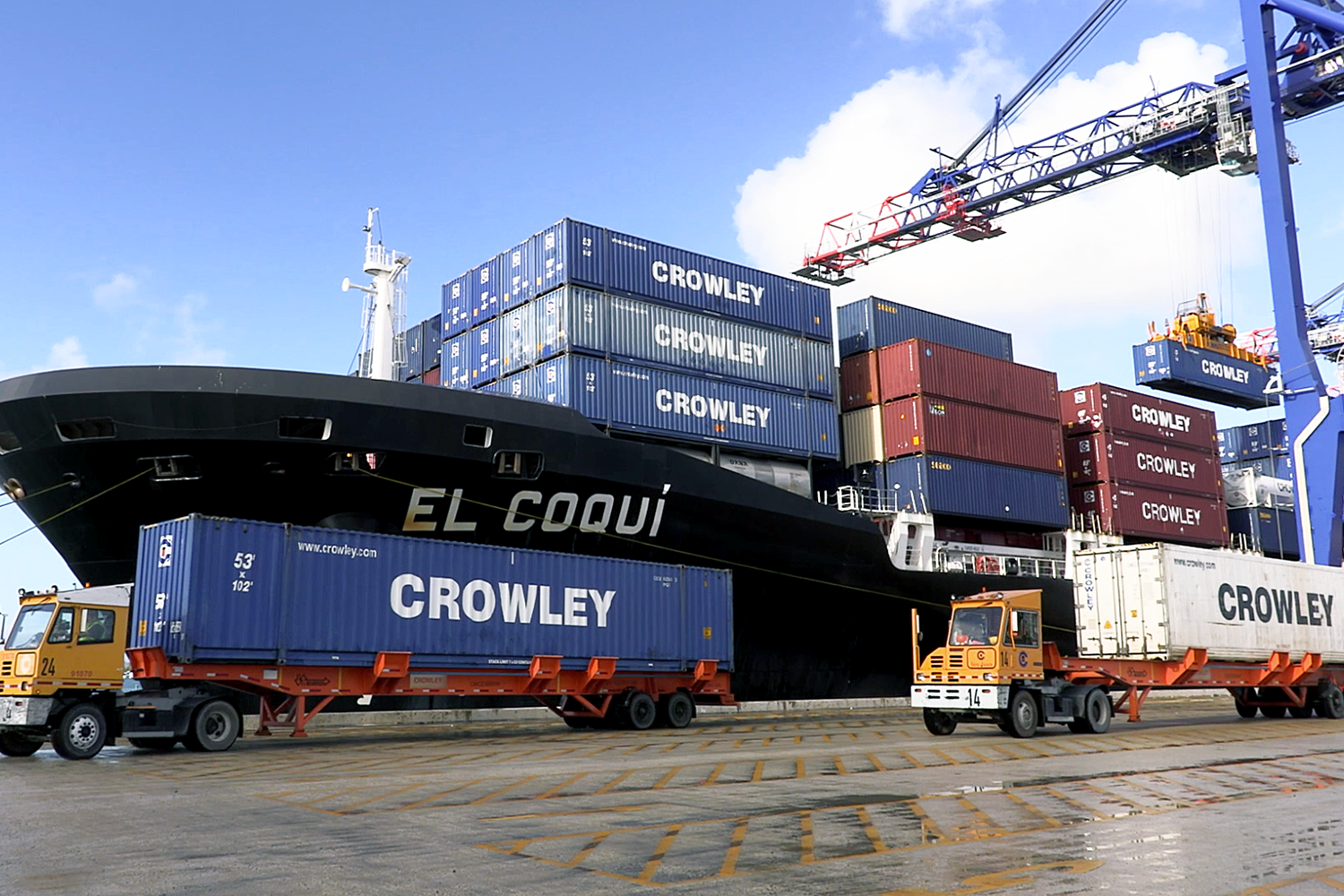
Crowley Maritime Of Jacksonville, Florida, Settles Cuba Libertad Act III Lawsuit For Use Of Port Mariel

ODETTE BLANCO DE FERNANDEZ née BLANCO ROSELL, Plaintiff, v. CROWLEY MARITIME CORPORATION, Defendant. [3:20-cv-01426 Middle District Florida; Transferred To Florida Southern District 1:21-cv-20443].  Case settled on 5 February 2026.

Murphy & Anderson, P.A. (plaintiff)
Berliner Corcoran & Rowe LLP (plaintiff)
Fields PLLC (plaintiff)
Law Offices of John S. Gaebe P.A. (plaintiff)
Horr, Novak & Skipp P.A. (plaintiff)
Venable LLP (defendant)

04/28/2026- PAPERLESS ORDER Dismissing Case with prejudice pursuant to 193 the Joint Stipulation of Dismissal with Prejudice. Signed by Judge Darrin P. Gayles on 4/28/2026. (hs01)04/24/2026 STIPULATION of Dismissal Joint Stipulation of Dismissal with Prejudice by Odette Blanco De Fernandez (Gaebe, John)
02/05/2026- PAPERLESS ORDER administratively closing case in light of 191 the Joint Notice of Confidential Settlement, which indicates that this matter has settled in principle. The parties are hereby notified that, within sixty (60) days of the date of this Order, they must file a Stipulation or Notice of Dismissal and/or Settlement Agreement along with any other pertinent document necessary to conclude this action. Any pending motions are denied as moot. Signed by Judge Darrin P. Gayles on 2/5/2026. (hs01) 
02/05/2026- NOTICE of Settlement Joint Notice of Confidential Settlement by Odette Blanco De Fernandez (Gaebe, John)

(2/5/26) JOINT NOTICE OF CONFIDENTIAL SETTLEMENT
Pursuant to S.D. Fla. L.R. 16.4, Plaintiff Odette Blanco de Fernandez née Blanco Rosell (“Plaintiff”) and Defendants Crowley Holdings, Inc., Crowley Maritime Corporation, Crowley Liner Services, Inc., Crowley Latin America Services, LLC, and Crowley Logistics, Inc. (“Defendants”) (collectively, the “Parties”), by and through their respective undersigned counsel, hereby notify the Court as follows: 1. The Parties participated in a mediation with Hon. Michael Hanzman (rtd.) of Bilzin Sumberg Baena Price & Axelrod LLP.  2. On January 30, 2026, the Parties reached a settlement in principle.  3. Having reached a settlement in principle, the Parties are in the process of preparing and executing a final settlement agreement. The Parties intend to have a final settlement agreement completed on or before March 4, 2026.  4. Upon execution of a final settlement agreement, the Parties will file a stipulation of dismissal.

(2/24/26) JOINT STIPULATION OF DISMISSAL WITH PREJUDICE
Plaintiff Odette Blanco de Fernandez née Blanco Rosell (“Plaintiff”) and Defendants Crowley Holdings, Inc.; Crowley Maritime Corporation; Crowley Liner Services, Inc.; Crowley Latin America Services, LLC; and Crowley Logistics, Inc., (“Defendants”) (collectively, the “Parties”), by and through their respective undersigned counsel, hereby stipulate as follows: 1. Pursuant to Federal Rule of Civil Procedure 41(a)(1)(A)(ii), the Parties stipulate to dismissal of this action, including all claims asserted herein, with prejudice as to all Defendants.

Link: Crowley Maritime Corporation Is 32nd Libertad Act Lawsuit- Plaintiffs Target Use Of ZEDM Port December 23, 2020

Link: Libertad Act Title III Lawsuit Filings Data/Statistics Since 2019

U.S. Ag/Food Exports To Cuba Decrease .85% For January-March 2026. Down 20.8% Year-To-Year. US$10.8 Million Vehicles And Parts. US$8.7 Million Fuels. US$18,490.00 Surfboard/Water Equipment

ECONOMIC EYE ON CUBA©
May 2026

March 2026 Ag/Food Exports To Cuba Increase .85% -
Year-To-Year Decrease 20.8%
51st Of 219 May 2026 U.S. Food/Ag Export Markets- 2
Year-To-Year Ranking 52nd Of 219 U.S. Ag/Export Markets- 2
Re-Emerging Private Sector Exports Continue To Increase – 3
Trump-Vance Administration Fuels Authorization- US$8,788,501.00
March 2026 CDA Healthcare Product Exports US$796,324.00 - 6
March 2026 Humanitarian Donations US$13,290,606.00 – 7
U.S. Port Export Data- 20


MARCH 2026 AG/FOOD EXPORTS TO CUBA INCREASE .85%- Exports of food products and agricultural commodities from the United States to the Republic of Cuba were US$36,967,947.00 in March 2026 compared to US$36,655,397.00 in March 2025 and US$40,624,058.00 in March 2024. 

US$102,799,469.00 thus far in 2026 compared with US$129,824,213.00 during the same period in 2025 representing a decrease of 20.8% year-to-year.

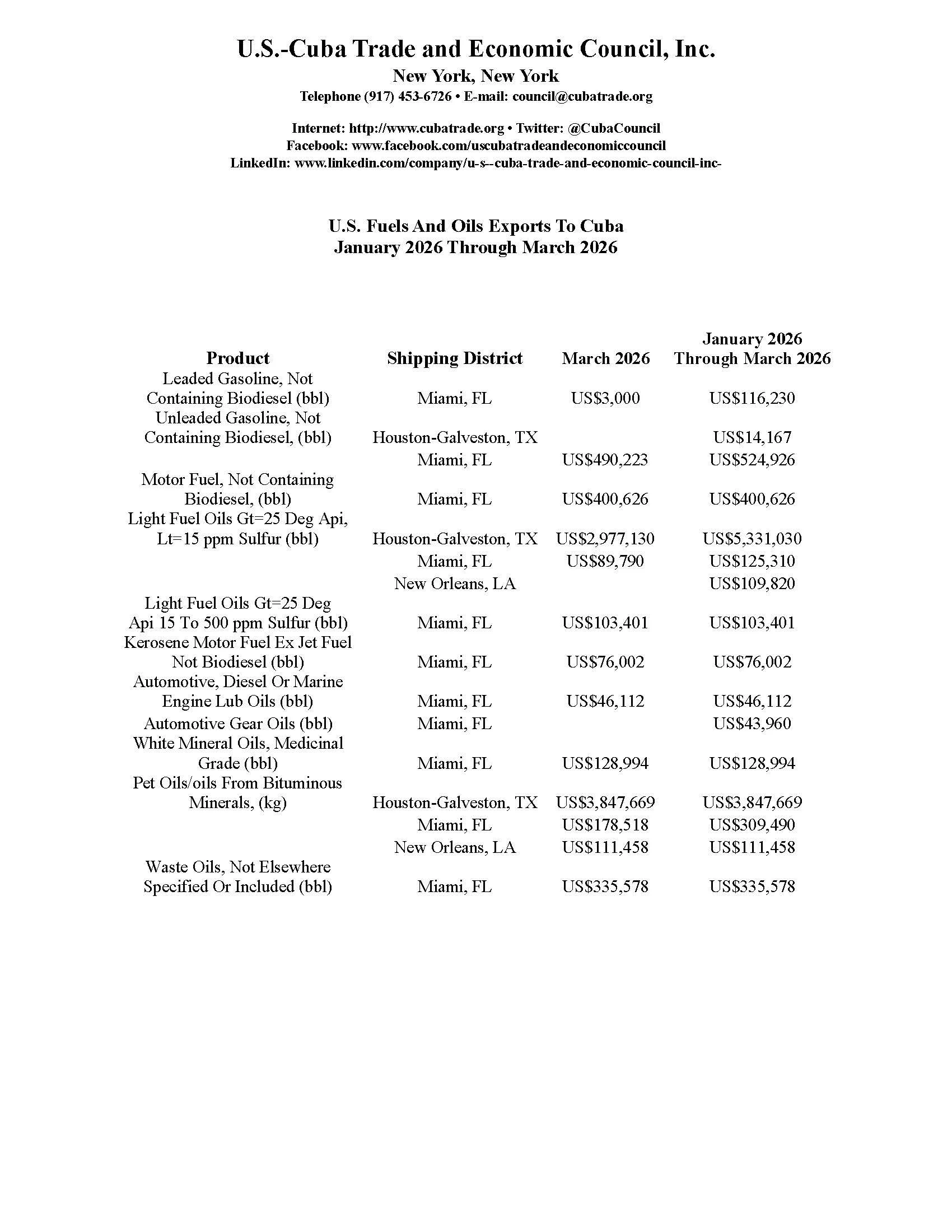
March 2026 highlights: US$527,132.00 (Fresh Eggs), US$335,578.00 (Waste Oils), Women’s Or Girls’ Dresses Synthetic Fibers (US$14,640.00), Building Blocks, Bricks Of Cement (US$2,600.00),

Since 2022, when the first BIS license was issued for the export of vehicles to Republic of Cuba nationals and to private companies in the Republic of Cuba, the cumulative export value of the initiatives in place during the Obama-Biden Administration, Trump-Pence Administration, Biden-Harris Administration, and Trump-Vance Administration exceeds US$427 million of which electric and gasoline-powered new and used vehicles, bicycles, trucks, motorcycles and mopeds, and parts, exceeds US$253 million (Year 2026: US$27,234,853.00; Year 2025: US$149,413,031.00; Year 2024: US$67,241,234.00; Year 2023: US$10,546,419.00; Year 2022: US$89,848.00), and purchases (equipment and products) for use by the re-emerging private sector in the Republic of Cuba driving the growth.

The data contains information on exports from the United States to the Republic of Cuba- products within the Trade Sanctions Reform and Export Enhancement Act (TSREEA) of 2000, Cuban Democracy Act (CDA) of 1992, and regulations implemented (1992 to present) for other products by the Office of Foreign Assets Control (OFAC) of the United States Department of the Treasury, Bureau of Industry and Security (BIS) of the United States Department of Commerce, and United States Department of State.

The TSREEA re-authorized the direct commercial (on a cash basis) export of food products (including branded food products) and agricultural commodities from the United States to the Republic of Cuba, irrespective of purpose. The TSREEA does not include healthcare products, which remain authorized and regulated by the CDA.

The data represents the U.S. Dollar value of product exported from the United States to the Republic of Cuba under the TSREEA, CDA, and other regulations, specifically including products exported from the United States to the re-emerging private sector in the Republic of Cuba.

The data does not include transportation charges, bank charges, or other costs associated with exports; the government of the Republic of Cuba reports unverifiable data that includes transportation charges, bank charges, and other costs.

LINK TO COMPLETE REPORT IN PDF FORMAT

LINKS TO U.S. PORT EXPORT DATA
January 2026
February 2026
March 2026

LINK TO COMPLETE LIST OF PRODUCTS IN 2025 EXPORTED FROM THE UNITED STATES TO CUBA

LINK TO COMPLETE LIST OF PRODUCTS IN 2024 EXPORTED FROM THE UNITED STATES TO CUBA

Havana Times

Delta Air Lines Is Defendant In Cuba Libertad Act Title III Lawsuit For Use Of Airport In Cuba

IN THE UNITED STATES DISTRICT COURT FOR THE SOUTHERN DISTRICT OF FLORIDA
CASE NO.: 25-25575-CIV-MORENO
JOSE RAMON LOPEZ REGUEIRO, Plaintiff, v. DELTA AIR LINES, INC., Defendant.


Rivero Mestre LLP (defendant)
Boies Schiller Flexner LLP (plaintiff)


11/26/25- THE ACTION

Jose Ramón López Regueiro sues defendant Delta Airlines, Inc. (“DAL”), under the Cuban Liberty and Democratic Solidarity Act, 22 U.S.C. § 6021, et seq. (the “Libertad Act”), for unlawful trafficking in his confiscated property in Cuba.

4/28/26- DELTA AIR LINES’ MOTION TO DISMISS AND CLAIM OF UNCONSTITUTIONALITY

Since 2016, the United States government has expressly authorized Defendant Delta Air Lines to provide scheduled flights from the U.S. to the José Martí International Airport in Havana (the “Airport”). Over the next decade, Delta’s Havana flights allowed countless Americans to engage in licensed travel to Cuba, consistent with federal policy. Now, six years after intimating that he would sue Delta and six years after he launched similar claims against other airlines, Plaintiff Jose Ramon Lopez Regueiro now asserts that Delta’s approved use of the Airport constitutes trafficking in confiscated property. Lopez Regueiro’s reluctance to sue Delta was warranted because his suit is legally barred many times over.

First, Lopez Regueiro acquired his uncertified claim (the “Claim”) too late. The Helms-Burton Act required him to acquire the Claim before March 12, 1996. But documents attached to the Complaint reveal that he had no possession or control of any claim until at the earliest 2010.  Indeed, the Complaint and its attachments reveal that Lopez Regueiro was a Cuban National who could not have inherited any assets from Jose Lopez Vilaboy (who died in the United States) before 1996, because the Cuban sanctions regime blocked such transfers.

Second, this suit is barred by Delta’s own certified claim. Indeed, this is the first Helms-Burton suit brought against a certified claimant by someone with an uncertified claim including the same property. Here, Plaintiff Lopez Regueiro alleges that he inherited an uncertified claim to the Airport. He asserts that Delta “trafficked” in that Airport by flying to it. But in 1962, the Cuban government confiscated Delta’s property in Cuba—including offices at the Airport—and the United States Foreign Claims Settlement Commission (“FCSC”) certified Delta’s claim to that confiscated property. The Helms-Burton Act was intended to benefit certified claimholders, not to expose them to suits by those lacking such claims.

Third, the suit also fails as a matter of law because, on its face, it alleges only that Delta engaged in lawful travel to Cuba, based on judicially noticeable federal orders expressly authorizing Delta to use this Airport.

Fourth, if the case cannot be resolved on these statutory grounds, the suit must be dismissed because the Helms-Burton Act’s private right of action is unconstitutional: Congress may not create a right of action that can be “suspended” at will by the President, as is the case here.

Complaint

Defendant Motion To Dismiss

Libertad Act Title III Lawsuit Filings Data/Statistics Since 2019

Iberostar Of Spain Settles Cuba Libertad Title III Lawsuit. European Union Tested Limits Of U.S. Courts.

MARIA DOLORES CANTO MARTI, AS PERSONAL REPRESENTATIVE OF THE ESTATES OF DOLORES MARTI MERCADE AND FERNANDO CANTO BORY V. IBEROSTAR HOTELES Y APARTAMENTOS SL [1:20-cv-20078; Southern Florida District; 21-11906 11th Circuit Court of Appeals] 

Zumpano Patricios P.A. (plaintiff)
Bird & Bird (defendant)
Holland & Knight (defendant) 

JOINT NOTICE OF SETTLEMENT 
Plaintiffs1 and Defendants2 (collectively, the “Parties”) reached a confidential settlement at the mediation held by Mediator Barbara Locke on August 25, 2025. All parties have signed a Binding and Confidential Settlement Term Sheet and anticipate executing a more formal confidential Settlement Agreement by next week. Upon executing the more formal confidential Settlement Agreement, the Parties will file a joint dismissal of this action with prejudice, with the Court retaining jurisdiction to enforce the terms of the settlement set forth in the Binding and Confidential Settlement Term Sheet and/or more formal Settlement Agreement.  Dated: August 29, 2025

JOINT STIPULATION BY ALL PARTIES FOR DISMISSAL WITH PREJUDICE 
Plaintiffs1 and Defendants2 (collectively, the “Parties”), by and through undersigned counsel and pursuant to Federal Rule of Civil Procedure 41(a)(1)(A)(ii) and the terms of their Binding and Confidential Settlement Term Sheet and Confidential Settlement Agreement, hereby stipulate to the dismissal, with prejudice, of this action subject to the Court’s entry of an order referenced in the next sentence. The effectiveness of this stipulation of dismissal is conditioned upon the Court’s entry of an order retaining jurisdiction to enforce the terms of the parties’ settlement agreement.  Dated: September 8, 2025

ORDER OF DISMISSAL 
The parties have dismissed this suit with prejudice in accordance with Federal Rule of Civil Procedure 41(a)(1)(A)(ii). (Joint Stip. for Dismissal, ECF No. 240.) The Court reserves jurisdiction to enforce the parties’ settlement agreement. The Court directs the Clerk to close this case. All pending motions, if any, are denied as moot.  Done and ordered in Miami, Florida, on September 9, 2025.

09/09/2025- Order of Dismissal (With Prejudice) Case Closed.   Signed by Senior Judge Robert N. Scola, Jr on 9/9/2025. See attached   document for full details. (gqa)
09/08/2025- STIPULATION of Dismissal Joint Stipulation by All   Parties For Dismissal with Prejudice by Roseanne Bradford, Enrique Canto   Marti, Fernando Jose Ignacio Canto Marti, Graciela Maria Canto Marti, Javier   Enrique Canto Marti, Maria Dolores Canto Marti, Roberto Jose Canto Marti,   Bernard Zumpano, Carlos Zumpano, Daniel Zumpano, Joseph Zumpano (Zumpano, Joseph)
08/29/2025- Order Administratively Closing Case upon Notice of   Settlement. By September 26, 2025, the Plaintiffs must file a stipulation of   dismissal, under Federal Rule of Civil Procedure 41(a)(1)(A)(ii), or a motion   to dismiss, consistent with Rule 41(a)(2). Signed by Senior Judge Robert N.   Scola, Jr on 8/29/2025. See attached document for full details. (gqa)   
08/29/2025- FINAL MEDIATION REPORT held before Mediator Barbara Locke.   Prepared by: Barbara Locke. Filed by Barbara Locke. Disposition: Settled in   full. Mediation held/partially held via video-conference. (Locke, Barbara) 
08/29/2025- NOTICE of Settlement (Joint with Defendants) by   Roseanne Bradford, Enrique Canto Marti, Fernando Jose Ignacio Canto Marti,   Graciela Maria Canto Marti, Javier Enrique Canto Marti, Maria Dolores Canto   Marti, Roberto Jose Canto Marti, Bernard Zumpano, Carlos Zumpano, Daniel  Zumpano, Joseph Zumpano (Patricios, Leon) 

Canto Marti v. Iberostar Hoteles Y Apartamentos SL   
Assigned to: Senior Judge Robert N. Scola, Jr   
Referred to: Magistrate Judge Enjolique A. Lett (Settlement)
Case in other court: USCA, 21-11906-AA
Cause: 22:6082 Cuban Liberty and Democratic Solidarity Act   of 1996
Date Filed: 01/08/2020   
Date Terminated: 08/29/2025   
Jury Demand: Plaintiff   
Nature of Suit: 890 Other Statutory Actions   
Jurisdiction: Federal Question

Libertad Act Title III Lawsuit Filings Data/Statistics Since 2019

Links

Iberostar Hoteles Of Spain Sued By Former Property Owner In Cuba Using Libertad Act April 17, 2020 

EC Now Has To Decide What It Perhaps Doesn’t Want To Decide- Iberostar Of Spain Libertad Act Lawsuit Is First To Report U.S. Court Recognizing EC’s Interest In Title III Lawsuits April 26, 2020 

Libertad Act Lawsuit Against Iberostar Of Spain Returns To Circuit Court. International Comity Does Not Tolerate Inaction For Three Years. Iberostar, IHG Forge Alliance- Except Cuba Properties. March 01, 2023

American Airlines Settles Cuba Libertad Act Title III Lawsuit Relating To Jose Marti International Airport In Havana

JOSE RAMON LOPEZ REGUEIRO V. AMERICAN AIRLINES INC. AND LATAM AIRLINES GROUP, S.A. [1:19-cv-23965; Southern Florida District].  Dismissed with prejudice on 6/30/22; Settlement 2/19/26

Rivero Mestre LLP (plaintiff)
Manuel Vazquez, P.A. (plaintiff)
Jones Day (defendant)
Akerman (defendant)

03/03/2026- STIPULATION of Dismissal with Prejudice by Jose Ramon Lopez Regueiro (Rivero, Andres)
02/19/2026- ORDER on Notice of Settlement. The above-styled action is administratively CLOSED without prejudice to the parties to file a Stipulation for Dismissal within thirty (30) days of the date of this Order. Signed by Judge Jose E. Martinez on 2/19/2026. See attached document for full details. (blc) 
02/19/2026- NOTICE of Settlement Joint Notice of Settlement by American Airlines Inc. (Puente, Ricardo)

JOINT STIPULATION OF DISMISSAL WITH PREJUDICE 
Pursuant to Federal Rule of Civil Procedure 41(a)(1)(A)(ii), Plaintiff Jose Ramon Lopez-Regueiro and American Airlines, Inc., by and through their respective undersigned counsel, hereby stipulate to the dismissal with prejudice of all claims in the above-captioned action, with each party to bear his or its own attorneys’ fees and costs.  Dated: March 3, 2026

JOINT NOTICE OF SETTLEMENT
PLEASE TAKE NOTICE that Plaintiff, Jose Ramon Lopez-Regueiro and Defendant, American Airlines, Inc. (“American”), have settled the above-referenced case. The parties anticipate filing a Joint Stipulation of Dismissal with Prejudice within the next two to three weeks after final payment under the settlement agreement has been made.  Dated: February 19, 2026

ORDER ON NOTICE OF SETTLEMENT
THIS CAUSE came before the Court on the parties' Joint Notice of Settlement [ECF No. 240]. Accordingly, it is: ORDERED AND ADJUDGED as follows: The above-styled action is administratively CLOSED without prejudice to the parties to file a Stipulation for Dismissal within thirty (30) days of the date of this Order.  If the parties fail to complete the expected settlement, either party may request the Court to reopen the case.  The Clerk shall CLOSE this case for administrative purposes only. Any pending motions are DENIED AS MOOT.  DONE AND ORDERED in Miami, Florida, this 19th day of February 2026.

Libertad Act Title III Lawsuit Filings Data/Statistics Since 2019

Elder Needs Law

President Trump Claimed One Political Scalp. A Second May Not Be Far Off. Title IV And SDN List Are Weapons Of Mass Destruction Against Cuba To Coerce Companies To Withdraw. This Company Next?

Title IV And SDN List Are New Weapons For Trump-Vance Administration To Coerce Non-United States-Based Companies To Withdraw From The Republic Of Cuba Marketplace 

Denial Of Visas And Access To Banking Can Be A Powerful Tool 

President Trump Has Already Claimed A Political Scalp- Prime Minister Mark Carney Of Canada. 

President Trump Next Aiming For Second Political Scalp- Prime Minister Pedro Sanchez Of Spain 

Given the animus by Donald Trump, President of the United States (2017-2021 and 2025-2029), toward Pedro Sanchez, Prime Minister of Spain (EU, NATO), not unanticipated would be for Palma de Mallorca, Spain-based Meliá Hotels International, S.A. (2025 revenue approximately US$2.3 billion) to be listed as a Specially Designated National (SDN) by the Office of Foreign Assets Control (OFAC) of the United States Department of the Treasury.   

In 2020, during the Trump-Pence Administration (2017-2021), Melia Hotels International S.A. received a Title IV letter (revoking travel visas) from the United States Department of State.   

Melia Hotels International S.A. has been a defendant in lawsuits for its use of properties in the Republic of Cuba which plaintiffs maintain are used without authorization or compensation.  One lawsuit was filed in Spain, and one lawsuit was filed in the United States. 

Melia Hotels International S.A. manages approximately 380 properties worldwide including two in the United States: INNSiDE by Melia New York NOMAD in New York City, New York, and Melia Orlando Celebration in Orlando, Florida.  The company is the largest operator of properties in the Republic of Cuba.  United States-based institutional investments are shareholders in Melia Hotels International S.A.  In 2019, United States-based shareholders controlled approximately 10% of the company. 

Including Melia Hotels International S.A. on the SDN list or using related policies, regulations, and statutes to target the company may be in place prior to the G7 Leaders’ Summit scheduled for 15 June 2026 to 17 June 2026 in Évian-les-Bains, France.  The host is Emmanuel Macron, President of the Republic of France (2017-2027).  Prime Minister Sanchez is expected to be invited, as in previous years.   

Sanctioning further Melia Hotels International S.A. would represent use of a very public political cudgel by President Trump to inflict upon Prime Minister Sanchez… with the satisfaction of Prime Minister Carney in the same room.  President Trump would not shed tears if Toronto, Canada-based Sherritt International Corporation (2025 revenue approximately US$422 million) declares bankruptcy.   

Title IV of the Cuban Liberty and Democratic Solidarity Act of 1996 (known as “Libertad Act”) has for thirty years been a quietly used tool in a very public political toolbox.  Although the use of Title III of the Libertad Act was suspended until 2019, Title IV letters from the United States Department of State continued to flow.   

The Clinton-Gore Administration (1993-2001), Bush-Cheney Administration (2001-2009), Obama-Biden Administration (2009-2017), Trump-Pence Administration (2017-2021), Biden-Harris Administration (2021-2025), did not robustly use Title IV.  Thus far, the Trump-Vance Administration (2025-2029) has not publicly confirmed its use of Title IV.  However, given the events of last week, that may be changing. 

Since 1996, approximately ten companies reportedly received Title IV letters from the United States Department of State. 

In 1996, during the Clinton-Gore Administration, executives (including their spouses, minor children, or agents) of Sherritt International Corporation were targeted by Title IV. 

Title IV Of The Cuban Liberty and Democratic Solidarity Act of 1996   

“Title IV: Exclusion of Certain Aliens - Directs the Secretary of State to deny a visa to, and the Attorney General to exclude from the United States, aliens (including their spouses, minor children, or agents) involved in the confiscation of property, or the trafficking in confiscated property, owned by a U.S. national. Provides for a case-by-case waiver of this exclusion for medical reasons or for purposes of litigation of a claim.” 

  • “(a) Grounds for exclusion:  The Secretary of State shall deny a visa to, and the Attorney General shall exclude from the United States, any alien who the Secretary of State determines is a person who, after March 12, 1996—" 

  • United States Department of State: “Title IV requires the denial of visas to and exclusion from the U.S. of persons who, after March 12, 1996, confiscate or "traffic" in confiscated property in Cuba claimed by U.S. nationals.  The objective of this provision is to protect the status of confiscated U.S. property and to support existing sanctions against the current regime.  The State Department reviews a broad range of economic activity in Cuba to determine the applicability of Title IV.  The results of this effort appear not only in the actual determinations of "trafficking," but also in the deterrent to investment in confiscated U.S. property and in the increasing uncertainly of investing in Cuba.” 

On 4 May 2026, Sherritt International Corporation issued a statement that the company was “consulting with its advisors and stakeholders to assess the potential implications of the Executive Order and is considering appropriate next steps as they relate to the Corporation’s Cuban interests.” 

On 7 May 2026, Sherritt International Corporation issued a statement that the company “has suspended its direct participation in joint venture activities in Cuba, effective immediately. Sherritt is taking steps to repatriate Sherritt’s expatriate employees in Cuba and Sherritt has requested that partners repatriate their expatriate personnel in Canada. Sherritt has communicated such decisions in a letter to its Cuban partners.” 

Within hours of the 7 May 2026 statement by the company, the company’s joint venture operating in the Republic of Cuba was listed as a Specially Designated National (SDN) by the Office of Foreign Assets Control (OFAC) of the United States Department of the Treasury. 

NOT FOR DISTRIBUTION TO UNITED STATES NEWSWIRE SERVICES OR FOR DISSEMINATION IN THE UNITED STATES 

“(4 May 2026) TORONTO – Sherritt International Corporation (“Sherritt” or the “Corporation“) (TSX:S) announced that on May 1, 2026, the U.S. administration issued an Executive Order expanding its sanctions against Cuba. Sherritt is consulting with its advisors and stakeholders to assess the potential implications of the Executive Order and is considering appropriate next steps as they relate to the Corporation’s Cuban interests. 

About Sherritt 

Sherritt is a world leader in using hydrometallurgical processes to mine and refine nickel and cobalt – metals deemed critical for the energy transition. Leveraging its technical expertise and decades of experience in critical minerals processing, Sherritt is committed to expanding domestic refining capacity and reducing reliance on foreign sources. The Corporation operates a strategically important refinery in Alberta, Canada, recognized as the only significant cobalt refinery and one of just three nickel refineries in North America. Sherritt’s Moa Joint Venture produces cost competitive critical minerals while maintaining high sustainability standards and has an estimated mine life of approximately 25 years.  The Corporation’s Power division, through its ownership in Energas, is the largest independent energy producer in Cuba, processing domestically sourced raw natural gas to generate electricity for sale to the Cuban national electrical grid. Sherritt’s common shares are listed on the Toronto Stock Exchange under the symbol “S”.” 

NOT FOR DISTRIBUTION TO UNITED STATES NEWSWIRE SERVICES OR FOR DISSEMINATION IN THE UNITED STATES

“(7 May 2026) TORONTO – Sherritt International Corporation (“Sherritt” or the “Corporation”) (TSX:S) provides the following update further to its May 4, 2026 news release regarding the Executive Order issued by the U.S. administration on May 1, 2026 expanding its sanctions against Cuba (the “Executive Order”). Brian Imrie, Richard Moat and Brett Richards have resigned from the Corporation’s Board of Directors effective immediately.

Sherritt has not been formally designated under the Executive Order. However, such a designation could occur at any time. In any event, the mere issuance of the Executive Order itself creates conditions that materially alter the Corporation’s ability to operate in the ordinary course, including activities related to Sherritt’s Cuban joint venture operations. 

Following consultation with its advisors, Sherritt has suspended its direct participation in joint venture activities in Cuba, effective immediately. Sherritt is taking steps to repatriate Sherritt’s expatriate employees in Cuba and Sherritt has requested that partners repatriate their expatriate personnel in Canada. Sherritt has communicated such decisions in a letter to its Cuban partners.

Currently, there is no immediate impact on operations in Fort Saskatchewan, Alberta. The refinery is continuing to produce finished nickel and cobalt for sale. The inventory of feed it has available for such production is expected to last until approximately mid-June.

The Executive Order, and any designation under the Executive Order, may also result in financial or other providers being unable or unwilling to continue to support Sherritt’s operation or other business activities.  Sherritt will continue to consult with its advisors and stakeholders as it assesses the implications of the Executive Order.” 

Cuban Liberty and Democratic Solidarity Act of 1996  

The Trump Administration has made operational Title III and further implemented Title IV of the Cuban Liberty and Democratic Solidarity Act of 1996 (known as “Libertad Act”).   

Title III authorizes lawsuits in United States District Courts against companies and individuals who are using a certified claim or non-certified claim where the owner of the certified claim or non-certified claim has not received compensation from the Republic of Cuba or from a third-party who is using (“trafficking”) the asset.   

Title IV restricts entry into the United States by individuals who have connectivity to unresolved certified claims or non-certified claims.   

Suspension History 

Title III was suspended every six months since the Libertad Act was enacted in 1996- by President William J. Clinton (1993-2001), President George W. Bush (2001-2009), President Barack H. Obama (2009-2017), and through the first two years of President Donald J. Trump (2017-2021).  President Joseph Biden (2021-2025) suspended again on 14 January 2025.  On 20 January 2025, President Donald J. Trump (2025-2029) reversed the suspension.   

  • On 16 January 2019, The Honorable Mike Pompeo, United States Secretary of State, reported a suspension for forty-five (45) days. 

  • On 4 March 2019, Secretary Pompeo reported a suspension for thirty (30) days. 

  • On 3 April 2019, Secretary Pompeo reported a further suspension for fourteen (14) days through 1 May 2019. 

  • On 17 April 2019, the Trump Administration reported that it would no longer suspend Title III. 

  • On 2 May 2019, certified claimants and non-certified claimants were permitted to file lawsuits in United States courts. 

  • Libertad Act Title III Lawsuit Filings Data/Statistics Since 2019

Certified Claims Background 

There are 8,821 claims of which 5,913 awards valued at US$1,902,202,284.95 were certified by the United States Foreign Claims Settlement Commission (USFCSC) and have not been resolved for nearing sixty years (some assets were officially confiscated in the 1960’s, some in the 1970’s and some in the 1990’s).  The USFCSC permitted simple interest (not compound interest) of 6% per annum (approximately US$114,132,137.10); with the approximate current value of the 5,913 certified claims is approximately US$9.2 billion.  

The first asset (along with 382 enterprises the same day) to be expropriated by the Republic of Cuba was an oil refinery on 6 August 1960 owned by White Plains, New York-based Texaco, Inc., now a subsidiary of San Ramon, California-based Chevron Corporation (USFCSC: CU-1331/CU-1332/CU-1333 valued at US$56,196,422.73).  

From the certified claim filed by Texaco: “The Cuban corporation was intervened on June 29, 1960, pursuant to Resolution 188 of June 28, 1960, under Law 635 of 1959.  Resolution 188 was promulgated by the Government of Cuba when the Cuban corporation assertedly refused to refine certain crude oil as assertedly provided under a 1938 law pertaining to combustible materials.  Subsequently, this Cuban firm was listed as nationalized in Resolution 19 of August 6, 1960, pursuant to Cuban Law 851.  The Commission finds, however, that the Cuban corporation was effectively intervened within the meaning of Title V of the Act by the Government of Cuba on June 29, 1960.” 

The largest certified claim (Cuban Electric Company) valued at US$267,568,413.62 is controlled by Boca Raton, Florida-based Office Depot, Inc.  The second-largest certified claim (International Telephone and Telegraph Co, ITT as Trustee, Starwood Hotels & Resorts Worldwide, Inc.) valued at US$181,808,794.14 is controlled by Bethesda, Maryland-based Marriott International; the certified claim also includes land adjacent to the Jose Marti International Airport in Havana, Republic of Cuba.  The third-largest certified claim valued at US$97,373,414.72 is controlled by New York, New York-based North American Sugar Industries, Inc.  The smallest certified claim is by Sara W. Fishman in the amount of US$1.00 with reference to the Cuban-Venezuelan Oil Voting Trust. 

The two (2) largest certified claims total US$449,377,207.76, representing 24% of the total value of the certified claims.  Thirty (30) certified claimants hold 56% of the total value of the certified claims.  This concentration of value creates an efficient pathway towards a settlement. 

LINK TO COMPLETE ANALYSIS IN PDF FORMAT

Update to OFAC's list of Specially Designated Nationals (SDN) and Blocked Persons; Issuance of Cuba-related General License and Frequently Asked Questions

“1256. Are all persons that operate or have operated in the five sectors of the Cuban economy identified in E.O. 14404 sanctioned by OFAC under E.O. 14404?

No. E.O. 14404 authorizes the Secretary of the Treasury, in consultation with the Secretary of State, or the Secretary of State, in consultation with the Secretary of the Treasury, to impose blocking sanctions on any foreign person determined to operate or have operated in the following sectors of the Cuban economy: (1) energy; (2) defense and related materiel; (3) metals and mining; (4) financial services; and (5) security. E.O. 14404 also authorizes the Secretary of the Treasury, in consultation with the Secretary of State, to determine that the prohibitions in section 2(a)(i)(A) of E.O. 14404 apply to additional sectors of the Cuban economy.

The identification of these sectors exposes foreign persons that operate or have operated in such sectors to sanctions risk; however, it does not automatically impose sanctions on all persons who operate or have operated in those sectors. Only foreign persons determined pursuant to E.O. 14404 to operate or have operated in an identified sector are subject to sanctions under this criterion.

Persons should also note that E.O. 14404 is separate from the Cuban Assets Control Regulations (CACR), 31 CFR part 515. A person that is not sanctioned pursuant to E.O. 14404 may still be subject to CACR prohibitions or restrictions. For further information regarding the CACR prohibitions, please see FAQs 1252, 1254, and 1255.

1255. Are persons blocked pursuant to the Cuban Assets Control Regulations (CACR), 31 CFR part 515, automatically blocked pursuant to the E.O. 14404? 

No. Persons blocked or otherwise identified pursuant to the CACR are not automatically blocked pursuant to the E.O. 14404. The CACR and E.O. 14404 are separate sanctions authorities. E.O. 14404 separately authorizes the imposition of blocking sanctions and certain less-than-blocking sanctions against foreign persons determined to meet one or more of the criteria in E.O. 14404. Persons sanctioned under the CACR are only subject to sanctions under E.O. 14404 if such persons are separately determined by the Secretary of the Treasury or the Secretary of State to meet the criteria under E.O. 14404.

Persons listed on OFAC's Specially Designated Nationals and Blocked Persons List may be identified under one or more sanctions authorities.

1254. On May 7, 2026, the Department of State designated the Cuban entity Grupo de Administración Empresarial S.A. (GAESA) pursuant to E.O. 14404. Are foreign persons, including foreign financial institutions (FFIs), subject to sanctions risk for transacting with GAESA?

Generally, yes, but the U.S. government does not intend to target foreign persons, including FFIs, pursuant to E.O. 14404 for engaging in transactions ordinarily incident and necessary to the wind down of transactions involving GAESA, or any entity in which GAESA owns, directly or indirectly, a 50 percent or greater interest, through June 5, 2026. However, non-U.S. persons, including FFIs, should proceed with caution in any dealings with a party sanctioned under this authority. Actions to return assets to a sanctioned party or transfer them to another jurisdiction for potential use by the target could expose non-U.S. persons to significant sanctions risk.

Foreign persons unable to wind down transactions involving GAESA, or any entity in which GAESA owns, directly or indirectly, a 50 percent or greater interest, before June 5, 2026, are encouraged to contact the OFAC Compliance Hotline.

Persons subject to U.S. jurisdiction, including U.S. persons and entities owned or controlled by U.S. persons, should additionally note that this limited non-targeting posture does not authorize any transaction prohibited by the Cuban Assets Control Regulations (CACR), 31 CFR part 515, or any other OFAC sanctions authority. Persons subject to U.S. jurisdiction have long been prohibited from transacting with GAESA, a Cuban military-controlled entity, absent OFAC authorization. GAESA has been identified on the List of Specially Designated Nationals and Blocked Persons (SDN List) and the State Department-administered Cuba Restricted List since December 21, 2020. Accordingly, persons subject to U.S. jurisdiction continue to be prohibited from engaging in transactions involving GAESA, including in connection with a foreign person's wind down of activities with GAESA, unless separately authorized by OFAC.

1253. What does Cuba-related General License (GL) 1, "Transactions Authorized Pursuant to the Cuban Assets Control Regulations," authorize? 

On May 7, 2026, OFAC issued Cuba-related GL 1, authorizing all transactions prohibited by E.O. 14404 where such transactions are authorized or exempt under the Cuban Assets Control Regulations, 31 CFR part 515 (CACR).

GL 1 includes transactions authorized by either general or specific license issued pursuant to the CACR. GL 1 is intended to ensure activity authorized or exempt under the CACR is not interrupted if a foreign person already blocked or otherwise identified under the CACR is also blocked pursuant to E.O. 14404, such as Grupo de Administración Empresarial S.A. (GAESA). In such cases, no additional OFAC authorization beyond GL 1 would be required to engage in CACR-authorized activities.

GL 1 does not expand the scope of any authorization or exemption under the CACR. Any transaction must continue to comply with all relevant conditions and limitations as provided in the CACR to be authorized under GL 1. As with all OFAC GLs, GL 1 is "self-executing," meaning that persons who assess that their transactions fall within the scope of the authorization may proceed without further assurance from OFAC. Transactions prohibited by E.O. 14404 require additional OFAC authorization if not authorized or exempt under the CACR.

1252. Does E.O. 14404 alter U.S. sanctions on Cuba pursuant to the Cuban Assets Control Regulations (CACR)? 

No. All existing prohibitions and authorizations pursuant to the CACR remain in effect.

E.O. 14404 was issued pursuant to the International Emergency Economic Powers Act (IEEPA), and is distinct from the CACR, which is issued pursuant to the Trading with the Enemy Act (TWEA), among other statutes. These authorities function in parallel. E.O. 14404 establishes the authority for a new Cuba-related sanctions program that includes blocking sanctions and certain less-than-blocking sanctions against foreign persons determined to meet one or more of the criteria in E.O. 14404.

Simultaneously, OFAC continues to administer the CACR, including its prohibitions, authorizations, and exemptions. OFAC maintains the authority to identify certain persons on the List of Specially Designated Nationals and Blocked Persons (SDN List) under the CACR, including persons acting for or on behalf of the Government of Cuba. However, the CACR continues to operate as a jurisdictional sanctions program focused specifically on Cuba and Cuban nationals.

Furthermore, Sections 2(b) and 4(c) of E.O. 14404 state that the relevant prohibitions found in E.O. 14404 do not affect the validity of licenses issued pursuant to the CACR.

1251. What does Executive Order (E.O.) 14404 of May 1, 2026, "Imposing Sanctions on Those Responsible for Repression in Cuba and for Threats to U.S. National Security and Foreign Policy," do?

E.O. 14404 takes additional steps with respect to the national emergency declared in E.O. 14380 of January 29, 2026, "Addressing Threats to the United States by the Government of Cuba." E.O. 14404 authorizes the imposition of sanctions by the Secretary of the Treasury and the Secretary of State on foreign persons determined to be involved in specified harmful activities related to Cuba, including: operating, or having operated in identified sectors of the Cuban economy (e.g., Cuba’s energy, defense and related materiel, metals and mining, financial services, and security sectors); acting for or on behalf of, or providing support to, the Government of Cuba or persons blocked pursuant to E.O 14404; and being responsible for or complicit in serious human rights abuse or corruption related to Cuba.  E.O. 14404 establishes a new Cuba-related sanctions program under the International Emergency Economic Powers Act (IEEPA) that is separate from, and in addition to, the Cuban Assets Control Regulations (CACR), 31 CFR part 515. All existing CACR prohibitions and authorizations remain in effect. E.O. 14404 also expressly states that prohibitions within and actions taken pursuant to E.O. 14404 do not affect the validity of licenses issued pursuant to the CACR. Additionally, on May 7, 2026, OFAC issued Cuba-related General License 1, "Transactions Authorized Pursuant to the Cuban Assets Control Regulations," authorizing all transactions prohibited by E.O. 14404 where transactions are authorized or exempt under the CACR. See FAQ 1253 for additional information.

While the United States has long maintained sanctions on Cuba and Cuban nationals pursuant to the CACR, E.O. 14404 broadens U.S. sanctions on Cuba to include authorizing sanctions on non-Cuban foreign persons for providing support to Cuba and on foreign financial institutions for conducting or facilitating significant transactions involving persons blocked pursuant to E.O. 14404. Foreign persons, including foreign financial institutions, should be aware of the new sanctions risk for engaging in certain conduct with Cuba as outlined in E.O. 14404.

Additions To SDN List

LASTRES MORERA, Ania Guillermina, Marianao, Havana, Cuba; DOB 19 Aug 1962; POB Marianao, Cuba; nationality Cuba; Gender Female (individual) [CUBA-EO]. 

GRUPO DE ADMINISTRACION EMPRESARIAL S.A. (a.k.a. GAESA; a.k.a. "GRUPO GAE"), Edificio de la Marina, Avenida Del Puerto Y Brapia, Havana, Cuba; Organization Established Date 28 Feb 1999; Organization Type: Activities of holding companies [CUBA]. -to- GRUPO DE ADMINISTRACION EMPRESARIAL S.A. (a.k.a. GAESA; a.k.a. "GRUPO GAE"), Edificio de la Marina, Avenida Del Puerto Y Brapia, Havana, Cuba; Organization Established Date 28 Feb 1999; Organization Type: Activities of holding companies; Entity Code 60446 (Cuba) [CUBA] [CUBA-EO]. 

MOA NICKEL SA, Cuba [CUBA]. -to- MOA NICKEL SA, Moa, Cuba; Organization Established Date 1994; Organization Type: Mining of other non-ferrous metal ores [CUBA] [CUBA-EO].”

Libertad Act 

The Trump-Pence Administration (2017-2021) on 2 May 2019 made operational Title III of the Cuban Liberty and Democratic Solidarity Act of 1996 (known as “Libertad Act”).  

Title III authorizes lawsuits in United States District Courts against companies and individuals who are using a certified claim or non-certified claim where the owner of the certified claim or non-certified claim has not received compensation from the Republic of Cuba or from a third-party who is using (“trafficking”) the asset.   

Title IV restricts entry into the United States by individuals who have connectivity to unresolved certified claims or non-certified claims.   

Toronto, Canada-based Sherritt International Corporation executives have been subject to since 1996 to Libertad Act Title IV provisions (no travel visas). 

Suspension History 

Title III was suspended every six months since the Libertad Act was enacted in 1996- by President William J. Clinton (1993-2001), President George W. Bush (2001-2009), President Barack H. Obama (2009-2017) and through the first two years of President Donald J. Trump (2017-2021).  President Joseph Biden (2021-2025) suspended again on 14 January 2025.  On 20 January 2025, President Donald J. Trump (2025-2029) reversed the suspension.   

  • On 16 January 2019, The Honorable Mike Pompeo, United States Secretary of State, reported a suspension for forty-five (45) days. 

  • On 4 March 2019, Secretary Pompeo reported a suspension for thirty (30) days. 

  • On 3 April 2019, Secretary Pompeo reported a further suspension for fourteen (14) days through 1 May 2019. 

  • On 17 April 2019, the Trump Administration reported that it would no longer suspend Title III. 

  • On 2 May 2019, certified claimants and non-certified claimants were permitted to file lawsuits in United States courts. 

Certified Claims Background 

There are 8,821 claims of which 5,913 awards valued at US$1,902,202,284.95 were certified by the United States Foreign Claims Settlement Commission (USFCSC) and have not been resolved for nearing sixty years (some assets were officially confiscated in the 1960’s, some in the 1970’s and some in the 1990’s).  The USFCSC permitted simple interest (not compound interest) of 6% per annum (approximately US$114,132,137.10); with the approximate current value of the 5,913 certified claims is approximately US$9.2 billion

OFAC Issues General License Relating To Cuba Transactions

Office of Foreign Assets Control
United States Department of the Treasury
Washington DC

7 May 2026

Executive Order 14404 of May 1, 2026 Imposing Sanctions on Those Responsible for Repression in Cuba and for Threats to United States National Security and Foreign Policy 

GENERAL LICENSE NO. 1

Transactions Authorized Pursuant to the Cuban Assets Control Regulations (a) Except as provided in paragraph (b) of this general license, all transactions prohibited by Executive Order 14404 are authorized to the extent such transactions are authorized or exempt under the Cuban Assets Control Regulations, 31 CFR part 515 (CACR), including transactions authorized by a general or specific license pursuant to the CACR. (b) This general license does not authorize any transaction that is otherwise prohibited by 31 CFR Chapter V. 

Bradley T. Smith
Director
Office of Foreign Assets Control

United States Government Sanctions Canada-Cuba Joint Venture And GAESA

United States Department of State
Washington DC
7 May 2026

U.S. Sanctions Target Cuba’s Military Regime, Elites
Marco Rubio, Secretary of State

The Trump Administration is taking decisive action to protect U.S. national security and deprive Cuba’s communist regime and military of access to illicit assets.  Today, I designated the following actors under President Trump’s Executive Order 14404 of May 1, 2026, “Imposing Sanctions on Those Responsible for Repression in Cuba and for Threats to United States National Security and Foreign Policy”:  

  • GRUPO DE ADMINISTRACION EMPRESARIAL S.A. (GAESA), pursuant to section 2(a)(i)(A) of E.O. 14404, for operating or having operated in the financial services sector of the Cuban economy.   

  • ANIA GUILLERMINA LASTRES MORERA (LASTRES), pursuant to section 2(a)(i)(E) of E.O. 14404, for being or having been a leader, official, senior executive officer, or member of the board of directors of GAESA.   

  • MOA NICKEL SA (MNSA), pursuant to section 2(a)(i)(A) of E.O. 14404 for operating or having operated in the metals and mining sector of the Cuban economy.   

These sanctions are part of the Trump Administration’s comprehensive campaign to address the pressing national security threats posed by Cuba’s communist regime and hold accountable the regime and those who provide it material or financial support.  Just 90 miles from the American homeland, the Cuban regime has brought the island to ruin and auctioned off the island as a platform for foreign intelligence, military and terror operations.  Additional designations can be expected in the following days and weeks.   

BACKGROUND 

GAESA, a Cuban military-controlled umbrella enterprise, is the heart of Cuba’s kleptocratic communist system.  Controlling an estimated 40 percent or more of the island’s economy, GAESA is involved in various sectors of the Cuban economy and is designed to generate income not for the Cuban people, but only for the benefit of its corrupt elites.  While the Cuban people suffer from hunger, disease and chronic under-investment in critical infrastructure such as its power grid, much of the proceeds of GAESA’s activities are funneled away to hidden overseas bank accounts.  According to recent public estimates, GAESA’s revenues are likely more than three times the state’s budget, and GAESA likely controls up to $20 billion in illicit assets.  Lastres, the Executive President of GAESA, is responsible for the management of GAESA’s illicit assets held internationally.  MNSA, a joint venture between Sherritt International Corporation and the Cuban state-owned La Compania General de Niquel, has exploited Cuba’s natural resources to benefit the regime at the expense of the Cuban people. It profits from assets that were originally expropriated by the Cuban regime from U.S. persons and corporations.   

SANCTIONS IMPLICATIONS   

As a result of today’s sanctions-related actions, and in accordance with Executive Order 14404 of May 1, 2026, “Imposing Sanctions on Those Responsible for Repression in Cuba and for Threats to U.S. National Security and Foreign Policy,” all property and interests in property of the designated persons described above that are in the United States or in possession or control of U.S. persons are blocked and must be reported to the Department of Treasury’s Office of Foreign Assets Control (OFAC).  Additionally, all entities and individuals that have ownership, either directly or indirectly, 50 percent or more by one or more blocked persons are also blocked.   

All transactions by U.S. persons or within (or transiting) the United States that involve any property or interests in property of designated or otherwise blocked persons are prohibited unless authorized by a general or specific license issued by OFAC or exempt.  These prohibitions include the making of any contribution or provision of funds, goods, or services by, to, or for the benefit of any blocked person and the receipt of any contribution or provision of funds, goods, or services from any such person.  Foreign persons that engage in transactions with persons designated pursuant to E.O. 14404 – or that operate in the energy, defense and related materiel, metals and mining, financial services, or security sector of the Cuban economy, as identified in E.O. 14404 – are themselves at risk of sanctions.  Non-U.S. persons, including foreign financial institutions, should proceed with caution in any dealings with a party sanctioned under this authority.  Actions to return assets to a sanctioned party or transfer them to another jurisdiction for potential use by the target could expose non-U.S. persons to significant sanctions risk.  All property and interests in property of persons that are blocked pursuant to the CACR continue to be blocked.  The CACR prohibits persons subject to U.S. jurisdiction from dealing in property in which Cuba or a Cuban national has an interest, unless authorized or exempt. 

The power and integrity of U.S. government sanctions derive not only from the U.S. government’s ability to designate and add persons to the Specially Designated Nationals and Blocked Persons (SDN) List, but also from its willingness to remove persons from the SDN List consistent with the law.  The ultimate goal of sanctions is not to punish, but to bring about a positive change in behavior.    

Petitions for removal from the SDN List may be sent to: OFAC.Reconsideration@treasury.gov.  Petitioners may also refer to the Department of State’s Delisting Guidance page.  

State’s action is being taken pursuant to Executive Order (E.O.) 14404, which authorizes sanctions on Cuban regime officials responsible for repression and threats to U.S. national security. This action also furthers both E.O. 14380, “Addressing Threats to the United States by the Government of Cuba” and National Security Presidential Memorandum 5 (NSPM-5), which directs the Executive Branch to improve human rights, encourage the rule of law, foster free markets and free enterprise, and promote democracy in Cuba. 

Libertad Act 

The Trump-Pence Administration (2017-2021) on 2 May 2019 made operational Title III of the Cuban Liberty and Democratic Solidarity Act of 1996 (known as “Libertad Act”).  

Title III authorizes lawsuits in United States District Courts against companies and individuals who are using a certified claim or non-certified claim where the owner of the certified claim or non-certified claim has not received compensation from the Republic of Cuba or from a third-party who is using (“trafficking”) the asset.   

Title IV restricts entry into the United States by individuals who have connectivity to unresolved certified claims or non-certified claims.   

Toronto, Canada-based Sherritt International Corporation executives have been subject to since 1996 to Libertad Act Title IV provisions (no travel visas). 

Suspension History 

Title III was suspended every six months since the Libertad Act was enacted in 1996- by President William J. Clinton (1993-2001), President George W. Bush (2001-2009), President Barack H. Obama (2009-2017) and through the first two years of President Donald J. Trump (2017-2021).  President Joseph Biden (2021-2025) suspended again on 14 January 2025.  On 20 January 2025, President Donald J. Trump (2025-2029) reversed the suspension.   

  • On 16 January 2019, The Honorable Mike Pompeo, United States Secretary of State, reported a suspension for forty-five (45) days. 

  • On 4 March 2019, Secretary Pompeo reported a suspension for thirty (30) days. 

  • On 3 April 2019, Secretary Pompeo reported a further suspension for fourteen (14) days through 1 May 2019. 

  • On 17 April 2019, the Trump Administration reported that it would no longer suspend Title III. 

  • On 2 May 2019, certified claimants and non-certified claimants were permitted to file lawsuits in United States courts. 

Certified Claims Background 

There are 8,821 claims of which 5,913 awards valued at US$1,902,202,284.95 were certified by the United States Foreign Claims Settlement Commission (USFCSC) and have not been resolved for nearing sixty years (some assets were officially confiscated in the 1960’s, some in the 1970’s and some in the 1990’s).  The USFCSC permitted simple interest (not compound interest) of 6% per annum (approximately US$114,132,137.10); with the approximate current value of the 5,913 certified claims is approximately US$9.2 billion

Sherritt International Corporation In Canada "Provides Update On Joint Venture Activities In Cuba"

NOT FOR DISTRIBUTION TO UNITED STATES NEWSWIRE SERVICES OR FOR DISSEMINATION IN THE UNITED STATES

”TORONTO – Sherritt International Corporation (“Sherritt” or the “Corporation”) (TSX:S) provides the following update further to its May 4, 2026 news release regarding the Executive Order issued by the U.S. administration on May 1, 2026 expanding its sanctions against Cuba (the “Executive Order”). Brian Imrie, Richard Moat and Brett Richards have resigned from the Corporation’s Board of Directors effective immediately.

Sherritt has not been formally designated under the Executive Order. However, such a designation could occur at any time. In any event, the mere issuance of the Executive Order itself creates conditions that materially alter the Corporation’s ability to operate in the ordinary course, including activities related to Sherritt’s Cuban joint venture operations.

Following consultation with its advisors, Sherritt has suspended its direct participation in joint venture activities in Cuba, effective immediately. Sherritt is taking steps to repatriate Sherritt’s expatriate employees in Cuba and Sherritt has requested that partners repatriate their expatriate personnel in Canada. Sherritt has communicated such decisions in a letter to its Cuban partners.

Currently, there is no immediate impact on operations in Fort Saskatchewan, Alberta. The refinery is continuing to produce finished nickel and cobalt for sale. The inventory of feed it has available for such production is expected to last until approximately mid-June.

The Executive Order, and any designation under the Executive Order, may also result in financial or other providers being unable or unwilling to continue to support Sherritt’s operation or other business activities.

Sherritt will continue to consult with its advisors and stakeholders as it assesses the implications of the Executive Order.

About Sherritt

Sherritt is a world leader in using hydrometallurgical processes to mine and refine nickel and cobalt – metals deemed critical for the energy transition. Leveraging its technical expertise and decades of experience in critical minerals processing, Sherritt is committed to expanding domestic refining capacity and reducing reliance on foreign sources. The Corporation operates a strategically important refinery in Alberta, Canada, recognized as the only significant cobalt refinery and one of just three nickel refineries in North America.

Sherritt’s common shares are listed on the Toronto Stock Exchange under the symbol “S”.

Forward-Looking Statements

Certain statements and other information included in this press release may constitute “forward -looking information” or “forward-looking statements” (collectively, “forward-looking statements”) under applicable securities laws (such statements are often accompanied by words such as “anticipate”, “forecast”, “expect”, “believe”, “may”, “will”, “should”, “estimate”, “intend” or other similar words). All statements in this press release, other than those relating to historical information, are forward-looking statements. Forward looking statements in this press release include, without limitation, statements regarding the implications of the Executive Order; the potential designation of Sherritt under the Executive Order, including that such designation could occur at any time; expectations regarding the availability and duration of feed inventory to support production at the Fort Saskatchewan refinery; and the implications of the suspension of Sherritt’s participation in Cuban joint venture activities.

The Corporation cautions readers of this press release not to place undue reliance on any forward-looking statement as a number of factors could cause actual future results, conditions, actions or events to differ materially from the targets, expectations, estimates or intentions expressed in the forward-looking statements. The key risks and uncertainties should be considered in conjunction with the risk factors described in the Corporation’s other documents filed with the Canadian securities authorities, including without limitation the “Managing Risk” section of the Management’s Discussion and Analysis for the three months and year ended December 31, 2025 and the Annual Information Form of the Corporation dated March 23, 2026 for the period ending December 31, 2025, which is available on SEDAR+ at www.sedarplus.ca. The forward-looking information and statements contained in this press release are made as of the date hereof and the Corporation undertakes no obligation to update publicly or revise any oral or written forward-looking information or statements, whether as a result of new information, future events or otherwise, except as required by applicable securities laws. The forward-looking information and statements contained herein are expressly qualified in their entirety by this cautionary statement.”

Libertad Act 

The Trump-Pence Administration (2017-2021) on 2 May 2019 made operational Title III of the Cuban Liberty and Democratic Solidarity Act of 1996 (known as “Libertad Act”).  

Title III authorizes lawsuits in United States District Courts against companies and individuals who are using a certified claim or non-certified claim where the owner of the certified claim or non-certified claim has not received compensation from the Republic of Cuba or from a third-party who is using (“trafficking”) the asset.   

Title IV restricts entry into the United States by individuals who have connectivity to unresolved certified claims or non-certified claims.   

Toronto, Canada-based Sherritt International Corporation executives have been subject to since 1996 to Libertad Act Title IV provisions (no travel visas). 

Suspension History 

Title III was suspended every six months since the Libertad Act was enacted in 1996- by President William J. Clinton (1993-2001), President George W. Bush (2001-2009), President Barack H. Obama (2009-2017) and through the first two years of President Donald J. Trump (2017-2021).  President Joseph Biden (2021-2025) suspended again on 14 January 2025.  On 20 January 2025, President Donald J. Trump (2025-2029) reversed the suspension.   

  • On 16 January 2019, The Honorable Mike Pompeo, United States Secretary of State, reported a suspension for forty-five (45) days. 

  • On 4 March 2019, Secretary Pompeo reported a suspension for thirty (30) days. 

  • On 3 April 2019, Secretary Pompeo reported a further suspension for fourteen (14) days through 1 May 2019. 

  • On 17 April 2019, the Trump Administration reported that it would no longer suspend Title III. 

  • On 2 May 2019, certified claimants and non-certified claimants were permitted to file lawsuits in United States courts. 

Certified Claims Background 

There are 8,821 claims of which 5,913 awards valued at US$1,902,202,284.95 were certified by the United States Foreign Claims Settlement Commission (USFCSC) and have not been resolved for nearing sixty years (some assets were officially confiscated in the 1960’s, some in the 1970’s and some in the 1990’s).  The USFCSC permitted simple interest (not compound interest) of 6% per annum (approximately US$114,132,137.10); with the approximate current value of the 5,913 certified claims is approximately US$9.2 billion

Cuba Announces New Laws On Migration, Foreigners and Citizenship

The Government of the Republic of Cuba announces new laws on Migration, Foreigners and Citizenship (5 May 2026)

The Government of the Republic of Cuba announced the new Migration, Foreigners, and Citizenship Laws, along with their respective regulations, as part of the comprehensive process of updating the country’s legal framework.

During a press conference, Cuban authorities from the Directorate of Identification, Immigration, and Foreigners and the General Directorate of Consular Affairs and Cubans Residing Abroad of the Ministry of Foreign Affairs reported that the regulations were approved following an extensive consultation process involving 37 agencies, which enriched their content and ensured their alignment with national and international realities.

The new provisions represent a qualitative leap in regulatory scope, significantly expanding the current legal framework. Among the main objectives, the laws aim to define immigration rights and duties more clearly, strengthen ties with Cubans residing abroad, and adapt the legal system to current trends in human mobility.

One of the central elements is the introduction of the concept of Effective Migration Residence, which recognizes as residents those individuals—whether Cuban or foreign—who remain in the country for more than 180 cumulative days per year, or those who, even without meeting this requirement, demonstrate deep roots through family, work, economic or property ties. Likewise, the previous 24-month limit on time spent abroad for Cuban citizens is eliminated, it is established that there is no time limit on their stay in the country; and furthermore, the increase in the number of people classified as emigrants is halted.

Regarding rights, it is reaffirmed that Cubans residing abroad retain the right to use, enjoy, and freely dispose of their property within the national territory, in accordance with the Constitution of the Republic.

The regulations also reorganize the immigration categories for Cuban and foreign citizens, incorporating new classifications such as provisional resident and humanitarian resident, and expanding the grounds for applying for permanent residence in Cuba, including family ties, length of stay in the country, professional qualifications and investment capacity.

Similarly, specific provisions are established for the protection of victims of migrant smuggling and human trafficking, with special attention to women, girls, boys, and teenagers.

Regarding citizenship, the concept of effective citizenship is introduced, recognizing the possibility of holding another citizenship without losing the Cuban one, although the obligation to use the latter in legal proceedings within the national territory remains. 

The processes for acquiring, renouncing, losing, being deprived of, and regaining citizenship are also regulated, including more clearly defined requirements for naturalization.

The new laws also strengthen citizens’ legal protections by establishing administrative procedures that allow to challenge decisions made by immigration authorities, thereby enhancing transparency and due process.

With this legislative update, Cuba reaffirms its commitment to modernizing its immigration policy, strengthening ties with its emigrants, and ensuring a legal framework that is more inclusive, orderly, and in line with the country’s economic and social transformations.

(Nación y Emigración-Cubaminrex)

Categoría: Comunidad cubana

LINK To MINREX Statement

Analysis Of 1 May 2026 Republic Of Cuba-Focused Executive Order From The White House: What It Means, Could Mean, May Not Mean

The Trump-Vance Administration’s (2025-2029) decisions relating to the Republic of Cuba are more representative of incrementalism than “shock and awe” to achieve specified, or unspecified, results. 

There is substantive distance between the headlines- the announcement of decisions, and the implementation of the headlines. 

The timeline is more reflective of pouring ketchup rather than from the impact of a fire hose. 

Whatever are the commercial, economic, financial, military, political, and societal changes implemented by the government of the Republic of Cuba, the implementers will be a combination of individuals currently serving in appointed and elected positions along with individuals new and renewed. 

For the Republic of Cuba, government (regime) change will be defined by changing the behavior of the government (regime) rather than changing, in totality, those who serve in the government (regime).   

Since 20 January 2025, the beginning of the Trump-Vance Administration, the government of the Republic of Cuba has continued to announce changes.  Thus far, they have announced more changes than they have implemented changes. 

Statements from officials continue to reflect the overall theme of what is desired by the Trump-Vance Administration.  Not perfectly aligned, but not in opposition.   

There continue to be statements emulating from the upper floors of the Palacio de la Revolucion from which The White House can declare victory- anything said by Havana since 20 January 2025 can be considered a response to Washington DC- where there is a new political sheriff in town. 

The 2,143-word Executive Order of 1 May 2026 is the political version of a storm cloud.  In this instance, a storm cloud measuring the length and width of the archipelago that is the Republic of Cuba with baby storm clouds distributed toward other countries- particularly those with connectivity to the government of the Republic of Cuba. 

As written, the Executive Order is designed to inflict on a global scale as much apprehension, confusion, fear, and uncertainty as possible.  It accomplished this goal. 

On Monday, compliance officers within financial institutions, general counsels at companies, and government bureaucrats will begin to dissect each of the 2,143 words to determine if and how they may impact their operations and the operations of their employees, employers, and constituents. 

The weakest link in the responsive chain will, as it has most recently since the Trump-Pence Administration (2017-2021) on 2 May 2019 made operational Title III of the Cuban Liberty and Democratic Solidarity Act of 1996 (known as “Libertad Act”), be the Brussels, Belgium-based leadership of the twenty-seven-member country European Union (EU). 

In 2019, the EU publicly said it would issue a Request for Proposal (RFP) to retain legal counsel in the United States for any EU-based defendant.  That never happened. 

Thus, The White House will believe, correctly, that it has nothing to fear in terms of retaliation for its Executive Order of 1 May 2026, as well as, previously Republic of Cuba-related Executive Orders.  There will likely be statements in opposition- but the current occupant of the Oval Office fuels from statements opposing his decisions. 

The country at most risk is EU-member and NATO-member Spain, where Prime Minister Pedro Sanchez is squarely in the political nightscope, rangefinder, and telescopic sight of Donald Trump, President of the United States (2017-2021 and 2025-2029). 

If, and this remains a capitalized IF, the United States Department of the Treasury and United States Department of State decide to implement provisions of the Executive Order issued on 1 May 2026, then Palma de Mallorca, Spain-based Melia Hotels International SA, along with Spain-based financial institutions, are the most likely targets. 

Not necessarily because Spain-based entities would be legitimately in contradiction to provisions of the Executive Order issued on 1 May 2026, but because of the satisfaction President Trump would receive from targeting Prime Minister Sanchez. 

In June 2026, the G7 Leaders’ Summit will be hosted by Emmanuel Macron, President of France.  Tradition has the government of Spain represented despite not being a member of the G7.  In 2025, Spain’s GDP would rank 14th or 15th. 

President Trump will be relishing, drooling at the prospect of a confrontation with Prime Minister Sanchez.   

LINK TO COMPLETE ANALYSIS IN PDF FORMAT

David Pakman-YouTube

"President Donald J. Trump Imposes Sanctions on Cuban Regime Officials Responsible for Repression and Threats to U.S. National Security and Foreign Policy"

The White House
Washington DC
1 May 2026


Fact Sheets

Fact Sheet: President Donald J. Trump Imposes Sanctions on Cuban Regime Officials Responsible for Repression and Threats to U.S. National Security and Foreign Policy

IMPOSING SANCTIONS ON THE CUBAN REGIME: Today, President Donald J. Trump signed an Executive Order imposing new sanctions on the Cuban regime, protecting U.S. national security.

The Order broadens the existing sanctions on Cuba to include new restrictions under the International Emergency Economic Powers Act.

The Order imposes new sanctions on entities, persons, or affiliates that support the Cuban regime’s security apparatus, are complicit in government corruption or serious human rights violations, or are agents, officials, or material supporters of the Cuban government.

The Order also authorizes new sanctions on covered persons, entities, or financial institutions that have conducted or facilitated transactions with persons or entities sanctioned under the Order.

COUNTERING CUBA’S MALIGN INFLUENCE: The President is addressing the national security threats posed by the communist Cuban regime by taking decisive action to hold the Cuban regime, and those that perpetuate it, accountable for its support of hostile actors, terrorism, and regional instability that endanger American security and foreign policy.

The Cuban regime aligns itself with countries and malign actors hostile to the United States, going so far as to facilitate their military and intelligence operations. For example, Cuba hosts foreign adversary facilities focused on targeting and exploiting sensitive national security information from the United States.

Cuba maintains close ties to other major state sponsors of terrorism, including the Government of Iran, and provides safe haven for transnational terrorist groups, including Hezbollah.

The regime persecutes and tortures political opponents, denies its citizens free speech rights, and actively spreads communist ideology across the region while repressing its populace.

Cuba’s corrupt regime continues to drive migration towards the United States, with more than 850,000 migrants arriving in America between 2022 and the fall of 2024.

Cuba provides a permissive environment for hostile foreign intelligence, military, and terrorist operations less than 100 miles from the American homeland.

These actions constitute an unusual and extraordinary threat to U.S. national security and foreign policy, requiring immediate response to protect American citizens and interests.

PUTTING AMERICA FIRST: President Trump has consistently confronted regimes that threaten U.S. security and interests, delivering where others have failed to hold adversaries accountable.

President Trump is continuing efforts from his first term to stand with the Cuban people and hold the regime accountable.

In his first term, President Trump implemented a robust policy toward Cuba, reversing the Obama Administration’s one-sided deal that eased restrictions without securing meaningful reforms for the Cuban people. Relying on decades of evidence, President Trump’s first Administration properly designated Cuba as a State Sponsor of Terrorism.

In June 2025, President Trump strengthened the United States’ policy pressure on Cuba through a National Secuirty Presidential Memorandum, ensuring that engagement between the United States and Cuba advances the interests of the United States and the Cuban people, including promoting human rights, fostering a private sector independent of government control, and enhancing national security.

In January 2026, President Trump signed an Executive Order declaring a national emergency and establishing a process to impose tariffs on goods from countries that sell or otherwise provide oil to Cuba, protecting U.S. national security and foreign policy from the Cuban regime’s malign actions and policies.

President Trump continues to demonstrate his commitment to directly addressing national security threats from abroad.

Operation Absolute Resolve captured Venezuelan dictator and indicted narcoterrorist Nicolas  Maduro and his wife to face American justice.

Operation Southern Spear eliminated 186 narcoterrorists in strikes against fentanyl-trafficking vessels, stemming the deadly flow of drugs into America.

In Operation Midnight Hammer, President Trump decisively eliminated Iran’s nuclear weapons capability via targeted military strikes, escalated sanctions, and intelligence operations.

Operation Epic Fury successfully completed all of its military objectives in less than six weeks. Iran no longer poses the nuclear and terror threat it did, and no longer has the nuclear ambitions it held before. Now, the U.S. naval blockade and Operation Economic Fury have dissipated Iran’s economy.

United States Department of the Treasury
Washington DC
1 May 2026


Issuance of Executive Order Imposing Sanctions on Those Responsible for Repression in Cuba and for Threats to United States National Security And Foreign Policy

Today, the President has signed a new Executive Order, "Imposing Sanctions on Those Responsible for Repression in Cuba and for Threats to United States National Security and Foreign Policy."

Link To Executive Order In PDF Format

Executive Order
May 1, 2026


By the authority vested in me as President by the Constitution and the laws of the United States of America, including the International Emergency Economic Powers Act (50 U.S.C. 1701 et seq.) (IEEPA), the National Emergencies Act (50 U.S.C. 1601 et seq.) (NEA), section 212(f) of the Immigration and Nationality Act of 1952 (8 U.S.C. 1182(f)), and section 301 of title 3, United States Code, and in order to take further steps with respect to the national emergency declared in Executive Order 14380 of January 29, 2026 (Addressing Threats to the United States by the Government of Cuba), I hereby determine and order: 

Section 1. Policy. The policies, practices, and actions of the Government of Cuba, as described in Executive Order 14380, continue to constitute an unusual and extraordinary threat, which has its source in whole or substantial part outside the United States, to the national security and foreign policy of the United States. Not only are these policies, practices, and actions designed to harm the United States, but they are also repugnant to the moral and political values of free and democratic societies. 

Sec. 2. Sanctionable Conduct. (a) All property and interests in property that are in the United States, that hereafter come within the United States, or that are or hereafter come within the possession or control of any United States persons of the following persons are blocked and may not be transferred, paid, exported, withdrawn, or otherwise dealt in: 

(i) any foreign person determined by the Secretary of State, in consultation with the Secretary of the Treasury; or by the Secretary of the Treasury, in consultation with the Secretary of State: 

(A) to operate in or have operated in the energy, defense and related materiel, metals and mining, financial services, or security sector of the Cuban economy, or any other sector of the Cuban economy, as may be determined by the Secretary of the Treasury, in consultation with the Secretary of State; 

(B) to be owned, controlled, or directed by, or to have acted or purported to act for or on behalf of, directly or indirectly, the Government of Cuba or any person whose property or interests in property are blocked pursuant to this order; 

(C) to own or control, directly or indirectly, any person whose property or interests in property are blocked pursuant to this order; 

(D) to have materially assisted, sponsored, or provided financial, material, or technological support for, or goods or services to or in support of, the Government of Cuba or any person whose property or interests in property are blocked pursuant to this order; 

(E) to be or have been a leader, official, senior executive officer, or member of the board of directors of the Government of Cuba or an entity whose property or interests in property are blocked pursuant to this order; 

(F) to be a political subdivision, agency, or instrumentality of the Government of Cuba; 

(G) to be responsible for or complicit in, or to have directly or indirectly engaged in or attempted to engage in, serious human rights abuse in Cuba; 

(H) to be responsible for or complicit in, or to have directly or indirectly engaged or attempted to engage in, corruption related to Cuba, including corruption by, on behalf of, or otherwise related to the Government of Cuba, or a current or former official at any level of the Government of Cuba, such as the misappropriation of public assets, expropriation of private assets for personal gain or political purposes, or bribery; or 

(I) to be an adult family member of a person designated pursuant to this order. 

(b) The prohibitions in subsection (a) of this section apply except to the extent provided by statutes, or in regulations, orders, directives, or licenses that are issued pursuant to this order, and notwithstanding any contract entered into or any license or permit granted prior to the date of this order; except that this subsection shall not apply to activities authorized by, and shall not affect the validity of, any license issued pursuant to part 515 of chapter 31 of the Code of Federal Regulations. 

(c) Except to the extent required by section 203(b) of IEEPA (50 U.S.C. 1702(b)), or provided in regulations, orders, directives, or licenses that are issued pursuant to this order, and notwithstanding any contract entered into or any license or permit granted prior to the date of this order: 

(i) any transaction or dealing by United States persons or within the United States in property or interests in property blocked pursuant to this order is prohibited, including but not limited to the making or receiving of any contribution of funds, goods, or services to or for the benefit of those persons whose property or interests in property are blocked pursuant to this order; 

(ii) any transaction by any United States person or within the United States that evades or avoids, or has the purpose of evading or avoiding, or attempts to violate, any of the prohibitions set forth in this order is prohibited; and 

(iii) any conspiracy formed to violate any of the prohibitions set forth in this order is prohibited. 

(d) I hereby determine that the making of donations of the type specified in section 203(b)(2) of IEEPA (50 U.S.C. 1702(b)(2)) by United States persons to persons determined to be subject to subsection (a) of this section would seriously impair my ability to deal with the national emergency declared in Executive Order 14380, and I hereby prohibit such donations. 

(e) For those persons determined to be subject to subsection (a) of this section who might have a constitutional presence in the United States, I find that, because of the ability to transfer funds or assets instantaneously, prior notice to such persons of measures to be taken pursuant to this order would render these measures ineffectual. I therefore determine that, for these measures to be effective in addressing the national emergency declared in Executive Order 14380, there need be no prior notice of a listing or determination made pursuant to subsection (a) of this section. 

Sec. 3. Travel. (a) I hereby find the unrestricted immigrant and nonimmigrant entry into the United States of aliens determined to meet one or more of the criteria in section 2(a)(i) of this order would be detrimental to the interests of the United States, and I hereby suspend entry into the United States, as immigrants or nonimmigrants, of such persons, except where the Secretary of State, or the Secretary of State’s designee, determines that the person ‘s entry is in the national interest of the United States. Such persons shall be treated in the same manner as persons covered by section 1 of Proclamation 8693 of July 24, 2011 (Suspension of Entry of Aliens Subject to United Nations Security Council Travel Bans and International Emergency Economic Powers Act Sanctions). 

Sec. 4. Foreign Financial Institutions. (a) The Secretary of the Treasury, in consultation with the Secretary of State, is hereby authorized to impose on a foreign financial institution one or more of the sanctions described in subsection (b) of this section upon determining that the foreign financial institution has conducted or facilitated any significant transaction or transactions for or on behalf of any person whose property or interests in property are blocked pursuant to this order. 

(b) With respect to any foreign financial institution determined to meet the criteria set forth in subsection (a) of this section, the Secretary of the Treasury, in consultation with the Secretary of State, may: 

(i) prohibit the opening of, or prohibit or impose strict conditions on the maintenance of, correspondent accounts or payable-through accounts in the United States; and 

(ii) block all property and interests in property that are in the United States, that hereafter come within the United States, or that are or hereafter come within the possession or control of any United States person of such foreign financial institution, and provide that such property and interests in property may not be transferred, paid, exported, withdrawn, or otherwise dealt in. The prohibitions described in this subsection shall include the making of any contribution or provision of funds, goods, or services by, to, or for the benefit of any person whose property or interests in property are blocked pursuant to this subsection; and the receipt of any contribution or provision of funds, goods, or services from any such person. 

(c) The sanctions described in subsection (b) of this section apply except to the extent provided by statutes, or in regulations, orders, directives, or licenses that may be issued pursuant to this order, and notwithstanding any contract entered into or any license or permit granted before the date of this order; except that this subsection shall not apply to activities authorized by, and shall not affect the validity of, any license issued pursuant to part 515 of chapter 31 of the Code of Federal Regulations. 

(d) I hereby determine that the making of donations of the types of articles specified in section 203(b)(2) of IEEPA (50 U.S.C. 1702(b)(2)) by, to, or for the benefit of any person whose property or interests in property are blocked pursuant to subsection (b) of this section would seriously impair my ability to deal with the national emergency declared in Executive Order 14380, and I hereby prohibit such donations. 

Sec. 5. Delegation. Consistent with applicable law, the Secretary of State and the Secretary of the Treasury are directed and authorized to take all actions necessary to implement and effectuate this order — including through temporary suspension or amendment of regulations or through notices in the Federal Register and by adopting rules, regulations, or guidance — and to employ all powers granted to the President, including by IEEPA, as may be necessary to implement this order. The head of each executive department and agency (agency) is authorized to and shall take all appropriate measures within the agency’s authority to implement this order. The head of each agency may, consistent with applicable law, including section 301 of title 3, United States Code, redelegate the authority to take such appropriate measures within the agency. 

Sec. 6. Reporting Directives. The Secretary of the Treasury, in consultation with the Secretary of State, is hereby authorized and directed to submit recurring and final reports to the Congress on the national emergency declared in, and authorities exercised by, Executive Order 14380, consistent with section 401 of the NEA (50 U.S.C. 1641) and section 204(c) of IEEPA (50 U.S.C. 1703(c)). 

Sec. 7. Definitions. For the purposes of this order: 

(a) the term “entity” means a partnership, association, trust, joint venture, corporation, group, subgroup, or other organization; 

(b) the term “Government of Cuba” means the Government of Cuba, any political subdivision, agency, or instrumentality thereof, including the Central Bank of Cuba, and any person owned, controlled, or acting for or on behalf of, the Government of Cuba; 

(c) the term “person” means an individual or entity; 

(d) the term “United States person” means any United States citizen, lawful permanent resident, entity organized under the laws of the United States or any jurisdiction within the United States (including foreign branches of such entities), or any person in the United States; and 

(e) the term “foreign financial institution” means any foreign entity that is engaged in the business of accepting deposits; making, granting, transferring, holding, or brokering loans or credits; purchasing or selling foreign exchange, securities, futures, or options; or procuring purchasers and sellers thereof, as principal or agent. It includes but is not limited to depository institutions; banks; savings banks; money services businesses; operators of credit card systems; trust companies; insurance companies; securities brokers and dealers; futures and options brokers and dealers; forward contract and foreign exchange merchants; securities and commodities exchanges; clearing corporations; investment companies; employee benefit plans; dealers in precious metals, stones, or jewels; and holding companies, affiliates, or subsidiaries of any of the foregoing. The term does not include the international financial institutions identified in 22 U.S.C. 262r(c)(2), the International Fund for Agricultural Development, the North American Development Bank, or any other international financial institution so notified by the Office of Foreign Assets Control. 

Sec. 8. General Provisions. (a) Nothing in this order shall be construed to impair or otherwise affect: 

(i) the authority granted by law to an executive department or agency, or the head thereof; or 

(ii) the functions of the Director of the Office of Management and Budget relating to budgetary, administrative, or legislative proposals. 

(b) This order shall be implemented consistent with applicable law and subject to the availability of appropriations. 

(c) This order is not intended to, and does not, create any right or benefit, substantive or procedural, enforceable at law or in equity by any party against the United States, its departments, agencies, or entities, its officers, employees, or agents, or any other person. 

(d) The costs for publication of this order shall be borne by the Department of State. 

DONALD J. TRUMP
THE WHITE HOUSE
May 1, 2026