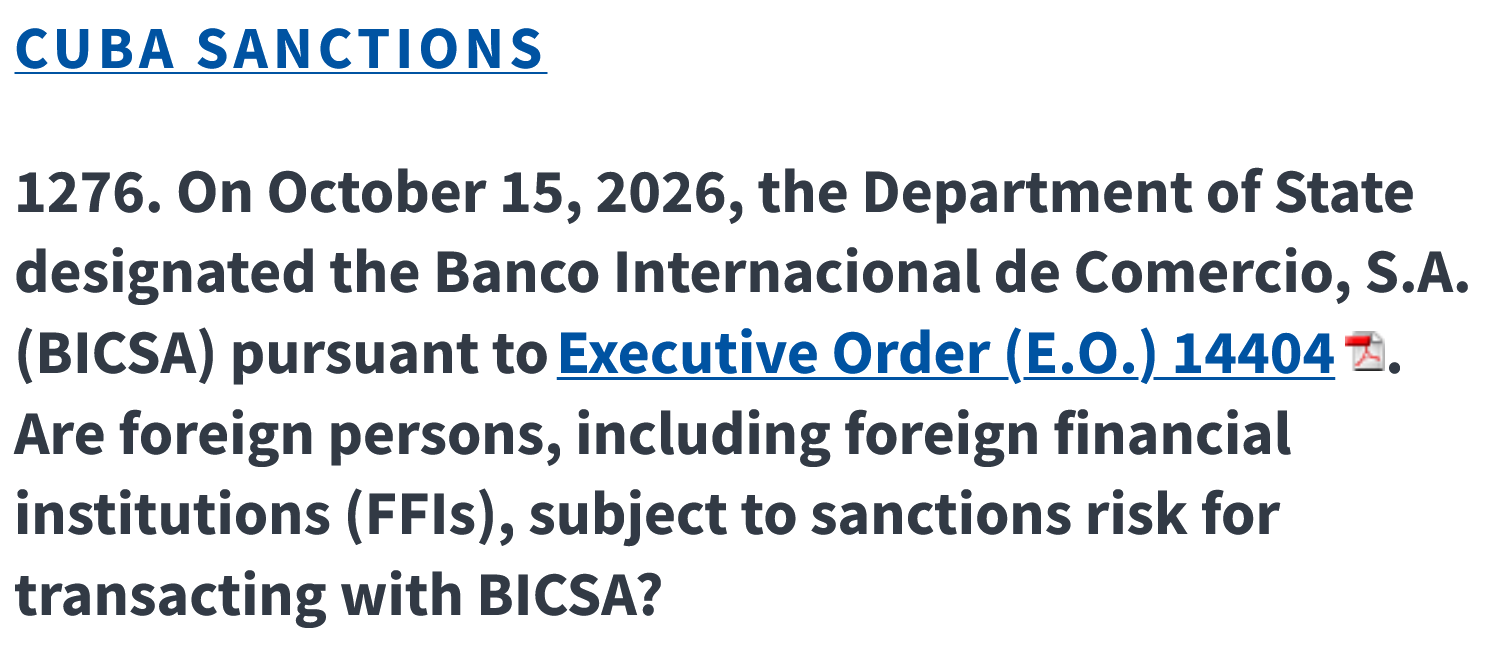

President Trump Claimed One Political Scalp. A Second May Not Be Far Off. Title IV And SDN List Are Weapons Of Mass Destruction Against Cuba To Coerce Companies To Withdraw. This Company Next?
/Title IV And SDN List Are New Weapons For Trump-Vance Administration To Coerce Non-United States-Based Companies To Withdraw From The Republic Of Cuba Marketplace
Denial Of Visas And Access To Banking Can Be A Powerful Tool
President Trump Has Already Claimed A Political Scalp- Prime Minister Mark Carney Of Canada.
President Trump Next Aiming For Second Political Scalp- Prime Minister Pedro Sanchez Of Spain
Given the animus by Donald Trump, President of the United States (2017-2021 and 2025-2029), toward Pedro Sanchez, Prime Minister of Spain (EU, NATO), not unanticipated would be for Palma de Mallorca, Spain-based Meliá Hotels International, S.A. (2025 revenue approximately US$2.3 billion) to be listed as a Specially Designated National (SDN) by the Office of Foreign Assets Control (OFAC) of the United States Department of the Treasury.
In 2020, during the Trump-Pence Administration (2017-2021), Melia Hotels International S.A. received a Title IV letter (revoking travel visas) from the United States Department of State.
Link: Spain's Melia Hotels International CEO Confirms He Is Restricted From Entering United States Due To Libertad Act Title IV Letter; Says 50 Other Companies Impacted February 05, 2020
Melia Hotels International S.A. has been a defendant in lawsuits for its use of properties in the Republic of Cuba which plaintiffs maintain are used without authorization or compensation. One lawsuit was filed in Spain, and one lawsuit was filed in the United States.
Melia Hotels International S.A. manages approximately 380 properties worldwide including two in the United States: INNSiDE by Melia New York NOMAD in New York City, New York, and Melia Orlando Celebration in Orlando, Florida. The company is the largest operator of properties in the Republic of Cuba. United States-based institutional investments are shareholders in Melia Hotels International S.A. In 2019, United States-based shareholders controlled approximately 10% of the company.
Including Melia Hotels International S.A. on the SDN list or using related policies, regulations, and statutes to target the company may be in place prior to the G7 Leaders’ Summit scheduled for 15 June 2026 to 17 June 2026 in Évian-les-Bains, France. The host is Emmanuel Macron, President of the Republic of France (2017-2027). Prime Minister Sanchez is expected to be invited, as in previous years.
Sanctioning further Melia Hotels International S.A. would represent use of a very public political cudgel by President Trump to inflict upon Prime Minister Sanchez… with the satisfaction of Prime Minister Carney in the same room. President Trump would not shed tears if Toronto, Canada-based Sherritt International Corporation (2025 revenue approximately US$422 million) declares bankruptcy.
Title IV of the Cuban Liberty and Democratic Solidarity Act of 1996 (known as “Libertad Act”) has for thirty years been a quietly used tool in a very public political toolbox. Although the use of Title III of the Libertad Act was suspended until 2019, Title IV letters from the United States Department of State continued to flow.
The Clinton-Gore Administration (1993-2001), Bush-Cheney Administration (2001-2009), Obama-Biden Administration (2009-2017), Trump-Pence Administration (2017-2021), Biden-Harris Administration (2021-2025), did not robustly use Title IV. Thus far, the Trump-Vance Administration (2025-2029) has not publicly confirmed its use of Title IV. However, given the events of last week, that may be changing.
Since 1996, approximately ten companies reportedly received Title IV letters from the United States Department of State.
In 1996, during the Clinton-Gore Administration, executives (including their spouses, minor children, or agents) of Sherritt International Corporation were targeted by Title IV.
Title IV Of The Cuban Liberty and Democratic Solidarity Act of 1996
“Title IV: Exclusion of Certain Aliens - Directs the Secretary of State to deny a visa to, and the Attorney General to exclude from the United States, aliens (including their spouses, minor children, or agents) involved in the confiscation of property, or the trafficking in confiscated property, owned by a U.S. national. Provides for a case-by-case waiver of this exclusion for medical reasons or for purposes of litigation of a claim.”
“(a) Grounds for exclusion: The Secretary of State shall deny a visa to, and the Attorney General shall exclude from the United States, any alien who the Secretary of State determines is a person who, after March 12, 1996—"
United States Department of State: “Title IV requires the denial of visas to and exclusion from the U.S. of persons who, after March 12, 1996, confiscate or "traffic" in confiscated property in Cuba claimed by U.S. nationals. The objective of this provision is to protect the status of confiscated U.S. property and to support existing sanctions against the current regime. The State Department reviews a broad range of economic activity in Cuba to determine the applicability of Title IV. The results of this effort appear not only in the actual determinations of "trafficking," but also in the deterrent to investment in confiscated U.S. property and in the increasing uncertainly of investing in Cuba.”
On 4 May 2026, Sherritt International Corporation issued a statement that the company was “consulting with its advisors and stakeholders to assess the potential implications of the Executive Order and is considering appropriate next steps as they relate to the Corporation’s Cuban interests.”
On 7 May 2026, Sherritt International Corporation issued a statement that the company “has suspended its direct participation in joint venture activities in Cuba, effective immediately. Sherritt is taking steps to repatriate Sherritt’s expatriate employees in Cuba and Sherritt has requested that partners repatriate their expatriate personnel in Canada. Sherritt has communicated such decisions in a letter to its Cuban partners.”
Within hours of the 7 May 2026 statement by the company, the company’s joint venture operating in the Republic of Cuba was listed as a Specially Designated National (SDN) by the Office of Foreign Assets Control (OFAC) of the United States Department of the Treasury.
NOT FOR DISTRIBUTION TO UNITED STATES NEWSWIRE SERVICES OR FOR DISSEMINATION IN THE UNITED STATES
“(4 May 2026) TORONTO – Sherritt International Corporation (“Sherritt” or the “Corporation“) (TSX:S) announced that on May 1, 2026, the U.S. administration issued an Executive Order expanding its sanctions against Cuba. Sherritt is consulting with its advisors and stakeholders to assess the potential implications of the Executive Order and is considering appropriate next steps as they relate to the Corporation’s Cuban interests.
About Sherritt
Sherritt is a world leader in using hydrometallurgical processes to mine and refine nickel and cobalt – metals deemed critical for the energy transition. Leveraging its technical expertise and decades of experience in critical minerals processing, Sherritt is committed to expanding domestic refining capacity and reducing reliance on foreign sources. The Corporation operates a strategically important refinery in Alberta, Canada, recognized as the only significant cobalt refinery and one of just three nickel refineries in North America. Sherritt’s Moa Joint Venture produces cost competitive critical minerals while maintaining high sustainability standards and has an estimated mine life of approximately 25 years. The Corporation’s Power division, through its ownership in Energas, is the largest independent energy producer in Cuba, processing domestically sourced raw natural gas to generate electricity for sale to the Cuban national electrical grid. Sherritt’s common shares are listed on the Toronto Stock Exchange under the symbol “S”.”
NOT FOR DISTRIBUTION TO UNITED STATES NEWSWIRE SERVICES OR FOR DISSEMINATION IN THE UNITED STATES
“(7 May 2026) TORONTO – Sherritt International Corporation (“Sherritt” or the “Corporation”) (TSX:S) provides the following update further to its May 4, 2026 news release regarding the Executive Order issued by the U.S. administration on May 1, 2026 expanding its sanctions against Cuba (the “Executive Order”). Brian Imrie, Richard Moat and Brett Richards have resigned from the Corporation’s Board of Directors effective immediately.
Sherritt has not been formally designated under the Executive Order. However, such a designation could occur at any time. In any event, the mere issuance of the Executive Order itself creates conditions that materially alter the Corporation’s ability to operate in the ordinary course, including activities related to Sherritt’s Cuban joint venture operations.
Following consultation with its advisors, Sherritt has suspended its direct participation in joint venture activities in Cuba, effective immediately. Sherritt is taking steps to repatriate Sherritt’s expatriate employees in Cuba and Sherritt has requested that partners repatriate their expatriate personnel in Canada. Sherritt has communicated such decisions in a letter to its Cuban partners.
Currently, there is no immediate impact on operations in Fort Saskatchewan, Alberta. The refinery is continuing to produce finished nickel and cobalt for sale. The inventory of feed it has available for such production is expected to last until approximately mid-June.
The Executive Order, and any designation under the Executive Order, may also result in financial or other providers being unable or unwilling to continue to support Sherritt’s operation or other business activities. Sherritt will continue to consult with its advisors and stakeholders as it assesses the implications of the Executive Order.”
Cuban Liberty and Democratic Solidarity Act of 1996
The Trump Administration has made operational Title III and further implemented Title IV of the Cuban Liberty and Democratic Solidarity Act of 1996 (known as “Libertad Act”).
Title III authorizes lawsuits in United States District Courts against companies and individuals who are using a certified claim or non-certified claim where the owner of the certified claim or non-certified claim has not received compensation from the Republic of Cuba or from a third-party who is using (“trafficking”) the asset.
Title IV restricts entry into the United States by individuals who have connectivity to unresolved certified claims or non-certified claims.
Suspension History
Title III was suspended every six months since the Libertad Act was enacted in 1996- by President William J. Clinton (1993-2001), President George W. Bush (2001-2009), President Barack H. Obama (2009-2017), and through the first two years of President Donald J. Trump (2017-2021). President Joseph Biden (2021-2025) suspended again on 14 January 2025. On 20 January 2025, President Donald J. Trump (2025-2029) reversed the suspension.
On 16 January 2019, The Honorable Mike Pompeo, United States Secretary of State, reported a suspension for forty-five (45) days.
On 4 March 2019, Secretary Pompeo reported a suspension for thirty (30) days.
On 3 April 2019, Secretary Pompeo reported a further suspension for fourteen (14) days through 1 May 2019.
On 17 April 2019, the Trump Administration reported that it would no longer suspend Title III.
On 2 May 2019, certified claimants and non-certified claimants were permitted to file lawsuits in United States courts.
Libertad Act Title III Lawsuit Filings Data/Statistics Since 2019
Certified Claims Background
There are 8,821 claims of which 5,913 awards valued at US$1,902,202,284.95 were certified by the United States Foreign Claims Settlement Commission (USFCSC) and have not been resolved for nearing sixty years (some assets were officially confiscated in the 1960’s, some in the 1970’s and some in the 1990’s). The USFCSC permitted simple interest (not compound interest) of 6% per annum (approximately US$114,132,137.10); with the approximate current value of the 5,913 certified claims is approximately US$9.2 billion.
The first asset (along with 382 enterprises the same day) to be expropriated by the Republic of Cuba was an oil refinery on 6 August 1960 owned by White Plains, New York-based Texaco, Inc., now a subsidiary of San Ramon, California-based Chevron Corporation (USFCSC: CU-1331/CU-1332/CU-1333 valued at US$56,196,422.73).
From the certified claim filed by Texaco: “The Cuban corporation was intervened on June 29, 1960, pursuant to Resolution 188 of June 28, 1960, under Law 635 of 1959. Resolution 188 was promulgated by the Government of Cuba when the Cuban corporation assertedly refused to refine certain crude oil as assertedly provided under a 1938 law pertaining to combustible materials. Subsequently, this Cuban firm was listed as nationalized in Resolution 19 of August 6, 1960, pursuant to Cuban Law 851. The Commission finds, however, that the Cuban corporation was effectively intervened within the meaning of Title V of the Act by the Government of Cuba on June 29, 1960.”
The largest certified claim (Cuban Electric Company) valued at US$267,568,413.62 is controlled by Boca Raton, Florida-based Office Depot, Inc. The second-largest certified claim (International Telephone and Telegraph Co, ITT as Trustee, Starwood Hotels & Resorts Worldwide, Inc.) valued at US$181,808,794.14 is controlled by Bethesda, Maryland-based Marriott International; the certified claim also includes land adjacent to the Jose Marti International Airport in Havana, Republic of Cuba. The third-largest certified claim valued at US$97,373,414.72 is controlled by New York, New York-based North American Sugar Industries, Inc. The smallest certified claim is by Sara W. Fishman in the amount of US$1.00 with reference to the Cuban-Venezuelan Oil Voting Trust.
The two (2) largest certified claims total US$449,377,207.76, representing 24% of the total value of the certified claims. Thirty (30) certified claimants hold 56% of the total value of the certified claims. This concentration of value creates an efficient pathway towards a settlement.