
DOD (War) OSC Could Be U.S. Taxpayer Partner Of Last Resort For Canada’s Sherritt And Australia’s Antilles. Cobalt, Copper, Gold, Nickel, Silver Are Strategic Minerals.
/The United States Department of Defense (War) Office of Strategic Capital Could Be Partner Of Last Resort For Canada’s Sherritt And Australia’s Antilles
Cobalt, Copper, Gold, Nickel, Silver Are Strategic Minerals The Trump-Vance Administration Wants To Control
United States Government (Taxpayers) As Shareholder In Both Companies?
Toronto, Canada-based Sherritt International Corporation (2025 revenue approximately US$389 million) has cobalt, nickel, and energy (30% interest in Energas S.A.) operations in the Republic of Cuba. Link: https://sherritt.com/
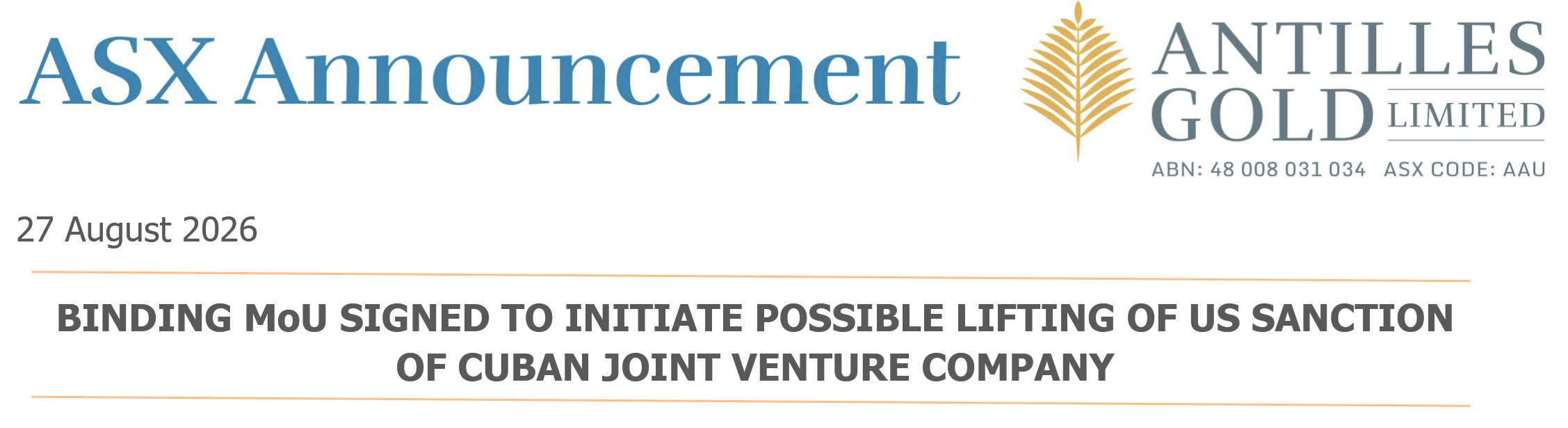
Bowral, Australia-based Antilles Gold Limited entered the Republic of Cuba in 2020 to develop copper, gold, and silver mining projects. Link: https://antillesgold.net/
Both companies have agreements with United States-based investors towards seeking authorization from The White House to continue operations in the Republic of Cuba. The companies require a license from the Bureau of Industry and Security (BIS) of the United States Department of Commerce, Office of Foreign Assets Control (OFAC) of the United States Department of the Treasury, and Office of Legal Adviser (OLA) of the United States Department of State, and connectivity with the United States Foreign Claims Settlement Commission (USFCSC) of the United States Department of Justice.
From 3 January 2026, the Trump-Vance Administration (2025-2029) has crafted and implemented strategies designed to alter the status quo in the Republic of Cuba for non-Republic of Cuba-based companies.
Attracting and Scaling Private Capital for National Security
The Department of War's Office of Strategic Capital (OSC) develops and implements strategies and partnerships to accelerate and scale private investment in critical supply chain technologies needed for national security. Link: https://www.cto.mil/osc/
Attracting Private Capital to Critical Technologies and Supply Chains
The United States is in a global competition for technological advantage. In that competition, private capital is the dominant source of funding and a key source of U.S. comparative advantage. Yet, some critical technologies and their components attract relatively little private investment and are not always supported by traditional procurement methods for national security needs.
In response, the Office of Strategic Capital was established to attract and scale investment to national security priorities. OSC aims to use the United States’ comparative advantages in capital markets and economic competition to crowd in capital for the critical technology supply chains needed by the Department of War.
DoW’s National Defense Science and Technology Strategy specifies 14 Critical Technology Areas vital to national security. By attracting private capital investments into these Critical Technology Areas, OSC seeks to accelerate the development and deployment of technology critical to current and future warfighting capabilities.
While those Critical Technology Areas are the starting point for OSC, investment may occur outside of those Critical Technology Areas so long as it involves supply chain and component-level technologies and processes that enable DoW capabilities but are not always supported through direct procurement.
National Security Fund Finance (NSFF) Program
The National Security Fund Finance (NSFF) Program is a fund-level financing solution to increase private capital investment in critical minerals vital to United States national security. The NSFF Program provides loans to qualified investment fund managers, who combine OSC loans with private capital to invest in companies addressing U.S. national security shortages related to critical minerals and materials. By providing credit to qualified asset managers, the NSFF Program will crowd private capital and expertise into firms and technologies that support Department of War priorities. The Office of Strategic Capital published a Notice of Funding Opportunity (NOFO) at SAM.gov. Complete proposals must be submitted to OSDRE-NationalSecurityFundFinanceSubmissions@groups.mail.mil by 5:00 p.m. EDT on November 1st, 2026.
Office of Strategic Capital Posts Application for National Security Fund Finance Program
The OSC is pleased to announce the formal Notice of Funding Opportunity (NOFO) for OSC's National Security Fund Finance (NSFF) program has been posted on OSC's website.
OSC's National Security Fund Finance program aims to provide capital support to credit funds addressing shortages, gaps, and vulnerabilities in critical minerals vital to United States national security. OSC's mission is to advance these strategic interests by providing direct loans and deploying other financial tools. The NSFF program acts as the fund-level financing solution to accomplish that goal.
The One Big Beautiful Bill Act, signed into law by President Donald J. Trump, provided funding for OSC to support critical minerals and materials. The NSFF program will provide loans to qualified investment fund managers, who will combine OSC loans with private capital to invest in portfolio companies focused on addressing U.S. national security shortages related to critical minerals and materials.
The NSFF NOFO is available for download at SAM.gov. Complete proposals must be submitted to OSDRE-NationalSecurityFundFinanceSubmissions@groups.mail.mil by 5:00 p.m. EDT on November 1st, 2026.
The Office of Strategic Capital reserves the right to extend any deadline(s), make one or more award(s) at an escalated timeline, or have dialogue with applicants during the period between proposal submission and the finalization of award decisions. Questions regarding NSFF can be addressed to OSDRE-NationalSecurityFundFinanceSubmissions@groups.mail.mil.
Wall Street Journal
New York, New York
29 August 2026
Inside Trump’s Plan to Give the Pentagon a Stake in Venezuela’s Oil Riches
excerpts
President Trump spent months declaring his ouster of Venezuela’s leader had secured the country’s oil for America. When U.S. energy companies resisted investing at the speed and scale he wanted, his administration devised an extraordinary solution to turn his vision into reality: make the U.S. government itself an investor.
The agreement announced Friday evening would transform the U.S. government from a broker of American oil investments in Venezuela to an investor itself. It would give Washington a direct financial stake in a private company that would be granted centurylong rights to some of the world’s largest proven oil reserves—and tie the U.S. more closely to the unelected government that is granting those rights.
Although it was negotiated by senior officials in both governments, the structure would make the U.S. an investor in a private company rather than a direct counterparty to the Venezuelan government. The U.S. plans to take a 35% passive stake in Betancourt’s North American Blue Energy Partners and would secure preferential rights to purchase 20% of its production at cost, according to people involved in negotiating the agreement.
The Pentagon’s Office of Strategic Capital plans to structure the investment through penny warrants that would yield the U.S. an equity ownership in the business without a significant capital investment, the people said. The Pentagon office has limited statutory authority to strike deals designed to support U.S. national-security interests, typically through loans and guarantees.
The deal was led by the State Department, and U.S. officials turned to the Pentagon’s Office of Strategic Capital late in the process while searching for a financial mechanism to deploy, according to some of the people familiar with the talks. The Defense Department will ultimately hold the government’s equity and purchase rights in the venture. A delegation of senior Pentagon and State Department officials, including OSC Director David Lorch, visited Venezuela in July to hammer out the deal’s terms, some of the people said. [Patrick Witt is Deputy Director of OSC]. The OSC launched in 2022 with a mandate to support industries considered critical to U.S. national security, though loans only started flowing from the office during the second Trump administration.
LINK TO COMPLETE ANALYSIS IN PDF FORMAT
Links To Related Analyses
Cuba: And Now There Are Two… Antilles Gold Has Until 25 January 2027 And Sherritt International Has Until 12 October 2026 August 27, 2026
U.S. Secretary Of State Rubio Meets With Minister Of Foreign Affairs Of Canada August 20, 2026
Trump-Vance Administration Increases Pressure On Cuba's Mining Sector. Impacting U.S. Control For Canada's Sherritt? August 20, 2026
Added To SDN List: Cuba Ministry Of Construction (MINCONS). August 20, 2026
U.S. Department Of State Sanctions ICAP And Nine Entities In Cuba August 20, 2026
The Drama In Canada Continues: "Kyma is not entitled to call a meeting of the Corporation’s shareholders... inappropriate and invalid..." August 19, 2026
For U.S. Secretary Of State Marco Rubio, Change In Cuba Seems More Like Pouring Ketchup Than Pouring Rum August 12, 2026