In Spanish: 9,492 Words From Government Of Cuba Will Not Be Enough To Implement Changes Required For Survival, But Is A Useful Beginning

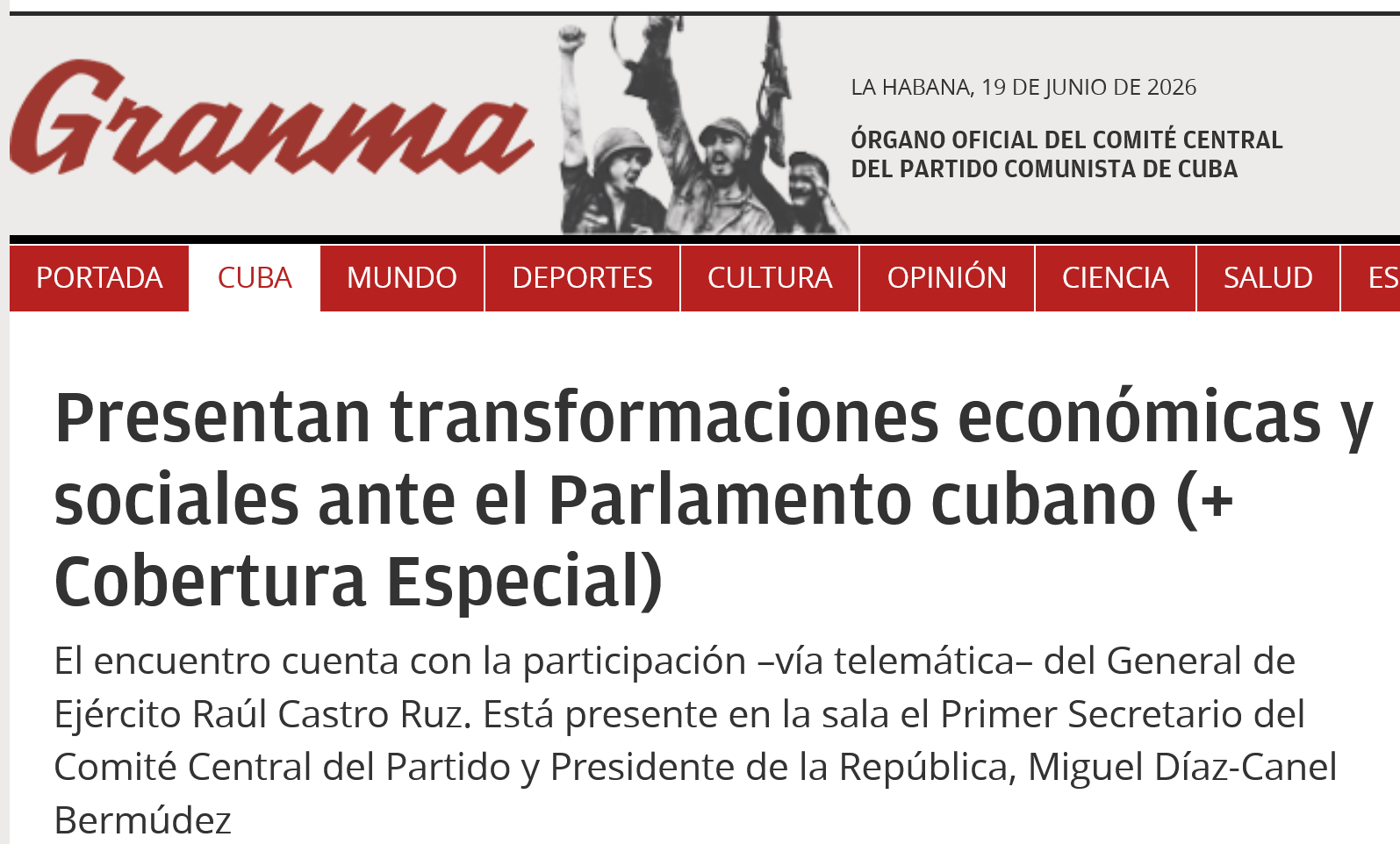
Granma
Havana, Republic of Cuba
18 June 2026

Presentan transformaciones económicas y sociales ante el Parlamento cubano (+ Cobertura Especial)

LINK: https://www.granma.cu/cuba/2026-06-18/comenzo-la-tercera-sesion-extraordinaria-de-la-asamblea-nacional-del-poder-popular

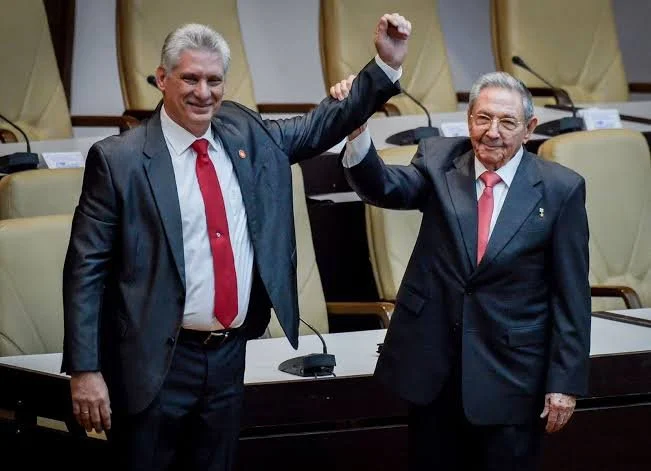
El encuentro cuenta con la participación –vía telemática– del General de Ejército Raúl Castro Ruz. Está presente en la sala el Primer Secretario del Comité Central del Partido y Presidente de la República, Miguel Díaz-Canel Bermúdez 

Para evaluar las propuestas de transformaciones económicas y sociales, un tema de vital importancia para el futuro del país, se realiza hoy la Tercera Sesión Extraordinaria de la Asamblea Nacional del Poder Popular (ANPP), en su X Legislatura.

El encuentro, que tiene lugar en su espacio habitual del Palacio de Convenciones con los diputados de La Habana y con aquellos que viven en la capital dadas sus responsabilidades, así como con todos los diputados del país conectados de forma digital, cuenta con la participación vía telemática del General de Ejército Raúl Castro Ruz.

Además, se encuentra presente en la sala el Primer Secretario del Comité Central del Partido y Presidente de la República, Miguel Díaz-Canel Bermúdez. 
El presidente de la ANPP y del Consejo de Estado, Esteban Lazo Hernández, recordó a Vilma Espín Guillois, heroína de la Revolución Cubana, quien falleciera en esta fecha hace 19 años.

INFORMA EL PRIMER MINISTRO TRANSFORMACIONES DE IMPACTO ESTRATÉGICO EN EL MODELO ECONÓMICO Y SOCIAL CUBANO

En el contexto más complejo que enfrenta el país desde el periodo especial, el miembro del Buró Político y primer ministro, Manuel Marrero Cruz, compareció ante la ANPP para presentar transformaciones de impacto estratégico en el modelo económico y social cubano, concebidas como un ejercicio soberano para preservar las conquistas de la Revolución sin renunciar al socialismo.

Durante su intervención, el Jefe de Gobierno contextualizó la situación actual: una combinación inédita de medidas coercitivas del gobierno de Estados Unidos, que ha llegado a interrumpir el suministro de combustible y las fuentes de ingreso en divisas, afectando de manera significativa la estabilidad de la infraestructura energética y la calidad de vida de la población. 
Reconoció, asimismo, que nunca se han negado los errores e insuficiencias propias, pero subrayó que este conjunto de factores ha incidido sostenidamente en la implementación de las transformaciones aprobadas desde el VI Congreso del Partido en 2011, cuyos resultados positivos se mantuvieron hasta mediados de 2019, cuando se recrudeció la política de sanciones, reforzada a inicios de enero de 2025.

En ese escenario, el Partido y el Gobierno, en legítimo ejercicio de su soberanía, han impulsado medidas para reactivar la economía y corregir distorsiones, proceso fortalecido con la aprobación del Programa Económico y Social del Gobierno, validado por el pueblo mediante consulta popular.

Tomando como referencia directa el sentir popular, el Primer Ministro anunció transformaciones que hallan su primer fundamento en el pensamiento del Comandante en Jefe Fidel Castro Ruz quien, en 1993, en pleno periodo especial, advirtió: «La vida, la realidad, la dramática situación que está viviendo el mundo, este mundo unipolar, nos obliga a hacer lo que de otra forma no habríamos hecho nunca si hubiésemos tenido capital y si hubiésemos tenido tecnología para hacerlo».

Bajo el principio rector de hacer lo necesario para conservar lo esencial, las medidas propuestas incluyen la ampliación de la participación de todos los actores económicos en igualdad de condiciones, el fomento de la inversión extranjera y la admisión de mecanismos de mercado como instrumento de asignación de recursos. Estas acciones –enfatizó– no constituyen una claudicación, sino la adecuación soberana de los instrumentos del desarrollo a las circunstancias concretas del país.

El Primer Ministro recordó las premisas del General de Ejército Raúl Castro Ruz en la conducción de la actualización del modelo económico y social: no ser dogmáticos ni inmovilistas, desterrar la asociación mecánica entre socialismo e igualitarismo, y reconocer que la planificación socialista no excluye, sino que debe incorporar y regular las reglas del mercado.
Las transformaciones presentadas, que serán debatidas, se inscriben en el esfuerzo colectivo por reactivar la economía y corregir distorsiones, sin renunciar jamás a la construcción socialista, sino como condición para su preservación.

Para la elaboración de las propuestas de transformaciones –expuso Marrero Cruz– se consideraron: las indicaciones del General de Ejército y del Primer Secretario del Comité Central, el Programa de Gobierno 2026, la propuesta de actualización de la Conceptualización del Modelo Económico y Social, así como los Acuerdos del Congreso de la ANEC y dirigentes del Estado y el Gobierno del país. 

Significó que se recibieron 390 propuestas, aceptándose el 66,7 % y el resto se corresponde con el proceso de implementación, otras valoraciones positivas, así como aspectos que no constituyen transformaciones.

Como resultado del análisis de las propuestas de transformaciones realizado en el Buró Político, fueron incorporadas al documento 69 recomendaciones. 

El Jefe de Gobierno apuntó que el documento que se presenta recoge 176 propuestas de transformaciones, agrupadas en 23 ejes fundamentales de la vida económica y social del país.

EJE 1: TRANSFORMACIONES EN EL MODELO DE GESTIÓN DE LOS ACTORES ECONÓMICOS 

Empresa Estatal Socialista

-Ampliar las facultades del sistema empresarial estatal en aras de que opere con mayor autonomía y en similares condiciones, con el resto de los actores económicos, lo que incluye la realización de cualquier actividad lícita, sin abandonar el objeto social principal. En lo adelante lo que se apruebe al resto de los actores se aplicará a la empresa estatal Socialista.

- Descentralizar al sistema empresarial la facultad de aprobación de los precios mayoristas y minoristas. En la formación se tendrán en cuenta los costos, gastos, tendencias del mercado, cadenas de valor y las relaciones verticales y horizontales entre los actores económicos.

- Redimensionar las OSDE, sin incluir funciones estatales ni aquellas que son propias de las empresas.

- Facultar a las OSDE para la creación de empresas y mipyme estatales; a las empresas para la creación de filiales y mipyme estatales y a ambos niveles para:

*Fusión, extinción, liquidación y otros movimientos organizativos, según corresponda.

*Se facultarán a las OSDE para definir sus estructuras y agrupar cargos administrativos o subcontratar servicios.

- Flexibilizar la aprobación y el destino de las utilidades después de impuestos.

- Actualizar las funciones y facultades de las Juntas de Gobierno para hacer más flexible su funcionamiento.

- Permitir el acceso al mercado cambiario en las nuevas condiciones derivadas de la Implementación de las transformaciones, a las estructuras empresariales que participan en cadenas de suministros.

* Eliminar la escala salarial en el sistema empresarial estatal y establecer un salario mínimo que tome en cuenta los niveles de inflación:

* Los niveles de salario, negociados con los trabajadores y con la participación del Sindicato, dependerán de la capacidad económica-financiera de las empresas.

- Cambiar la relación del presupuesto del Estado con el sistema empresarial, lo que incluye la revisión de la carga financiera y la eliminación de los subsidios a las empresas.

- Facultar a los Gobiernos Provinciales y a los Consejos de la Administración Municipales para la creación, fusión, extinción, liquidación de empresas estatales locales y el resto de los movimientos organizativos.

- Reducir al mínimo imprescindible los indicadores para medir la eficiencia del sistema empresarial estatal.

-Permitir y fomentar que las empresas (incluye las empresas privadas) realicen inversión financiera.

- Diseñar instrumentos financieros que permitan la capitalización de las empresas, sin la participación del presupuesto del Estado.

- Implementar un Programa Nacional de Valoración y Titulación de Activos (avalúos) Empresariales Estatales que: 

*Realice un inventario nacional de activos tangibles e intangibles del sistema empresarial con valoración de mercado. 

*Emita certificados de propiedad ejecutables que puedan constituirse en garantía colateral para crédito bancario. 

*Permita que las empresas estatales moneticen activos subutilizados mediante arrendamiento a largo plazo a diferentes actores de la economía e inversión extranjera.

- Diseñar un sistema empresarial eficiente y competitivo que genere ingresos para el apoyo a los servicios de los organismos del sector social.

- Establecer procedimientos para la quiebra, liquidación y reestructuración de activos con pérdidas sostenidas en el sector estatal.

- Transformar la empresa estatal socialista a sociedad mercantil por acciones o participaciones:

*El Estado definirá su participación accionaria en los sectores de la economía, garantizando en los estratégicos su presencia mayoritaria.

*Las empresas estatales podrán comprar acciones de otras empresas.

*También podrán comprar acciones las formas de gestión no estatal y personas naturales, en la gradualidad que se defina. 

*Para este proceso será necesario clasificar las empresas.
Formas de gestión no estatal

- Autorizar la creación de las mipymes y cooperativas no agropecuarias pendientes de aprobación en la

Plataforma de Actores Económicos.

- Reducir los requisitos, trámites y términos para la creación, conversión y operación de las formas de gestión no estatal, definiendo los tiempos de aprobación.

- Permitir la contratación de más de 100 trabajadores. A partir de esta cifra se clasificarán como empresas privadas.

- Permitir que una persona natural pueda ser titular de más de una empresa privada.

- Ampliar las formas societarias bajo las que pueden organizarse las empresas privadas, incluyendo sociedades anónimas por acciones.

- Permitir que una misma persona natural cuente con participación accionaria en más de una empresa privada.

- Conceder derechos reales (usufructo y superficie) a empresas privadas o cooperativas, con el fin de realizar inversiones para el desarrollo de sus actividades productivas o de servicios.

- Autorizar que los depósitos de divisas en efectivo de actores no estatales se acrediten en cuentas bancarias en la misma moneda, sujeto a declaración de origen lícito de los fondos y derecho de extracción.

- Permitir que las formas de gestión no estatal desarrollen otras actividades productivas y de servicios, sin abandonar su actividad principal.

- Reducir la lista de actividades prohibidas para los actores económicos no estatales. 

- Perfeccionar la Plataforma de Actores Económicos e incorporar el empleo de la Inteligencia Artificial. Garantizar su transparencia, trazabilidad y agilidad.

- Transformar la estructura institucional y las formas de propiedad y gestión de la base productiva del sector agropecuario. Permitir empresas privadas en la actividad agropecuaria.

- Desarrollar un mercado de insumos, con la participación de todos los actores, y con la posibilidad de acceder al mercado cambiario.

- Crear una Plataforma Nacional para Encadenamientos Productivos que establezca la obligación de las empresas estatales a publicar sus necesidades de insumos y subcontratación, así como el otorgamiento de incentivos fiscales por niveles de compras a los productores nacionales. 

EJE 2: TRANSFORMACIONES EN LAS RELACIONES DE PROPIEDAD. DIFERENCIAS ENTRE PROPIEDAD Y GESTIÓN

El Jefe de Gobierno señaló que, en cuanto a las transformaciones en las relaciones de propiedad y las diferencias entre propiedad y gestión, se ratifica la propiedad social sobre los medios fundamentales de producción y avanzar en la gestión no estatal sobre estos medios.

Agregó que dentro de las nuevas medidas están permitir la compra de acciones y propiedades de empresas estatales por parte de personas jurídicas estatales y no estatales, nacionales y extranjeras, así como naturales, siempre que se demuestre el origen lícito de los fondos.

Resaltó la creación de un Programa de Inversión que incentive la participación en empresas cubanas de cubanos residentes en el país y en el exterior; además de reconocer el crecimiento legítimo del patrimonio financiero y material de las personas jurídicas y naturales y garantizar la protección de los derechos laborales y sociales sin permitir una explotación indiscriminada del hombre por el hombre. 

EJE 3: TRANSFORMACIONES EN EL SISTEMA DE PLANIFICACIÓN DE LA ECONOMÍA

-  Perfeccionar la planificación de mediano y largo plazos, enfocada en el diseño del desarrollo, priorizando los equilibrios macroeconómicos, reducir problemas estructurales y dar señales de política para todos los actores económicos.

-Incorporar en las proyecciones del Plan Nacional de Desarrollo Económico y Social hasta 2030 y en las Estrategias de Desarrollo Provincial y Municipal las actividades económicas, comerciales y de servicios de los actores económicos no estatales.

-  Transitar hacia un modelo de planificación financiera, donde el Estado abandona progresivamente la distribución física de recursos, dando mayor participación a las señales del mercado:

•    Las empresas estatales accederán de forma descentralizada a insumos, divisas y otros recursos para su producción a través de mecanismos de mercado. 

•    El encargo estatal se ejecutará mediante un esquema contractual entre entidades oferentes y  demandantes. 

•    El proceso de planificación deberá tener presente la satisfacción de las demandas del mercado interno. 

-  Mantener los balances fundamentales de la economía (agroalimentarios, divisas, energéticos y el presupuesto del Estado), convirtiéndose en instrumentos de diagnóstico, anticipación y corrección de políticas.

-  Ampliar los límites de aprobación de las inversiones a partir de la descentralización de la facultad a empresas estatales, sociedades mercantiles o de inversión extranjera en función de sus capacidades financieras y acceso a los recursos. 

EJE 4: TRANSFORMACIONES Y REDIMENSIONAMIENTO DEL SECTOR PRESUPUESTADO

Marrero Cruz significó que dentro de las propuestas de transformación económica se plantea una reestructuración de la Administración Central del Estado, que incluiría una reducción significativa del número de ministerios y organismos presupuestados.

Según explicó, ya circula una propuesta legislativa que contempla la reorganización de las estructuras estatales y gubernamentales, con el propósito de adecuarlas a las nuevas condiciones económicas del país y hacer más eficiente la gestión pública.

Este proceso –dijo– también impactaría directamente en las administraciones provinciales y municipales, donde se prevé un redimensionamiento de las estructuras y plantillas laborales. 

EJE 5: TRANSFORMACIONES EN LA AUTONOMÍA MUNICIPAL

Descentralizar a nivel municipal las siguientes competencias:

- Planificación estratégica.

- Ordenamiento territorial y urbano.

- Soberanía alimentaria y seguridad alimentaria y nutricional.

- Servicios comunales.

 - Fomento del desarrollo económico local:

•    Diversificar y fortalecer su tejido productivo, que considera la participación de los diferentes actores económicos, cubanos residentes en el país y en el exterior, e incluye sistemas productivos locales. 

•    Capacidad de exportar e importar, así como generar y retener divisas para gastos corrientes y de capital. 

•    Estimular y gestionar inversión extranjera directa. 

- Gestión administrativa y de recursos humanos municipales.

- Gestión presupuestaria, financiera y tributaria local. 

EJE 6: TRANSFORMACIONES ENERGÉTICAS

-Permitir la participación del capital privado y extranjero en la importación y comercialización de combustibles, incluida la red minorista.

- Ampliar y reestructurar la gestión de la red de servicentros, incluidos los servicentros móviles:

*Establecer que los servicentros gestionados por los diferentes actores económicos incorporen sistemas fotovoltaicos con acumulación para que los mismos se independicen del Sistema Eléctrico Nacional.

*Estimular la instalación de solineras para comercializar el servicio de carga de vehículos eléctricos. 

-Diseñar líneas de financiamiento, flexibilizar los requisitos y ampliar las garantías para el otorgamiento de créditos a las personas jurídicas y naturales, que incentiven la transición energética. Estimular la inversión desde el lado de la demanda.

-Permitir a las empresas estatales el uso de plataformas extranjeras para ejecutar pagos para la compraventa de combustibles.

-Aplicar el impuesto hasta un 1 % a la importación de combustible físico o financiero, con destino a los inventarios operacionales.

-Reducir el impuesto, en un monto equivalente a la inversión realizada, a los actores económicos estatales y no estatales que realicen inversiones con fuentes renovables de energía, como parte de su responsabilidad social, en centros de servicios a la población, sociales o de cuidados, incluyendo el alumbrado público.  

EJE 7: TRANSFORMACIONES PARA INCENTIVAR LA RECUPERACIÓN AGRÍCOLA

- Modificar la gestión y uso de la tierra a todos los actores económicos:

*Mantener el principio de la propiedad de la tierra de todo el pueblo.

*Otorgar el derecho real de usufructo sobre la tierra, a las personas jurídicas estatales, privadas, mixtas o naturales que lo soliciten, por tiempo indeterminado y la cantidad de áreas según proyecto presentado, para todas las producciones agropecuarias, forestales y tabacaleras, así como para proyectos de desarrollo de eco y agroturismo.

*Facultar a la empresa estatal que administra la tierra propiedad socialista de todo el pueblo que la entregue en usufructo a los solicitantes mediante el correspondiente contrato, cumpliendo las normas legales vigentes.

*Facultar la entrega de tierras en usufructo a las Cooperativas de Producción Agropecuaria (CPA), una vez aprobado por la Asamblea General de la cooperativa y cumpliendo las normas legales vigentes.

*Eliminar los requisitos de trabajo directo y estable en la tierra por parte de los usufructuarios.

*Evaluar la definición de colectivos laborales y proponer las transformaciones estructurales necesarias.

- Transformar el modelo de gestión de las cooperativas:

*Autorizar a las cooperativas a importar y comercializar combustibles como insumo. 

*Otorgar las facultades a las cooperativas de realizar comercio exterior de forma directa, para las exportaciones de sus productos y las importaciones de insumos y tecnologías agropecuarias.

*Permitir a las cooperativas a gestionar directamente financiamientos externos para producciones exportables, que sustituyan importaciones y para inversiones.

*Permitir que las cooperativas abran cuentas bancarias en el exterior y en bancos cubanos, tanto en pesos como en divisas.

*Flexibilizar la comercialización agropecuaria. Reconocer el mercado en la formación de precios:

*Descentralizar y facultar la formación de precios de los productos agropecuarios, a las entidades del sistema empresarial estatal y no estatal, las cooperativas y productores.

*La contratación y concertación de precios de los productos agropecuarios serán acordados entre el productor y el comprador.

*Homologar el régimen impositivo de todos los actores económicos, que produzcan, transformen y comercialicen alimentos.

*Crear el Sistema Nacional de Información de Precios de los mercados de los productos agropecuarios, con publicaciones de los precios de referencia, en plataformas digitales.

- Diseñar incentivos para que todos los actores económicos comercialicen insumos agropecuarios en divisas y en pesos y tengan acceso al mercado cambiario:

*Autorizar a todos los actores económicos la comercialización directa de insumos y equipos agropecuarios en divisas y en pesos.

*Fomentar la creación de mercados de insumos en divisas, donde participan personas naturales y jurídicas nacionales y extranjeras, mediante un proceso simplificado.

*Aprobar un régimen impositivo especial para todos los actores económicos que participen en el mercado de insumos, con incentivos y bonificaciones para la importación y comercialización de insumos en divisas.

*Crear los procedimientos bancarios que garanticen la ejecución de las transacciones en divisas de la venta de insumos a los productores y el pago a los proveedores en el exterior, mediante la utilización de POS para el pago por tarjeta magnética, transferencia, pago en efectivo, comercio electrónico y otros instrumentos de pago autorizados. 

-Incrementar el financiamiento al sector productivo primario mediante la ampliación y descentralización territorial del Fondo de Fomento Agrícola y la creación de un Banco para el Fomento Agrícola:

*Descentralizar a los municipios la utilización del Fondo de Fomento Agrícola, ajustado a las características del territorio, previa presentación de los proyectos que tributen a las Estrategias de Desarrollo, vinculado a la producción de alimentos. 

EJE 8: TRANSFORMACIONES SOCIALES

- Digitalizar y transparentar la gestión de las ayudas mediante el empleo de la plataforma SOBERANIA para la actualización en tiempo real del registro de las personas y familias en situaciones de vulnerabilidad, de manera que se sistematice las diferentes formas de atención, su trazabilidad y control gubernamental y público.

- Establecer que todos los actores económicos (estatales y privados – nacionales y extranjeros) como parte de su responsabilidad social a nivel comunitario, en el orden financiero, de recursos materiales y servicios, participen directamente en las actividades siguientes:

*Apoyar el pago a pensionados mediante convenios con los bancos.

*Respaldar los comedores del Sistema de Atención a la Familia y Hogares de Alimentación Comunitaria.

*Apoyar hogares de niños sin amparo parental.

*Apoyar hogares de ancianos, maternos, casas de abuelos y otros centros sociales.

*Establecer precios diferenciados, descuentos, gratuidades o cupos solidarios para personas en situación de vulnerabilidad.

*Atender casos en situación de vulnerabilidad identificados por los gobiernos locales.

*Apoyar el transporte social y sanitario.

*Respaldar instituciones de la salud pública y centros educacionales.

*Contribuir a la higiene comunal y al saneamiento de zonas críticas.

*Destinar productos básicos a instituciones sociales.

*Crear módulos básicos mensuales para personas y familias en situación de vulnerabilidad.

*Ofrecer empleo, capacitación o aprendizaje a personas en situación de vulnerabilidad.

*Crear fondos de emergencia locales con aportes privados.

*Habilitar locales privados como puntos de acopio y distribución en situaciones de emergencia.

*Apoyar servicios funerarios para familias sin recursos.

*Impulsar ferias y ventas populares en comunidades en situación de vulnerabilidad. 

-Fortalecer el Trabajo Social con un enfoque proactivo y preventivo a partir de jerarquizar su labor en el municipio.

-Dotar de activos de pequeña escala, para el desarrollo de actividades no estatales, a personas en situación de vulnerabilidad multidimensional, como vía para incorporarse al empleo y superar esta condición.

-Diseñar servicios educativos, de capacitación, de postgrado, culturales y otros seleccionados que constituyan fuentes de ingresos al sector social.

-Diseñar tarifas diferenciadas para los servicios de círculos infantiles y de seminternado en correspondencia con los ingresos familiares. 

-Diseñar beneficios fiscales a los talleres donde laboren personas en situación de discapacidad con el objetivo de incrementar los ingresos de los trabajadores. 

EJE 9: TRANSFORMACIONES DEL SUBSIDIO A PRODUCTOS AL SUBSIDIO A PERSONAS

-Eliminar subsidios a productos transformándolos en subsidios a personas e implementarlo en el orden siguiente:

*Productos transversales a la economía (combustibles, electricidad, transporte de cargas y pasajeros y tarifa de agua) que impactan en la producción y los servicios para trasladar los costos reales a los precios mayoristas y minoristas.

*Otros productos.

-Crear un Fondo de Protección Social, como condición previa a las transformaciones, a partir de una parte del ahorro por la eliminación de los subsidios a productos.  

EJE 10: TRANSFORMACIONES LABORALES Y SALARIALES

- Implementar una reforma integral de salarios en el sector presupuestado.

- Fijar anualmente el salario mínimo y, en correspondencia, la cuantía de las prestaciones, y pensiones de la seguridad social, así como los incrementos salariales, a partir de la tendencia de la inflación

-Con relación al Sistema de pensiones de la seguridad social establecer:

*La eliminación del límite de la escala establecida para el pago de la contribución social del sector no estatal.

*Que las personas que laboran en los sectores estatal y no estatal, de manera simultánea, puedan afiliarse y contribuir a los regímenes correspondientes de cada actividad. 

*Que, de los 30 años mínimos de servicio exigidos por el régimen contributivo, se considere, hasta un máximo de 10, si la persona los ha dedicado a cuidados familiares.

-Eliminar la aprobación administrativa para el ejercicio del pluriempleo por los técnicos, profesionales de la salud, la investigación, maestros, profesores y funcionarios.

-Establecer incentivos para retener la fuerza de trabajo calificada con énfasis en los jóvenes.

-Establecer un ingreso mensual equivalente a un salario mínimo por ayuda para su devolución posterior, a jóvenes entre 18 y 30 años desvinculados del estudio y el empleo que se vinculen a un curso de preparación. El financiamiento correrá a cargo del presupuesto de la asistencia social o el sistema empresarial, según corresponda. Se reconocerá el periodo de formación como tiempo de servicio prestado. 

-Facultar a los empleadores, en acuerdo con la organización sindical, para la concertación de jornadas laborales reducidas y de los pagos correspondientes, para actividades profesionales, las que incorporan en el convenio colectivo de trabajo.

-Establecer para el sector empresarial y presupuestado que trabajadores de la propia entidad puedan realizar actividades profesionales, mantenimientos constructivos y similares.

-Permitir el ejercicio del teletrabajo desde el exterior, por interés del empleador.

-Incluir como causa justificada de suspensión del cumplimiento del servicio social, la superación en el extranjero por interés personal asociado al perfil profesional, con la conformidad del empleador.

-Facultar directamente a las entidades para determinar los trabajadores que cesan el vínculo laboral por motivos económicos, tecnológicos y estructurales, previa evaluación en el órgano colegiado de dirección, de común acuerdo con la organización sindical y análisis en la asamblea de afiliados y trabajadores:

*Los trabajadores en esta condición reciben una protección monetaria equivalente a un mínimo de tres y máximo de seis veces el salario básico del cargo que ocupaban por una única vez. 

-Establecer la protección equivalente a un mes de remuneración a los trabajadores contratados por los TCP, ante la suspensión temporal o cancelación de la actividad. 

EJE 11: TRANSFORMACIONES Y MODERNIZACIÓN DEL SISTEMA BANCARIO Y FINANCIERO

- Fomentar la participación del capital privado en la actividad bancaria:

* Ampliación de instituciones financieras bancarias y no bancarias por parte de empresas privadas, cooperativas e inversión extranjera con licencia de banca corporativa y universal.

* La banca privada operará bajo supervisión del BCC en igualdad de condiciones regulatorias con la banca estatal.

*Se permitirá el establecimiento de instituciones financieras no bancarias o no financieras de apoyo al sector bancario de capital privado nacionales o extranjeras para el otorgamiento de microcréditos.

-  Eliminar las restricciones a los pagos en divisas entre negocios con capital extranjero y sus proveedores nacionales.

-  Permitir la apertura de cuentas en divisas por parte de personas jurídicas y naturales, sin autorización administrativa previa.

-  Implantar el marco regulatorio para activos virtuales y el uso de tecnologías financieras y expandir su uso para operaciones de cobros y pagos internacionales y nacionales. Crear entidades financieras para activos virtuales.

- Actualizar el sistema de tasas de interés ajustándolo a las condiciones actuales de la economía (incluyendo los bonos soberanos).

* La banca privada operará bajo supervisión del BCC en igualdad de condiciones regulatorias con la banca estatal.

* Se permitirá el establecimiento de instituciones financieras no bancarias o no financieras de apoyo al sector bancario de capital privado, nacionales o extranjeras, para el otorgamiento de microcréditos.

-  Implantar la figura de agente de pago de última milla para formalizar los flujos de remesas a través de un canal privado.

-  Diseñar otras vías de capitalización de los bancos, en adición a los recursos del presupuesto del Estado.

-  Actualizar la estrategia con nuevo enfoque para el tratamiento de la deuda externa, teniendo en cuenta las condiciones actuales.

-  Acelerar el proceso de automatización de los bancos y la reducción de los trámites asociados a sus servicios.

-  Otorgar a Transfermóvil licencia de institución financiera no bancaria.

-  Culminar el proceso de eliminación de los límites en las transferencias bancarias y la extracción de personas naturales y jurídicas, nacionales y extranjeras.

Transformaciones cambiarias

-  Redimensionar el mercado cambiario oficial y de remesas, con la participación de actores económicos no estatales, lo que incluye otorgar licencias para operaciones de casas de cambio privadas:

* Crear un mercado cambiario digital, en tiempo real, con agentes autorizados.

* Implementar un sistema de subastas de divisas.

-  Realizar devaluaciones sucesivas de la moneda nacional para reducir las diferencias de tipo de cambio. Las empresas que no soporten la devaluación serán liquidadas.

* Incorporar al segmento II las cooperativas, sector diplomático, mipymes estatales e inversión extranjera que operan con formas de gestión no estatales, garantizando que no ocurra arbitraje. Las empresas estatales concurrirán libremente para la venta y de manera controlada para las compras.

- Crear instituciones financieras no bancarias estatales y privadas que se dediquen a la canalización de flujos financieros, incluyendo las remesas, a través de operaciones cambiarias.

-  Establecer ventanillas únicas de cambio para todos los actores económicos que se decida.

-  Ampliar el objeto social de instituciones financieras no bancarias que ofrezcan el servicio para la administración de fondos de la cooperación internacional.  

EJE 12: TRANSFORMACIONES DEL SISTEMA TRIBUTARIO

-  Perfeccionar la imposición al consumo, mediante la implementación gradual del Impuesto sobre el Valor Añadido (IVA). Se iniciará por determinadas cadenas de producción-consumo y contemplará tipos impositivos reducidos a productos de la canasta de bienes y servicios.

-  Establecer la factura electrónica fiscal con incentivos que promuevan su asimilación por parte de los contribuyentes.

-  Aplicar una bonificación al Impuesto sobre las ventas y servicios en función de los niveles de ventas bancarizadas.

-  Reducir la carga fiscal del sector empresarial por concepto del impuesto sobre utilidades, con el objetivo de incrementar sus capacidades de crecimiento e inversión. Ampliar la base imponible eliminando deducciones especiales no justificadas económicamente y reduciendo el riesgo de la evasión fiscal.

* Establecer un impuesto sobre ingresos brutos a las empresas que declaren pérdidas por más de dos periodos fiscales.

-  Aplicar un tipo impositivo reducido del Impuesto sobre Utilidades para el sector agropecuario.

-  Simplificar el cálculo y pago del Impuesto sobre Utilidades, eliminando el término de la utilidad per cápita, lo que implica aplicar el impuesto a los socios de CNA, CPA y UBPC.

-  Diseñar un régimen de depreciación acelerada para la adquisición de maquinarias, tecnologías de producción de alimentos y procesamiento industrial, que favorezca la recuperación de las inversiones.

-  Disminuir la carga financiera de las entidades, determinada por el aporte del rendimiento de la inversión estatal, condicionada para su uso en el desarrollo y capitalización.

-  Aplicar incentivos fiscales a los actores económicos estatales y no estatales que financien inversiones en el sector social.

-  Actualizar el impuesto sobre ingresos personales, en correspondencia con el actual escenario inflacionario, mediante los siguientes ajustes:

* Modificar la escala progresiva para la liquidación y pago anual del tributo. Reducir el número de escalas para homogeneizar la aplicación del impuesto.

 * Incrementar el mínimo exento hasta el nivel del salario medio del país al cierre del año 2025.

-  Retomar el régimen simplificado de tributación sobre las actividades de menor complejidad, con un sistema de ajuste automático según los niveles de ingresos brutos anuales, facilitando que la Oficina Nacional de Administración Tributaria concentre el control en contribuyentes de mayor escala.

-  Incrementar las cuantías fijas de los siguientes tributos:

* Impuesto sobre el transporte terrestre según el tipo de vehículo, su valor, combustible, entre otros aspectos.

* Impuesto sobre embarcaciones.

* Impuesto sobre documentos.

* Impuestos ambientales.

* Tasa de radicación de anuncios y propaganda comercial.

-  Diseñar tarifas arancelarias e incentivos que favorezcan los procesos productivos nacionales y la importación de materias primas, materiales, tecnologías y equipamiento para el uso de fuentes renovables de energía.  

EJE 13: TRANSFORMACIONES EN LA POLÍTICA DE PRECIOS

-  Descentralizar la facultad de aprobación de precios y tarifas a las empresas y a las administraciones territoriales y locales.

-  Eliminar la formación de precios por el método de gastos y establecer para su formación el precio de referencia del mercado o por correlación, marcando su posición en la cadena de valor.  

EJE 14: TRANSFORMACIONES EN LA INVERSIÓN EXTRANJERA

-  Estimular la participación de inversión extranjera en empresas privadas y cooperativas, mediante la creación de empresas mixtas y contratos de asociación económica internacional.

-  Extender el límite del otorgamiento de derechos de superficie hasta 99 años y de derechos de usufructo por más de 50 años para la inversión extranjera.

-  Permitir que los negocios con capital extranjero, en cualquier modalidad, puedan abrir cuentas bancarias en el exterior, sin necesidad de autorización. En todos los casos notificar al Banco Central de Cuba y a la Oficina Nacional de Administración Tributaria.

-  Permitir que los negocios inmobiliarios puedan realizar operaciones de compraventa de unidades residenciales.

-  Eliminar el uso obligatorio de entidades empleadoras para seleccionar y contratar al personal.

-  Permitir que la inversión extranjera disponga de sus ingresos en divisas, opere con flexibilidad en un entorno de dolarización parcial de la economía y permita su acceso al mercado cambiario.

-  Reducir la documentación, plazos, así como descentralizar la aprobación de la inversión extranjera, lo que incluye aplicar el silencio administrativo positivo. Este último será aplicado en todos los procesos permisológicos del país relacionados con la expedición de licencias para actividades económicas, financieras y comerciales con efecto directo en la actividad registral.

-  Permitir la inversión extranjera en La Habana Vieja y otras zonas patrimoniales.  

EJE 15: TRANSFORMACIONES EN EL COMERCIO EXTERIOR

-  Fomentar las exportaciones de bienes y servicios que, mediante la descentralización de facultades de exportación, incentivos diferenciados e integración productiva con el capital extranjero, eleve el valor total de las exportaciones para lograr una balanza comercial de bienes y servicios superavitaria de forma sostenida.

-  Aplicar el principio de nomenclatura negativa para las empresas que realizan comercio exterior, incluyendo la inversión extranjera.

-  Permitir que las empresas privadas y cooperativas realicen directamente actividades de comercio exterior, previa autorización del Ministerio del Comercio Exterior y la Inversión Extranjera.

-  Aprobar que las instituciones puedan vender marcas y patentes en el mercado internacional, previa autorización.  

EJE 16: ALCANCE DE LA DOLARIZACIÓN PARCIAL DE LA ECONOMÍA

-  Ampliar el alcance de la dolarización parcial de la economía en las operaciones interempresariales y comerciales, acorde a la situación actual.

-  Modificar la actual concepción de los esquemas cerrados de autofinanciamiento en divisas hacia un esquema de aportes a partir de las transacciones en divisas. 

EJE 17: TRANSFORMACIONES EN EL SECTOR DEL TURISMO

-Adicionar a las modalidades de negocios ya existentes (empresa mixta y contratos de administración) para todas las actividades turísticas:

* Los arrendamientos.

* Otorgamiento de derechos reales de usufructo con carácter oneroso.

* Concesión de áreas con activos o en desarrollo en diferentes regiones del país, y la venta de inmuebles (aprobación caso a caso).

Tanto para inversionistas extranjeros, cubanos residentes en el exterior y en el territorio nacional.

-Incluir en la Cartera de Oportunidades de Negocios determinadas áreas del país como Zonas de Desarrollo Económico, donde se establecen regímenes especiales. 

-Permitir la aplicación de todas las modalidades de negocios, en los cayos, zonas patrimoniales de la Habana Vieja y Trinidad, así como en todos los destinos turísticos del país donde estos modelos sean beneficiosos para el sector y se requiera la inversión extranjera para su desarrollo.

-Permitir el desarrollo inmobiliario en todas las zonas turísticas del país, donde se requiera este tipo de negocios. Establecer la posibilidad de desarrollar negocios de naturaleza inmobiliaria en zonas de la ciudad de La Habana y otras zonas urbanas del país vinculadas a la actividad turística.

-Permitir la modalidad de empresas mixtas y arrendamiento para la negociación de las marinas turísticas.

-Aprobar para todos los actores económicos beneficios tributarios y fiscales para proyectos de ecoturismos y otras modalidades de turismo especializado con la finalidad de atraer inversión extranjera y diversificar el desarrollo turístico, sostenible y responsable. 

-Crear un banco corporativo online para el sector turístico con vínculos en el exterior y que promueva los servicios de activos virtuales. 

-Actualizar la actividad de renta de autos (que hoy es exclusiva de dos empresas en el país) a otras empresas estatales, a la inversión extranjera y a las formas de gestión no estatal. 

-Actualizar la constitución de agencias de viaje a empresas mixtas, 100 % extranjera, así como formas de gestión no estatal. 

-Autorizar los guías de turismo y agentes de ventas privados, previa autorización por el alto nivel de especialización que requiere esta actividad. 

-Aprobar gestores de destinos locales que sean capaces de integrar a todos los actores, y sean capaces de garantizar que el modelo de gobernanza mixta funcione. 

-Evaluar el cobro de un impuesto especial –que hoy no existe– o contribución para todos los que hagan turismo en una zona o polo turístico, y destinarlo a la sostenibilidad, mantenimiento y promoción de esta zona. 

-Promover las franquicias en el exterior de marcas cubanas, como una vía para generar ingresos, por ejemplo: las Casas Cuba, las Casas del Habano, la Bodeguita del Medio, el Floridita y Tropicana.  

EJE 18: TRANSFORMACIONES EN EL TRANSPORTE

-Eliminar la restricción establecida para la adquisición de vehículos por los diferentes actores económicos y personas naturales, así como los plazos establecidos, estimulando la movilidad eléctrica fotovoltaica.

-Autorizar la importación directa sin carácter comercial, por parte de las personas naturales de un auto 100 % eléctrico. Siempre que se acompañe de su correspondiente estación de carga con fuente renovable de energía con cobertura total, se exonera del pago de los impuestos y aranceles.

-Permitir la importación directa con carácter comercial, para el ensamblaje y comercialización de vehículos eléctricos de las clases ciclomotor, motocicletas y triciclos, a las personas jurídicas estatales y no estatales que se autoricen. Siempre que se acompañe de su correspondiente estación de carga con fuente renovable de energía con cobertura total, se exonera del pago de los impuestos. 

EJE 19: TRANSFORMACIONES EN EL COMERCIO, LA GASTRONOMÍA Y LOS SERVICIOS

-Modificar la política sobre la gestión administrativa estatal del comercio, la gastronomía y los servicios, dando prioridad a las formas de gestión no estatal y a las modalidades de inversión extranjera.

-Reordenar el comercio mayorista priorizando la creación de mercados de abasto con acceso directo de personas naturales y jurídicas. No poner límites a los actores que realicen esta actividad.

-Autorizar la comercialización y prestación de servicios por entidades extranjeras radicadas en el país, incluyendo sucursales y representaciones.

-Crear cadenas de tiendas, de restaurantes y red de gastronomía ligera de marcas reconocidas u otras, que se extiendan por todo el país.

-Invitar a franquicias de alimentos ligeros a invertir en el país.

-Licitar a empresas estatales, extranjeras, privadas y cooperativas parques recreativos, zoológicos, acuarios, áreas protegidas y unidades de alojamiento, fijando las condiciones para su explotación, incluyendo porcientos de ventas en pesos y en divisas.

-Formalizar, en las comunidades, vendedores en diversas modalidades, habilitar carné de «vendedor ambulante» y aplicar un régimen simplificado de impuestos.

-Estimular las compras públicas mayoristas y minoristas, utilizando como capital de trabajo el fondo presupuestario de compras públicas y créditos bancarios.

-Crear un sistema automatizado, digital, auditable y público para la licitación de locales y activos a todos los actores económicos.

-Transitar de la canasta familiar normada, a las ventas controladas sin subsidios en la red de comercio.

-Autorizar a las personas naturales a realizar importaciones con carácter comercial, gravando los aranceles en divisas. No implica otorgar facultades de comercio exterior. 

EJE 20: TRANSFORMACIONES EN LA POLÍTICA DE SEGUROS

-Reconocer la rentabilización de los recursos financieros que se movilizan en la actividad de seguros.

-Crear el seguro de vida con carácter complementario a las protecciones de la seguridad social.

-Dinamizar la comercialización de pólizas en divisas en protecciones de riesgos sobre transporte, viajes y gastos médicos.

-Regular con carácter obligatorio el seguro de responsabilidad civil para conductores de vehículos. 

EJE 21: TRANSFORMACIONES DIGITAL, INTELIGENCIA ARTIFICIAL Y ECONOMÍA DEL CONOCIMIENTO

- Establecer el marco nacional de interoperabilidad obligatoria, gobernanza de datos, inteligencia artificial y equidad territorial.

- Aplicar un sistema de remuneración competitivo que tribute al impulso de la exportación de servicios profesionales en tecnologías digitales e inteligencia artificial.

- Permitir la inversión extranjera en la ampliación de las capacidades de data center de Etecsa.

- Permitir al sector privado brindar servicios de centros de datos que no alojen plataformas de gestión de infraestructuras críticas del país, la fabricación de equipos, así como instalación de redes móviles y fijas, comercialización triple play, centros de datos, servicios de nube, telefonía IP y centros de contacto.

- Establecer una plataforma digital con el uso de inteligencia artificial para el sistema de compras públicas y las licitaciones, que garantice transparencia, seguridad e incluya clasificación de riesgos.

- Permitir gestión mixta de infraestructura postal y logística de última milla.

- Reconocer el dato como el quinto factor de producción (junto a tierra, trabajo, capital y capacidad empresarial), lo que implica que se considere como recurso económico no renovable, con capacidad de generar riqueza. 

EJE 22: TRANSFORMACIONES EN EL SISTEMA ESTADÍSTICO NACIONAL

- Diseñar un sistema estadístico que se ajuste a las transformaciones económicas y sociales.

- Culminar el cambio del año base de las Cuentas Nacionales.

- Retomar la construcción de los índices de precios al productor y de comercio exterior, manteniendo el de precios al consumidor, unido a los productos derivados de los precios observados. 

EJE 23: TRANSFORMACIONES EN LOS MECANISMOS DE CONTROL E INSPECCIÓN

- Crear un grupo de trabajo, por su importancia y transversalidad, conducido por el Comité Central del PCC e integrado por la ANPP, la Fiscalía General de la República, la Contraloría General de la República, el Tribunal Supremo Popular, el Consejo de Ministros (DAOLPP, DSPOD y Departamento de Prevención al Delito), el MININT y el MINJUS, a fin de analizar lo establecido en materia de control y realizar propuestas de transformaciones.

De manera preliminar, se identificó que la implementación de las transformaciones impacta a más de 148 disposiciones del ordenamiento jurídico cubano:

■ 15 normas por derogar.

■ 22 normas por modificar totalmente.

■ 79 normas por modificar parcialmente.

■ Más de 50 normas complementarias de menor rango (resoluciones).

Adicionalmente, será necesario elaborar 32 nuevas normas de rango superior (10 leyes, 14 decretos-leyes y 8 decretos).

El primer ministro de Cuba, Manuel Marrero Cruz, afirmó que las propuestas de transformaciones económicas y sociales se desarrollan en correspondencia con el Programa de Gobierno para 2026, al considerar que ambas estrategias son complementarias y responden a las condiciones objetivas de la economía y la dinámica sociodemográfica actual.

Según explicó, el 76 % de estas transformaciones se corresponde plenamente con el contenido del programa, mientras que el resto lo amplía, integrando cambios en el tejido empresarial, mayor apertura al capital privado nacional y extranjero, modernización del sistema bancario, coherencia entre reformas cambiarias, tributarias y de precios, así como la descentralización territorial y el redimensionamiento de la administración central del Estado.

Marrero Cruz subrayó que estas transformaciones no implican renunciar a la responsabilidad social del Estado, sino que incorporan un reconocimiento de mecanismos de mercado como instrumentos de asignación eficiente de recursos.

Asimismo, señaló que entre los principales retos para la implementación se encuentran la definición de una secuencia operativa y cronograma adecuado, el fortalecimiento de capacidades institucionales, la protección social, la legitimación jurídica y la participación ciudadana, además de la mitigación de riesgos geopolíticos.

El Primer Ministro indicó que durante la ejecución del proceso se presentarán contradicciones a resolver, entre ellas el impacto de la dolarización parcial en la evaluación económica, la eliminación de subsidios y su relación con los precios, así como la descentralización de competencias sin suficiente capacidad municipal y la liberación de precios agrícolas sin un incremento proporcional de la producción.

En este sentido, afirmó que el proceso de implementación será flexible, con revisión constante, adopción de acciones correctivas y un sistema de aprendizaje dirigido a cuadros y directivos.

Marrero Cruz destacó, además, que las propuestas buscan enfrentar la actual crisis económica mediante una ventana de transformación estructural, cuya no implementación podría generar consecuencias irreversibles en el orden político y social.

Finalmente, reiteró que estas medidas no constituyen una desviación del proyecto socialista, sino que responden a la lógica de su desarrollo, en un contexto en el que Cuba continúa la construcción del socialismo guiado por las ideas de Fidel y Raúl. 

EN LA VOZ DE LOS DIPUTADOS 

El diputado Danhiz Díaz Pereira afirmó que entre los principales sentimientos que suscita el análisis del documento sobre las transformaciones económicas y sociales, se encuentran la defensa del socialismo y la voluntad de construir un país más desarrollado, con dignidad plena para todos los ciudadanos.

Consideró que las propuestas constituyen una oportunidad para avanzar hacia un modelo capaz de garantizar una educación de calidad, mejores universidades, mejores salarios para maestros y trabajadores, así como una salud universal con mejores instituciones y disponibilidad de medicamentos.

Entre sus planteamientos, propuso que en la transformación 63, referida al proyecto de la plataforma Soberanía, se precise que constituye una vía adicional para la identificación de personas vulnerables y no la única, teniendo en cuenta que el Ministerio de Trabajo y Seguridad Social dispone de otros mecanismos para ese fin.

Valoró positivamente el reconocimiento del aporte social que pueden realizar las empresas y consideró que debe hablarse de un único sistema empresarial en Cuba. Sugirió, además, incluir entre los beneficiarios de oportunidades de empleo, capacitación y aprendizaje a las personas que desempeñan funciones de cuidado.

Propuso igualmente que en las disposiciones sobre la habilitación de espacios privados como puntos de acopio y distribución se incorporen crisis específicas, que no necesariamente constituyen situaciones de emergencia.

Díaz Pereira comentó, en lo relacionado con la creación de un fondo de protección social y la implementación de una reforma integral de salarios, que son prioridades que deben materializarse antes de ejecutar otras transformaciones para evitar mayores afectaciones a la población.

En cuanto a la eliminación de prohibiciones administrativas para el ejercicio del empleo por parte de profesores y médicos, sugirió precisar el concepto de funcionario para una mejor comprensión de su alcance.
Resaltó que más de 10 medidas del documento incluyen de manera explícita a las juventudes, en coherencia con la política aprobada para este sector.

Entre las acciones complementarias propuestas, planteó crear un canal de comunicación, incluso apoyado en inteligencia artificial, que permita a la población aclarar dudas sobre las transformaciones; revisar los procedimientos de la política de cuadros para potenciar la presencia de los mejores dirigentes en los municipios; y convocó a los ministerios de Educación y Educación Superior a adecuar planes y programas de estudio a las nuevas realidades.

Asimismo, propuso completar un registro único nacional de empleo, centralizado y digital, que facilite la gestión de información laboral.

El diputado insistió en la necesidad de fortalecer las capacidades de gestión de los municipios y señaló experiencias positivas en La Habana, donde ministros y viceministros han acompañado directamente a las autoridades locales para transmitir habilidades y competencias de dirección.

Manifestó preocupación por los riesgos de corrupción y tráfico de influencias asociados a las nuevas medidas, aunque afirmó que no se debe temer a las transformaciones, sino fortalecer los mecanismos de control y protección social. En ese sentido, subrayó la importancia de preservar los derechos laborales y continuar perfeccionando las garantías existentes.

Finalmente, enfatizó que la comunicación sobre las transformaciones constituye una responsabilidad compartida y afirmó que los 470 diputados, junto con los organismos e instituciones, tienen el deber de explicar al pueblo el alcance de las medidas. Destacó la necesidad de prestar especial atención a la juventud cubana y expresó la confianza en la capacidad del país para salvar la Patria, la Revolución y el socialismo.

El diputado Carlos Miguel Pérez Reyes expresó que, pese a la política de máxima presión ejercida contra Cuba, el país mantiene su firmeza en la defensa de la Patria y de su modelo social y económico. No obstante, afirmó que junto a los efectos del bloqueo existen trabas internas que corresponde eliminar y destacó que varias de las transformaciones presentadas han sido propuestas durante años.

Subrayó que cambiar no significa renunciar al socialismo, sino defender las condiciones reales del país, y sostuvo que no puede existir una justicia social verdadera sobre una economía que no produce. En ese sentido, respaldó las transformaciones presentadas por favorecer una mayor autonomía de la empresa estatal y abrir espacios a todos los actores económicos, al tiempo que destacó la visión de un único sector empresarial cubano integrado por formas estatales, cooperativas, privadas y extranjeras.

Durante su intervención, realizó varias observaciones al documento analizado. En relación con las transformaciones vinculadas con la propiedad estatal, la gestión no estatal y la transmisión de activos, consideró necesario definir con precisión el concepto de medios fundamentales de producción y evitar formulaciones abiertas sobre la gradualidad de las transformaciones.

Propuso revisar el punto 32 para evitar contradicciones entre la propiedad pública sobre los medios fundamentales de producción y el avance de formas de gestión no estatal sobre estos. Asimismo, sugirió eliminar la palabra «privada» del punto 23 y precisar que una misma persona natural podrá contar con participaciones accionarias y sociales en más de una empresa.

En cuanto al punto 56, llamó a precisar el alcance de la contribución adicional del 1 % vinculada al combustible, al considerar que la acumulación de diversos gravámenes puede encarecer un producto de alta sensibilidad para la población.

Respecto al sistema tributario, propuso que mientras no se implemente el impuesto sobre el valor agregado y la facturación electrónica se elimine el impuesto sobre las ventas y los servicios mayoristas, al considerar que incrementa los costos en las cadenas de valor.

En materia bancaria, planteó incluir de forma explícita al sector privado cubano entre los actores con capacidad para realizar cobros en el exterior, en igualdad de condiciones con otros sujetos económicos.

El diputado señaló cinco elementos indispensables para el éxito de las transformaciones: la rendición de cuentas públicas sobre los avances y dificultades; la implementación ágil de las medidas; la participación activa de economistas, universidades, empresas, gobiernos locales y la población; la atención a quienes ejecutan los cambios; y la necesidad de subsidiar a las personas y no a los productos, acompañando estas acciones con una elevación de ingresos.

También convocó al sector privado cubano a fortalecer su responsabilidad social mediante el apoyo, en la medida de sus posibilidades, a jubilados, sistemas de atención a la familia, hogares de niños sin amparo parental, casas de abuelos, círculos infantiles y otros sectores vulnerables. Consideró que los aportes de este sector deben organizarse para convertirlos en una fuerza concreta al servicio del pueblo.

Al concluir, expresó que el mayor riesgo no es transformar demasiado, sino hacerlo a medias, y llamó a avanzar unidos, con el pueblo y para el pueblo, en la producción, las transformaciones y el desarrollo del país.

«Como he dicho en varias ocasiones, esto sí es aplicar el concepto de Revolución», afirmó por su parte, el diputado Emilio Interián Rodríguez, quien reconoció el trabajo realizado en la elaboración de las propuestas y llamó a actuar con rapidez, sin burocracia ni temores, para implementar las transformaciones y contribuir a superar la compleja situación que enfrenta el país.

Al referirse al sector agropecuario, consideró que las medidas presentadas responden a muchos de los problemas que han limitado el crecimiento de la producción de alimentos. Destacó las transformaciones relacionadas con la comercialización, la contratación y la formación de precios, y señaló que estos deben corresponderse con los costos reales para estimular a los productores y recuperar renglones afectados, entre ellos la ganadería.

Subrayó la importancia de mantener estímulos fiscales a la producción y de favorecer la importación de insumos y materias primas mediante políticas arancelarias e impositivas que permitan reducir costos y aumentar la competitividad de las producciones nacionales. Puso como ejemplo la producción porcina, cuyo desarrollo, dijo, puede beneficiarse de un mayor aprovechamiento de las materias primas disponibles en el país y de la obtención de productos de mayor calidad.

Interián Rodríguez calificó de revolucionarias las transformaciones asociadas al uso y tenencia de la tierra. Consideró necesario ampliar el acceso a áreas ociosas para productores con resultados demostrados y eliminar limitaciones que obstaculizan la incorporación de nuevas tierras a la producción.

Llamó también a revisar la situación de las deudas pendientes con los productores agropecuarios, al considerar que los atrasos en los pagos afectan la motivación y constituyen un elemento que requiere atención.

El diputado destacó que las nuevas medidas demandan una mayor iniciativa de los productores y la búsqueda de alternativas propias mediante encadenamientos productivos y otras formas de gestión, en correspondencia con las orientaciones dirigidas a incrementar la producción nacional.

Acentuó que las transformaciones económicas y sociales responden a decisiones soberanas del país y aseguró que cualquier cambio futuro continuará realizándose bajo la premisa de preservar la independencia nacional y el socialismo.

Como parte del debate, la diputada Laura Marian Bacallao Padrón alabó propuestas innovadoras como la 66 y 69 asociadas al Eje de las Transformaciones Sociales que necesitan un responsable para llevarse a cabo y sugirió valorar la posibilidad de explicar las transformaciones a la población para un mayor entendimiento y evitar tergiversaciones.

Asimismo, el diputado por Santiago de Cuba, Francisco Ricardo Sagaró, propuso estimular el pago por el cumplimiento de indicadores y diferencias salariales que estimulen, entre otros, el estudio de carreras y pago por desempeño.  

Por otra parte, la diputada Ailyn Febles aseguró que son transformaciones para todos los cubanos y no unos pocos, medidas que permitirán, a pesar del bloqueo, «más socialismo a la cubana».

Reconoció que todas las empresas son nacionales y el funcionamiento del sistema empresarial tiene que estar reflejado sobre la base del socialismo y resaltó la importancia del intercambio directo con la población por la importancia de estas medidas.

De igual forma, Ana Teresa Igarza sostuvo que el reto fundamental de las transformaciones está en su implementación y mantener el diseño fundacional del Comandante en las conquistas alcanzadas.

Consideró que es el momento, a partir de las transformaciones, de hablar de la Ley de Empresas al existir un cúmulo de actores y sobre la plataforma de encadenamiento productivo destacó que es aplicable a todo el sector empresarial.

Propuso que las mipymes no se evalúen por la cantidad de trabajadores sino por los ingresos que reciben y la rentabilidad de los mismos. 

En otro momento, la diputada Leydis María Labrador comentó sobre el aseguramiento jurídico de las propuestas y transformaciones, teniendo en cuenta que la Constitución respalda las medidas, y consideró que, desde los fundamentos políticos de la Carta Magna, existe una manera de refrendar estas propuestas.

El diputado José Carlos del Toro Ríos, presidente de la Asociación Nacional de Economistas y Contadores de Cuba (ANEC), destacó que las propuestas presentadas son también resultado de los análisis y aportes realizados por los economistas cubanos. Señaló que existe un compromiso de la organización con el proceso de comunicación de las transformaciones y con el seguimiento a su implementación, para contribuir a la identificación y mitigación de riesgos. Asimismo, expresó su respaldo a las transformaciones y ratificó la voluntad de avanzar en defensa del socialismo, bajo la premisa planteada por el Comandante en Jefe Fidel Castro Ruz de cambiar todo lo que deba ser cambiado para preservar lo esencial. 

Al intervenir en el debate, el Primer Secretario del Comité Central del Partido y Presidente de la República, Miguel Díaz-Canel Bermúdez, subrayó que las transformaciones económicas y sociales propuestas no significan una renuncia al socialismo, sino la búsqueda de cómo continuar construyéndolo en las condiciones específicas de Cuba, un país que ha enfrentado durante décadas el bloqueo impuesto por Estados Unidos.

Señaló que se trata del socialismo cubano y explicó que las propuestas son resultado de los aportes de los economistas, del estudio de las experiencias de otros países socialistas y del amplio debate desarrollado en el país durante años. 

Recordó que muchas de las medidas ya estaban contenidas en la primera versión de los Lineamientos y consideró que, independientemente del complejo escenario actual, el país debía avanzar hacia estas transformaciones.

«Hemos llegado a un momento de madurez, de reflexión, propio del debate que en todos estos años se ha desarrollado, que nos está diciendo que teníamos que seguir defendiendo el socialismo, pero construyéndolo con algunas transformaciones», expresó.

Díaz-Canel señaló que, incluso en un contexto económico más favorable, hubiera sido necesario emprender estos cambios, aunque en circunstancias más cómodas. Añadió que el principal desafío es preservar y ampliar la justicia social construida por la Revolución, para lo cual resulta imprescindible contar con una economía capaz de generar los recursos necesarios.

«Todos hablamos de que hay que mantener la justicia social, pero lo primero que hay que hacer es producir. Si no producimos, si no generamos riqueza, si no damos servicios de calidad que sean inclusivos y abarcadores, ¿qué justicia social vamos a defender?», reflexionó.

El mandatario afirmó que la justicia social requiere de una base económica sólida y enfatizó que la prioridad es trabajar, producir y crear riqueza. «En condiciones tan difíciles solo hay una manera de hacerlo bien: innovando», concluyó.

Al intervenir al cierre del intercambio, el miembro del Buró Político y primer ministro, Manuel Marrero Cruz, destacó la profundidad de los análisis realizados tanto en el Buró Político como en el Pleno del Comité Central del Partido y en la sesión extraordinaria de la Asamblea Nacional, y resaltó el carácter enriquecedor y transformador del debate.

Subrayó que las intervenciones de los diputados no se limitaron al respaldo de las propuestas, sino que incorporaron planteamientos concretos que implican modificaciones e incluso nuevas transformaciones. En ese sentido, informó que el grupo de trabajo encargado de elaborar el documento comenzará de inmediato un proceso de reconstrucción para incorporar las propuestas, opiniones y criterios aportados durante el análisis, con vistas a conformar un documento único.

Marrero Cruz precisó que las transformaciones presentadas constituyen el «qué» y que corresponde ahora desarrollar el «cómo»; es decir, los mecanismos para su implementación y la definición más precisa de sus alcances. Señaló que muchos de los planteamientos realizados por los diputados forman parte precisamente de esa etapa de ejecución, donde deberán concretarse y ampliarse las medidas para que puedan apreciarse sus resultados.

Reconoció que se trata de un proceso arduo y complejo, que demanda una conducción rigurosa y una articulación entre diversas instituciones. Explicó que, por decisión adoptada al más alto nivel, corresponde al Gobierno dirigir y conducir todo el proceso de implementación; a la Asamblea Nacional del Poder Popular y a su presidente, Esteban Lazo Hernández, acompañar jurídicamente las transformaciones; y al miembro del Buró Político y secretario de Organización del Comité Central del Partido, Roberto Morales Ojeda, asumir personalmente el aseguramiento político del proceso.

El Primer Ministro subrayó que la máxima dirección del país ha asumido la responsabilidad de conducir integralmente el proceso que se desprende de las transformaciones económicas y sociales propuestas.

El miembro del Buró Político y secretario del Consejo de Ministros, José Amado Ricardo Guerra dio lectura a una carta enviada por el General de Ejército Raúl Castro Ruz, en la que expresó su respaldo a las transformaciones económicas y sociales propuestas. En el mensaje, el líder al frente de la Revolución manifestó su coincidencia con las medidas presentadas y su convicción de que estas contribuyen al propósito de fortalecer el socialismo y preservar las conquistas alcanzadas en las complejas circunstancias que enfrenta el país.

Bacardi Loses Appellate Decision To Cubaexport, But Victory May Be Brief As 2024 U.S. Law Prevents Trademark Renewal

UNITED STATES COURT OF APPEALS FOR THE FOURTH CIRCUIT

No. 25-1355 (1:21-cv-01441-LMB-IDD)

BACARDI & COMPANY LIMITED; BACARDI USA, INC., Plaintiffs – Appellants v. JOHN A. SQUIRES, in his official capacity as the Director of the United States Patent & Trademark Office; UNITED STATES PATENT & TRADEMARK OFFICE, Defendant – Appellee, and EMPRESA CUBANA EXPORTADORA DE ALIMENTOS Y PRODUCTOS VARIOS, Intervenor/Defendant - Appellee

J U D G M E N T

In accordance with the decision of this court, the judgment of the district court is affirmed.

RICHARDSON, Circuit Judge: This spirited trademark dispute lands before our Court yet again. In 2005, Cubaexport applied to renew a trademark registration with the United States Patent and Trademark Office (PTO). But Cubaexport’s payment of renewal fees was legally void without a specific license issued by the Treasury’s Office of Foreign Assets Control (OFAC). For over a decade, OFAC refused to issue that license. Then, in 2016, it issued a license retroactively authorizing Cubaexport’s 2005 payment. Based on the issuance of that license, the PTO approved Cubaexport’s renewal filing. Bacardi argues that the PTO exceeded its statutory authority and acted arbitrarily and capriciously by granting renewal ten years after the renewal deadline. We disagree. OFAC’s 2016 license validated Cubaexport’s 2005 payment, removing the sole legal obstacle to renewal. So we affirm.

Link To Opinion In PDF Format

12/09/2025 ORAL ARGUMENT heard before the Honorable Paul V. Niemeyer, Julius N. Richardson and Allison J. Rushing. Attorneys arguing case: David Meir Zionts for Appellants Bacardi and Company Limited and Bacardi USA, Incorporated, Carl Jonas Micarelli for Appellee Empresa Cubana Exportadora de Alimentos y Productos Varios and Weili Justin Shaw for Appellees United States Patent & Trademark Office and Coke Morgan Stewart. Courtroom Deputy: E. Borneisen. [1001890787] [25-1355] JK 

06/15/2026 ORDER filed substituting party John A. Squires for Coke Morgan Stewart. Copies to all parties. [1001997220] [25-1355] TW 

06/16/2026 PUBLISHED AUTHORED OPINION filed. Originating case number: 1:21-cv-01441-LMB-IDD. [1001997669] [25-1355] KH 

06/16/2026 PUBLISHED JUDGMENT ORDER filed. Decision: Affirmed. Originating case number: 1:21-cv-01441-LMB-IDD. Entered on Docket Date: 06/16/2026. Copies to all parties and the district court/agency. [1001997688] [25-1355] KH

Will G7 Discuss Cuba? Three Have Companies Impacted By Trump Administration Decisions Beginning In 2019 And Accelerating In 2026. Ten Located In EU. Probably Giving Carte Blanche.

Will G7 Discuss Cuba? Three (Canada, France, Germany) Have Companies Impacted By Trump Administration Decisions Beginning In 2019 And Accelerating In 2026 

Ten Companies Are Located In The European Union 

Collective Hostility In 2019 And Again In 2026, But No Push Back  

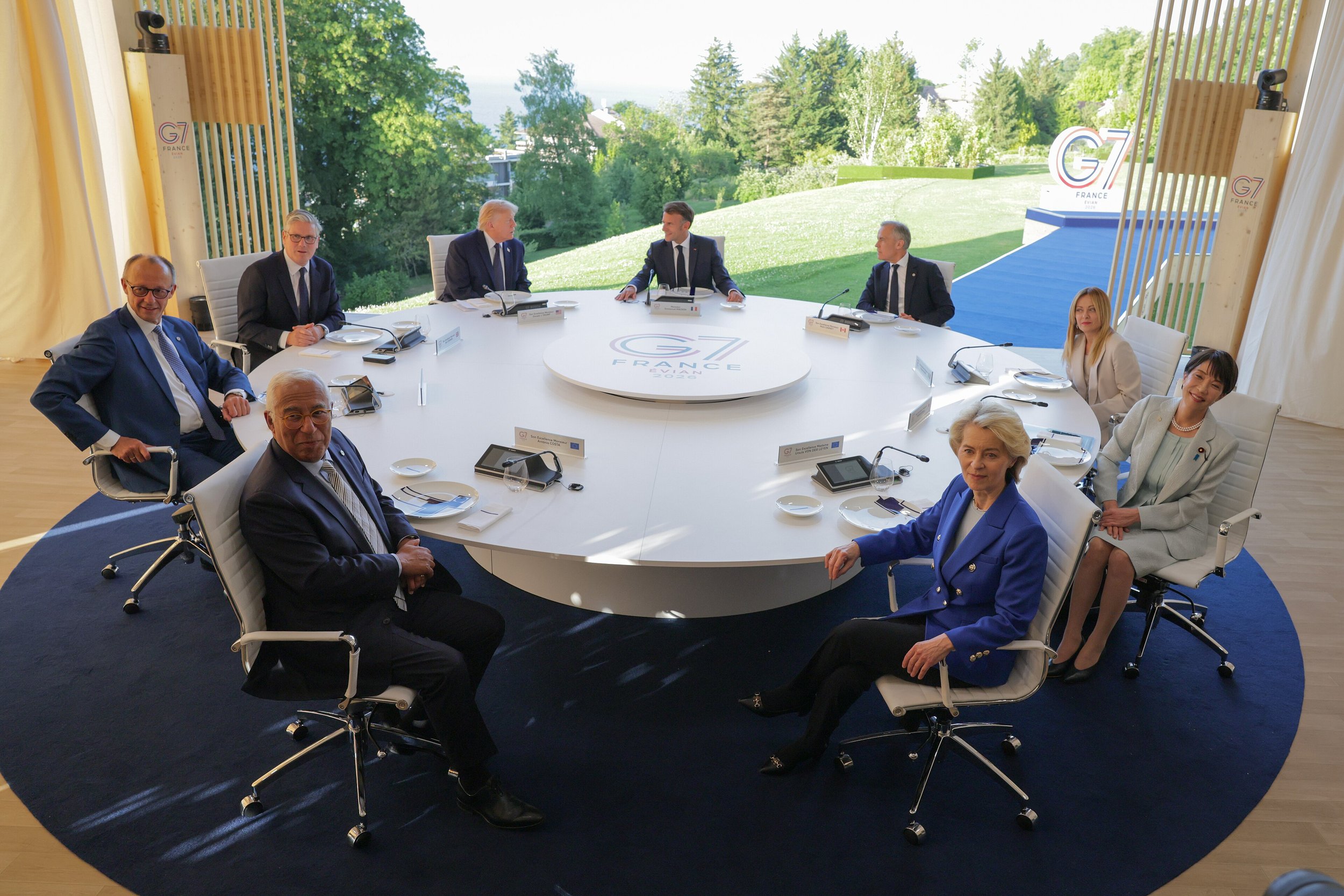
If G7 members (United States, Germany, Japan, United Kingdom, France, Italy, Canada), including the United States, do not address issues relating to the Republic of Cuba, the message to Donald Trump, President of the United States (2017-2021 and 2025-2029) will take from the silence is he has carte blanche to due what he wants with the 800-mile long archipelago with approximately 10 million inhabitants located 93 miles south of Key West, Florida. 

  • “Carte blanche means having complete, unconditional authority or full discretionary power to act as you see fit. It translates from French literally as “white card” or “blank paper”—symbolizing a signed, blank document where the holder is trusted to fill in the terms.”  

Thus far in 2026, companies located in Australia, Canada, France, Germany, Indonesia, and Spain among others have abandoned, contracted, severed, or suspended their operational relationships with Republic of Cuba government-operated companies. 

Ten companies located in the Brussels, Belgium-based European Union (EU) are or remain defendants in lawsuits filed in United States District Courts beginning in 2019. 

  • EU: Austria, Belgium, Bulgaria, Croatia, Cyprus, Czech Republic, Denmark, Estonia, Finland, France, Germany, Greece, Hungary, Ireland, Italy, Latvia, Lithuania, Luxembourg, Malta, Netherlands, Poland, Portugal, Romania, Slovakia, Slovenia, Spain, Sweden.  

  • The Trump-Pence Administration (2017-2021) on 2 May 2019 made operational Title III of the Cuban Liberty and Democratic Solidarity Act of 1996 (known as “Libertad Act”).  

  • Title III authorizes lawsuits in United States District Courts against companies and individuals who are using a certified claim or non-certified claim where the owner of the certified claim or non-certified claim has not received compensation from the Republic of Cuba or from a third-party who is using (“trafficking”) the asset.   

The Group of Seven (G7) consists of countries based upon their GDP and the type of political system- defined as democracies. 

  • 2026 G7: (2014-Present) United States, Germany, Japan, United Kingdom, France, Italy, Canada, and European Commission (president) and European Council (president).  The Russian Federation (2025 GDP ranks 8th) was excluded in 2014 due to its military actions (annexation) of the Crimean Peninsula in Ukraine.  NOTE: Spain is  considered a “permanent guest” at G7 Leaders’ Summits despite ranking 12th in 2025 GDP.  Spain is not participating in the 2026 G7 Leaders’ Summit.

  • The G7 has seven country members and two representatives of the EU- European Commission (president) and European Council (president).  Dr. Ursula von der Leyen is president (2019-2029) of the European Commission and Antonio Costa is president (2024-2029) of the European Council.    

Link To Related Analyses 

For Cuba, 5 June 2026 Is 21st Century D-Day. President Trump Hitting G7 Members Canada, France, Germany.  And, A Particular Favorite G7 Guest, G20 Member, And NATO Member Spain June 3, 2026

LINK TO COMPLETE ANALYSIS IN PDF FORMAT

Issues With 2026 Vanguard Energy Transaction With Cuba Reminds Of 2018 MLB Failure And 2022 PYME Financing/Investment Success. Obvious Signals. Lack Of Engagement?

Issues With 2026 Vanguard Energy Transaction With Cuba Reminds Of 2018 MLB Failure And 2022 PYME Financing/Investment Success 

Two Obvious Issues And Signals: Payments To Cuba Company Which Is Defendant In Libertad Act Lawsuit Now Before United States Supreme Court And Logical Trajectory Of SDN Listings 

Ill-Advised To Assume A Cuba-Related Transaction Is Authorized.  Best Strategy Is First Directly Engage With BIS, OFAC, OCA, OLA, NSA Before Going Public 

There are commonalities from June 2026, May 2022, and December 2018, where each reflects how companies, consultants, legal counsel, and organizations determined their licensing and negotiation strategies with the Bureau of Industry and Security (BIS) of the United States Department of Commerce, Office of Foreign Assets Control (OFAC) of the United States Department of the Treasury, Office of Cuban Affairs (OCA) and Office of the Legal Advisor (OLA) at the United States Department of State, and the National Security Council (NSC) in The White House. 

The efforts in December 2018 and June 2026 were derailed by lack of engagement with the BIS, OFAC, OCA, OLA, and NSC.  

The efforts of May 2022 were successful because of engagement with the BIS, OFAC, OCA, OLA, and NSC.   

Successful strategies for Republic of Cuba-related transactions have in common the attorneys, companies, consultants, and organizations engage early and often with the BIS, OFAC, OCA, OLA, and NSC.   

This engagement is critical even when there may be policy, precedent, regulation, and statutory basis not to require engagement.  Meaning, portions of the transaction or the transaction itself is deemed permissible under general licenses- not requiring specific written authorization. 

The June 2026 OFAC issue for Coral Gables, Florida-based Vanguard Energy compares with the December 2018 OFAC issue when New York, New York-based Major League Baseball (MLB) executed an agreement with Republic of Cuba-based Federacion Cubana de Beisbol (FCB) which included payments to FCB rather than payments-in-kind, meaning equipment, etc.  

MLB retained a former NSC official in the Obama-Biden Administration (2009-2017) who should have known that potential payments of millions of United States Dollars to an instrumentality of the government of the Republic of Cuba would be problematic and a solution may be to use the funds to purchase products and then export those products to the Republic of Cuba.  Upon the MLB agreement becoming public, officials within the Trump-Pence Administration (2017-2021) rejected the MLB agreement because it provided funds to the government of the Republic of Cuba.  From the OFAC (19 April 2029) to attorneys for MLB: 

  • “We are writing to update you on the applicability of a general license under the Cuban Assets Control Regulations, 31 C.F.R. Part 515 (CACR), to the activities of the Office of the Commissioner of Major League Baseball (MLB). In September 2016, the U.S. Department of the Treasury’s Office of Foreign Assets Control (OFAC) provided written guidance to MLB with respect to various proposed activities involving Cuba and the Cuban Baseball Federation.1 In particular, OFAC indicated that certain payments from MLB to the Cuban Baseball Federation were authorized by a general license found at section 515.571(e) of the CACR.”  

  • “The CACR, administered by OFAC, prohibit all persons subject to the jurisdiction of the United States from dealing in property in which Cuba or a Cuban national has an interest except as authorized or exempt. Section 515.571(e) of the CACR authorizes transactions related to the sponsorship or hiring of a Cuban national to work in the United States in a non-immigrant status or pursuant to other non-immigrant travel authorization by the U.S. government, except that an employer may not make payments to the Cuban government in connection with the sponsorship or hiring of a Cuban national.” 

  • “In light of facts recently brought to our attention, and after consultation with the U.S. Department of State, OFAC has determined that MLB’s payments to the Cuban Baseball Federation are not authorized by section 515.571(e) of the CACR, because a payment to the Cuban Baseball Federation is a payment to the Cuban government. Additionally, no other general license in the CACR authorizes these payments. As such, MLB’s payments to the Cuban Baseball Federation are prohibited unless specifically licensed by OFAC. If MLB would like to make these payments, it may seek a specific license from OFAC.” 

One of the Members of the 115th United States Congress who opposed the MLB agreement was Marco Rubio (R- Florida), a member of the United States Senate (2011-2025). 

Last week, Vanguard Energy announced that the company would make payment(s) to lease fuel storage facilities from Republic of Cuba government-operated Union-Cuba Petroleo (CUPET).  Soon after the announcement, the OFAC listed CUPET as a Specially Designated National (SDN).  That SDN listing was anticipated.  CUPET is a defendant in a case currently before the United States Supreme Court (SCOTUS) with a decision expected soon. 

  • ”UNION CUBA PETROLEO (a.k.a. CUPET), Avenida Salvador Allende No. 666, Entre Oquendo y Soledad, Havana 10300, Cuba; Organization Established Date 25 Mar 1992; Target Type State-Owned Enterprise; Entity Code 2605 (Cuba) [CUBA-EO14404].”

  • That is why, today, I am designating Cuba’s state-owned oil and gas company Union Cuba-Petroleo (CUPET), key assets of which were unlawfully expropriated from American owners years ago, pursuant to President Trump’s Executive Order (E.O.) 14404 of May 1, 2026.  CUPET is being designated pursuant to Section 2(a)(i)(A) of E.O. 14404, for operating or having operated in the energy sector of the Cuban economy.”  Marco Rubio, United States Secretary of State

Payments to CUPET may have also been viewed by the Trump-Vance Administration through the Libertad Act Title III lawsuit filed in 2019 by Spring, Texas-based Exxon Mobil Corporation (2025 revenue approximately US$332 billion) against Republic of Cuba government-operated Corporacion Cimex S.A. and CUPET.  Unknown if Vanguard Energy interacted with Exxon Mobil Corporation.  Title III of the Liberated Act provides for private settlements by owners with those deemed to be trafficking in the asset.   

Exxon Mobil Corporation has the 8th largest certified claim against the government of the Republic of Cuba: US$71,611,002.90 and US$173,157.12. 

  • The Trump-Pence Administration on 2 May 2019 made operational Title III of the Cuban Liberty and Democratic Solidarity Act of 1996 (known as “Libertad Act”). 

  • Title III authorizes lawsuits in United States District Courts against companies and individuals who are using a certified claim or non-certified claim where the owner of the certified claim or non-certified claim has not received compensation from the Republic of Cuba or from a third-party who is using (“trafficking”) the asset.  

  • 24-699 EXXON MOBIL CORP. V. CORPORACION CIMEX, ET AL. (CUPET): “QUESTION PRESENTED: In 1960, the Cuban government confiscated the property of American nationals and transferred it to state-owned enterprises. After years without a diplomatic resolution, Congress enacted the Helms-Burton Act, which created a damages action for American nationals against "any person ... that traffics in" such confiscated property. 22 U.S.C. § 6082(a)(1). The Act defines "person" to include "any agency or instrumentality of a foreign state," id. § 6023(11), and expressly contemplates "judgment[s] against an agency or instrumentality of the Cuban Government," id. § 6082(d). The question presented is: Whether the Helms-Burton Act abrogates foreign sovereign immunity in cases against Cuban instrumentalities, or whether parties proceeding under that Act must also satisfy an exception under the Foreign Sovereign Immunities Act.  LOWER COURT CASE NUMBER: 21-7127, 22-7019, 22-7020”

  • Link: U.S. Supreme Court Agrees To Hear Two Cuba Libertad Act Cases. Trump Administration Supports Both Plaintiffs. October 03, 2025

The Biden-Harris Administration (2021-2025) directed the OFAC to issue the first license authorizing an entity subject to United States jurisdiction (not affiliated directly or indirectly with an individual of Cuban descent) to deliver a direct equity investment to and authorizing direct financing for an officially registered privately-owned company (in the service sector) located in the Republic of Cuba and owned by a Republic of Cuba national. Neither entity in the transaction is connected with the other in terms of commercial relationships or family relationships. The parties did not have connectivity prior to this transaction. 

The inter-agency review process across the United States government required approximately one year of consultations, discussions, meetings, and negotiations.  The OFAC license was issued on 10 May 2022.  

LINK TO COMPLETE ANALYSIS IN PDF FORMAT

Paul kaye

1497 Days Waiting For A Document Does Not Inspire Confidence That President Diaz-Canel Can Or Knows How To Fix The Commercial Pandemic Infecting Cuba.

Miguel Diaz-Canel, President of the Republic of Cuba (2019- ), announced a journey to restructure the commercial, economic, financial, political, and societal infrastructure of the Republic of Cuba.

4 years 1 months 5 days or 49 months 5 days or 213 weeks 6 days or 1497 calendar days and the re-emerging private sector in the Republic of Cuba awaits one page of paper…  Why?

The inter-agency review process required approximately one year with consultations, discussions, meetings, and negotiations with officials throughout the Biden-Harris Administration (2021-2025).  The Office of Foreign Assets Control (OFAC) license was issued on 10 May 2022.  

The Biden-Harris Administration directed the OFAC to issue the first license authorizing an entity subject to United States jurisdiction (not affiliated directly or indirectly with an individual of Cuban descent) to deliver a direct equity investment to and authorizing direct financing for an officially registered privately-owned company (in the service sector) located in the Republic of Cuba and owned by a Republic of Cuba national. Neither entity in the transaction is connected with the other in terms of commercial relationships or family relationships. The parties did not have connectivity prior to this transaction. 

LINK TO COMPLETE ANALYSIS IN PDF FORMAT

Cuba's President Díaz-Canel "explains priorities designed to overcome current difficulties"

“The First Secretary of the Central Committee of the Communist Party of Cuba and President of the Republic, Miguel Díaz-Canel Bermúdez, gave a statement to the press team of the Presidency of the Republic. He spoke about how, on the island, thought and consensus are focused on moving forward despite the fierce imperial blockade

Granma: 12 June 2026

"In complex times, one cannot do without the passion for development." This is a Fidel Castro-era concept that embodies the will not to be defeated, and it was shared by the First Secretary of the Central Committee of the Communist Party of Cuba, Miguel Díaz-Canel Bermúdez, with the press team of the Presidency of the Republic.

Taking as a starting point a question alluding to the difficult times the country is experiencing and what could be done from the island to move forward, and even grow, the dignitary shared reflections on several measures designed to overcome the current situation. First, he spoke about the "multidimensional aggression as part of a completely aggressive policy of the United States government toward Cuba, with total contempt, with an interventionist character."

The Head of State stated that this policy "is having an impact that complicates the daily lives of Cubans." And he emphasized: "In every detail of the lives of Cuban men and women, in every family detail, in every detail of our economy, there are extremely complex situations, which only a people as heroic as ours can face,” and which “can survive and can have the will to overcome."

The president expressed that precisely about this "we have to talk": about how Cubans "are going to overcome them"; about "how we are overcoming them." He then stressed that "the United States cannot forgive itself that, at this point, with all the maximum pressure they have exerted, the Revolution continues to exist and the country continues to function." And they themselves don't believe what they talk about and repeat so much about a failed state."

The President of the Republic reflected that a failed state wouldn't have been able to survive, not even for weeks, a situation like the current one; and he recalled that, as "Fidel taught us," in complex times we cannot do without a passion for creativity, that which, "together with the unity of our people and with our will, can allow us to overcome all these challenges." The dignitary recalled Fidel's idea that "every opportunity in the midst of a crisis must be seized as a moment of takeoff, as a moment of growth. Therefore, we have established a set of priorities to confront this entire situation. "

The first, he said, "is preparation for defense. And you all know the intensity with which every element of the territorial defense system is being prepared; how the weekly Defense Days are being utilized and everything that is being done to refine the plans—the adaptation of the plans to the experiences we have gained; but also seeking everything we can optimize in terms of population protection, population participation, in a People's War strategy."

ECONOMIC AND SOCIAL ISSUES TAKE FRONT

The other major priority, the president stated, "is the Economic and Social Program for 2026." Díaz-Canel recalled that it was submitted for public debate at the end of last year, and that from this collective reflection "many proposals emerged, especially regarding elements of transformation in the economic and social model.”

"This public debate broadened, strengthened, and reinforced the projections contained in the initial document. And respecting the opinion of our people, in recent months we have worked intensively with experts, consulting criteria, including international criteria, using Artificial Intelligence platforms," comparing, he said, the Island’s experience with "the particularities of countries like China and Vietnam, which are also in processes of socialist construction and which, at a certain point, not as prolonged as ours, experienced blockades. "

The Head of State affirmed: " I believe there is a maturity in a significant portion of these ideas, of these proposals." He explained that the measures are "being finalized for approval by the Political Bureau and the National Assembly; and immediately afterward, an information and explanation process will begin for the population, because the most important thing is that these necessary transformations are understood, shared, defended, and implemented with maximum efficiency."
The president commented that work has been done on more than twenty issues "related to transformation."

The first of these, he specified, "has to do with the economic management system. There is a whole group of proposed measures or actions that will allow us to resolve old contradictions we have between the Plan, between central planning and the incentives." Díaz-Canel spoke about the importance of breaking down barriers to stimulate national production, both "to offer more goods and services to our population," and for exports that will generate revenue.

"In other words, the perspective behind everything we propose is that together we can productively boost the country, create wealth, and distribute that wealth with social justice." The dignitary warned that, "if we don't have wealth, it's very difficult to move forward," especially in social programs and in addressing "the inequalities that have been created, addressing the vulnerabilities of individuals, families, and communities."

Along the same lines, he stated that there is a set of measures designed to resolve "the contradiction between centralization and decentralization." He then posed several questions: "What should the country's central planning focus on? What should it promote? What should it strategically address?" While safeguarding these essential aspects, he emphasized removing obstacles and granting powers "to other levels, so that they can carry out their own activities that also promote the endogenous potential that exists in those areas."

THE MUNICIPALITY AND THE STATE-OWNED ENTERPRISE: KEY COMPONENTS OF THE COUNTRY'S ENGINE

Municipal autonomy and business autonomy were other work priorities on which the Cuban President reflected. Regarding the powers that can be granted to municipalities, he referred to creating the conditions so that these entities have "every possibility of deciding which are their enterprises, which are their economic actors, what the matrices of interrelation are among these economic actors, how local production systems are conceived and built, and how endogenous strengths are leveraged."

He said that the municipality should have the power to import and export, and should not depend on central plans; that the municipality should be able to manage foreign currency revenues based on its ability to stimulate and manage foreign direct investment in its own interest; that it should be able to manage investments or projects with Cubans residing abroad, that it should be able to approve investments by Cubans residing in Cuba, and that it should be able to facilitate all interconnections and partnerships among all economic actors.

Regarding this space of great importance to society, the Head of State spoke about the possibility of municipalities having the power to export and import based on their own production, thus enabling them to defend their development. He emphasized that this idea does not contradict national priorities; on the contrary, it reinforces them. He reasoned:

"I believe the country will always be stronger and have greater capacity to respond to the extent that its municipalities are also stronger." Following this same line of reasoning, he referred to the autonomy of state-owned enterprises: "They should operate without intermediaries, without interference in their management. And above all, with significant participation from the company's workers—who are the owners, who represent the State, who represent the people's social ownership of these companies."

According to the plan, as the Head of State explained to reporters, based on worker participation in decision-making, "companies will design their size, they will design their salary systems, they will have unlimited and unhindered power to use their profits as they see fit, as they approve."

"Collectively, they will have export and import powers; they will have contracts that will allow them to earn foreign currency and, in addition to their contributions to the country, they will have a portion of that foreign currency to expand their production and services."

"They will be able to form economic partnerships with any type of economic actor; they will decide who their clients and suppliers are. They will develop their plans—some will respond to state orders, but other plans must facilitate production and services for export and for the population."

The dignitary stated that "companies will have a broad scope; In other words, companies will be able to produce and provide services of all kinds, leveraging their full potential without any limits. I believe this will put state-owned enterprises on a level playing field with other economic actors, which is something that has been strongly demanded. "

There are ways, the President explained, in which "state-owned enterprises will be able to participate directly in the foreign exchange market. And, therefore, the foreign exchange market will also be a space where state-owned enterprises will have a presence."

Díaz-Canel Bermúdez commented that there will also be a restructuring of the State apparatus, the government, the business sector, the Party, political organizations, and mass organizations throughout the country: "There is already a draft bill that has been made public on the National Assembly website so that the public can offer their opinions before it goes to the National Assembly; but there is a significant reduction, not only in the number of ministries, but also in the number of positions. "

This, he argued, will lead to "savings in the budget, which will then be available to support social programs or the salary reform, which we must implement as quickly as possible, especially in the budgetary sector, because in the business sector there are no limits—that is, each company designs its own salary system and pays salaries based on the revenue it is able to generate."
The dignitary emphasized: "I believe that we will then achieve a State, a Government, and organizations that are less bureaucratic, more dynamic, and better able to adapt to the demands of our times."

The First Secretary of the Central Committee of the Communist Party of Cuba also stressed: "That everything we do contributes to addressing social inequalities and vulnerabilities."

MORE POWERS FOR THE EFFECTIVE USE OF LAND

The broad range of powers—the Head of State reflected—is very much geared toward stimulating and revitalizing agricultural production, food production. He referred to "the powers that will be granted for land use; to give land to those who can truly produce it; to minimize idle land; to maximize productivity; to ensure producers have access to input markets, both in foreign currency and in national currency; to give producers access to the foreign exchange market; and to enable producers from any sector—state, cooperative, private, and foreign investment, which may also be involved in food production—to interact and form partnerships."

The Head of State also mentioned the possibility, for both the State Socialist Enterprise and all sectors, “of opening real accounts in foreign currency at banks.” Likewise, he shared the idea that "all the procedures for creating companies, all the procedures for promoting agricultural production should be as streamlined as possible, with the least possible delay, paperwork, and bureaucracy; and that a whole range of business models can be developed among different actors that will allow, in a short time, to achieve food sovereignty and self-sufficiency in food production."

A MORE DYNAMIC FOREIGN TRADE

The president commented on "a group of measures aimed at foreign trade, exports, value chains, and logistics," all designed to make this area of ​​the national structure increasingly "more dynamic." In this regard, he stated that "it will not be mandatory for any economic actor to export and import through intermediaries"; and added: "Those who import inputs or raw materials for production and service processes in Cuba will benefit from import tariffs more than those who import finished products that can be manufactured domestically."

In outlining the premises for this revitalization, the president emphasized "that deposits in real accounts will be respected. The possibility of allowing a group of entities engaged in foreign trade to hold accounts in other countries is also being evaluated."
Regarding non-state management forms, Díaz-Canel stated that "prohibited activities will be limited," with the aim of broadening the scope of each form "to allow for the development of the greatest number of activities, all within clear rules and legal frameworks." He also said that "opportunities for shareholder participation" will be expanded.

Currently, the president affirmed, a process is underway to expedite the approval of MSMEs, both state-owned and non-state-owned, that had submitted their projects and objectives but had not yet been approved: "And all these powers will also be extended to the municipalities; therefore, the process will be simpler."

The president emphasized the importance of "streamlining and incentivizing the special economic partnership relationships that we have already approved between state-owned and non-state entities, which is something that has already been approved but has not yet been fully utilized."

"There is also a set of provisions to incentivize foreign direct investment. These relate to surface rights, removing obstacles, the use of bank accounts, the approval times for foreign direct investment, and the expeditious nature of responses."

"And among all this foreign direct investment, two particular forms of investment by Cubans have also been addressed: that of Cubans residing abroad and that of Cubans in Cuba. The aim is for them to participate, on equal terms, as economic actors alongside foreign direct investment, state-owned enterprises, non-state entities, and cooperatives in the country’s economic and productive fabric."

The Cuban President asked that these transformations be viewed "within a stable, legal framework that guarantees long-term business security; a framework that is respectful, secure, and above all, that incentivizes and encourages the participation of these actors. "

THE ENERGY THAT CUBA DEMANDS, SOCIAL PROJECTION, AND OTHER GOALS

Another priority that has been addressed and promoted, as the president explained, involves the use of renewable energy sources in all sectors, and how we are becoming "less and less dependent on electricity generation using fossil fuels—and especially imported fossil fuels—given the impact of this criminal energy blockade on our country, which has seen only one oil tanker enter Cuba in the last five months."

On the topic of energy, he said, "we are committed to increasing electric mobility, both through the importation of electrical equipment and through the assembly and manufacturing of different types of equipment in Cuba."

Addressing another high-priority task for Cuba, Díaz-Canel stated: "We are going to gradually eliminate product subsidies and implement subsidies for individuals, with differentiated attention given to those who need it most." He also spoke of “taking into account the social responsibility of all economic actors on our map,” at the municipal, provincial, and national levels.

The Head of State told reporters that "there are proposals regarding fiscal policy," alluding to "a different relationship between the budget and state-owned enterprises, so that the budget doesn't have to finance the inefficiency of those enterprises."

Later in his remarks, Díaz-Canel Bermúdez said: "There is also a vision for monetary policy, and especially for a restructuring and a different operation with the participation of all actors in the foreign exchange market. And here I come to the need to strengthen our financial and banking system."

ON TOURISM, FUEL, TRADE, AND HUMAN CAPITAL

Regarding tourism, severely impacted by the imperialist blockade, the president alluded to the importance of moving towards "new approaches, with new players" that will allow for the development of "all the infrastructure we have."

"We cannot think, at this time, only about the large chains when many of them, due to pressure from the United States government, have withdrawn from the country." Along the same lines, the Head of State referred to how "we manage businesses in the real estate and tourism sectors, with new approaches and with other players who are not those who have traditionally been in these areas."

Furthermore, "we are going to remove, as much as possible," the president said, "the restrictions on vehicle imports. Always prioritizing, in terms of tariffs and prices, the import of electric vehicles, electric vehicles that are charged with solar energy."
Regarding domestic trade, Díaz-Canel Bermúdez emphasized the importance of "leveraging our existing network of retail infrastructure and managing it more efficiently and quickly," so that "domestic trade becomes an incentive for national production and fosters development."

He noted that plans are underway to establish electronic invoicing nationwide and, to the extent possible, to further expand the use of digital platforms for domestic trade.

"There are also actions and measures focused on human capital, particularly on protecting the potential of our young, skilled workforce." In this regard, the president spoke about "how we protect them through wages and incentives, so that these young people don't have to pursue projects abroad and have the conditions and opportunities to contribute to their country's development here."

CUBA HAS NOT STOPPED

Toward the end of his remarks, the Head of State spoke about "having confidence," because "the country is not stopped. The country is intelligently confronting this entire situation. We can’t say everything so clearly because the enemy is lurking in everything we do."

The First Secretary of the Central Committee of the Communist Party emphasized: "I believe our response must be one of unity. These things will be discussed openly; and anyone who has a better idea or a better proposal should share it, and it will always be considered."

Regarding the heroic resistance of the Cuban people, he stated: "They want to condemn us every day with some measure." The dignitary denounced rhetoric that speaks of an increasingly aggressive escalation by the empire; he spoke of "psychological warfare to intimidate us, to make us afraid, to make us surrender.” But he also considered a crucial detail in these historic days: "They don't realize that there is a people, for the most part, willing not to surrender, not to be humiliated, and not to lose what can be improved."

The Cuban President referred to a perfection that "we must achieve among ourselves, with our own effort and talent, not with external interference that wants nothing to do with what the Revolution has dreamed of for the people of Cuba."“

U.S. Ag/Food Exports To Cuba Increase 20.1% In April 2026; Decrease 12.4% Year-To-Year. Corn And Soybean Oilcake Have Returned. Manicure/Pedicure Preparations.

ECONOMIC EYE ON CUBA©
June 2026

April 2026 Ag/Food Exports To Cuba Increase 20.1% -
Year-To-Year Decrease 12.4%
44th Of 229 April 2026 U.S. Food/Ag Export Markets- 2
Year-To-Year Ranking 51st Of 229 U.S. Ag/Export Markets- 2
Re-Emerging Private Sector Exports Continue To Increase – 3
Trump-Vance Administration Fuels Authorization- US$12,382,266.00
April 2026 CDA Healthcare Product Exports US$17,120.00 - 6
April 2026 Humanitarian Donations US$17,747,405.00 – 7
U.S. Port Export Data- 20


APRIL 2026 AG/FOOD EXPORTS TO CUBA INCREASE 20.1%%- Exports of food products and agricultural commodities from the United States to the Republic of Cuba were US$44,043,561.00 in March 2026 compared to US$36,655,397.00 in March 2025 and US$40,624,058.00 in March 2024.  

US$144,843,030 thus far in 2026 compared with US$167,685,124.00.00 during the same period in 2025 representing a decrease of 12.4% year-to-year.

Highlights: Corn (US$3,008,120.00), Soybean Oilcake (US$4,554,552.00), Solar Cells (US$299,861.00), Diesel Generator Sets (US$34,080.00), Manicure & Pedicure Preparations (US$16,800.00).

Since 2022, when the first BIS license was issued for the export of vehicles to Republic of Cuba nationals and to private companies in the Republic of Cuba, the cumulative export value of the initiatives in place during the Obama-Biden Administration, Trump-Pence Administration, Biden-Harris Administration, and Trump-Vance Administration exceeds US$469 million of which electric and gasoline-powered new and used vehicles, bicycles, trucks, motorcycles and mopeds, and parts, exceeds US$268 million (Year 2026: US$41,003,372.00; Year 2025: US$149,413,031.00; Year 2024: US$67,241,234.00; Year 2023: US$10,546,419.00; Year 2022: US$89,848.00), and purchases (equipment and products) for use by the re-emerging private sector in the Republic of Cuba driving the growth.

The data contains information on exports from the United States to the Republic of Cuba- products within the Trade Sanctions Reform and Export Enhancement Act (TSREEA) of 2000, Cuban Democracy Act (CDA) of 1992, and regulations implemented (1992 to present) for other products by the Office of Foreign Assets Control (OFAC) of the United States Department of the Treasury, Bureau of Industry and Security (BIS) of the United States Department of Commerce, and United States Department of State.

The TSREEA re-authorized the direct commercial (on a cash basis) export of food products (including branded food products) and agricultural commodities from the United States to the Republic of Cuba, irrespective of purpose. The TSREEA does not include healthcare products, which remain authorized and regulated by the CDA.

The data represents the U.S. Dollar value of product exported from the United States to the Republic of Cuba under the TSREEA, CDA, and other regulations, specifically including products exported from the United States to the re-emerging private sector in the Republic of Cuba.

The data does not include transportation charges, bank charges, or other costs associated with exports; the government of the Republic of Cuba reports unverifiable data that includes transportation charges, bank charges, and other costs.

LINK TO COMPLETE REPORT IN PDF FORMAT

LINK TO 2026 U.S. PORT EXPORT DATA

LINK TO COMPLETE LIST OF PRODUCTS IN 2025 EXPORTED FROM THE UNITED STATES TO CUBA

LINK TO COMPLETE LIST OF PRODUCTS IN 2024 EXPORTED FROM THE UNITED STATES TO CUBA

OFAC Adds Cuba's CUPET To SDN List. No Surprise, Except Why Decision Took So Long Given Case Before SCOTUS.

Office of Foreign Assets Control
United States Department of the Treasury
Washington DC
11 June 2026

Specially Designated Nationals List Updates

The following entity has been added to OFAC's SDN List:

”UNION CUBA PETROLEO (a.k.a. CUPET), Avenida Salvador Allende No. 666, Entre Oquendo y Soledad, Havana 10300, Cuba; Organization Established Date 25 Mar 1992; Target Type State-Owned Enterprise; Entity Code 2605 (Cuba) [CUBA-EO14404].”

Spring, Texas-based Exxon Mobil Corporation (2025 revenue approximately US$332 billion) filed a Title III Libertad Act lawsuit in 2019 against Republic of Cuba government-operated Corporacion Cimex S.A. and Republic of Cuba government-operated Union Cuba Petroleo (CUPET).

Exxon Mobil Corporation has the 8th largest certified claim against the government of the Republic of Cuba: US$71,611,002.90 and US$173,157.12.

The Trump-Pence Administration (2017-2021) on 2 May 2019 made operational Title III of the Cuban Liberty and Democratic Solidarity Act of 1996 (known as “Libertad Act”). 

Title III authorizes lawsuits in United States District Courts against companies and individuals who are using a certified claim or non-certified claim where the owner of the certified claim or non-certified claim has not received compensation from the Republic of Cuba or from a third-party who is using (“trafficking”) the asset.  

EXXON MOBIL CORPORATION V. CORPORACION CIMEX, S.A. (Cuba) et al., CORPRACION CIMEX, S.A. (Panama), AND UNION CUBA-PETROLEO [1:19-cv-01277; Washington DC].  31 October 2021 to Court of Appeals for the District of Columbia (21-7127).  Case pending before United States Supreme Court.

Steptoe (plaintiff)
Cross Castle, PLLC (plaintiff- withdrawn)
Rabinowitz, Boudin, Standard, Krinsky & Lieberman, P.C. (defendant)

EXXON MOBIL CORPORATION V. CORPRACION CIMEX, S.A. (Panama), AND UNION CUBA-PETROLEO [1:19-cv-01277; Washington DC].  31 October 2021 to Court of Appeals for the District of Columbia (21-8010).  Case pending before United States Supreme Court.

Steptoe (plaintiff)
Cross Castle, PLLC (plaintiff- withdrawn)
Rabinowitz, Boudin, Standard, Krinsky & Lieberman, P.C. (defendant)

24-699 
EXXON MOBIL CORP. V. CORPORACION CIMEX
DECISION BELOW: 111 F.4th 12
CERT. GRANTED 10/3/2025


QUESTION PRESENTED: In 1960, the Cuban government confiscated the property of American nationals and transferred it to state-owned enterprises. After years without a diplomatic resolution, Congress enacted the Helms-Burton Act, which created a damages action for American nationals against "any person ... that traffics in" such confiscated property. 22 U.S.C. § 6082(a)(1). The Act defines "person" to include "any agency or instrumentality of a foreign state," id. § 6023(11), and expressly contemplates "judgment[s] against an agency or instrumentality of the Cuban Government," id. § 6082(d). The question presented is: Whether the Helms-Burton Act abrogates foreign sovereign immunity in cases against Cuban instrumentalities, or whether parties proceeding under that Act must also satisfy an exception under the Foreign Sovereign Immunities Act.  LOWER COURT CASE NUMBER: 21-7127, 22-7019, 22-7020

Links To Related Analysis

Link: U.S. Supreme Court Rules 8-1 For Plaintiff, Havana Docks Corporation, In US$440 Million Lawsuit Against Four Cruise Lines May 21, 2026

Link: Transcripts And Recordings Of SCOTUS Libertad Act Title III Arguments: Havana Docks And Exxon Mobil February 24, 2026

Link: US Supreme Court Permits US Solicitor General To Deliver Ten Minute Argument On 23 February 2026 Supporting Exxon Mobil Corporation Against Cuba Government In Libertad Act Lawsuit January 27, 2026

Link: Foreign Sovereign Immunities Act Is Focus Of Two Libertad Act Lawsuits At DC Court Of Appeals: Exxon Mobil Versus Cimex S.A. (Cuba), Cimex S.A. (Panama), Union Cuba-Petroleo January 20, 2022

Link: U.S. Supreme Court Agrees To Hear Two Cuba Libertad Act Cases. Trump Administration Supports Both Plaintiffs. October 03, 2025

U.S. Department Of State Sanctions Cuba's CUPET. No Surprise, Except Why Decision Took So Long Given Case Before SCOTUS.

United States Department of State
Washington DC
11 June 2026

Sanctioning Cuba’s State-Owned Oil and Gas Company Unión Cuba-Petróleo

”Like every resource on the island, energy has long been weaponized by Cuba’s Communist government as a tool of both repression and self-serving regime kleptocracy.  While the Cuban people have suffered fuel shortages and blackouts because of decades of under-investment in critical infrastructure, Cuba’s Communist leaders have diverted energy resources to line their own pockets:  reselling countless barrels of scarce energy on the secondary market, hoarding energy supplies for its military, intelligence and repressive forces, and rationing energy as a tool of social control.  As regular Cubans wait for weeks to fill their cars and suffer relentless blackouts, the Castro family flies around on a private jet, the government buses in fake protesters for publicity stunts, and the regime prioritizes keeping the power on in luxury tourist hotels.

That is why, today, I am designating Cuba’s state-owned oil and gas company Union Cuba-Petroleo (CUPET), key assets of which were unlawfully expropriated from American owners years ago, pursuant to President Trump’s Executive Order (E.O.) 14404 of May 1, 2026.  CUPET is being designated pursuant to Section 2(a)(i)(A) of E.O. 14404, for operating or having operated in the energy sector of the Cuban economy.  The Trump Administration will continue to target Cuba’s ability to leverage energy trade to further its corrupt agenda and repressive security apparatus. 

The Department’s actions are being taken pursuant to E.O. 14404, which authorizes sweeping sanctions on Cuba, including persons who support the Cuban regime’s security apparatus and those responsible for repression in Cuba and threats to U.S. national security.  Today’s action also furthers the objectives of the national emergency declared in E.O. 14380, “Addressing Threats to the United States by the Government of Cuba” and the National Security Presidential Memorandum 5 (NSPM-5), which direct the Executive Branch to improve human rights, encourage the rule of law, foster free markets and free enterprise, and promote democracy in Cuba.      

Sanctions Implications 

As a result of today’s sanctions-related actions, and in accordance with E.O. 14404 of May 1, 2026, “Imposing Sanctions on Those Responsible for Repression in Cuba and for Threats to U.S. National Security and Foreign Policy,” all property and interests in property of the designated  entity described above that are in the United States or in possession or control of U.S. persons are blocked and must be reported to the Department of the Treasury’s Office of Foreign Assets Control (OFAC).  Additionally, all entities that are owned individually or in the aggregate, 50 percent or more by one or more blocked persons are also blocked.   

All transactions and dealings by U.S. persons or persons within (or transiting) the United States that involve any property or interests in property of designated or otherwise blocked persons are prohibited unless authorized by a general or specific license issued by OFAC or exempt.  These prohibitions include the making of any contribution or provision of funds, goods, or services by, to, or for the benefit of any blocked person and the receipt of any contribution or provision of funds, goods, or services from any such person.  Foreign persons who engage in transactions with persons designated pursuant to E.O. 14404—or that operate in the energy, defense and related materiel, metals and mining, financial services, or security sector of the Cuban economy, as identified in E.O. 14404—are themselves at risk of sanctions.  Non-U.S. persons, including foreign financial institutions, should proceed with caution in any dealings with a party sanctioned under this authority.  Actions to return assets to a sanctioned party or transfer them to another jurisdiction for potential use by the target could expose non-U.S. persons to significant sanctions risk.  All property and interests in property of persons that are blocked pursuant to the Cuban Assets Control Regulations (CACR) continue to be blocked.  The CACR prohibits persons subject to U.S. jurisdiction from dealing in property in which Cuba or a Cuban national has an interest, unless authorized or exempt.

The power and integrity of U.S. government sanctions derive not only from the U.S. government’s ability to designate and add persons to the Specially Designated Nationals and Blocked Persons (SDN) List, but also from its willingness to remove persons from the SDN List consistent with the law.  The ultimate goal of sanctions is not to punish, but to bring about a positive change in behavior.  

Petitions for removal from the SDN List may be sent to: OFAC.Reconsideration@treasury.gov.  Petitioners may also refer to the Department of State’s Delisting Guidance page.” 

Spring, Texas-based Exxon Mobil Corporation (2025 revenue approximately US$332 billion) filed a Title III Libertad Act lawsuit in 2019 against Republic of Cuba government-operated Corporacion Cimex S.A. and Republic of Cuba government-operated Union Cuba Petroleo (CUPET).

Exxon Mobil Corporation has the 8th largest certified claim against the government of the Republic of Cuba: US$71,611,002.90 and US$173,157.12.

The Trump-Pence Administration (2017-2021) on 2 May 2019 made operational Title III of the Cuban Liberty and Democratic Solidarity Act of 1996 (known as “Libertad Act”). 

Title III authorizes lawsuits in United States District Courts against companies and individuals who are using a certified claim or non-certified claim where the owner of the certified claim or non-certified claim has not received compensation from the Republic of Cuba or from a third-party who is using (“trafficking”) the asset.  

EXXON MOBIL CORPORATION V. CORPORACION CIMEX, S.A. (Cuba) et al., CORPRACION CIMEX, S.A. (Panama), AND UNION CUBA-PETROLEO [1:19-cv-01277; Washington DC].  31 October 2021 to Court of Appeals for the District of Columbia (21-7127).  Case pending before United States Supreme Court.

Steptoe (plaintiff)
Cross Castle, PLLC (plaintiff- withdrawn)
Rabinowitz, Boudin, Standard, Krinsky & Lieberman, P.C. (defendant)

EXXON MOBIL CORPORATION V. CORPORACION CIMEX, S.A. (Panama), AND UNION CUBA-PETROLEO [1:19-cv-01277; Washington DC].  31 October 2021 to Court of Appeals for the District of Columbia (21-8010).  Case pending before United States Supreme Court.

Steptoe (plaintiff)
Cross Castle, PLLC (plaintiff- withdrawn)
Rabinowitz, Boudin, Standard, Krinsky & Lieberman, P.C. (defendant)

24-699 
EXXON MOBIL CORP. V. CORPORACION CIMEX
DECISION BELOW: 111 F.4th 12
CERT. GRANTED 10/3/2025


QUESTION PRESENTED: In 1960, the Cuban government confiscated the property of American nationals and transferred it to state-owned enterprises. After years without a diplomatic resolution, Congress enacted the Helms-Burton Act, which created a damages action for American nationals against "any person ... that traffics in" such confiscated property. 22 U.S.C. § 6082(a)(1). The Act defines "person" to include "any agency or instrumentality of a foreign state," id. § 6023(11), and expressly contemplates "judgment[s] against an agency or instrumentality of the Cuban Government," id. § 6082(d). The question presented is: Whether the Helms-Burton Act abrogates foreign sovereign immunity in cases against Cuban instrumentalities, or whether parties proceeding under that Act must also satisfy an exception under the Foreign Sovereign Immunities Act.  LOWER COURT CASE NUMBER: 21-7127, 22-7019, 22-7020

Links To Related Analysis

Link: U.S. Supreme Court Rules 8-1 For Plaintiff, Havana Docks Corporation, In US$440 Million Lawsuit Against Four Cruise Lines May 21, 2026

Link: Transcripts And Recordings Of SCOTUS Libertad Act Title III Arguments: Havana Docks And Exxon Mobil February 24, 2026

Link: US Supreme Court Permits US Solicitor General To Deliver Ten Minute Argument On 23 February 2026 Supporting Exxon Mobil Corporation Against Cuba Government In Libertad Act Lawsuit January 27, 2026

Link: Foreign Sovereign Immunities Act Is Focus Of Two Libertad Act Lawsuits At DC Court Of Appeals: Exxon Mobil Versus Cimex S.A. (Cuba), Cimex S.A. (Panama), Union Cuba-Petroleo January 20, 2022

Link: U.S. Supreme Court Agrees To Hear Two Cuba Libertad Act Cases. Trump Administration Supports Both Plaintiffs. October 03, 2025

January 2026 Through April 2026 To Cuba: US$24 Million In Gasolines, Fuels, Pet Oils, Kerosene, Mineral, Motor

January 2026 Through April 2026
Product
Shipping District
U.S. Dollar Value

Leaded Gasoline, Not Containing Biodiesel (bbl)

Miami, FL- US$324,292.00

Unleaded Gasoline, Not Cont Biodiesel, Nesoi (bbl)

Houston-Galveston, TX- US$14,167.00

Miami, FL- US$2,279,375.00

Tampa, FL- US$83,097.00

Motor Fuel, Not Containing Biodiesel, Nesoi (bbl)

Miami, FL- US$921,713.00

Tampa, FL- US$96,000.00

Light Oils/preparations Fr Bitumins Minerals,nesoi (bbl)

Miami, FL- US$82,908.00

No4 Fl Oil,lt=500 ppm S,dist/resid,lt 25,nt Biodsl (bbl)

Miami, FL- US$198,543.00

Light Fuel Oils Gt=25 Deg Api, Lt=15 ppm Sulfur (bbl)

Houston-Galveston, TX- US$7,926,887.00

Miami, FL- US$2,099,190.00

New Orleans, LA- US$109,820.00

Light Fuel Oils Gt=25 Deg Api 15 To 500 ppm Sulfur (bbl)

Miami, FL- US$364,707.00

Kerosene Motor Fuel Ex Jet Fuel Nt Biodiesel Nesoi (bbl)

Miami, FL- US$433,067.00

Automotive, Diesel Or Marine Engne Lub Oils (bbl)

Miami, FL- US$46,112.00

Automotive Gear Oils (bbl)

Miami, FL- US$43,960.00

White Mineral Oils, Medicinal Grade (bbl)

Miami, FL- US$380,642.00

Mix Of Hydrocarbons Nesoi,lt=50% 1 Hydcbn Compound (bbl)

Miami, FL- US$29,336.00

Pet Oils/oils From Bituminous Minerals, Nesoi (kg)

Houston-Galveston, TX- US$6,443,450.00

Miami, FL- US$1,312,974.00

New Orleans, LA- US$111,458.00

Tampa, FL- US$77,560.00

Pet Oils/oils From Bitmns Minrls, Cont Biodiesel (bbl)

Miami, FL- US$279,849.00

Waste Oils, Not Elsewhere Specified Or Included (bbl)

Miami, FL- US$335,578.00

Petroleum Gases, Other Gas Hydrocarbons Liq, Nesoi (kg)

Houston-Galveston, TX- US$12,354.00

Synthetic Pigments Of Iron Oxides And Hydroxides (kg)

Miami, FL- US$4,275.00

The New York Times: "As Trump Toughens Rules on Cuba’s Economy, Hotel Chains Pull Out"

The New York Times
New York, New York
4 June 2026

As Trump Toughens Rules on Cuba’s Economy, Hotel Chains Pull Out
The Trump administration’s efforts to tighten the economic noose on Cuba appear to be working, as more international firms announced they would leave the island.

The Catedral in Havana is one of 15 hotels in Cuba run by the Spanish firm, Meliá.Credit...Yamil Lage/Agence France-Presse — Getty Images

By Frances Robles
Reporting from Florida

The Trump administration’s campaign to force Cuba’s economic unraveling achieved key gains this week, when three international hotel chains and a bank that processes Visa and Mastercard transactions withdrew business from the communist nation to avoid violating new U.S. regulations.

Foreign businesses have until Friday to pull out of any venture in Cuba run by the Cuban military conglomerate that controls about half the nation’s economy. On Thursday, the U.S. government announced that it was imposing sanctions on another swath of Cuban officials and entities, including the armed forces.

Business leaders whose companies stay in Cuba risk losing their visa to travel to the United States and having their assets frozen. The companies themselves could also face sanctions, such as losing access to American banks.

The increasing exodus of businesses from Cuba will lead to increased unemployment and fewer financial resources for Cuba’s government, aggravating an increasingly untenable economic crisis.

While the United States has long prohibited most American companies from trading with Cuba, these new regulations, called “secondary sanctions,” are a major escalation, because they target foreign companies and financial institutions.

Cuba’s Central Bank announced Wednesday that a bank that processes Visa and Mastercard transactions had withdrawn to comply with a recent executive order from the White House that threatened sanctions against foreign companies doing business in Cuba.

People lining up outside a bank in Havana on Wednesday.Credit...Yamil Lage/Agence France-Presse — Getty Images

The Cuban government, which did not name the bank, called the decision part of President Trump’s “strategy to strangle the Cuban people.”

The Spanish hotel operator Iberostar said it would end its partnership to run 12 hotels for Gaviota, Cuba’s tourism company, which is part of the Business Administration Group, a military conglomerate known by its Spanish acronym, GAESA.

Another Spanish firm, Meliá, said it would withdraw from its partnership running 15 Cuban hotels. Blue Diamond, a Canadian company that ran dozens of hotels in Cuba, also announced that it was pulling out.

Citing an announcement from the company, news reports said the Indonesian chain Archipelago International had also closed shop. The website for the company’s Aston Hotels in Cuba showed they were “no longer available for accommodation.”

The proposed U.S. sanctions are part of a series of stringent measures by the Trump administration designed to cripple Cuba’s economy and force economic and political change.

Mr. Trump on Thursday told reporters in Washington that Cuba had “sort of collapsed.”  Repeating a statement he had made in the past, he said he would “handle” Cuba as soon as his administration moves on from the conflict with Iran. “As soon as that’s done, on our way back, we’ll just make a little brief stop,” the president said without providing specific details.

Mr. Trump’s tightening vise on Cuba, including an effective oil blockade, is worsening a humanitarian crisis, leaving millions of people enduring extended power outages and struggling to find food and gasoline.

The U.S. State Department said on Thursday that it was adding five more Cuban officials and five entities to a list of sanctioned people and companies, including President Miguel Díaz-Canel and his family. 

Vast neighborhood groups organized by the government, called the Committees for the Defense of the Revolution and known for spying on local residents, were also targeted, as was Cuba’s gold mining venture.

“The entities and individuals designated today direct or fund the regime and its efforts to mobilize its radical revolutionary movements in the United States and around the world,” Secretary of State Marco Rubio said in a statement.

Two major shipping companies, one German and the other French, had already announced plans to cease operations in Cuba.

The United Nations’ World Food Program was forced to put off plans to purchase nearly 3,000 tons of food for Cuba “because we cannot find a shipping solution to bring it to Cuba,” said Etienne Labande, the agency’s Cuba country director.  The World Food Program, which was helping supply provisions for Cuba’s subsided food rations, is also trying to find other ways to pay for fuel it used to buy from private companies, because it can no longer pay with Visa or Mastercard, he said.

San Lazaro Avenue in Havana during a blackout last month.Credit...Norlys Perez/Reuters

The Trump administration’s sanctions against foreign companies, announced in May, largely targeted GAESA, the military conglomerate that operates everything from retail businesses to the tourism industry.

GAESA was born out of Cuba’s economic crisis in the 1990s following the collapse of the Soviet Union, which had been the island nation’s main benefactor.

The U.S. State Department, relying on media reports suggesting GAESA was sitting on enormous piles of cash even as the nation suffers, said the moves would deprive Cuba’s military “access to illicit assets.”

The Cuban government did not respond to a request for comment, but released a scathing statement denouncing the Trump administration.

The U.S. government, the statement said, had “once again acted with premeditated intent in its eagerness to manufacture pretexts to discredit the Cuban Revolution, its historic leadership, its current leaders, and, in doing so, confuse both our people and international public opinion.”

Mr. Díaz-Canel said on social media that GAESA was not “a path to enrichment for a few.’’

“On the contrary, it is one of the many examples that, along our path, has allowed us to resist the permanent aggression of the United States government.”

Seth Eisen, a spokesman for Mastercard, said the decision to withdraw had not been made by Mastercard.

The bank that had managed the company’s transactions decided to limit operations in Cuba, and without the foreign financial partner, Mastercards will not work to make purchases in Cuba, he said.

Visa, Iberostar and Blue Diamond did not respond to a request for comment. Meliá, in a statement, said its decision to leave Cuba “was made out of a deep sense of corporate responsibility,” but that the impact of its decision was limited because most of its hotels were already closed.

Cuba’s tourism sector has largely collapsed. In January, the Trump administration blocked fuel deliveries to Cuba, which limited the availability of jet fuel and led several airlines to cancel service.

A nearly empty street in Playa Larga, Cienaga de Zapata, Cuba, in April. Tourism in Cuba has largely come to a halt.Credit...Norlys Perez/Reuters

“The reach of these sanctions was much wider and stronger, especially among the hotel chains,” said Paolo Spadoni, a political economist at Augusta University in Georgia who studies Cuba’s tourism industry.

He noted that not all of Cuba’s hotels are run by the military conglomerate, and the Spanish hotel companies were continuing to operate hotels run by Cuban entities not tied to GAESA and not targeted with sanctions.

John S. Kavulich, president of the U.S.-Cuba Trade and Economic Council, said the latest measures could lead the Cuban military conglomerate to dismantle its operations to comply with the new rules.

“In the last 30 days, there has been more commercial, economic and financial destruction in Cuba than in any period since 1959,” Mr. Kavulich said, referring to the year of the Cuban revolution that eventually ushered in Communist rule.

The U.S. administration, he said, “achieved so much without firing a shot or one boot on the ground.”

The State Department acknowledged that the withdrawal of the hotel firms was precisely what the measures were intended to accomplish.

“Our sanctions are deliberately targeted to prevent the Cuban military and security services from profiting off international investment in Cuba to fund their continued oppression of the Cuban people and threat to U.S. national security,” the State Department said in a statement provided to The New York Times.

“Companies choosing to exit the Cuban market are making a prudent decision to comply with U.S. law and avoid enriching a regime that routinely violates fundamental human rights.”

OFAC: "Cuba Designations; Issuance of Cuba-related Frequently Asked Question"

United States Department of the Treasury
Washington DC
4 June 2026

Cuba Designations; Issuance of Cuba-related Frequently Asked Question


The Department of the Treasury's Office of Foreign Assets Control (OFAC) is issuing one new Cuba-related Frequently Asked Question, FAQ 1258.

Additionally, OFAC has updated the Specially Designated Nationals and Blocked Persons List.
Specially Designated Nationals List Updates

The following individuals have been added to OFAC's SDN List:

ANIDO CUESTA, Manuel, Madrid, Spain; DOB 03 Nov 1994; POB Holguin, Cuba; nationality Cuba; Gender Male (individual) [CUBA-EO14404] (Linked To: CUESTA PERAZA, Lis). 

CASTRO CALIS, Raul Alejandro, Havana, Cuba; DOB 16 May 1995; nationality Cuba; Gender Male (individual) [CUBA-EO14404] (Linked To: CASTRO ESPIN, Alejandro). 

CASTRO ESPIN, Alejandro (a.k.a. "El Tuerto"), Cuba; DOB 1965; nationality Cuba; Gender Male (individual) [CUBA-EO14404]. 

CUESTA PERAZA, Lis, Cuba; DOB 28 Mar 1971; POB Holguin, Cuba; nationality Cuba; Gender Female (individual) [CUBA-EO14404] (Linked To: DIAZ-CANEL BERMUDEZ, Miguel). 

DIAZ-CANEL BERMUDEZ, Miguel, Cuba; DOB 20 Apr 1960; POB Santa Clara, Cuba; nationality Cuba; Gender Male (individual) [CUBA-EO14404].

The following entities have been added to OFAC's SDN List:

AMISTUR CUBA SA, Calle 13 #504 e/ D y E, Vedado, Havana, Cuba; Organization Established Date 19 Jan 1996; Organization Type: Travel agency activities [CUBA-EO14404] (Linked To: CUBAN INSTITUTE OF FRIENDSHIP WITH THE PEOPLES). 

COMMITTEES FOR THE DEFENSE OF THE REVOLUTION (a.k.a. COMITES DE DEFENSA DE LA REVOLUCION; a.k.a. "CDR"), Linea Avenue, Havana, Cuba; Organization Established Date 28 Sep 1960; Organization Type: Public order and safety activities [CUBA-EO14404]. 

CUBAN INSTITUTE OF FRIENDSHIP WITH THE PEOPLES (a.k.a. INSTITUTO CUBANO DE AMISTAD CON LOS PUEBLOS; a.k.a. "ICAP"), Calle 17 No. 301 e/ H e I, Vedado, Havana, Cuba; Organization Established Date 30 Dec 1960; Entity Code 652 (Cuba) [CUBA-EO14404]. 

MINERA LA VICTORIA SA (a.k.a. "MLV"), Office 123, First Floor, Third Avenue Between 76 and 78, Beijing Building, Miramar Business Center, Playa, Havana 11300, Cuba; Organization Established Date 14 Aug 2020; Organization Type: Mining of other non-ferrous metal ores [CUBA-EO14404]. 

MINISTRY OF THE REVOLUTIONARY ARMED FORCES OF CUBA (a.k.a. MINISTERIO DE LAS FUERZAS ARMADAS REVOLUCIONARIAS; a.k.a. "MINFAR"), Independence Avenue, Sierra Maestra Building, Plaza of the Revolution Municipality, Havana, Cuba; Organization Established Date 16 Oct 1959; Target Type Government Entity [CUBA-EO14404].

1258. I am a non-U.S. person, what is my exposure to sanctions risk for transacting with entities owned by Grupo de Administración Empresarial S.A. (GAESA), the Cuban Ministry of the Interior (MININT), or the Cuban Ministry of the Revolutionary Armed Forces (MINFAR), including their subsidiaries listed on the Cuba Restricted List (CRL)? 

As of June 4, 2026, GAESA, MININT, and MINFAR are all blocked pursuant to Executive Order (E.O.) 14404. These three entities are also blocked pursuant to the Cuban Assets Control Regulations (CACR), and MININT is also blocked pursuant to the Global Magnitsky sanctions program under E.O. 13818, as of January 2021. Non-U.S. persons, including foreign financial institutions, are exposed to sanctions risk for engaging in transactions with persons designated under E.O. 14404. Sanctions risk also extends to transactions with any entity in which GAESA, MININT, or MINFAR own, directly or indirectly, a 50 percent or greater interest. Many of the entities listed on the CRL are 50 percent or more owned by one of these three entities and therefore present the same sanctions risk. In addition, any non-blocked CRL entity may become the subject of future sanctions actions. Consequently, persons transacting with any entity on the CRL may run the risk of themselves being sanctioned by the U.S. government.

Non-U.S. persons should consider conducting enhanced due diligence to inform a risk-based approach to transactions with GAESA, MININT, MINFAR, or any entity in which they own, directly or indirectly, a 50 percent or greater interest. As part of such due diligence, non-U.S. persons are encouraged to consult all available sources to inform their independent assessment regarding the network of entities under GAESA, MININT, and MINFAR, including trusted sources provided by the U.S. government, such as the CRL.  Released on Jun 04, 2026 

U.S. Department Of State: Fact Sheet For "Sanctions on Cuban Actors Responsible for Subversive Anti-American Activities" 

United States Department of State
Washington DC
4 June 2026

Sanctions on Cuban Actors Responsible for Subversive Anti-American Activities Fact Sheet
 

Today, the Department of State is designating five entities and five individuals as part of the Trump Administration’s comprehensive push to end the Cuban regime’s decades-long campaign of political, ideological, and institutional warfare against the United States and to hold accountable those who sustain its operations and profit from the Cuban people’s oppression. 

The Cuban regime continues to demonstrate that it prioritizes the exportation of radical left-wing violence through its malign influence networks and the enrichment of the regime over the well-being of the Cuban people.  These sanctions are designed to hold international actors supporting the Cuban regime accountable.  Foreign banks and companies providing services to those designated are at risk of sanctions and should freeze those activities. The Trump Administration will continue to target the Cuban regime’s subversive network, those who enable its subversive operations, and those who profit while the Cuban people suffer. 

All Department of State targets designated today have been designated pursuant to Executive Order (E.O.) 14404, which authorizes sanctions on persons determined to meet specified criteria related to repression in Cuba and threats to U.S. national security and foreign policy.   

Taking Action Against the Cuban Regime 

The following entities associated with developing, implementing, and funding the Cuban regime’s violent revolutionary network are being designated:  

Ministry of the Revolutionary Armed Forces of Cuba  (MINFAR)
MINFAR is being designated pursuant to Sec. 2(a)(i)(F) of E.O. 14404 for being a political subdivision, agency, or instrumentality of the Government of Cuba.  MINFAR is the government ministry in charge of the Cuban military. 
Cuban Institute of Friendship with the Peoples (ICAP)
ICAP is being designated pursuant to Sec. 2(a)(i)(F) of E.O. 14404 for being a political subdivision, agency, or instrumentality of the Government of Cuba.  ICAP is a Cuban organization founded by Fidel Castro in 1960 that supports Cuban intelligence and counterintelligence activities. 
Amistur Cuba SA
Amistur Cuba SA is being designated pursuant to Sec. 2 (a)(i)(B) of E.O. 14404 for being owned, controlled, or directed by, or having acted or purported to act for or on behalf of, directly or indirectly, ICAP, an entity designated pursuant to E.O. 14404 for being a political subdivision, agency, or instrumentality of the Government of Cuba.   
Committees for the Defense of the Revolution (CDR)
CDR is being designated pursuant to Sec. 2 (a)(i)(B) of E.O. 14404 for being owned, controlled, or directed by, or having acted or purported to act for or on behalf of, directly or indirectly, the Government of Cuba.  CDR is under the direction of the MINISTRY OF INTERIOR OF CUBA, which was previously designated for being a political subdivision, agency, or instrumentality of the Government of Cuba, and is a fundamental pillar of Cuba’s state oppressive security apparatus. 

The following regime-aligned elites and their family members are being designated: 
Miguel Diaz-Canel Bermudez (DIAZ-CANEL)
DIAZ-CANEL is being designated pursuant to Sec. 2 (a)(i)(E) of E.O. 14404 for being or having been a leader, official, senior executive officer, or member of the board of directors of the Government of Cuba.  DIAZ-CANEL is the President of Cuba.
Lis Cuesta Peraza
LIS CUESTA PERAZA is being designated pursuant to Sec. 2(a)(i)(I) of E.O. 14404 for being an adult family member of a person designated pursuant to this order.  LIS CUESTA PERAZA is the spouse of DIAZ-CANEL.  
Manuel Anido Cuesta
MANUEL ANIDO CUESTA is being designated pursuant to Sec. 2(a)(i)(I) of E.O. 14404 for being an adult family member of a person designated pursuant to this order.  MANUEL ANIDO CUESTA is LIS CUESTA PERAZA’s son and DIAZ-CANEL’s stepson.  
Alejandro Castro Espin
ALEJANDRO CASTRO ESPIN is being designated pursuant to Sec. 2(a)(i)(B) of E.O. 14404 for being owned, controlled, or directed by, or having acted or purported to act for or on behalf of, directly or indirectly, the Government of Cuba.  ALEJANDRO CASTRO ESPIN is the former head of the Cuban intelligence services and the son of Raul Modesto Castro Ruz.   
Raul Alejandro Castro Calis
RAUL ALEJANDRO CASTRO CALIS is being designated pursuant to Sec. 2(a)(i)(I) of E.O. 14404 for being an adult family member of a person designated pursuant to this order.  RAUL ALEJANDRO CASTRO CALIS is the son of ALEJANDRO CASTRO ESPIN. 
Depriving Revenue to the Cuban Regime 
The following entity, responsible for generating revenue for the Cuban regime, is being designated pursuant to Sec. 2(a)(i)(A) of E.O. 14404 for operating in or having operated in the metals and mining sector of the Cuban economy: 
Minera la Victoria SA
MINERA LA VICTORIA S.A., which is a Cuban gold mining joint venture created by Australia-based entity Antilles Gold Ltd and Cuban SOE Geominera SA.  

Sanctions Implications

As a result of today’s sanctions-related actions, and in accordance with Executive Order 14404 of May 1, 2026, “Imposing Sanctions on Those Responsible for Repression in Cuba and for Threats to U.S. National Security and Foreign Policy,” all property and interests in property of the designated persons described above that are in the United States or in possession or control of U.S. persons are blocked and must be reported to the Department of the Treasury’s Office of Foreign Assets Control (OFAC).  Additionally, all entities that are owned individually or in the aggregate, 50 percent or more by one or more blocked persons are also blocked. 

All transactions and dealings by U.S. persons or persons within (or transiting) the United States that involve any property or interests in property of designated or otherwise blocked persons are prohibited unless authorized by a general or specific license issued by OFAC or exempt.  These prohibitions include the making of any contribution or provision of funds, goods, or services by, to, or for the benefit of any blocked person and the receipt of any contribution or provision of funds, goods, or services from any such person.  Foreign persons that engage in transactions with persons designated pursuant to E.O. 14404—or that operate in the energy, defense and related materiel, metals and mining, financial services, or security sector of the Cuban economy, as identified in E.O. 14404— are themselves at risk of sanctions.  Non-U.S. persons, including foreign financial institutions, should proceed with caution in any dealings with a party sanctioned under this authority.  Actions to return assets to a sanctioned party or transfer them to another jurisdiction for potential use by the target could expose non-U.S. persons to significant sanctions risk.  All property and interests in property of persons that are blocked pursuant to the Cuban Assets Control Regulations (CACR) continue to be blocked.  The CACR prohibits persons subject to U.S. jurisdiction from dealing in property in which Cuba or a Cuban national has an interest, unless authorized or exempt. 

The power and integrity of U.S. government sanctions derive not only from the U.S. government’s ability to designate and add persons to the Specially Designated Nationals and Blocked Persons (SDN) List, but also from its willingness to remove persons from the SDN List consistent with the law.  The ultimate goal of sanctions is not to punish, but to bring about a positive change in behavior.    

Petitions for removal from the SDN List may be sent to: OFAC.Reconsideration@treasury.gov.  Petitioners may also refer to the Department of State’s Delisting Guidance page. 

U.S. Department Of State: "Sanctions on Cuban Military Instrumentalities & Other Actors Responsible for Subversive Anti-American Activities"

United States Department of State
Washington DC
4 June 2026

Sanctions on Cuban Military Instrumentalities & Other Actors Responsible for Subversive Anti-American Activities

For nearly seven decades, the Communist Cuban regime has waged a continuous campaign of political, ideological, and institutional warfare against the United States.  Tragically, the Cuban people are the hostages of a brutal and repressive government which disregards their safety and prosperity to advance the Castro regime’s true purpose:  serving as an outpost for our adversaries and exporting radical left-wing violence and terror across our hemisphere.   

Today, pursuant to President Trump’s Executive Order (E.O.) 14404 of May 1, 2026, “Imposing Sanctions on Those Responsible for Repression in Cuba and for Threats to United States National Security and Foreign Policy,” I am designating five Cuban entities and five individuals who sustain the regime’s malicious campaign to subvert and destabilize U.S. national security. 

These sanctions target the Cuban regime’s wide-ranging and violent radical action network and the actors who implement and fund it.  Beginning with Fidel Castro’s program to globalize the so-called Marxist “revolution,” Havana has served as a forward operating base for global irregular warfare against U.S. interests, recruiting, training, and equipping violent left-wing militants across our region – including Marxist terrorist groups in the United States – with the ultimate goal of undermining U.S. national security.  

The entities and individuals designated today direct or fund the regime and its efforts to mobilize its radical revolutionary movements in the United States and around the world.  These targets include President of Cuba Miguel Díaz-Canel Bermudez, Castro family member and representative Alejandro Castro Espín, and members of their networks who advance the regime’s threats to U.S. national security.  

I am also continuing to crack down on the military cartel that has consolidated all economic power in Cuba for the benefit of a small circle of regime elites and their overseas hidden bank accounts.  While I have already designated Grupo de Administración Empresarial (GAESA), the primary holding company for the military’s strangle-hold on the economy, today I am sanctioning the Ministry of the Revolutionary Armed Forces of Cuba (MINFAR).  As a result, MINFAR’s majority holdings and subsidiaries, many of which are identified on the Department of State’s Cuba Restricted List (CRL), are considered blocked.  Anyone dealing with entities owned 50 percent or more by GAESA, MINFAR, or the previously designated Ministry of the Interior risk exposure to potential U.S. sanctions action.  I am also designating a Cuban government gold mining joint venture that continues to enrich the Cuban military and elite at the expense of its people.  

The Department’s actions are being taken pursuant to Executive Order (E.O.) 14404, which authorizes sweeping sanctions on Cuba, including persons who support the Cuban regime’s security apparatus and those responsible for repression in Cuba and threats to U.S. national security.  These actions also further both E.O. 14380, “Addressing Threats to the United States by the Government of Cuba” and National Security Presidential Memorandum 5 (NSPM-5), which direct the Executive Branch to improve human rights, encourage the rule of law, foster free markets and free enterprise, and promote democracy in Cuba.  For more information on today’s action, please see the Department of State’s Fact Sheet

At SPIEF 2026, Deputy Prime Minister Of Russia Talks Expansion And Projects. Same Message As At 2025 SPIEF. How Did That Work Out During The Last Twelve Months?

Despite external pressure, Russian companies continue to expand their presence in Cuba and are ready to invest in long-term projects.  Russia can offer solutions in the areas of digital services, cybersecurity, telemedicine, and business automation... about 90 Russian companies are interested in supplying meat, dairy, and fish products.”  Dmitry Chernyshenko, Deputy Prime Minister of the Russian Federation (4 June 2026) 

According to Deputy Prime Minister Chernyshenko, exports from the Russian Federation to the Republic of Cuba increased 20% in 2025 from 2024.  Unsaid if importers in the Republic of Cuba had paid or maintained payment agreements for the products.  

Quotes from Oscar Perez-Oliva Fraga, Deputy Prime Minister, Minister of Foreign Trade and Investment, of the Republic of Cuba, during the Russia-Cuba Business Dialogue at the 2025 St. Petersburg International Economic Forum (SPIEF) the Russia-Cuba Business Dialogue:   

  • “To pay off our debts, we need to produce and develop entrepreneurship. And in this regard, we will, of course, cooperate with Russian entrepreneurs.  We are already implementing this decision and have made significant efforts to develop this area.  Therefore, please continue to trust Cuba, and we will certainly fulfill all our obligations.”  

  • “We can also cooperate in industry and transportation.  A project was recently launched where Russian cars were assembled in Cuba, and this is, of course, beneficial for both sides.”  

  • “Russia is under a ton of Western sanctions.  And we're seeing fascist, Russophobic attitudes.  Sanctions against Cuba are only getting stronger, so we're all going through tough times.”  

  • “Today is a real turning point in our relations.  In the coming months of this year, I believe many projects will be implemented, and we will prove that doing business in Cuba is entirely possible and can be very successful.” 

Link: At SPIEF’25 Russia-Cuba Dialogue, One Side Talks Dreams, Other Talks Reality. “Reliable Partner”- “Science Fiction” Or Reality? Russia Says Entrepreneurs Important. Cuba Not So Enthusiastic June 19, 2025 

Deputy Prime Minister Fraga and Ernesto Rodriguez Hernandez, First Deputy Minister of Communications of the Republic of Cuba, are participating in the 2026 SPIEF.  

A scheduled Russia-Cuba Business Dialogue disappeared from the official SPIEF schedule.   

Deputy Prime Minister Fraga is now one of seven (7) speakers during a seventy-five (75) minute Russia-Latin America Business Dialogue.   

First Deputy Minister Rodriguez is participating as one of nine speakers on the panel, Technologies Shaping the Future Turnkey Digital Sovereignty: Mutually Beneficial Prospects.  

Thus far in 2026, despite rhetoric professing the opposite, the government of the Russian Federation has remained reticent to provide consistent and meaningful commercial, economic, energy, financial, military, and political support to the government of the Republic of Cuba.

New Executive Order Victims: MasterCard and Visa Branded Cards No Longer Valid In Cuba

Foreign bank suspends Visa and Mastercard transactions in Cuba as of June 6th due to U.S. measures
3 June 2026
Radio Habana Cuba


On June 2nd, a communication was received from the foreign bank that processes transactions in Cuba using VISA and MASTERCARD cards, announcing the suspension of its relationship with FINCIMEX S.A.  This suspension is directly related to Executive Order No. 14404 of May 1st, issued by U.S. President Donald Trump, as part of his strategy to economically strangle the Cuban people.  As a result of this decision, Cuba is unable to receive income from the sale of goods and services through internationally recognized cards such as VISA and MASTERCARD.  The foreign bank announced that, as of June 6th, the date the measure imposed by the United States takes effect, it becomes illegal and impossible to continue executing agreements with the Cuban entity.  The established payment methods for foreign currency transactions in the country remain in place: Cash,100% Cuban prepaid cards: Clásica and Tropical,International cards: Mir and UnionPay

(Information from the Central Bank of Cuba)
[ SOURCE: CUBA DEBATE ]

At SPIEF 2026, There Is A Russia-Cuba Business Dialogue. But, Not On The Official Program And Not At The Venue.

Although remaining unpublished on the official schedule for the annual St. Petersburg International Economic Forum (SPIEF) from 3 June 2026 to 6 June 2026, the Russia-Cuba Business Dialogue was held at 8:00 am on 4 June 2026 at St. Petersburg State University. Presiding, as he did at SPIEF 2025, was Mr. Azer Talibov, Chairman of the Russia-Cuba Business Council.

Oscar Perez-Oliva Fraga, Deputy Prime Minister, Minister of Foreign Trade and Foreign Investment of the Republic of Cuba, who participated in SPIEF 2025, and Ernesto Rodriguez Hernandez, First Deputy Minister of Communications of the Republic of Cuba, are the only officials of the government of the Republic of Cuba publicly identified on the program for SPIEF 2026.

A scheduled Russia-Cuba Business Dialogue disappeared from the official SPIEF 2026 schedule. 

Deputy Prime Minister Fraga is now one of seven (7) speakers during a seventy-five (75) minute Russia-Latin America Business Dialogue.  The speaker list is in alphabetical order, so the deputy prime minister is listed last- symbolically reinforcing his significance 

First Deputy Minister Rodriguez is one of nine speakers on the panel, Technologies Shaping the Future Turnkey Digital Sovereignty: Mutually Beneficial Prospects

Thus far in 2026, despite rhetoric professing the opposite, the government of the Russian Federation has remained reticent to provide consistent and meaningful commercial, economic, energy, financial, military, and political support to the government of the Republic of Cuba.

For Cuba, 5 June 2026 Is 21st Century D-Day. President Trump Hitting G7 Members Canada, France, Germany.  And, A Particular Favorite G7 Guest, G20 Member, And NATO Member Spain

For Cuba, 5 June 2026 Is 21st Century D-Day

President Trump Hitting G7 Members Canada, France, Germany.  And, A Particular Favorite G7 Guest, G20 Member, And NATO Member Spain

GAESA Could Dissolve, Restructure Into Employee-Owned Companies.  It is Too Toxic Now.

Deputy Prime Minister Of Cuba Participating At SPIEF This Week.  Host Not Providing The Welcome He Would Have Preferred

The approximately ten million inhabitants of the Republic of Cuba, located on an 800-mile long archipelago approximately ninety-three miles from Key West, Florida, are most certainly continuing to deconstruct a statement by Donald Trump, President of the United States (2017-2021 and 2025-2029): “Life is a gimmick, if you think about it, right?

The Cambridge Dictionary defines gimmick as “something that is not serious or of real value that is used to attract people's attention or interest temporarily.”

President Trump said previously that he could have the “honor of taking” the Republic of Cuba and “do anything I want with it.”  Now, there is an added context- the gimmick, an added layer to the enigma defining Trump-Vance Administration (2025-2029) plan(s) for the Republic of Cuba- its citizens, its government, its military and, most importantly, its future.

During the last six months, the plan(s) has been defined by incrementalism and innuendo.  Slowly increasing pressure within the Republic of Cuba and from outside of the Republic of Cuba.  Increasing pressure upon companies, financial institutions, and governments which engage with the Republic of Cuba. 

Cocoon the innuendo with layers of doubt, secrecy, and suspicion.  Lastly, put a date out there and see if the desired results can be achieved absent “boots on the ground” or firing a shot.

Thus far, whatever its call-sign, however it is defined, the Trump-Vance Administration decisions impact upon the government of the Republic of Cuba have been enormous and unprecedented. 

The abduction and extraction in January 2026 of Nicolas Maduro, President of the Bolivarian Republic of Venezuela (2013-2025), created a political bank-shot impacting the Republic of Cuba with speed and depth unseen during the sixty-six years that defines the 1959 Revolution.  From the perspective of Havana, the trajectory toward change is unwelcome.  It is also inescapable.

6 June 1945 is known as “D-Day” to identify the moment during World War II (1939-1945) when the Allied Forces crossed the English Channel to invade Normandy, France.

Operation Overlord defined the Battle of Normandy and originally was scheduled for 5 June 1945.  Fog, storms, and winds caused the twenty-four-hour delay.

The Trump-Vance Administration in Washington DC has determined that 5 June 2026 is D-Day for the Diaz-Canel-Valdes Mesa Administration (2019- ) in Havana, Republic of Cuba. 

For the government of the Republic of Cuba, D-Day is defined as Decision Day where some of the decisions are, for now, in their control.  Other decisions will be implemented by the government of the United States which is serving-up globally the commercial version of an “offer they can’t refuse.”

That offer continues to ricochet throughout the world, but specifically targeting some of the twenty-seven (27) country members of the Brussels, Belgium-based European Union (EU). 

A primary target is Spain which may have forty (40) companies and financial institutions disengage from connectivity with the Republic of Cuba.

From the Office of Foreign Assets Control (OFAC) of the United States Department of the Treasury:

  • “1254. On May 7, 2026, the Department of State designated the Cuban entity Grupo de Administración Empresarial S.A. (GAESA) pursuant to E.O. 14404.  Are foreign persons, including foreign financial institutions (FFIs), subject to sanctions risk for transacting with GAESA? 

  • Generally, yes, but the U.S. government does not intend to target foreign persons, including FFIs, pursuant to E.O. 14404 for engaging in transactions ordinarily incident and necessary to the wind down of transactions involving GAESA, or any entity in which GAESA owns, directly or indirectly, a 50 percent or greater interest, through June 5, 2026.  However, non-U.S. persons, including FFIs, should proceed with caution in any dealings with a party sanctioned under this authority.  Actions to return assets to a sanctioned party or transfer them to another jurisdiction for potential use by the target could expose non-U.S. persons to significant sanctions risk.  Foreign persons unable to wind down transactions involving GAESA, or any entity in which GAESA owns, directly or indirectly, a 50 percent or greater interest, before June 5, 2026, are encouraged to contact the OFAC Compliance Hotline.” 

Should be no surprise when GAESA restructures, perhaps dissolves and its subsidiaries privatize where management and employees gain ownership.  GAESA is far too toxic for companies and financial institutions.  

The toxicity will metastasize and taint other Republic of Cuba government-operated companies due to a lack of transparency by the government of the Republic of Cuba.  Proving a Republic of Cuba government-operated company has no connectivity with GAESA, directly or indirectly, will be striving for near the impossible. 

That the Republic of Cuba marketplace is not essential to any company- for exports, for imports, or for services; is not essential as a political interlocutor with meaningful influence to determine outcomes; and has billions of United States Dollars in unpaid debts to companies and governments throughout the world, provides Havana with few opportunities to bargain with Washington DC. 

Thus far, Republic of Cuba-related decisions in 2026 by the Trump-Vance Administration have impacted most visibly companies in Canada (including Toronto, Canada-based Sherritt International Corporation and Toronto, Canada-based Blue Diamond Resorts/Royalton International), France (including Marseille, France-based CMA CGM), and Germany (including Hamburg, Germany-based Hapag-Lloyd AG). 

Spain is often a guest at G7 Leaders’ Summits.  Thus far in 2026, impacted companies include: Palma de Mallorca, Spain-based Iberostar Hoteles & Apartamentos S.L. which has two properties in Miami, Florida; Madrid, Spain-based Alto Cedro Bank; Sabadell, Spain-based Banco Sabadell which has a branch at One Rockefeller Plaza in New York, New York; and Palma de Mallorca, Spain-based Melia Hotels International S.A. which has the largest number of properties under management in the Republic of Cuba and has two properties in New York, New York. 

Jakarta, Indonesia-based Archipelago International Hotels has withdrawn from the Republic of Cuba.  Prabowo Subianto, President of the Republic of Indonesia, embraces connectivity with the Trump-Vance Administration.  President Subianto is a member of the Board of Peace created by President Trump. 

Coincidently, Canada, France, and Germany are members of the Group of Seven Industrialized Nations (G7).  The Trump-Vance Administration has non-Republic of Cuba-related issues with the government of each including defense spending, military base usage, and trade agreements. 

  • G7: (2014-Present) United States, Germany, Japan, United Kingdom, France, Italy, Canada, and European Commission (president) and European Council (president).  The Russian Federation (2025 GDP ranks 8th) was excluded in 2014 due to its military actions (annexation) of the Crimean Peninsula in Ukraine.  NOTE: Spain is often a guest at G7 Leaders’ Summits despite ranking 12th in 2025 GDP. 

  • The 2026 G7 Leaders’ Summit is scheduled for 15 June 2026 to 17 June 2026 in Évian-les-Bains, France.  The host is Emmanuel Macron, President of the Republic of France (2017-2027). 

President Trump said to Volodymyr Zelensky, President of Ukraine (2019-2024; term extended due to imposition of martial law in 2022), that the government of Ukraine did not have “the cards” in its dealings with Vladimir Putin, President of the Russian Federation (2000-2008 and 2012-2030). 

For the government of the Republic of Cuba, President Trump believes Miguel Diaz-Canel, President of the Republic of Cuba (2019-2028), not only hasn’t the cards, but he also hasn’t even a deck of cards from which to draw. 

Some members of the Trump-Vance Administration view efforts targeting the government of the Republic of Cuba for commercial, economic, financial, military, political, and societal change similar in context to the 6 June 1945 Order of the Day from Dwight Eisenhower, Supreme Commander of the Allied Expeditionary Force (1943-1945).  Replacing German with the Republic of Cuba, replacing Nazi with Communist, and replacing Europe with the Republic of Cuba.  

·       Excerpt: “You are about to embark upon the Great Crusade, toward which we have striven these many months.  The eyes of the world are upon you.  The hopes and prayers of liberty-loving people everywhere march with you.  In company with our brave Allies and brothers-in-arms on other Fronts, you will bring about the destruction of the German war machine, the elimination of Nazi tyranny over the oppressed peoples of Europe, and security for ourselves in a free world.” 

Oscar Perez-Oliva Fraga, Deputy Prime Minister, Minister of Foreign Trade and Foreign Investment of the Republic of Cuba, is the only official of the government of the Republic of Cuba identified as participating in the annual St. Petersburg International Economic Forum (SPIEF) from 3 June 2026 to 6 June 2026.  He also participated in 2025.  On 1 June 2026, the SPIEF program added one other official from the government of the Republic of Cuba: Ernesto Rodriguez Hernandez, First Deputy Minister of Communications of the Republic of Cuba, participating as one of nine speakers on the panel, Technologies Shaping the Future Turnkey Digital Sovereignty: Mutually Beneficial Prospects

A scheduled Russia-Cuba Business Dialogue disappeared from the official SPIEF schedule.  Deputy Prime Minister Fraga is now one of seven (7) speakers during a seventy-five (75) minute Russia-Latin America Business Dialogue.  The speaker list is in alphabetical order, so the deputy prime minister is listed last- symbolically reinforcing his significance 

  • Thus far in 2026, despite rhetoric professing the opposite, the government of the Russian Federation has remained reticent to provide consistent and meaningful commercial, economic, energy, financial, military, and political support to the government of the Republic of Cuba.

LINK TO COMPLETE ANALYSIS IN PDF FORMAT

SPIEF 2026 Included Russia-Cuba Business Dialogue, Until It Did Not. Now DPM One Of Seven Speakers In 75-Minute Russia-Latin America Business Dialogue. Ignominious Moment?

SPIEF 2026 Included Russia-Cuba Business Dialogue, Until It Did Not

What Happened?  No Comment

From A Bilateral Dialogue To One Of Seven Speakers In Seventy-Five Minutes

Speaker List Is In Alphabetical Order, So Deputy Prime Minister Listed Last- Symbolically Reinforcing His Significance

An Ignominious Moment?

Thus far in 2026, despite official rhetoric professing the opposite, the government of the Russian Federation has remained reticent to provide consistent and meaningful commercial, economic, energy, financial, military, and political support to the government of the Republic of Cuba.

The government of the Russian Federation has neither taken nor implemented decisions to confront the Trump-Vance Administration (2025-2029) in terms of attempting and then succeeding with sustained deliveries of products or services to the Republic of Cuba either by vessel or aircraft.

The official rhetoric of the government of the Russian Federation combined with the historical relationship between the U.S.S.R. and the Republic of Cuba and subsequently between the Russian Federation and the Republic of Cuba suggested a more robust response to the acute issues impacting the Republic of Cuba. 

Vladimir Putin, President of the Russian Federation (2000-2008 and 2012-2030), has decided that the Republic of Cuba is not worth a confrontation with Donald Trump, President of the United States (2017-2021 and 2025-2029).  The Republic of Cuba is a political commodity whose value continues to decrease.

Other countries with which the government of the Republic of Cuba has engaged during the last decades have not responded robustly to the acute issues impacting the Republic of Cuba.  The governments of Brazil, Canada, China, Colombia, Iran, Mexico, North Korea, Spain, and Vietnam among others have not provided assistance whereby the impact is meaningful and sustainable for the Republic of Cuba’s current population of approximately ten (10) million, which continues to decrease due to departures and lower birth rates.  

TASS- HAVANA, 10 April 2026: “The format of the Cuban delegation's participation in the St. Petersburg International Economic Forum (SPIEF) is being worked out, Russian Deputy Foreign Minister Sergey Ryabkov said in response to a question from TASS.  “The format of Cubans’ participation in the SPIEF is being worked out,” he said.  “It's too early to talk about final decisions, but I'm sure the level should be solid.””

Oscar Perez-Oliva Fraga, Deputy Prime Minister, Minister of Foreign Trade and Foreign Investment of the Republic of Cuba, was until 1 June 2026 the only official of the government of the Republic of Cuba identified as participating in the annual St. Petersburg International Economic Forum (SPIEF) from 3 June 2026 to 6 June 2026.  He also participated in 2025.  On 1 June 2026, the SPIEF program added one other official from the government of the Republic of Cuba: Ernesto Rodriguez Hernandez, First Deputy Minister of Communications of the Republic of Cuba, participating as one of nine speakers on the panel, Technologies Shaping the Future Turnkey Digital Sovereignty: Mutually Beneficial Prospects.

Quotes from Deputy Prime Minister Fraga during the Russia-Cuba Business Dialogue on 18 June 2025:  

  • “To pay off our debts, we need to produce and develop entrepreneurship. And in this regard, we will, of course, cooperate with Russian entrepreneurs.  We are already implementing this decision and have made significant efforts to develop this area.  Therefore, please continue to trust Cuba, and we will certainly fulfill all our obligations.” 

  • “We can also cooperate in industry and transportation.  A project was recently launched where Russian cars were assembled in Cuba, and this is, of course, beneficial for both sides.” 

  • “Russia is under a ton of Western sanctions.  And we're seeing fascist, Russophobic attitudes.  Sanctions against Cuba are only getting stronger, so we're all going through tough times.” 

  • “Today is a real turning point in our relations.  In the coming months of this year, I believe many projects will be implemented, and we will prove that doing business in Cuba is entirely possible and can be very successful.”

Until last week, the following was in the official SPEIF 2026 program:

3 June 2026
17:15–18:30
Business Dialogue
Russia-Cuba

“Cuba is a reliable foreign policy partner and a priority ally of Russia in Latin America.  The two countries maintain aligned positions on a wide range of global agenda, which is particularly significant amid rising tensions across many regions of the world.  The level of trade and economic cooperation reflects the strong foundation of their political relationship.  How can business and government jointly address global challenges and build effective bridges between the two countries?  Which key issues require priority attention in the near term?”

The currently available official program for SPIEF 2026 does not include a Russia-Cuba Business Dialogue.  Deputy Prime Minister Fraga is listed as one of seven (7) speakers in this one hour and fifteen-minute session:

3 June 2026
17:00–18:15
Business Dialogue
Russia-Latin America

“Interregional ties are playing an increasingly important role today amidst growing geopolitical instability. Such ties serve as a tool that complements traditional diplomacy and interstate relations and makes foreign policy more attuned to real-world needs.  Today, St. Petersburg is one of the leaders in terms of fostering international cooperation with the nations of Latin America.  The city’s vast potential in such sectors as industry, port infrastructure, trade, transport, healthcare, and culture creates ample opportunities to intensify the international dialogue with its counterparts across Latin America.  What do these bridges of cooperation between Russia’s northern capital and the countries of Latin America look like?  How does St. Petersburg’s experience help reinforce the ties between Russia and Latin America?  What new mechanisms and instruments for bilateral relations can St. Petersburg offer its Latin American partners?

Moderator:
• Sergey Brilev, President, The Global Energy Association

Speakers:
• Carmen Caballero, President, ProColombia
• Luis Alfredo Fratti Silveira, Minister of Livestock, Agriculture and Fisheries of the Oriental Republic of Uruguay
• Eugene Grigoriev, Member of the Government of St. Petersburg – Chairman of the Committee on External Relations of St. Petersburg
• Dmitry Khandoga, Head of Department, Gazprom; General Director, Gazprom Export
• Sergey Machekhin, Deputy General Director for Project Engineering, Sustainable Development and International Cooperation, RusHydro
• Igor Maksimtsev, Rector, Saint Petersburg State University of Economics; Honorary Consul of the Republic of Chile in Saint Petersburg
Oscar Perez-Oliva Fraga, Deputy Prime Minister, Minister of Foreign Trade and Foreign Investment of the Republic of Cuba

Front row participants:
• Alexander Shchetinin, Director of the Latin American Department, Ministry of Foreign Affairs of the Russian Federation
• Andrey Zhukovsky, Leading Researcher, Institute of Regional Economy and Interbudgetary Relations, Financial University under the Government of the Russian Federation”

4 June 2026
09:00–10:15
Technologies Shaping the Future Turnkey Digital Sovereignty: Mutually Beneficial Prospects
 

Russia rightfully ranks among the top three countries in the world with genuine digital sovereignty. Despite facing over 30,000 sanctions, Russia has confidently shown the world that it is capable of independently meeting its own digital needs, ranging from applications to infrastructure. Russia has shed its dependence on foreign IT solutions and no longer fears the threat of suddenly having its access to services cut off. The country’s unique experience is actively generating interest among nations of the Global South, which currently find themselves facing a difficult choice. On one side they have well established Western corporations with their world-renowned ecosystems, while on the other is China’s Digital Silk Road, which offers relatively affordable products and infrastructure. Russia’s pragmatic approach is appealing because it does the best job of fully taking into account the specific national regulatory, cultural, and historical features of individual countries and regions. Russia offers turnkey digital sovereignty solutions with comprehensive assistance in building entire independent digital ecosystems, formulating national strategies, establishing regulatory frameworks, setting standards, developing soft law instruments, and, of course, training specialists from partner nations. How can we transform Russia’s experience from a concept of survival into a model of equitable technological partnership that is capable of bolstering the digital independence of friendly nations? 
Moderator:

Moderator:
• Vadim Glushchenko, Director, Center for Global IT-Cooperation

Speakers: 
• Andrey Bezrukov, President, Technological Sovereignty Export Association; Professor at the Department of Applied Analysis of International Problems, MGIMO University 
• Alexey Borodin, Director General, Regional Commonwealth in the Field of Communications 
• Maxim Filippov, Deputy General Director, Positive Technologies 
• Pavel Gontarev, General Director, VK Tech 
• Darii Khalitov, Deputy President, Chairman of the Board, Rostelecom 
• Cristina Amor Maclang, Co-Founder, Secretary General, International Digital Economies Association (IDEA); Convenor, Digital Pilipinas (online) 
• Kirill Menshov, Senior Vice President, Head of Technology Block, Sberbank 
• Alexey Raikevich, General Director, GLONASS 
• Ernesto Rodriguez Hernandez, First Deputy Minister of Communications of the Republic of Cuba

From the government of the Russian Federation: “The St. Petersburg International Economic Forum (SPIEF) is a unique event in the world of business and economics. SPIEF has been held since 1997, and since 2006, it has been held under the auspices of the President of the Russian Federation, who has also attended each event.”

SPIEF is where President Putin seeks to demonstrate the Russian Federation remains a global player and countries want to engage with it.  SPIEF is signage: The Russian Federation is open for business and business is good.  

However, President Putin has delivered a different message to Miguel Diaz-Canel, President of the Republic of Cuba (2019-2028) and to the Diaz-Canel-Valdes Mesa Administration (2019-2028). 

If the Republic of Cuba is a historical, necessary, and strategic relationship, then why is the defense of that relationship by the government of the Russian Federation so brittle and absent of resolve?   

Because the government of the Republic of Cuba continues to avoid implementing decisions that would foster its attractiveness rather than continue to embrace anachronistic ideals that depend solely upon the resources of others to function.

LINK TO COMPLETE ANALYSIS IN PDF FORMAT