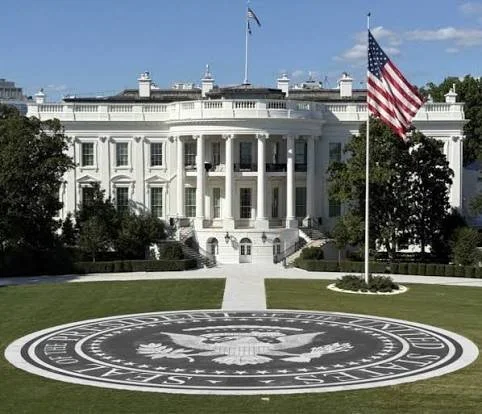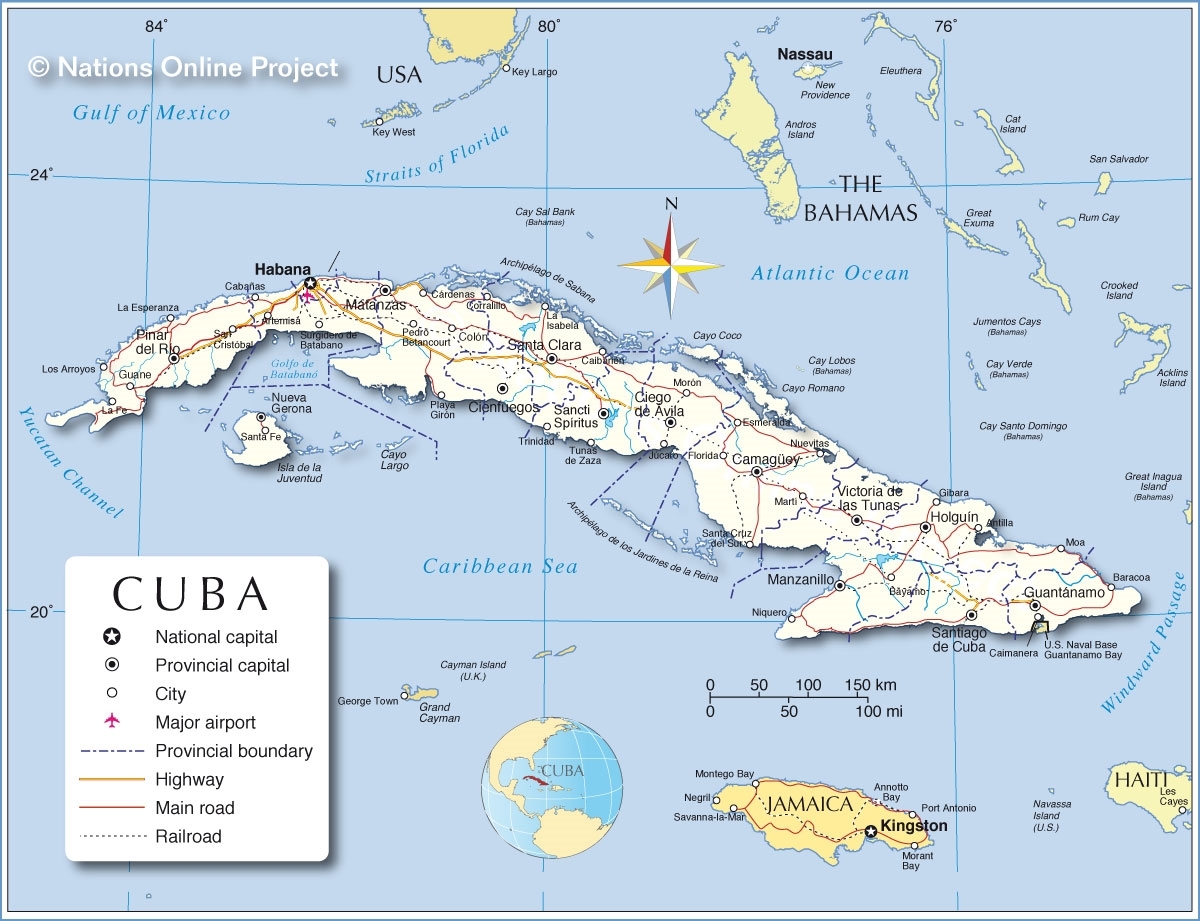

Unfolding Trump-Vance Administration Strategy For Cuba: Eleven Focuses. Do Not Be Shocked If President Diaz-Canel Of Cuba Visits The White House
/NOTE: During briefings in South Florida on 6/7/8 May 2026, the U.S.-Cuba Trade and Economic Council shared verbally this bullet-point perspective about how the organization views the engagement unfolding by the Trump-Vance Administration (2025-2029) and the Diaz-Canel-Valdes Mesa Administration (2019-2028). The perspective is updated.
Do Not Be Shocked If President Diaz-Canel Of Cuba Visits The White House
Through Fourteen United States Presidential Administrations… With It End With Fifteenth?
Defining “Transition” Provides President Trump With Elasticity- Unwelcomed For Some Stakeholders
Impact Of Executive Orders
Two SCOTUS Opinions
Raul Castro Indictment Absent The Defendant
G7 Trio In The Crosshairs: Presents For Carney, Macron, Merz, Sanchez
5,913 Certified Claimants
Nomination Of United States Ambassador To Cuba
Returning Cubans To Cuba And Preventing Cubans From Illegally Entering United States
President Trump’s Cuba Timeline Is Finish By 12:00 PM On Saturday, 20 January 2029
In 1992, a diplomat assigned to the United States Interests Section in Havana, Republic of Cuba, shared what was described as a hypothetical statement for appreciating how Fidel Castro, President of the Republic of Cuba (1976-2008), viewed his political relationship with successive occupants of The White House.
The diplomat created a statement to reflect President Castro. “I am prepared to let my people suffer. Are you prepared to let my people suffer?”
The answer occupies the tipping point for individuals of Cuban descent residing in the United States. How much suffering will they accept to be inflicted upon their acquaintances, colleagues, families, and friends?
The “embargo” (executive orders, policies, regulations, and statutes) by the government of the United States upon the government of the Republic of Cuba commenced in 1960 during the Eisenhower-Nixon Administration (1953-1961).
The trigger was the 1960 expropriation of an oil refinery owned by White Plains, New York-based Texaco, Inc., now a subsidiary of San Ramon, California-based Chevron Corporation (USFCSC: CU-1331/CU-1332/CU-1333 valued at US$56,196,422.73).
It has continued thus far into fifteen (15) United States presidential administrations- eight (8) Republican and seven (7) Democrat.
The “embargo” continued from the Eisenhower-Nixon Administration through the Kennedy-Johnson Administration (1961-1963), Johnson Administration (1963-1965), Johnson-Humphrey Administration (1965-1969), Nixon-Agnew-Ford Administration (1969-1974), Ford-Rockefeller Administration (1974-1977), Carter-Mondale Administration (1977-1981), Reagan-Bush Administration (1981-1989), Bush-Quayle Administration (1989-1993), Clinton-Gore Administration (1993-2001), Bush-Cheney Administration (2001-2009), Obama-Biden Administration (2009-2017), Trump-Pence Administration (2017-2021), Biden-Harris Administration (2021-2025), and thus far continues through into Trump-Vance Administration (2025-2029).
Donald Trump, President of the United States (2017-2021 and 2025-2029), will focus upon being the occupant of the Oval Office who presides at the commercial, economic, financial, military, political, and societal re-engagement with the government of the Republic of Cuba where the dis-engagement began sixty-six years ago with Dwight Eisenhower, President of the United States (1953-1961).
The coveted Nobel Peace Prize would certainly be within range and reach of President Trump should he preside during the “complete and total” commercial, economic, financial, military, political, and societal re-engagement with the citizens, government, and residents of the Republic of Cuba.
Maximalist demands from Washington DC and maximalist demands from Havana will shift gradually to achievable, desirable, doable, implementable, and sustainable.
No one will be entirely satisfied with the outcome, rather outcomes of the conversations, dialogue, discussions, and negotiations by Washington DC and Havana.
Members of the United States Congress will need to accept and adapt to disappointment. They will support President Trump regardless of the agreement(s) he endorses with the government of the Republic of Cuba. Those agreements will be signed not with a regime, but with a government led by Miguel Diaz-Canel, President of the Republic of Cuba (2019-2028). Members of the United States Congress will swallow hard. They will be unable to default to a traditional ego-driven position of invincibility.
Antagonizing President Trump with the message that he did not demand enough, do enough, and go far enough, is risky. His response could well be- “OK, I will return Nicolas Maduro [President of Venezuela (2013-2026)], to Caracas, and you can have back Joe Biden [President of the United States (2021-2025)]. Is that what you want? I have done what fourteen presidents could not do.”
The Cuban Liberty and Democratic Solidarity Act of 1996 (known as “Libertad Act”) provides for the president of the United States to define and determine that a “transition government” is operational in the Republic of Cuba. Individuals who serve in the current government are not prohibited from serving in a transitional government or democratic government.
President Trump will be elastic in defining “transition” and to defining constraining provisions of the Cuban Democracy Act (CDA) of 1992, Libertad Act, and Trade Sanctions Reform and Export Enhancement Act (TSREEA) of 2000.
AUTHORIZATION. (1) IN GENERAL. The President shall develop a plan for providing economic assistance to Cuba at such time as the President determines that a transition government or a democratically elected government is in power.
SEC. 204. TERMINATION OF THE ECONOMIC EMBARGO OF CUBA. (a) PRESIDENTIAL ACTIONS. Upon submitting a determination to the appropriate congressional committees under section 203(c)(1) that a transition government in Cuba is in power, the President, after consultation with the Congress, is authorized to take steps to suspend the economic embargo of Cuba and to suspend the right of action created in section 302 with respect to actions thereafter filed against the Cuban Government, to the extent that such steps contribute to a stable foundation for a democratically elected government in Cuba.
The Trump-Vance Administration will embark upon similar strategies used with the Syrian Arab Republic where some sanctions were removed/suspended for its transition government despite uncertainty as to the short-term, medium-term, and long-term trajectory. President Trump deemed the risk worth the potential reward. The decision also unlocked financing and investment from other countries.
The government of the United States will provide incentives to the government of the Republic of Cuba as it currently inhabits the space. The challenge will be creating incentives that the government of the Republic of Cuba will accept- and they will accept what they believe they can withstand.
The government of the Republic of Cuba will need to continue the process of correlating the words of its political leadership with implementing policies, regulations, and statutes for transitioning the words into operational results.
Impact Of Executive Orders
The Republic of Cuba-focused Executive Orders (EOs) and Specially Designated Nationals and Blocked Persons List (SDN) designations issued by the Trump-Vance Administration are having a cumulative impact upon Cuba. A boulder rolling downhill... picking up speed and creating havoc.
Executive Order 14380 (29 January 2026)
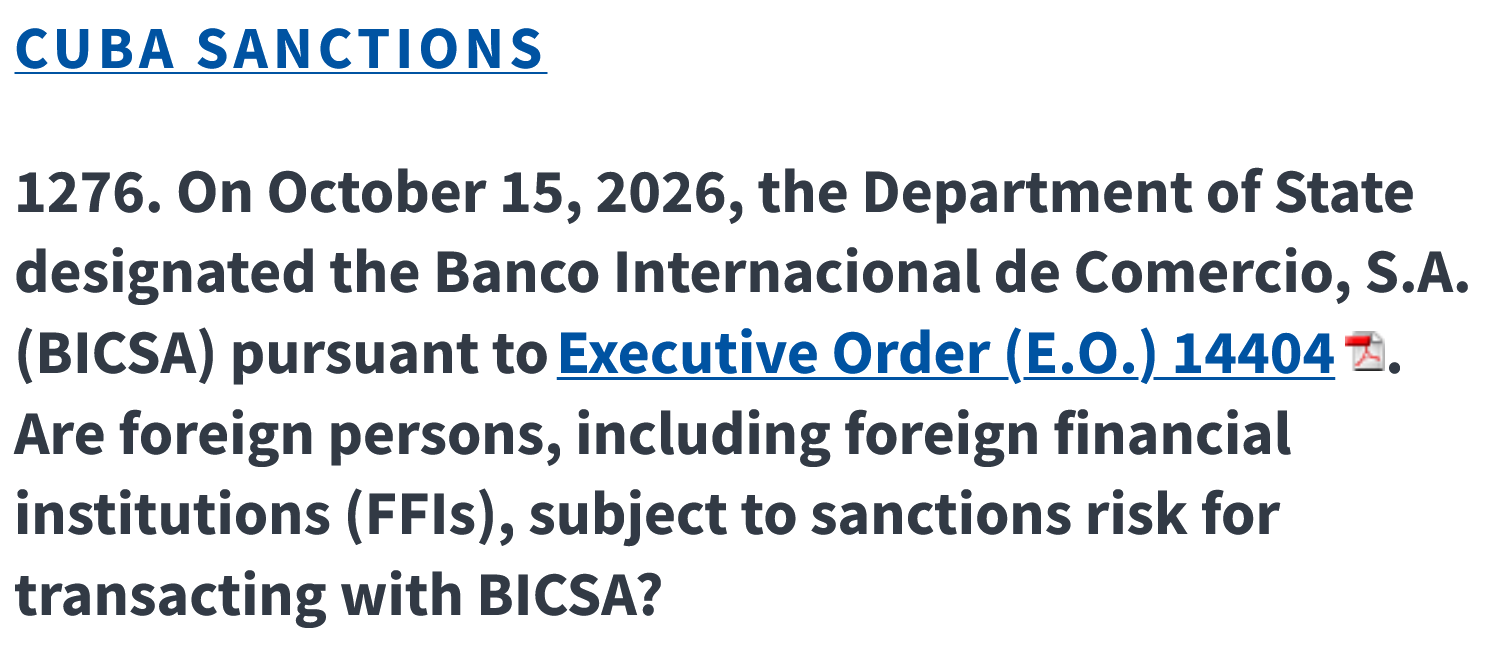
Executive Order 14404 (1 May 2026)
United States Department of State Designations- SDN List (7 May 2026)
Companies dislike havoc and uncertainty- and the Executive Orders are designed to inflict both.
A political python- strategy is to constrict until prey (government of the Republic of Cuba) relents. However, significant thus far is the Trump-Vance Administration has not specifically sanctioned any company; the Republic of Cuba-based joint venture of Sherritt International Corporation was sanctioned. No country has been sanctioned for exporting fuels to the Republic of Cuba.
From the perspective of The White House, the approximately 4,326 words in the Executive Orders have been well worth the time to craft them and publish them.
And which countries have thus been swept-into the Executive Order vortex? Canada, France, Germany, and Spain.... each of which has political leadership with whom President Trump has issues.
The Executive Orders are written in a manner reflecting a scene in the 1978 motion picture, Animal House, when Dean Vernon Woermer is informed a fraternity is already on official probation, he responds “They are? Well, as of this moment, they're on double secret probation!”
Provisions of the Trump-Vance Administration Executive Orders may be implemented without advance notification to a target party. This double secret probation-like implementation further stokes uncertainty- which is precisely the objective.
Opinions In Two Cases Before Supreme Court Of The United States (SCOTUS)
The United States Department of Justice (DOJ) supports the plaintiffs in both cases. If the SCOTUS rules in favor of the plaintiffs, the Trump-Vance Administration will view the results as additional tools to influence the behavior of the Diaz-Canel-Valdes Mesa Administration. The decisions will negatively impact the Republic of Cuba by further creating reasons for companies and financial institutions to avoid connectivity with the Republic of Cuba. If the SCOTUS rules in favor of the defendants or remands the cases for further consideration by lower courts, the Trump-Vance Administration will view the result as dissuasive because the result is continued uncertainty- which companies and financial institutions seek to avoid. The government of the Republic of Cuba loses either way.
Exxon Mobil Corporation v Corporacion Cimex, et al. (24-699)
Havana Docks Corporation v Royal Caribbean Cruises, et al. (24-983)
Indictment Of Raul Castro, President Of The Republic Of Cuba (2008-2018)
Raul Castro, ninety-four (94) years old (ninety-five in June 2026), was Minister of Defense of the Republic of Cuba (1959-2008) when on 24 February 1996 “two aircraft carrying members of the Brothers to the Rescue organization were shot down by an aircraft operated by the Cuban Revolutionary Air and Air Defense Force (DAAFAR). Four people in the aircraft were killed: Carlos Costa, Armando Alejandre, Jr., Mario de la Peña, and Pablo Morales.”
The Southern District of Florida is the likely venue for a federal indictment of Raul Castro given the victims were residents of the State of Florida and, most importantly, the political value of a grand jury indictment in a state with approximately 1.6 million residents with Republic of Cuba ancestry and a state whose voters continue to shift form the Democratic Party to the Republican Party.
For many individuals of Cuban descent residing in Florida, Texas, California, New Jersey, and New York, an indictment of Raul Castro would be extracting revenge, though partial.
Raul Castro will not be extradited from the Republic of Cuba to the United States. There will be no televised perp walk. Raul Castro will die in the Republic of Cuba and his ashes interred in the Santa Ifigenia Cemetery in Santiago de Cuba, alongside his brother, Fidel Castro, who died in 2016.
The United States Department of Defense (War) will not engage in an operation to extract Raul Castro from the Republic of Cuba. The Trump-Vance Administration will not condition its commercial, economic, financial, military, political, and societal re-engagement with the Republic of Cuba upon the extradition of Raul Castro. They will ask, but they will not condition. The indictment will therefore be performative because it has no expectation for a defendant in a courtroom in Miami, Florida.
For President Trump, he will forcefully remind voters in the State of Florida that the Clinton-Gore Administration (1993-2001), Bush-Cheney Administration (2001-2009), Obama-Biden Administration (2009-2017), Trump-Pence Administration (2017-2021), and Biden-Harris Administration (2021-2025) failed to bring an indictment against Raul Castro. The Trump-Vance Administration did what predecessors were too weak to do.
G7 Leaders’ Summit From 15 June 2026 To 17 June 2026 In Évian-Les-Bains, France
The G7 Leaders’ Summit is scheduled for 15 June 2026 to 17 June 2026 in Évian-les-Bains, France. The host is Emmanuel Macron, President of the Republic of France (2017-2027). The G7 consists of countries based upon their Gross Domestic Product (GDP) and the type of political system- defined as democracies. Media reporting that President Macron is considering inviting President Xi Jinping To The G7 Leaders’ Summit. Unknown if Volodymyr Zelensky, President of Ukraine (2019-2024; term extended due to imposition of martial law in 2022), will participate.
2026 G7: (2014-Present) United States, Germany, Japan, United Kingdom, France, Italy, Canada, and European Commission (president) and European Council (president). The Russian Federation (2025 GDP ranks 8th) was excluded in 2014 due to its military actions (annexation) of the Crimean Peninsula in Ukraine. NOTE: Spain is a “permanent guest” at G7 Leaders’ Summits despite ranking 12th in 2025 GDP.
The Republic of Cuba-related Executive Orders signed by President Trump thus far in 2026 have trapped like a spider web companies located in Canada, France, Germany, and Spain.
This means non-Republic of Cuba-related issues President Trump has with the one head of state (France) and the three heads of government (Canada, Germany, Spain): Israel-United States-Iran War, Military Spending, NATO relationship, Russian Federation-Ukraine War, Sanctions, Taiwan, Trade Agreements, and Tariffs will have company- Republic of Cuba-related issues.
Mark Carney, Prime Minister of Canada (2025- ), Friedrich Merz, Chancellor of Germany (2025- ), President Macron, and Pedro Sanchez, Prime Minister of Spain (2018- ), will need to decide upon the value of the Republic of Cuba to their respective governments, to their respective economies, to their respective companies and financial institutions, and collectively to the twenty-seven country members of the Brussels, Belgium-based European Union (EU).
EU: Austria, Belgium, Bulgaria, Croatia, Cyprus, Czech Republic, Denmark, Estonia, Finland, France, Germany, Greece, Hungary, Ireland, Italy, Latvia, Lithuania, Luxembourg, Malta, Netherlands, Poland, Portugal, Romania, Slovakia, Slovenia, Spain, Sweden.
In financial distress is Toronto, Canada-based Sherritt International Corporation (2025 revenue approximately US$422 million) which in May 2026 announced it was severing connectivity with all operations (mining and energy) in the Republic of Cuba due to Executive Orders.
During the Trump-Pence Administration (2021-2025), executives of Palma de Mallorca, Spain-based Meliá Hotels International, S.A. (2025 revenue approximately US$2.3 billion) were subject to Title IV of the Cuban Liberty and Democratic Solidarity Act of 1996 (known as “Libertad Act”). The company has also been a defendant in a Title III lawsuit.
Title III authorizes lawsuits in United States District Courts against companies and individuals who are using a certified claim or non-certified claim where the owner of the certified claim or non-certified claim has not received compensation from the Republic of Cuba or from a third-party who is using (“trafficking”) the asset.
Title IV restricts entry into the United States by individuals who have connectivity to unresolved certified claims or non-certified claims. One Canada-based company and one Spain-based company are currently known to be subject to this provision based upon a certified claim and non-certified claim.
In May 2026, Hamburg, Germany-based Hapag-Lloyd AG (2025 revenue US$21 billion) suspends operations in the Republic of Cuba due to Executive Orders.
In May 2026, Marseille, France-based- CMA CGM (2025 revenue US$55 billion) suspends operations in the Republic of Cuba due to Executive Orders.
For President Trump, inflicting pain upon members of the G7 is a political version of a chocolate sundae with an extra cherry. Cheeseburger with extra [French] fries. Or, two Diet Cokes.
The Trump-Vance Administration has added “GRUPO DE ADMINISTRACION EMPRESARIAL S.A. (GAESA), pursuant to section 2(a)(i)(A) of E.O. 14404, for operating or having operated in the financial services sector of the Cuban economy” as a Specially Designated National (SDN) by the Office of Foreign Assets Control (OFAC) of the United States Department of the Treasury.
Reported entities with connectivity to Melia Hotels International, S.A. include: Republic of Cuba government-operated Gaviota, Cubanacan, and Gran Caribe.
“Below is the U.S. Department of State’s “Cuba Restricted List” of entities and subentities with which the Cuban Assets Control Regulations (31 CFR 515.209) generally prohibit direct financial transactions. These entities are under the control of, or acting for or on behalf of, the Cuban military, intelligence, or security services or personnel with which direct financial transactions would disproportionately benefit such services or personnel at the expense of the Cuban people or private enterprise in Cuba. All entities and subentities were listed effective February 6, 2025, unless otherwise indicated.”
Some hotels in the Republic of Cuba managed by Melia Hotels International, S.A. are included in the Cuba Restricted List. Other Republic of Cuba government-operated entities with connectivity to Melia Hotels International S.A. are on the Cuba Restricted List:
CIMEX- Corporación CIMEX S.A.
GAESA- Grupo de Administración Empresarial S.A.
Gaviota- Grupo de Turismo Gaviota
Gaviota Hoteles Cuba
Disposition Of The 5,913 Certified Claims
The Trump-Vance Administration is focused upon resolving the issue of the certified claimants. There is concern that President Trump could be introduced during a gathering at his Mar-a-Lago Club in Palm Beach, Florida, to a non-certified claimant, for example, an older woman who was a citizen of the Republic of Cuba and whose small business was expropriated. Upon hearing the story, he would summon Marco Rubio, United States Secretary of State (2025- ), with the instruction to “put this number one on the list that I want from Cuba. I want this lady’s business returned to her.” With that, the interests of the 5,913 certified claimants become entangled with hundreds of thousands or millions of non-certified claims which should be solely the jurisdiction of the government of the Republic of Cuba and solely to be adjudicated by citizens of the Republic of Cuba with the government of the Republic of Cuba.
Joining certified claimants with non-certified claimants will result in no settlement for either category.
There are 8,821 claims of which 5,913 awards valued at US$1,902,202,284.95 were certified by the United States Foreign Claims Settlement Commission (USFCSC) and have not been resolved for nearing sixty years (some assets were officially confiscated in the 1960’s, some in the 1970’s and some in the 1990’s). The USFCSC permitted simple interest (not compound interest) of 6% per annum (approximately US$114,132,137.10); with the approximate current value of the 5,913 certified claims is approximately US$9.2 billion.
The first asset (along with 382 enterprises the same day) to be expropriated by the Republic of Cuba was an oil refinery on 6 August 1960 owned by White Plains, New York-based Texaco, Inc., now a subsidiary of San Ramon, California-based Chevron Corporation (USFCSC: CU-1331/CU-1332/CU-1333 valued at US$56,196,422.73).
From the certified claim filed by Texaco: “The Cuban corporation was intervened on June 29, 1960, pursuant to Resolution 188 of June 28, 1960, under Law 635 of 1959. Resolution 188 was promulgated by the Government of Cuba when the Cuban corporation assertedly refused to refine certain crude oil as assertedly provided under a 1938 law pertaining to combustible materials. Subsequently, this Cuban firm was listed as nationalized in Resolution 19 of August 6, 1960, pursuant to Cuban Law 851. The Commission finds, however, that the Cuban corporation was effectively intervened within the meaning of Title V of the Act by the Government of Cuba on June 29, 1960.”
The largest certified claim (Cuban Electric Company) valued at US$267,568,413.62 is controlled by Boca Raton, Florida-based Office Depot, Inc. The second-largest certified claim (International Telephone and Telegraph Co, ITT as Trustee, Starwood Hotels & Resorts Worldwide, Inc.) valued at US$181,808,794.14 is controlled by Bethesda, Maryland-based Marriott International; the certified claim also includes land adjacent to the Jose Marti International Airport in Havana, Republic of Cuba. The third-largest certified claim valued at US$97,373,414.72 is controlled by New York, New York-based North American Sugar Industries, Inc. The smallest certified claim is by Sara W. Fishman in the amount of US$1.00 with reference to the Cuban-Venezuelan Oil Voting Trust.
The two (2) largest certified claims total US$449,377,207.76, representing 24% of the total value of the certified claims. Thirty (30) certified claimants hold 56% of the total value of the certified claims. This concentration of value creates an efficient pathway towards a settlement.

Nomination Of United States Ambassador To The Republic Of Cuba
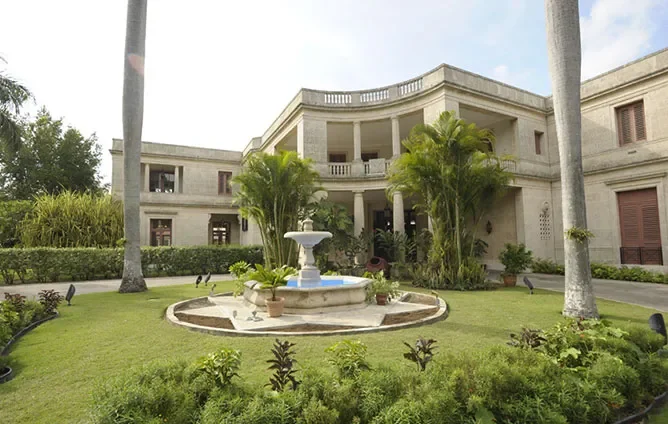
During the Obama-Biden Administration (2009-2017), after the re-opening in 2015 of the United States Embassy in Havana, Republic of Cuba, there was an expectation for a nominee as the first United States Ambassador to the Republic of Cuba since Philip Bonsal, who departed in October 1960. That did not happen.
A United States ambassador extraordinary and plenipotentiary is the highest-ranking diplomatic official representing a country. The individual is the official representative of the President of the United States.
The Trump-Vance Administration will view the installation of an ambassador neither a badge of legitimacy nor a reward to the government of the Republic of Cuba.
The presence of a United States ambassador will reinforce the strength of the government of the United States- and project a message to other countries that the Trump-Vance Administration will seek to expand, influence, and protect its self-defined interests throughout The Americas.
Agreement On Return Of Republic Of Cuba Nationals
The Trump-Vance Administration is neither concerned nor focused upon a potential 21st century version of what impacted the Carter-Mondale Administration (1977-1981) and Clinton-Gore Administration (1993-2001).
In 1980, approximately 125,000 Republic of Cuba nationals arrived by vessels (primarily rafts) to the United States.
In 1994, approximately 35,000 Republic of Cuba nationals arrived by vessels (primarily rafts) to the United States.
Mr. Stephen Miller, Deputy Chief of Staff for Policy and Homeland Security Advisor at The White House, will forgo concern as to political ramifications in the State of Florida for the Republican Party. He will robustly direct the United States Department of Defense (War) to deploy the United States Navy and United States Coast Guard to the Atlantic Ocean and if necessary, into the Gulf of Mexico (America) for Operation Interdiction And Return Home. All Republic of Cuba nationals will be returned, forcibly, if necessary, to the internationally recognized territory of the Republic of Cuba.
The Trump-Vance Administration will not be cowered by the optics of hundreds, thousands, tens of thousands, or hundreds of thousands of Republic of Cuba nationals in makeshift vessels or more solid vessels attempting to traverse the ninety-three miles from the Port of Havana to the most southern portion of Key West, Florida.
The Trump-Vance Administration will require the government of the Republic of Cuba to accept the return of Republic of Cuba nationals deemed deportable from the United States and to create multi-layered impediments to prevent unauthorized departures from the Republic of Cuba.
President Diaz-Canel Visits The White House
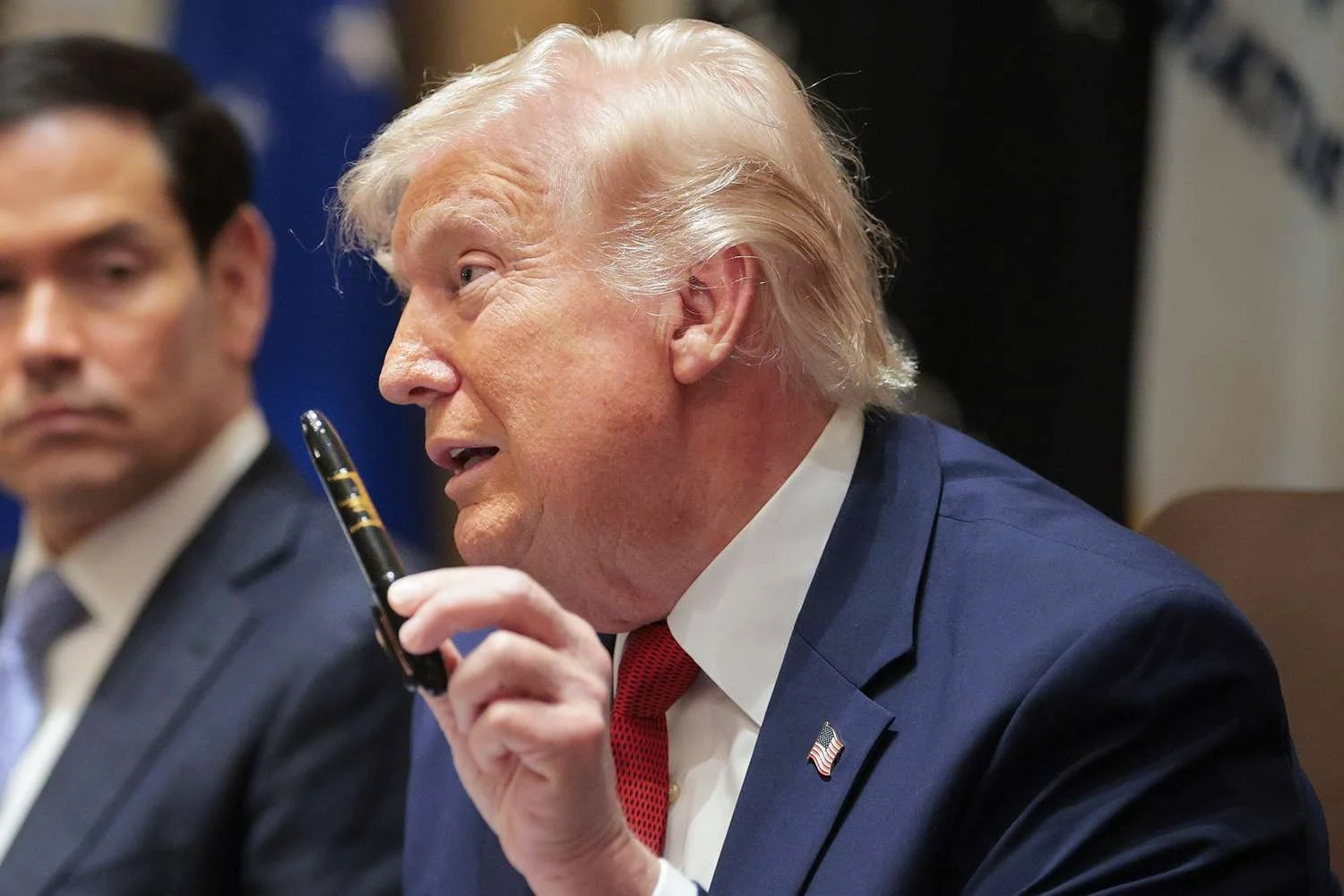
The bigger the deal, more likely the visit. President Trump will savour politically the optics of President Diaz-Canel visiting The White House for a signing ceremony. An opportunity to use the Presidential Sharpie will prove intoxicating.
There is no record of a head of government of the Republic of Cuba or head of state of the Republic of Cuba visiting The White House. President Trump is attracted to setting precedents.
Benefiting the government of the Republic of Cuba is the affinity of President Trump for agreements reflecting simplicity (number of points and sheets of paper), flexibility, and often audacity. Agreements are frequently staged- preliminary, intermediate, and then final. Almost all require addendums. Almost all are subject to revisions. Measurability metrics often become fluid. All of this means the process takes time. Expanding time is a primary goal of the government of the Republic of Cuba.
The Diaz-Canel-Valdes Mesa Administration continues to evaluate how the Trump-Vance Administration engages with the Rodriguez Administration (2026- ) in the Bolivarian Republic of Venezuela and with the Pezeshkian-Aref Administration (2024-2028) in the Islamic Republic of Iran.
Officials within the Trump-Vance Administration continue to monitor President Trump to determine the parameters of his elasticity in defining “total and complete victory” with Venezuela and Iran as indicators for definitions relating to the Republic of Cuba.
A fatal mistake to underappreciate the consistent desire by President Trump to correct what his predecessors in the Oval Office could not do, did not do, or would not do.
Politically dangerous for anyone to seek to separate President Trump from his effort to bring finality to the sixty-seven-year estrangement between the government of the United States and the government of the Republic of Cuba.
P.S. 2.63 waterfront acres in downtown Miami, Florida, is the location for the Donald J. Trump Presidential Library. That is an incentive for the Trump-Vance Administration to have in place a sustainable re-engagement with the Republic of Cuba prior to 12:00 pm on Saturday, 20 January 2029, when President Trump departs The White House.