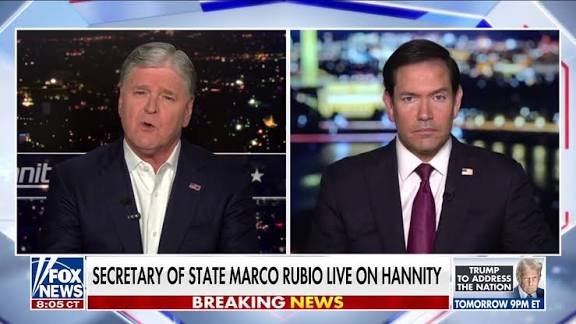

U.S. Secretary Of State Rubio Discusses Cuba While At UNGA In New York City
/Marco Rubio
United States Secretary of State
Palace Hotel
New York City, New York
23 September 2026
QUESTION: Mr. Secretary, the President said that freedom will come to Cuba.
SECRETARY RUBIO: Yes.
QUESTION: How will that happen? In the past you’ve said that it’ll collapse on its own, but –
SECRETARY RUBIO: Who has said that?
QUESTION: Well, the administration has said that the regime –
SECRETARY RUBIO: No, no. Look —
QUESTION: The President has said it.
SECRETARY RUBIO: Yeah, look. The Cuban revolution – want to answer. I know your question. The Cuban revolution has failed. It has failed for 60-something years. It is a failure now. And I think there’s acknowledgment within the Cuban system that the revolution has failed. The question is what replaces it or what – and they have an opportunity to make changes; they have an opportunity to begin to put their country on an irreversible trajectory towards progress and a better future. And that involves both political and economic freedom, no doubt about it. And so, we’ll be reengaged in that portfolio. We’ll do – we’re open to measures moving forward that begin that process of change. And it will be a process that will not be easy. We’ve seen these transitions happen historically throughout the world. They don’t happen overnight. They don’t happen immediately. You don’t reverse 60-something years of mismanagement, corruption, and incompetence in six months. But I do think that Cuba has a golden opportunity to place itself on an irreversible path towards a better future, and we are prepared to be helpful in that regard if they’re open to it, obviously. Right now, I mean, Cuba still – at least the people that speak on behalf of the government and led by people who, at least publicly, are quite recalcitrant. But the reality of their situation is things are not going to get better in Cuba without them making very substantial changes.
QUESTION: But could it involve something like Venezuela, changing the regime with some military extraction? There’s an indictment against the former president. There are other actions. Would you rule that out?
SECRETARY RUBIO: Look, first of all, the United States – and I say this – this is a general answer, not even specific towards Cuba – if there was a threat to the national security of the United States, the President has both the power and the obligation to address it. That’s just my general statement, not just Cuba-specific. That said, our preference always is to deal with these things in a – I don’t want to call it diplomatic, but in a negotiated way, in a political way, in a way in which progress is made through substantial changes to a country that don’t involve the use of military force. So, I’m not going to speculate beyond that, and I’m certainly not going to threaten anything. I’m just going to tell you that Cuba and its leaders, or the people that are in charge of its government now, have an opportunity to begin the process of forever positively changing that country. And it’s an opportunity that they should take, and I’m hopefully that they will. I’m not confident that they will, but I’m hopeful that they will. And we stand prepared to contribute towards that. Obviously, there are some individuals in that regime with whom we can never work because their hands are stained in blood. But there are people there that I believe that you could work with, if they are willing to put the country on a path towards political and economic freedom and the process that will get us to that ultimate goal, although that’ll take some time to get there.
QUESTION: Back on the subject of Cuba, how far along are the opportunities —
SECRETARY RUBIO: Ah, how come I always get the Cuba questions? (Laughter.) Go ahead. I’m sorry. Yeah, yeah. I know. I know. I get you.
QUESTION: (Inaudible.)
SECRETARY RUBIO: I know. It’s a joke.
QUESTION: How far along are the opportunities for American privatization of Cuban industrial sectors? And have you personally seen any of the proposals for U.S. business interest to own or operate on the island that would satisfy some of the administration’s goals?
SECRETARY RUBIO: Well, first of all, here’s – it’s actually a good question about – the question is on Cuba and American private sector. What people have to understand is unlike some other parts of the world, U.S. policy towards Cuba is codified in law, in statute, by Helms-Burton. So, there are substantial limitations to what any American company can do in Cuba, because Helms-Burton – a law that was passed by Congress and is on the books – limits it. It makes certain conditions have to be met in order for that commercial interaction to happen. Now, do I believe that American business interests could play a positive role in a future Cuba in which its economy is free and open and people are allowed to self-employ or work for whoever they want? Sure, of course. We’re the largest economy in the world. I also think, by the way, that one of the huge opportunities that Cuba has is that it has a very large expatriate community of Cuban Americans and Cubans living in other parts of the world that could contribute greatly, the diaspora that could contribute greatly to Cuba’s future. And there are also companies from other parts of the world that could contribute as well.
The fundamental challenge in Cuba, and what keeps companies – forget about American companies for a moment, because obviously they’re impeded by – from some investments by Helms-Burton. What keeps – Cuba can do trade and commerce with any country in the world they want, outside the United States. The reason why they don’t is because why would I invest – giving you an example – why I, businessperson from whatever, Spain – why would I invest $10 million in Cuba if two years from now they just decide on their own to change the rules, take it from me, and keep the money and never pay me back? And that’s happened over and over and over in Cuba. Even now, as they announce these reforms, everyone’s saying, well, these things are just on paper; (a) you have to implement them, and (b) you have to keep them. So, certainty is the problem, and there’s simply no legitimacy or credibility that this regime will ever live up to these conditions, because they never have before. So, that ultimately is an impediment.
But to answer your question, have I reviewed any of these, well, look, people are always pitching things. I’m aware that there are some companies and individuals and others that would love to be involved in Cuba’s economic future. But right now, that’s not possible; (a) it’s not feasible, because of Helms-Burton, and also because of the lack of certainty about its future. No one is going to invest in Cuba under their current governance model. They’re just not going to do it. Which is why I always go back to it’s not just about political freedom, which is incredibly important, but it is about having a governance model on that island that give the private sector confidence that if they invest, they’re going to make their money back with a profit and have – not have it taken from them and never get paid back.