President Trump Seeking To Oust Cuban-American Member Of Congress; Exacting Revenge More Important Than Number Of Cuban-Americans In Congress?

Punchbowl News
Los Angeles, California
17 March 2021

Max Miller, a former White House aide to Donald Trump, is running in a primary against Ohio Rep. Anthony Gonzalez, who supported impeaching the 45th president. Gonzalez is a well-liked former Ohio State football star who played in the NFL and later graduated from Stanford Business School.”  

From Wikipedia: “Gonzalez's Cuban-American father immigrated to the U.S. from Cuba after Fidel Castro took power.” 

Members of the United States Congress identifying as of Cuban descent:   

United States Senate
The Honorable Ted Cruz (R- Texas)
The Honorable Marco Rubio (R- Florida)
The Honorable Robert Menendez (D- New Jersey)

United States House of Representatives
The Honorable Albio Sires (New Jersey; D- 8th)
The Honorable Alex Mooney (West Virginia; R- 2nd)
The Honorable Anthony E. González (Ohio; R- 16th)
The Honorable Mario Díaz-Balart (Florida; R-25th)
The Honorable Carlos Gimenez (Florida; R- 26th)
The Honorable Maria Elvira Salazar (Florida; R- 27th)
The Honorable Nicole Malliotakis (New York; R- 11th)

The Biden Administration will remain concerned about the 435-member United States House of Representatives where the Democratic Party has a nine-seat majority in the 117th United States Congress.  

The 2020 Census is expected to deliver to Florida two (2) additional seats in the United States House of Representatives- which increases the electoral prominence of the state in the 2022 and 2024 elections (24 votes of the required 270 votes for victory in the Electoral College).    

The state legislature in Florida is controlled by Republican Party.  In 2021, the Florida Senate (24- R and 16- D) and the Florida House of Representatives (78- R and 42- D) will expectantly seek to craft favorably the two new districts for the United States House of Representatives and recraft existing districts to lessen the number of Democrats.  There will likely too be court challenges. 

One result will be current Democratic Party members of the United States House of Representatives from Florida will tact right, meaning against Biden Administration Republic of Cuba initiatives in their primaries or general election. 

There will also be Democratic Party members of the United States House of Representatives and United States Senate from other states who will oppose perceived lessening of pressures upon the Republic of Cuba. 

What some advocates will promote as a vote of legislative courage others will decry as a shortcut to the unemployment line.

Efforts to request the Biden Administration suspend Title III of the Cuban Liberty and Democratic Solidarity Act of 1996 (known as “Libertad Act”) made operational on 2 May 2019 by the Trump Administration risks antagonizing an important constituency in Florida and conflicting with President Biden’s appreciation of not interrupting the judicial process from his tenure as Chairman of the United States Senate Committee on the Judiciary (1987-1995).   

There have been thirty-three lawsuits filed since 2019 and some are at Courts of Appeals.  Title III authorizes lawsuits in United States District Courts against companies and individuals who are using a certified claim or non-certified claim where the owner of the certified claim or non-certified claim has not received compensation from the Republic of Cuba or from a third-party who is using (“trafficking”) the asset.   

And there are the many unknowns which can influence the 2022 and 2024 elections in Florida and other states: H.E. Nicolas Maduro, President of Venezuela, is removed from office.  H.E. Daniel Ortega, President of Nicaragua, is removed from office.  The government of the Republic of Cuba decides to robustly engage with the Biden Administration; the 5,913 certified claims are resolved.  

The Biden Administration and Democratic Party will continue to appease the State of Florida and its 2020 population of 21.48 million residents (14.5 million registered voters) where the Republican Party has 5,219,015 and the Democratic Party has 5,335,965; and 3,790,478 have no party affiliation.  In the 2020 Presidential Election, Florida voted 51.2% Republican to 47.9% Democratic; in 2016, 49.0% Republican to 47.8% Democratic; in 2012, 50.0% Democratic to 49.1% Republican; and in 2008, 51.0% Democratic to 48.2% Republican.  That data does not suggest a red state.   

Neither the Biden Administration nor the Democratic Party headquarters in Washington DC will abandon Florida and policies relating to the Republic of Cuba will reflect the electoral realities of Florida. 

Cuba’s Return To State Sponsors Of Terrorism List Ricochets To Impact Negotiations For Certified Claimants, Embassy Staffing Levels- Trap Set By Trump Administration? Diplomats Bait?

33 Years On. 6 Years Off. 64 Days On.
11 Terrorism Lawsuits And US$5.1 Billion In Judgements

Terrorism Lawsuits Again Permitted Against Government Of Cuba
If Cuba Doesn’t Defend Lawsuits, Default Judgements Can Exist In Perpetuity
New Marketing Effort To Sell Judgements- It’s Legal
U.S. Government Can File To Dismiss The Lawsuits

Injured U.S. Diplomats May Now Sue Government Of Cuba
Was This The Secret Strategy Of The Trump Administration?
Will Government Of Cuba Accept Additional U.S. Diplomats If Sued By U.S. Diplomats?

If Biden Administration Removes Cuba From Terrorism List, Attorneys Will Have 45 Days To File Lawsuits

Chairman Of U.S. Senate Committee On Foreign Relations Robert Menendez Will Have Input- And Perhaps Leverage

May There Be A Moment When Neither Current Government In Havana Or Future Government In Havana Will Have The Means Or Desire To Satisfy The Certified Claims And Judgements?

Original 1960 Value Of 5,913 Certified Claims US$1.9 Billion Plus 6% Annual Interest
Terrorism Judgements Come Ahead Of Certified Claimants
Terrorism Judgements Used 100% Of Funds Meant To Compensate Certified Claimants
Cuba Funds Frozen In U.S. To Repay Certified Claimants Used For Terrorist Judgements

When the Obama Administration removed the Republic of Cuba from the State Sponsors of Terrorism List on 29 May 2015, there was a certification to leadership of the United States Congress that “the Government of Cuba has not provided any support for international terrorism during the preceding 6-month period; and ... has provided assurances that it will not support acts of international terrorism in the future.”   

At the time of the removal from the State Sponsors of Terrorism List, the President of the Republic of Cuba was H.E. General Raul Castro (2008-2018).  Presumably, the Obama Administration obtained a written or verbal assurance from President Castro.   

Since 2019, H.E. Miguel Diaz-Canel has been President of the Republic of Cuba.  Has or would the Biden Administration need obtain a written or verbal assurance from President Diaz-Canel prior to providing a certification to the United States Congress?  Would President Diaz-Canel provide such certification? 

The Biden Administration has four reviews underway relating to the Republic of Cuba: 1) comprehensive policy review led by the National Security Council (NSC) and United States Department of State with a focus upon what changes should be made to policies and regulations implemented during the Trump Administration (2017-2021) including whether to nominate a United States Ambassador to the Republic of Cuba 2) reviews led by the Central Intelligence Agency (CIA) and United States Department of State into the causes of injuries to United States government employees in 2016/2017 while they were in the Republic of Cuba 3) whether to suspend again Title III of the Cuban Liberty and Democratic Solidarity Act of 1996 (known as the “Libertad Act”) and 4) whether to remove the Republic of Cuba from the State Sponsors of Terrorism List maintained by the United States Department of State.   

Impacting the Biden Administration timeline for conclusion of the reviews has among others included: 1) obtaining confirmation in the evenly-divided United States Senate for cabinet secretaries, sub-cabinet officials, agency officials, ambassadors, and judicial appointments 2) obtaining legislative approval for US$1.9 trillion in COVID-19-related funding 3) obtaining legislative approval for US$1+ trillion in infrastructure-related funding 4) approval of a budget  5) obtaining legislative approval for an increase to the national minimum wage and 6) obtaining political support for foreign policy initiatives. 

Absent a crisis in the Republic of Cuba impacting directly the United States, there has been no demonstrated urgency for completing the four reviews. 

On 28 February 2021, Thomson Reuters reported: “The Biden administration also appears to have little sense of urgency for major gestures toward Cuba despite hopes for a softer approach after Trump, often citing its support for Maduro, rolled back historic Obama-era détente with Havana.  Some Biden advisers had suggested earlier that he could start by loosening up the flow of remittances from Cuban Americans and ease restrictions on family travel to the Communist-ruled island.  But while acknowledging such changes could have a positive impact, the official said a Cuba policy shift was not currently among Biden’s top priorities, which include the coronavirus pandemic, economic recovery and rebuilding alliances abroad.  “Frankly, first things first,” the official said.  There has also been no sign of any immediate plans to rescind Cuba’s designation as a state sponsor of terrorism, though Biden officials have said Trump’s last-minute decision to return Havana to the U.S. blacklist is under review.” 

On 3 March 2021, Thomson Reuters reported “Asked about the prospects for loosening up remittances and easing restrictions on family trips, the White House official said: “The best ambassadors are the American people, specifically the Cuban-American people maybe coming in with remittances and travel.  A White House official dampened hopes for a quick Cuba policy shift in an interview with Reuters at the weekend, saying it was not currently among Biden’s top priorities,.…” 

SSTL History (1982-2021) 

The Reagan-Bush Administration (1981-1989) first added the Republic of Cuba to the State Sponsors of Terrorism List on 1 March 1982.   

The Obama-Biden Administration (2009-2017) removed the Republic of Cuba from the State Sponsors of Terrorism List on 29 May 2015.   

The Trump-Pence Administration (2017-2021) returned the Republic of Cuba to the State Sponsors of Terrorism List on 12 January 2021.   

The Biden-Harris Administration (2021- ) is expected to remove the Republic of Cuba from the State Sponsors of Terrorism List.  A forty-five-day advance notification to the United States Congress is required. 

ANECDOTE: From 26 September 2002 to 30 September 2002, while the Republic of Cuba was on the State Sponsors of Terrorism List, the [George W.] Bush Administration authorized 923 representatives of United States-based companies participated in the U.S. Food & Agribusiness Exhibition held at the Palacio de Convenciones de la Habana (Pabexpo) in the city of Havana, Republic of Cuba, during which the Republic of Cuba contracted for to purchase US$91.9 million in agricultural commodities and food products from the United States.  More than 154,000 pounds of cargo, including livestock, was transported using four aircraft from the United States to the Republic of Cuba for the exhibition.  This was and remains the single-largest gathering of United States business representatives to visit the Republic of Cuba since 1959.  More than 16,000 Republic of Cuba nationals visited the exhibition, which was held under licenses issued by the Office of Foreign Assets Control (OFAC) of the United States Department of the Treasury.  

While the Republic of Cuba was on the State Sponsor of Terrorism List from 1982 to 2015, plaintiffs won primarily in state courts eleven (11) lawsuits using the terrorism exception to the Foreign Sovereign Immunities Act (FSIA).   

Total Compensatory Damages and Punitive Damages are US$4,420,592,158.37 plus annual interest for uncollected judgements with the State of Florida permitting 11% annual interest.  According to the Washington DC-based Congressional Research Service (CRS), many of the judgements “involved conduct that occurred prior to Cuba’s terrorism designation, and all were obtained as default judgments without an entry of appearance by the Cuban government.” 

Who Now Can Sue? 

As of 12 January 2021, any individual subject to United States jurisdiction believing they have a personal claim against the government of the Republic of Cuba for acts of terrorism may file a lawsuit in a state court or federal court seeking damages from the government of the Republic of Cuba.   

With the expectation the government of the Republic of Cuba will not appear to defend itself, as in previous lawsuits, almost any legal argument can result in a default judgement.  With eleven of the previous lawsuits obtaining default judgements of US$4.2 billion, likely not a difficult decision to obtain legal counsel, pay court fees, file a lawsuit, and await the default judgement. 

Among those who may file lawsuits could be some of the reported twenty-four (24) United States nationals injured during their posting to the Republic of Cuba in 2016/2017 remain employed by the United States government, including at the United States Department of State and Central Intelligence Agency (CIA).  According to the heavily redacted 2018 report from the United States Department of State Accountability Review Board, the health impact for some were “so severe they may never be able to return to their previous jobs.” 

To file a lawsuit, United States law requires a country to be included on the State Sponsors of Terrorism List when a terrorism-related action is taken, although there have been instances where lawsuits were filed, and judgements were rendered for actions attributed to the Republic of Cuba prior to its inclusion on the State Sponsors of Terrorism List.  The United States Department of State could have sought to have courts void the judgements using the Foreign Sovereign Immunities Act (FSIA) in those instances where the Republic of Cuba was sued for terrorist acts while not on the State Sponsors of Terrorism List.  The United States Department of State declined to do so.  

Did Trump Administration Set A Trap For Biden Administration?   

Perhaps, a trap by the Trump Administration was to use the return of the Republic of Cuba to the State Sponsors of Terrorism List as an enticement for some of the twenty-four injured individuals and/or their families to file lawsuits believing accurately that once lawsuits are filed the bipartisan political atmospherics would be challenging for the Biden Administration to remove the Republic of Cuba from the State Sponsors of Terrorism List.  The message then from some Democrats and Republicans in the United States Congress to the Biden Administration- do not remove an opportunity for justice.   

If some of the individuals are injured permanently might they and their families want compensation?  Suing the United States Government is generally problematic.  Suing the Republic of Cuba may provide justice, but not necessarily result in economic pain for the Republic of Cuba because collecting on a judgement is not an easy process.   

Since the Republic of Cuba has maintained it did not cause the injuries and does not know who caused the injuries, it would unlikely present a defense in a lawsuit.  The result would be a default judgement.  If the lawsuit is filed in the State of Florida, the judgement would be subject to an 11% annual interest rate for what remains outstanding.  Judgements are valid for twelve (12) years and may be renewed to endure- and may be transferred, sold, bartered, and inherited.  The ultimate monetary ticking time bomb

With a judgment, a plaintiff may seek throughout each of the fifty states and territories of the United States any asset to which the government of the Republic of Cuba has an interest- and then once identified, ask a relevant court to enforce the judgement.  

The Biden Administration can seek to have FSIA lawsuits against the government of the Republic of Cuba dismissed by courts.  One argument is such lawsuits are an interference and hindrance to the conduct of foreign policy by the executive branch. 

Complicating legal and political matters further are the reports that United States nationals employed by the United States Government injured during their posting to the People’s Republic of China and to the Russian Federation have reported injuries similar to those reported in the Republic of Cuba.  Neither the People’s Republic of China nor Russian Federation are on the State Sponsors of Terrorism List. 

A Formidable Political Obstacle From New Jersey 

There are impediments for a removal of the Republic of Cuba from the State Sponsors of Terrorism List.  As previous occupants of The White House have done, the Trump Administration reinterpreted the United States statutory definition of “terrorism” which can add time for evaluation and complicates the evaluation process.   

The chairman of the United States Senate Committee on Foreign Relations, The Honorable Robert Menendez (D- New Jersey) is of Cuban descent and all issues relating to the Republic of Cuba are personal- particularly the connectivity between a convicted murderer of a New Jersey State Police officer who escaped in 1979 from a correctional facility in New Jersey and resides in the Republic of Cuba.   

In returning the Republic of Cuba to the State Sponsors of Terrorism List, the Trump Administration, like previous administrations, referenced Mrs. JoAnne Chesimard who remains since 2 May 2013 as the first woman to be on the FBI Most Wanted Terrorists List.  There is a US$2 million reward.  The Honorable Robert Mueller was Director of the Federal Bureau of Investigation (FBI) from 4 September 2001 to 4 September 2013. The Honorable Christopher Christie was Governor of the State of New Jersey from 19 January 2010 to 16 January 2018

Connectivity With Kerry, Blinken And Sullivan 

Senator Menendez was previously chairman of the United States Senate Committee on Foreign Relations from 1 February 2013 to 3 January 2015 during the Obama Administration (2009-2017) when Mrs. Chesimard was added to the FBI Most Wanted Terrorists List.  The United States Secretary of State during the period 1 February 2013 to 20 January 2017 was The Honorable John Kerry (D- Massachusetts) who served as chairman of the United States Senate Committee on Foreign Relations from 6 January 2009 to 1 February 2013.  The Honorable Antony Blinken, United States Secretary of State, was Assistant to the President and Deputy National Security Advisor from 20 January 2013 to 9 January 2015 and Assistant to the President and National Security Advisor to the Vice President from 20 January 2009 to 20 January 2013.  The Honorable Jake Sullivan, Assistant to the President for National Security Affairs, served as Assistant to the President and National Security Advisor to the Vice President of the United States from 26 February 2013 to 1 August 2014.  Mr. Sullivan was Director of Policy Planning at the United States Department of State from 4 February 2011 to 15 February 2013. 

Terrorism Judgements Against The Republic Of Cuba 

Compensatory damages awarded to plaintiffs are designed to give justice to them after being wronged.  There are two types of compensatory damages- general and actual.  Actual damages are intended to provide funds to only replace what was lost.  General compensatory damages awarded are more complex, as these compensatory damages do not represent a monetary expenditure.  Punitive damages are designed to prevent others from being hurt by the same or similar actions.”

Terrorism Judgements Against The Republic Of Cuba.jpg

Cuba On The Of State Sponsors Of Terrorism List From Congressional Research Service (CRS)  

The “state sponsors of terrorism list” is mandated under Section 6(j) of the Export Administration Act of 1979, as amended (P.L. 96-72; 50 U.S.C. app. 2405(j)), under which the Secretary of State makes a determination when a country “has repeatedly provided support for acts of international terrorism.” 

Both Section 620A of the Foreign Assistance Act and Section 40 of the Arms Export Control Act have provisions similar to Section 6(j) of the Export Administration Act in which the Secretary of State may publish a determination that a country is supporting international terrorism. However, the only published determinations by the Secretary of State have been those under Section6(j) and constitute what is known as the “state sponsors of terrorism list.” 

In addition to the terrorism list sanctions imposed by the Export Administration Act, Section 40A of the Arms Export Control Act (P.L. 90-629; 22 U.S.C. 2781) prohibits the sale or export of defense articles and defense services if the President determines and certifies to Congress, by May 15 of each year, that the country “is not cooperating fully with United States antiterrorism efforts.” This list has been issued annually since 1997, and currently includes Cuba. 

Cuba was first added to the State Department’s list of states sponsoring international terrorism in 1982 [1 March 1982], pursuant to Section 6(j) of the Export Administration Act of 1979 (P.L. 96-72). At the time, numerous U.S. government reports and statements under the Reagan Administration alleged Cuba’s ties to international terrorism and its support for terrorist groups in Latin America. Cuba had a history of supporting revolutionary movements and governments in Latin America and Africa, but in 1992 Fidel Castro stressed that his country’s support for insurgents abroad was a thing of the past. Cuba’s policy change was in large part a result of Cuba’s diminishing resources following the breakup of the Soviet Union and the loss of billions of dollars in annual subsidies to Cuba. 

While the Administration provided no explanation in the Federal Register notice as to why Cuba was added to the terrorism list, various U.S. government reports and statements under the Reagan Administration in 1981 and 1982 alleged Cuba’s ties to international terrorism. In addition, a 1998 State Department chronology on U.S.-Cuban relations and a 2003 State Department document provide further explanation of why Cuba originally was designated a state sponsor of terrorism.  The Central Intelligence Agency’s Patterns of International Terrorism 1980, published in June 1981, stated: “Havana openly advocates armed revolution as the only means for leftist forces to gain power in Latin America, and the Cubans have played an important role in facilitating the movement of men and weapons into the region. Havana provides direct support in the form of training, arms, safe havens, and advice to a wide variety of guerrilla groups. Many of these groups engage in terrorist operations.”  

In January 1982, President Reagan stated in his State of the Union address: “Toward those who would export terrorism and subversion in the Caribbean and elsewhere, especially Cuba and Libya, we will act with firmness.” In February 1982, the Department of State published a research paper on “Cuba’s Renewed Support for Violence in Latin America,” originally presented in December 1981 to the Subcommittee on Western Hemisphere Affairs of the Senate Foreign Relations Committee, which detailed Cuba’s support for armed insurgencies and terrorist activities in Latin America and the Caribbean.7 The State Department asserted in the paper that Cuba has “encouraged terrorism in the hope of provoking indiscriminate violence and repression, in order to weaken government legitimacy and attract new converts to armed struggle.”  

The paper maintained that Cuba was most active in Central America, especially Nicaragua, where it wanted to exploit and control the revolution, and El Salvador and Guatemala, where it wanted to overthrow the governments.8 Cuba also was reported “to provide advice, safe haven, communications, training, and some financial support to several violent South American organizations.” This included training Colombian M-19 guerrillas, with the objective of establishing a “people’s army.” The State Department’s Patterns of International Terrorism: 1982stated that “both Cuba and the Soviet Union continue to provide financial and logistical support and training to leftist forces in the area [Central America] that conduct terrorist activity.” The report further stated: “In its efforts to promote armed revolution by leftist forces in Latin America, Cuba supports organizations and groups that use terrorism to undermine existing regimes. In cooperation with the Soviets, the Cubans have facilitated the movement of people and weapons into Central and South America and have directly provided funding, training, arms, safe haven, and advice toa wide variety of guerrilla groups, and individual terrorists.”  

A 1998 State Department chronology of U.S.-Cuban relations from 1958 to 1998 notes that the United States added Cuba to the terrorist list in 1982 because of its support for the M-19 guerrilla group in Colombia. In January 1982, State Department officials asserted that Cuba was involved in providing arms to the M-19 in exchange for facilitating U.S.-bound drug smuggling. M-19 was responsible for hijacking a plane from Colombia in January 1982; the incident ended when the hijackers were given safe passage to Cuba. A 2003 State Department document broadened the explanation of why Cuba was designated a state sponsor of terrorism in 1982. Reflecting the rationale set forth in the documents from 1981 and1982 described above, the State Department maintains that Cuba was added to the list because of its support for terrorist groups in Latin America. It contends that Cuba was providing support for terrorist organizations at the time, including the Puerto Rican nationalist group known as the Armed Forces of National Liberation (FALN), the Farabundo Marti National Liberation Front (FMLN) in El Salvador, and the Sandinista National Liberation Front (FSLN) in Nicaragua. It also asserts that “Cuba helped transship Soviet arms to Nicaragua and El Salvador for use by terrorist organizations, trained anti-American insurgents elsewhere in Latin America, and supported insurgencies or war efforts in Angola and Ethiopia.” 

Certified Claims Background 

There are 8,821 claims of which 5,913 awards valued at US$1,902,202,284.95 were certified by the United States Foreign Claims Settlement Commission (USFCSC) and have not been resolved for nearing sixty years (some assets were officially confiscated in the 1960’s, some in the 1970’s and some in the 1990’s).  The USFCSC permitted simple interest (not compound interest) of 6% per annum (approximately US$114,132,137.10); with the approximate current value of the 5,913 certified claims US$8.7 billion.  

The first asset (along with 382 enterprises the same day) to be expropriated by the Republic of Cuba was an oil refinery on 6 August 1960 owned by White Plains, New York-based Texaco, Inc., now a subsidiary of San Ramon, California-based Chevron Corporation (USFCSC: CU-1331/CU-1332/CU-1333 valued at US$56,196,422.73).  

From the certified claim filed by Texaco: “The Cuban corporation was intervened on June 29, 1960, pursuant to Resolution 188 of June 28, 1960, under Law 635 of 1959.  Resolution 188 was promulgated by the Government of Cuba when the Cuban corporation assertedly refused to refine certain crude oil as assertedly provided under a 1938 law pertaining to combustible materials.  Subsequently, this Cuban firm was listed as nationalized in Resolution 19 of August 6, 1960, pursuant to Cuban Law 851.  The Commission finds, however, that the Cuban corporation was effectively intervened within the meaning of Title V of the Act by the Government of Cuba on June 29, 1960.” 

The largest certified claim (Cuban Electric Company) valued at US$267,568,413.62 is controlled by Boca Raton, Florida-based Office Depot, Inc.  The second-largest certified claim (International Telephone and Telegraph Co, ITT as Trustee, Starwood Hotels & Resorts Worldwide, Inc.) valued at US$181,808,794.14 is controlled by Bethesda, Maryland-based Marriott International; the certified claim also includes land adjacent to the Jose Marti International Airport in Havana, Republic of Cuba.  The third-largest certified claim valued at US$97,373,414.72 is controlled by New York, New York-based North American Sugar Industries, Inc.  The smallest certified claim is by Sara W. Fishman in the amount of US$1.00 with reference to the Cuban-Venezuelan Oil Voting Trust. 

The two (2) largest certified claims total US$449,377,207.76, representing 24% of the total value of the certified claims.  Thirty (30) certified claimants hold 56% of the total value of the certified claims.  This concentration of value creates an efficient pathway towards a settlement.   

The ITT Corporation Agreement 

In July 1997, then-New York City, New York-based ITT Corporation and then-Amsterdam, the Netherlands-based STET International Netherlands N.V. signed an agreement whereby STET International Netherlands N.V. would pay approximately US$25 million to ITT Corporation for a ten-year right (after which the agreement could be renewed and was renewed) to use assets (telephone facilities and telephone equipment) within the Republic of Cuba upon which ITT Corporation has a certified claim valued at approximately US$130.8 million.  ETECSA, which is now wholly-owned by the government of the Republic of Cuba, was a joint venture controlled by the Ministry of Information and Communications of the Republic of Cuba within which Amsterdam, the Netherlands-based Telecom Italia International N.V. (formerly Stet International Netherlands N.V.), a subsidiary of Rome, Italy-based Telecom Italia S.p.A. was a shareholder.  Telecom Italia S.p.A., was at one time a subsidiary of Ivrea, Italy-based Olivetti S.p.A.  The second-largest certified claim (International Telephone and Telegraph Co, ITT as Trustee, Starwood Hotels & Resorts Worldwide, Inc.) valued at US$181,808,794.14 is controlled by Marriott International.  

Libertad Act 

The Trump Administration has made operational Title III and further implemented Title IV of the Cuban Liberty and Democratic Solidarity Act of 1996 (known as “Libertad Act”). 

Title III authorizes lawsuits in United States District Courts against companies and individuals who are using a certified claim or non-certified claim where the owner of the certified claim or non-certified claim has not received compensation from the Republic of Cuba or from a third-party who is using (“trafficking”) the asset.   

Title IV restricts entry into the United States by individuals who have connectivity to unresolved certified claims or non-certified claims.  One Canada-based company and one Spain-based company are currently known to be subject to this provision based upon a certified claim and non-certified claim. 

Suspension History 

Title III had been suspended every six months since the Libertad Act was enacted in 1996- by President William J. Clinton, President George W. Bush, President Barack H. Obama, and President Donald J. Trump. 

On 16 January 2019, The Honorable Mike Pompeo, United States Secretary of State, reported a suspension for forty-five (45) days. 

On 4 March 2019, Secretary Pompeo reported a suspension for thirty (30) days. 

On 3 April 2019, Secretary Pompeo reported a further suspension for fourteen (14) days through 1 May 2019. 

On 17 April 2019, the Trump Administration reported that it would no longer suspend Title III. 

On 2 May 2019 certified claimants and non-certified claimants were permitted to file lawsuits in United States courts.

LINK TO COMPLETE ANALYSIS IN PDF FORMAT

FROM FATF/GAFILAT: Cuba's Progress In Strengthening Measures To Tackle Money Laundering & Terrorist Financing

Cuba's progress in strengthening measures to tackle money laundering and terrorist financing 

AML: Anti-Money Laundering

CFT: Countering The Financing Of Terrorism

MER: Mutual Evaluation Report 

From January 2021: “Cuba continues making significant progress in addressing the Technical Compliance deficiencies identified in its MER and has been re-rated for R.31 (Partially Compliant to Compliant), R.28 (Partially Compliant to Compliant) and R. 35 (Partially Compliant to Largely Compliant). It also maintained its rating of Partially Compliant regarding R.8, and of Compliant regarding R.2, R.5, R.18 and R.21. Finally, it was re-rated in R.15 (from Compliant to Partially Compliant).” 

LINK To Publications 

GAFILAT Fourth Regular Follow-Up Report And Re-Rating Of Cuba (2021) 

GAFILAT Technical Analysis Of FATF Recommendations- Re-Rating Of Cuba (2017) 

GAFILAT Mutual Evaluation Report Of The Republic Of Cuba (2015) 

FATF Methodology For Assessing Technical Compliance With The FATF Recommendations And The Effectiveness Of AML/CFT Systems (2013) 

FATF-GAFI Cuba Profile

“Paris, France-based Financial Action Task Force (FATF) is the global money laundering and terrorist financing watchdog. The inter-governmental body sets international standards that aim to prevent these illegal activities and the harm they cause to society. As a policy-making body, the FATF works to generate the necessary political will to bring about national legislative and regulatory reforms in these areas. 

With more than 200 countries and jurisdictions committed to implementing them.  The FATF has developed the FATF Recommendations, or FATF Standards, which ensure a co-ordinated global response to prevent organised crime, corruption and terrorism. They help authorities go after the money of criminals dealing in illegal drugs, human trafficking and other crimes.  The FATF also works to stop funding for weapons of mass destruction. 

The FATF reviews money laundering and terrorist financing techniques and continuously strengthens its standards to address new risks, such as the regulation of virtual assets, which have spread as cryptocurrencies gain popularity.  The FATF monitors countries to ensure they implement the FATF Standards fully and effectively, and holds countries to account that do not comply.” 

“The purpose of the Financial Action Task Force of Latin America, GAFILAT, (formerly known as Financial Action Task Force of South America (GAFISUD)) is to work toward developing and implementing a comprehensive global strategy to combat money laundering and terrorist financing as set out in the FATF Recommendations.  The effort includes encouraging the creation of the offence of money laundering in relation to serious crimes, the development of legal systems to effectively investigate and prosecute these offences, the establishment of systems for reporting suspicious transactions, the promotion of mutual legal assistance.  GAFILAT also fosters the training of persons involved in anti-money laundering efforts.  GAFILAT enables regional factors to be taken into account in the implementation of anti-money laundering measures.‌ 

The origins of GAFILAT go back to ongoing efforts to integrate anti-money laundering efforts in South America and was encouraged by the creation of other anti money-laundering regional groups that were established following the FATF model.  It was created as GAFISUD on 8 December 2000 in Cartagena, Colombia by means of a memorandum of understanding by representatives of the governments of nine South American countries.  The Organization of American States (OAS) is also a member in an advisory capacity through the Inter-American Commission against Drug Abuse (CICAD).  Following the events of 11 September 2001, GAFISUD expanded its scope to include the countering of terrorist financing. The GAFISUD Plenary of 7-11 July 2014 approved the change of name from GAFISUD to GAFILAT to reflect the expansion of its membership to include all Latin American countries.  

GAFILAT is committed to carrying out mutual evaluations and co-ordinating anti-money laundering training and educational efforts in the region.  Its work mandate is set out in a memorandum of understanding containing specific terms of reference for the group.  GAFILAT is supported by a Secretariat, which serves as the focal point for its activities.  GAFILAT became and Associate Member of the FATF in 2006.”

Understanding-Financial-Action-Task-Force.jpg

EC Responds To European Parliament Inquiry About EU Ambassador To Cuba Letter To President Biden- Navarro "Committed Two Major... Failures..."

H.E. Josep Borrell Fontelles
High Representative
Vice President of the European Commission
Brussels, Belgium


Excerpt:

"Ambassador Navarro has acknowledged that it is not within the scope of his functions as a diplomatic representative of the European Union to subscribe to this type of initiative, even less so when they are addressed to the leader of a third country."

LINK To Letter In PDF Format

29-261-European-Union-foreign-policy-chief-Josep-Borrell.jpg

U.S. Department Of State Appoints Former Ambassador With Focus Upon "Havana Syndrome"

United States Department of State
Washington DC
12 March 2021

Ambassador Pamela Spratlen Designated as Senior Advisor to Department Health Incident Response Task Force

Office of the Spokesperson

The Department has designated Ambassador Pamela Spratlen to serve as the Senior Advisor to the Health Incident Response Task Force (HIRTF), reporting directly to the Department’s senior leadership. Since its creation in 2018, the HIRTF has served as the coordinating body for the Department and interagency’s response to unexplained health incidents for personnel and dependents under Chief of Mission security responsibility, including identification and treatment of affected personnel and family members; investigation and risk mitigation; messaging; and diplomatic outreach.

A career member of the Foreign Service for nearly 30 years, Ambassador Spratlen was formerly Senior Advisor of the Office of Inspector General in the U.S. State Department, Inspections Division. She was the U.S. Ambassador to Uzbekistan from 2015-2018 and Ambassador to the Kyrgyz Republic (Kyrgyzstan) from 2011-2014. She has also served as the Deputy Chief of Mission at the U.S. Embassy in Kazakhstan (2009-2011).

In addition to numerous Washington assignments and a tour as Diplomat in Residence at the East-West Center in Honolulu, Ambassador Spratlen also served in Russia (Moscow and Vladivostok), France (U.S. Mission to the OECD) and Latin America (Guatemala and the U.S. Mission to the Organization of American States).

As Secretary Blinken said, “The selection of Ambassador Spratlen will help us make strides to address this issue wherever it affects Department personnel and their families. She will streamline our coordination efforts with the interagency community, and reaffirm our commitment to make certain that those affected receive the care and treatment they need.”

United States Department of State
Washington DC
12 March 2021

Ned Price, Department Spokesperson


QUESTION: (Inaudible) health advisor. In the written announcement, there was nothing said about Cuba or any particular country where these issues may arise. Is that for a reason? Is it broader than that? And then my second question has to do with – it’s one that I brought up before with the Houthis, and that is that this situation seems to be getting worse rather than better – the humanitarian situation – since you guys removed them from the FTO list and since the three leaders were removed from the terrorism part of the SDGT list. And so I’m just wondering, I mean, is there any thought that you guys may have made a mistake in doing that? Thank you.

MR PRICE: Thanks, Matt. To your first question, as we mentioned, we do have no higher priority than the safety and security of U.S. personnel, their families, and other U.S. citizens. Of course, these health incidents have been a priority for Secretary Blinken even before he was officially Secretary Blinken. He requested a comprehensive briefing on these incidents during the transition when he was secretary-designate. On his first day, full day here at the department, he received an update. He has since received comprehensive briefings.

He also wanted to ensure that the task force that has been established and working on these incidents since May of 2018 had connectivity directly to him, and directly to his senior leadership team. And so that is why we have decided, and he has decided to name Ambassador Spratlen as the senior advisor to the task force.

We didn’t specifically mention countries in that announcement because as you know, Matt, there have been now several countries where these incidents have been reported. We are seeking a full accounting of all of those who may have been affected by these incidents. That will be a large part of Ambassador Spratlen’s role, is to ensure that we know the full extent of these incidents.

There is also an individual on the task force who is responsible solely for engaging with those who may have been victims of these incidents. So we will continue to pay close attention to this. Secretary Blinken will continue to pay close attention to this, because he has no higher priority than the health and the safety and security than the department and dependents of department personnel.

1572316636130.jpg

U.S. Department Of State Spokesperson Answers Question About Cuba Policy; Reiterates Previous Positions

United States Department of State
Washington DC
11 March 2021

Mr. Ned Price, Department Spokesperson:

QUESTION: Hey, Ned. On Cuba, the White House says a policy shift with Cuba is not a top priority for President Biden. Does that mean that the administration finds value in the current policy, or is it quite literally just not a top priority and something that you imagine you’ll get to later?

MR PRICE: It is a policy that we are reviewing. Secretary Blinken spoke to this yesterday. He spoke to the core principles that animate that review.

First, support for democracy and human rights will be at the core of our efforts, because we believe it is the means to empower the Cuban people to determine their own future; and second, as we’ve said before, we also know that Americans, especially Cuban Americans, are in most cases the best ambassadors for freedom and prosperity in Cuba. We are committed to both of these principles. Our review is being animated by both of those principles. We have also committed – and you heard this from Secretary Blinken up on the Hill yesterday – to consult closely with members of Congress as we undertake this review. So it is not that – it is not that this is in any way on the back burner. It is something we’re looking at very closely, and as that review progresses, we’ll consult with members of Congress. And when we have something to share, we’ll let you know.

Screenshot_2021-03-11 U S Department of State - United States Department of State.png

Cuba Targeting Individuals Of Cuban Descent For DFI In Projects Valued At Less Than US$1 Million; Will Cuba Do Same For Individuals Not Of Cuban Descent? Biden Administration Will Support Both.

AFP
Paris, France
10 March 2021


”HAVANA, Cuba (AFP) — Foreign-based Cubans will be allowed to invest in small projects such as rice, orange and avocado plantations, the government revealed on Wednesday in a bid to attract investment from the country's diaspora. "We're focusing on small projects ... that could be worth up to one million dollars," in sectors such as agriculture, fishing, light industry and manufacturing, said Katia Alonso, the official responsible for foreign investments. With just over 11 million inhabitants, Cuba also has a diaspora of 1.5 million people in 40 countries, although the majority live in the United States. Some had previously registered an interest in investing in the island nation but were put off by the multi-million dollar mega projects the communist government previously proposed.

These smaller projects are an attempt to convince the diaspora to take the plunge at a time when Cuba is in the midst of a severe economic crisis, with GDP having fallen 11 per cent in 2020 to its lowest level since 1993. In total the government is proposing 503 projects worth a total of US$12.07 billion. Cuba opened its economy to foreign investment following the fall of the Soviet Union, which plunged the country into a serious economic trouble in the 1990s. But the country is struggling to attract as many foreign companies as it would like as its own bureaucracy and US sanctions have discouraged many investors. According to Alonso, there are around 280 foreign companies from 40 countries operating in Cuba.”

LINK To List Of Available Commercial Opportunities

Analysis

Critical for the Biden Administration will be transparency in the process of evaluating proposals for Direct Foreign Investment (DFI) received from individuals of Cuban descent, particularly those residing in the United States.

Equally important will be for each accepted DFI proposal to be publicly disclosed with details of the DFI structure available for review by the public.

The Biden Administration and Members of the United States Congress will seek confirmation that no implementated DFI proposal includes the use of assets certified by the United States Foreign Claims Settlement Commission (USFCSC).

Libertad Act

The Trump Administration has made operational Title III and further implemented Title IV of the Cuban Liberty and Democratic Solidarity Act of 1996 (known as “Libertad Act”).

Title III authorizes lawsuits in United States District Courts against companies and individuals who are using a certified claim or non-certified claim where the owner of the certified claim or non-certified claim has not received compensation from the Republic of Cuba or from a third-party who is using (“trafficking”) the asset.

Title IV restricts entry into the United States by individuals who have connectivity to unresolved certified claims or non-certified claims. One Canada-based company and one Spain-based company are currently known to be subject to this provision based upon a certified claim and non-certified claim.

Suspension History

Title III has been suspended every six months since the Libertad Act was enacted in 1996- by President William J. Clinton, President George W. Bush, President Barack H. Obama and President Donald J. Trump.

On 16 January 2019, The Honorable Mike Pompeo, United States Secretary of State, reported a suspension for forty-five (45) days.

On 4 March 2019, Secretary Pompeo reported a suspension for thirty (30) days.

On 3 April 2019, Secretary Pompeo reported a further suspension for fourteen (14) days through 1 May 2019.

On 17 April 2019, the Trump Administration reported that it would no longer suspend Title III.

On 2 May 2019 certified claimants and non-certified claimants were permitted to file lawsuits in United States courts.

Certified Claims Background

There are 8,821 claims of which 5,913 awards valued at US$1,902,202,284.95 were certified by the United States Foreign Claims Settlement Commission (USFCSC) and have not been resolved for nearing sixty years (some assets were officially confiscated in the 1960’s, some in the 1970’s and some in the 1990’s).  The USFCSC permitted simple interest (not compound interest) of 6% per annum (approximately US$114,132,137.10); with the approximate current value of the 5,913 certified claims US$8.7 billion. 

The first asset (along with 382 enterprises the same day) to be expropriated by the Republic of Cuba was an oil refinery on 6 August 1960 owned by White Plains, New York-based Texaco, Inc., now a subsidiary of San Ramon, California-based Chevron Corporation (USFCSC: CU-1331/CU-1332/CU-1333 valued at US$56,196,422.73). 

From the certified claim filed by Texaco: “The Cuban corporation was intervened on June 29, 1960, pursuant to Resolution 188 of June 28, 1960, under Law 635 of 1959. Resolution 188 was promulgated by the Government of Cuba when the Cuban corporation assertedly refused to refine certain crude oil as assertedly provided under a 1938 law pertaining to combustible materials. Subsequently, this Cuban firm was listed as nationalized in Resolution 19 of August 6, 1960, pursuant to Cuban Law 851. The Commission finds, however, that the Cuban corporation was effectively intervened within the meaning of Title V of the Act by the Government of Cuba on June 29, 1960.”

The largest certified claim (Cuban Electric Company) valued at US$267,568,413.62 is controlled by Boca Raton, Florida-based Office Depot, Inc. The second-largest certified claim (International Telephone and Telegraph Co, ITT as Trustee, Starwood Hotels & Resorts Worldwide, Inc.) valued at US$181,808,794.14 is controlled by Bethesda, Maryland-based Marriott International; the certified claim also includes land adjacent to the Jose Marti International Airport in Havana, Republic of Cuba. The third-largest certified claim valued at US$97,373,414.72 is controlled by New York, New York-based North American Sugar Industries, Inc. The smallest certified claim is by Sara W. Fishman in the amount of US$1.00 with reference to the Cuban-Venezuelan Oil Voting Trust.

The two (2) largest certified claims total US$449,377,207.76, representing 24% of the total value of the certified claims. Thirty (30) certified claimants hold 56% of the total value of the certified claims. This concentration of value creates an efficient pathway towards a settlement.

The ITT Corporation Agreement

In July 1997, then-New York City, New York-based ITT Corporation and then-Amsterdam, the Netherlands-based STET International Netherlands N.V. signed an agreement whereby STET International Netherlands N.V. would pay approximately US$25 million to ITT Corporation for a ten-year right (after which the agreement could be renewed and was renewed) to use assets (telephone facilities and telephone equipment) within the Republic of Cuba upon which ITT Corporation has a certified claim valued at approximately US$130.8 million. ETECSA, which is now wholly-owned by the government of the Republic of Cuba, was a joint venture controlled by the Ministry of Information and Communications of the Republic of Cuba within which Amsterdam, the Netherlands-based Telecom Italia International N.V. (formerly Stet International Netherlands N.V.), a subsidiary of Rome, Italy-based Telecom Italia S.p.A. was a shareholder. Telecom Italia S.p.A., was at one time a subsidiary of Ivrea, Italy-based Olivetti S.p.A. The second-largest certified claim (International Telephone and Telegraph Co, ITT as Trustee, Starwood Hotels & Resorts Worldwide, Inc.) valued at US$181,808,794.14 is controlled by Bethesda, Maryland-based Marriott International.

Associated Press
New York, New York
10 March 2021

Cuba se abre a inversiones, incluso de cubanos emigrados

Por ANDREA RODRÍGUEZ

LA HABANA (AP) — Cuba promovió una cartera de negocios para inversores extranjeros incorporando proyectos que requieren bajo capital e invitó a los cubanos que residen afuera del país a sumarse, un enfoque novedoso en el estricto marco comercial de la isla.

La directora de Negocios del Ministerio de Comercio Exterior, Katia Alonso, indicó el miércoles que para este año hay 503 oportunidades ofertadas a empresarios del mundo dispuestos a operar con la isla por un monto 12.000 millones de dólares, entre los que se cuentan desde grandes iniciativas de ingeniería o energía, hasta pequeños emprendimientos.

Alonso destacó el cambio de enfoque que significó incorporar negocios no tan voluminosos ni exigentes como los de la cartera de años anteriores, dando la posibilidad incluso a cubanos residentes en el extranjero de participar.

“La idea es ésa: pequeños proyectos que nos vayan resolviendo el problema alimentario y no alimentario”, expresó Alonso. “Pueden ser hasta menos de un millón de dólares los proyectos en que estamos interesados en promover y concretar”.

Aunque la ley no lo rechaza, durante décadas las autoridades cubanas fueron muy celosas a la hora de permitir a los empresarios cubanos emigrados traer sus capitales a la isla bajo la premisa ideológica de ser incompatible con el modelo socialista de la nación.

Además, el grueso de los cubanos emigrados vive en Estados Unidos --muchos protegidos como refugiados—, donde las leyes de las sanciones impuestas por Washington para presionar a La Habana les imponen limitaciones para traer su capital. El tema de la inversión de cubanos es sensible tanto en Cuba como en el extranjero.

“Han existido comentarios de que eso (la inversión de cubanos residentes en el extranjero) no se puede, pero eso nunca estuvo prohibido; ahora todo se va concatenando”, expresó Alonso, quien indicó que un punto es que en general los empresarios cubanos en el exterior no tienen tanto capital para invertir.

“Entonces estamos abogando también por proyectos pequeños y son proyectos más a la medida de los cubanos residentes en el exterior, que son personas que tienen pequeñas y medianas empresas”, agregó la funcionaria.

Alonso incluso indicó que países como China permiten a sus nativos que viven afuera reinvertir en su país de origen. Ni la cartera de oportunidades ni la ley de Inversión Extranjera aplica para los ciudadanos cubanos en la isla.

Por su parte, Idalberto Aparicio, subdirector de Negocios, explicó que ya se hizo efectivo un negocio con la inversión de un cubano residente en el extranjero --no de Estados Unidos-- con un contrato de administración en el área de producción agrícola, aunque no ofreció más detalles.

No es la primera vez que se logran acercamientos para inversionistas cubanos que viven afuera. En 2016 con el influjo del deshielo realizado por el expresidente Barack Obama hacia la isla, el empresario Saúl Berenthal comenzó las negociaciones que luego quedaron paralizadas para traer e instalar una fábrica de tractores de pequeño formato ideales para el agro cubano.

Luego, las presiones de Donald Trump desmotivaron cualquier intención inversora. Los trámites se realizan a través de una ventanilla única, explicó la directora de esa oficina inaugurada el año pasado, Anabel Reloba.

Este mecanismo busca hacer frente a una crítica de muchos empresarios en la isla que lamentan la cantidad de trámites burocráticos que exigen las autoridades. Según Reloba, desde su apertura en enero de 2020 ha realizado 186 trámites y evacuado información de otros 80 inversores potenciales.

Directivos de empresas suelen además lamentar algunos mecanismos vigentes en las leyes y que a su entender los desestimulan, como la contratación indirecta --que debe realizarse a través de una agencia empleadora estatal cubana-- o las dificultades para construir o comprar inmuebles. Reloba aclaró que tales normas seguían vigentes. Actualmente en la isla hay operando 280 compañías extranjeras de unos 40 países.

Hasta menos de un millón de dólares: los cubanos residentes en el exterior podrán realizar 'inversiones de menudeo' en Cuba
'Nunca estuvo prohibido', declaró el MINCEX sobre la posibilidad de invertir en Cuba para los cubanos residentes en el exterior.

DDC
La Habana
10 March 2021


El Gobierno de Cuba atraviesa una grave crisis económica y para ello, al parecer, está dispuesto a echar mano a todo, excepto a la liberación de las fuerzas productivas del país. Uno de sus últimos proyectos radica en la promoción de una cartera de negocios para inversores, específicamente para los cubanos residentes en el exterior, según informó la agencia AP.

La directora de negocios del Ministerio de Comercio Exterior y le Inversión Extranjera (MINCEX), Katia Alonso, dijo a AP que la idea es incorporar el capital de los cubanos residentes en el exterior pero en pequeñas inversiones.

"La idea es ésa: pequeños proyectos que nos vayan resolviendo el problema alimentario y no alimentario. Pueden ser hasta menos de un millón de dólares los proyectos en que estamos interesados en promover y concretar", dijo Alonso.

Según esta funcionaria, para 2021 su Gobierno ofertará 503 oportunidades a los empresarios internacionales dispuestos a operar en Cuba, por un monto de 12.000 millones de dólares. Dichas ofertas incluyen inversiones en el sector de la minería, de la energía y también de "los pequeños emprendimientos".

Alonso confesó confiar en lo efectivo que serán las nuevas ofertas de inversión que, a diferencia de años anteriores, no incorpora negocios que exigen grandes sumas de dinero.

"Han existido comentarios de que la inversión de cubanos residentes en el extranjero no se puede, pero nunca estuvo prohibido; ahora todo se va concatenando", señaló la funcionaria, quien aseguró también que en general, los empresarios cubanos en el exterior no contaban con mucho capital para invertir.

Sobre esto, el subdirector de Negocios del MINCEX, Idalberto Aparicio, anunció que ya se hizo efectivo un negocio con la inversión de un cubano residente en el exterior en materia agrícola. Dicho cubano, cuyo nombre no fue revelado, no reside en EEUU.

Si bien es cierto que las inversiones de los cubanos emigrados no están prohibidas en la Ley de Inversión Extranjera, el Gobierno aprueba esos negocios uno a uno y la regularidad ha sido rechazar las propuestas de los exiliados.

mincex100321.jpg

Three Members Of The U.S. Senate Inform Leaders Schumer & McConnell They Will "object to any motions..."

To move legislation in the United States Senate, knowledge of and use of procedure is critical, particularly when there are 50 members who generally vote with the Democratic Caucus and 50 members who generally vote with the Republican Caucus.

From the letter: “We believe the Cuban people deserve no less than the most rudimentary foundations of a free society and therefore, we object to any motions of unanimous consent requests regarding legislation that amends U.S. law towards Cuba.”

On 10 March 2021, three members of the Republican Caucus of the United States Senate wrote to The Honorable Charles Schumer (D- New York), the Majority Leader of the United States Senate, and The Honorable Mitch McConnell (R- Kentucky), the Minority Leader of the United States Senate. They are:

The Honorable Marco Rubio (R- Florida), the Ranking Member of the Committee on Foreign Relations Subcommittee on Western Hemisphere, Transnational Crime, Civilian Security, Democracy, Human Rights, and Global Women's Issues; and Ranking Minority Member of the United States Senate Select Committee on Intelligence.
The Honorable Ted Cruz (R- Texas)
The Honorable Rick Scott (R- Florida)


LINK To Text Of Letter In PDF Format

us-senate-e1520392893969.jpg

U.S. Secretary Of State Blinken Reminds & Emphasizes To Congress That Biden Administration Has Not Yet Made Changes To Trump Administration Cuba Policies- And Congress Will Be Consulted

On 9 March 2021, The Honorable Antony Blinken, United States Secretary of State, answered questions from members of the United States House of Representatives Committee on Affairs.

The Republic of Cuba was a subject during an exchange between Secretary Blinken and The Honorable Albio Sires (D 8th- New Jersey), Chairman of the Subcommittee on Western Hemisphere, Civilian Security, Migration And International Economic Policy of the United States House of Representatives Committee on Foreign Affairs. Representative Sires is of Cuban descent.

The Honorable Nicole Malliotakis (R- 11th, New York) and The Honorable Maria Elvira Salazar (R- 27th, Florida) also asked questions relating to the Republic of Cuba. Representatives Malliotakis and Salazar are of Cuban descent.

Representative Sires Questioning LINK To Video

Representative Salazar Questioning LINK To Video

Awaiting Official Transcript

C-Span
Washington DC
10 March 2021
UNEDITED

Representative Sires: secretary begin thank you for testifying today and congratulations as chairman of the embassy i look forward to working with you and your staff to deep in the united states and latin america and the caribbean u.s. policy towards cuba is deeply personal to be an kfirsthand experience of where it is to live under the castro dictatorship i came when i was 11 years old and i thought memories of the military and searching my house and using my father of the merchandise i have all these memories and i made it a priority when i came to congress for democracy and human rights. All over i've been encouraged by the statement of the present invited to the white house regarding in the human rights at the center of our policy towards cuba and our secretary i was wondering what steps can you take promote a lights, civil liberties and then the attacks on human rights defenders in cuba.  

Secretary Blinken: i think across-the-board we share the same goals when it comes to cuba and that's democracy and freedom for his people, inre particular respect for the views and the experiences of our citizens are cuban-american we not only noah but we lived at how your families have lived it and this is something that resonates for me. We are looking at the entire policy right now and we have haven't come to any conclusion, knowing what the goals are freedom and democracy the people of cuba we start with the recognition that obviously no policy in the past has fully succeeded in achieving that but working to be reviewing the policy in close consultation with congress and members who know these issues so well as you have seen there is no early policy changes and certainly weou will not make any changes without fully consulting so i look forward to the opportunity to do that.  

Representative Sires: Venezuela obviously is going to come up i had a hearing in venezuela the other day i was very happy to see that the president designated to the venezuelans about 320,000 of them in this country i think that's the rights that they suffer greatly, my concern for venezuela is russia seems to be more engaged with venezuela and i don't think, i know they tried to destabilize the region i spoke to the ambassadornk of columbia in 2019 russia had 6000 people go through columbia and they expelled three russians. E for russia columbia is not exactly a beach destination so my concern they are using venezuela toex destabilize columbia to get involved in other elections in south america and i would hope the administration would focus on russia's efforts to try to destabilize our neighbors in the western hemisphere. 

Secretary Blinken: I share the concern and we see them venezuela and we seen a resurgence of russian and president of activity in cuba the lastse few years and were very attentive to that across-the-board into the point you made a minute ago i should come back to say your emphasis on spotlighting and combating corruption is absolutely essential and this is something ywe will dedicate more focus, time and resources to because we see it unfortunately is prevalent in so many cases but also a little bit ada's and keeley's heel we could put a spotlight because when people see thet corruption of their leaders that is a good way to undermine support with the civil leaders.  

Representative Salazar: i represent miami which is the capital of the americans and home too thousands and thousands of exiles from all over latin america and it's great to talk to you i want to talk about cuba, columbia, venezuela so that's why i want to use my time effectively i only need a yes or no  

Will you commit to continue implementing the law until the regime opens a democraticye gain in cuba, yes or no? 

Forgive me because i didn't hear. 

Will you commit to continue to implement the Helms-Burton law until the Castro regime opens and democratic in Cuba? Yes or no. 

We are not taking any unilateral actions on cuba in advance of any consultations with congress and we have no plans. 

Is the way to continue to be implemented? 

We will always implement the law. 

It wasn't for 30 years up until the last administration. 

We will implement the law. 

Will you commit to consult with the cuban-american exile community before engaging in any type of economic or political speaking or any type of engagement with the cuban regime will you commit commit to engage with my community before you do? 

We will absolutely consult and engage with the Cuban Americans on anything having to do with Cuba. 

Thank you. With columbia two months ago the colombian media intercepted a dossier coming from cuba which outlines in detail how have and i was plotting to steal columbia's presidential election. Were you aware of this? 

I haven't seen this. 

Is coming from a reputable publication. Maybe you will want to see it. Inin one year, columbia eradicated a record of 130,000 taxpayers, 20 times the size of manhattan, ten times more than the administration in four years. Do you care with they are doing yto eradicate this evil? 

We do and we have to do more and also have to help colombians create alternative livelihoods for people so that they don't get into --- 

Let's go to nicaragua. Are you concerned that the opposition will participate in the upcoming presidential election without real guarantees that those are going to be free and fair? 

We have deep concerns about those and the ability to be free and fair. 

Will you consider the possibility of breaking diplomatic relations with nicaragua and the regime if that is the case? 

Well, we have -- 

Will you consider the possibility if they steal the election? 

We will always consider any possibility but our job and our business at the state department is to continue to find ways to engage countries. 

We havens lots of countries we are dealing with around the world that are doing things. 

But not nicaragua. You didn't answer. Venezuela, would you consider including venezuela on the list of countries that sponsor terrorism? 

If it meets the requirements of the law, yes. 

They engage with hezbollah -- iran. 

The time is expired. 

Yes. 

Can i have one more question? 

No, the gentle ladies time is expired. I now recognize -- 

Representative Spanberger: thank you mr. Chairman and mr. Secretary for joining us today. I look forward to working with you closely. I'd like to focus my questions on the public servants who serve the country at home and abroad. Looking out for their safety is absolutely critical. I will be following up with a number of questions but i'd like to run through a couple in the time thatbe we have. I'd like to ask about the mysterious and harmful attacks on u.s. personnel sometimes referred to as havana syndrome though they haven't been limited to occurring only in cuba. The lack of the coordinated approach has been the ability to receive medical care and management in the pieces of this issue. Well the administration and the department under your leadership set up a whole of government approach to make sure we are addressingng these attacks? Thank you mr. Secretary. If you could share as the government identified the perpetrator or the entities behind these attacks? 

Representative Malliatokis: Some type of negotiation. We are not happy happy with of the administration trying to bring whether it's democracy or humanev rights or ending the dual citizen. To try to spread this to the cuban people and also as you look to reenter the united nations security council, i would urge you if you could please use the leverage to try to help people suffering under human rights conditions around the globe. The fact that they were given a platform by the united nations, human rights council and i think that i would like to know some of your thoughts on the entry.

Screenshot_2021-03-10 Secretary Blinken testifies before the House Committee on Foreign Affairs.png

In New Filing, Plaintiffs In Libertad Act Lawsuit Against Expedia, Hotels.com, Booking.com, Orbitz, Argue They Have "Constitutional Standing" & Previous Court Order Was "Mystifyingly Myopic"

DIEGO TRINIDAD v. EXPEDIA, INC., HOTELS.COM L.P., HOTELS.COM GP, LLC, ORBITZ, LLC, BOOKING.COM B.V., BOOKING HOLDINGS INC. [1:19-cv-22629; Southern Florida District] Case dismissed with leave to amend on 16 November 2020.

Rivero Mestre (plaintiff)
Manuel Vazquez (plaintiff)
Akerman LLP (defendant- Expedia Group, Inc., Expedia, Inc.)
Scott Douglass & McConnico LLP (defendant- terminated 2/12/20))
Baker & McKenzie (defendant- Booking Holdings, Inc., Booking.com B.V.)

LINK To 48-Page Filing (3/4/21)
Excerpts:

In separate Motions to Dismiss, defendants Booking Holdings Inc. and Booking.com B.V. (the “Booking defendants”2), and Expedia Group, Inc., Hotels.com L.P., Hotels.com GP, LLC, and Orbitz, LLC (the “Expedia defendants”3) (jointly, the “defendants”), demand dismissal of the Amended Class Action Complaint for Damages (D.E. 125) (“Am Comp.” or “complaint”), inter alia, for plaintiffs’ lack of so-called “constitutional standing” to bring their claim, on the notion that there is no causal connection between plaintiffs’ injury and defendants’ trafficking. See Expedia MTD at 5-9; Booking MTD at 12-15. This is a rank mischaracterization of Title III of the Helms-Burton Act, 22 U.S.C. § 6021, et. seq. (“Title III” of “the Act”), not to mention Article III of the U.S. Constitution. The express language of Title III and the operative complaint make clear that plaintiffs’ injury in this case is not the Cuban government’s theft of their properties in Varadero, Cuba (the “Properties”).

In their motions, defendants admit that they trafficked in the Barceló Solymar and the Occidental Arenas Blancas (the “Trafficked Hotels”), which were built on the Properties.4 Expedia MTD at 1 (“Decades after the Cuban government allegedly confiscated the Properties, certain subsidiaries of defendant Expedia Group, Inc. (‘Expedia Group’) began to offer travelers the ability to secure reservations at the Resorts through web-based systems . . . .”); Booking MTD at 4 (“[T]he booking.com website only permitted reservations to be completed at the [Trafficked Hotels].”). Plaintiffs’ injury—indeed the sole focus of Title III and this action—is defendants’ trafficking (including benefitting from others’ trafficking) in the Properties, which these defendants have admitted.

In addition to an ill-conceived “constitutional standing” argument, defendants argue that the complaint fails to allege a prima facie case for “doing business” long-arm jurisdiction under Fla. Stat. § 48.193(1)(a)(1), despite its easily proven allegations that defendants and their agents have offices in Florida with hundreds of employees, are registered to do business in Florida, are registered as sellers of travel in Florida, and do business in Florida every day of the year, including actively marketing the Trafficked Hotels to Florida residents (using, inter alia, emails sent to targeted Floridians to promote trafficking in the Trafficked Hotels and their locale), and enticing Florida residents to use their interactive websites, through which Floridians can—and do—reserve and pay for rooms at the Trafficked Hotels.

Defendants place unwarranted reliance on a dismissal order in Del Valle v. Trivago, 2020 WL 2733729 (S.D. Fla. May 26, 2020). That order was ill-founded and is under appeal for dismissing the action based on a mystifyingly myopic reading of the complaint’s jurisdiction allegations.6 The allegations here are materially different, far more detailed, and discovery already has confirmed that defendants are subject to personal jurisdiction.

MARIO ECHEVARRIA, ESTHER SANCHEZ, CONSUELO CUEVAS, AND CARMEN FLORIDO V. EXPEDIA, INC., TRIVAGO GMBLJ, A GERMAN LIMITED LIABILITY COMPANY, BOOKING.COM B.V., A DUTCH LIMITED LIABILITY COMPANY, GRUPO HOTELERO GRAN CARIBE, CORPORACION DE COMERCIO Y TURISMO INTERNACIONAL CUBANACAN S.A., GRUPO DE TURISMO GAVIOTA S.A., RAUL DOE 1-5, AND MARIELA ROE 1-5, [1:19-cv-22620; Southern Florida District]. Lawsuit dismissed with leave to amend on 16 November 2020.

Rivero Mestre LLP (plaintiff)
Manuel Vazquez, P.A. (plaintiff)
Baker & McKenzie (defendant- Booking Holdings, Inc., Booking.com B.V.)
Scott Douglas & McConnico LLP (defendant- Expedia, Inc., Hotels.com GP, LLC, Hotels.com L.P., Orbitz, LLC)
Akerman LLP (defendant- Expedia, Inc., Hotels,com GP, LLC, Hotels.com L.P., Orbitz, LLC)

LINK To 49-Page Filing (3/4/21)
Excerpts:

In separate Motions to Dismiss, defendants Booking Holdings Inc. and Booking.com B.V. (the “Booking defendants”2), and Expedia Group, Inc., Hotels.com L.P., Hotels.com GP, LLC, and Orbitz, LLC (the “Expedia defendants”3) (jointly, the “defendants”), demand dismissal of the Amended Complaint for Damages (D.E. 116) (“Am Comp.” or “complaint”), inter alia, for plaintiffs’ lack of so-called “constitutional standing” to bring their claim, on the notion that there is no causal connection between plaintiffs’ injury and defendants’ trafficking. See Expedia MTD at 6-10; Booking MTD at 12-15. This is a rank mischaracterization of Title III of the Helms-Burton Act, 22 U.S.C. § 6021, et. seq. (“Title III” of “the Act”), not to mention Article III of the U.S. Constitution. The express language of Title III and the operative complaint make clear that plaintiffs’ injury in this case is not the Cuban government’s theft of their property on Cayo Coco, Cuba (the “Property”).

In their motions, defendants admit that they trafficked in the Pullman Cayo Coco (the “Trafficked Hotel”), which was built on the Property.4 Expedia MTD at 1 (“More than fifty years after the Cuban government allegedly confiscated the Property, certain subsidiaries of defendant Expedia Group, Inc. . . . began to offer travelers the ability to secure reservations at the Pullman Cayo Coco through web-based systems . . . .”); Booking MTD at 4 (“[T]he booking.com website only permitted reservations to be completed at the Pullman Cayo Coco . . . .”). Plaintiffs’ injury—indeed the sole focus of Title III and this action—is defendants’ trafficking (including benefitting from others’ trafficking) in the Property, which these defendants have admitted.

In addition to an ill-conceived “constitutional standing” argument, defendants argue that the complaint fails to allege a prima facie case for “doing business” long-arm jurisdiction under Fla. Stat. § 48.193(1)(a)(1), despite its easily proven allegations that defendants and their agents have offices in Florida with hundreds of employees, are registered to do business in Florida, are registered as sellers of travel in Florida, and do business in Florida every day of the year, including actively marketing the Trafficked Hotel to Florida residents (using, inter alia, emails sent to targeted Floridians to promote trafficking in the Trafficked Hotel and their locale), and enticing Florida residents to use their interactive websites, through which Floridians can—and do—reserve and pay for rooms at the Trafficked Hotel.

Defendants place unwarranted reliance on a dismissal order in Del Valle v. Trivago, 2020 WL 2733729 (S.D. Fla. May 26, 2020). That order was ill-founded and is under appeal for dismissing the action based on a mystifyingly myopic reading of the complaint’s jurisdiction allegations.6 The allegations here are materially different, far more detailed, and discovery already has confirmed that defendants are subject to personal jurisdiction.

GetImage.jpg

The White House Addresses Cuba's Presence On The State Sponsors Of Terrorism List

The White House
Washington DC
9 March 2021

Media Briefing, Jennifer Psaki

Excerpt:

Q Jen, just a week -- actually, eight days, precisely, before the President entered the White House, the previous administration put Cuba back on the list of State Sponsors of Terrorism. Does the President share this view?

MS. PSAKI: Well, we’ve talked about this a little bit in here before and nothing has really changed, but I’m happy to reiterate our policy. Our policy, as it relates to Cuba, will be governed by two principles: First, support for democracy and human rights will be at the core of our efforts through empowering the Cuban people to determine their own futures. Second, Americans, especially Cuban Americans, are the best ambassadors for freedom and prosperity in Cuba. A Cuba policy shift is not currently among President Biden's top priorities, but we are committed to making human rights a core pillar of our U.S. policy, and we're committed to carefully reviewing policy decisions made in the prior administration, including the decision to designate Cuba as a State Sponsor of Terrorism.

106828665-1611336874529-GettyImages-1297509093.jpg

In Announcement For TPS For Venezuela, Biden Administration Does Not Mention Cuba. Is There A Message? Trump Administration Maintained Connectivity

United States Department of State
Washington DC
9 March 2021

Ned Price, Spokesperson

Excerpt:

Later today, Secretary of Homeland Security Alejandro Mayorkas will announce Venezuela’s designation for Temporary Protected Status, also known as TPS. This designation demonstrates the continuing support of the United States for the people of Venezuela.

To date, nearly 5.5 million Venezuelans have fled their homeland, while another seven million remain in chronic need of humanitarian aid. Nicolas Maduro’s repression, his corruption, and economic mismanagement have victimized these Venezuelans and produced this political and humanitarian crisis. Maduro’s willful neglect of his people, in a bid to remain in power, has created one of the hemisphere’s worst refugee and migration crises.

With this designation, we proudly join Colombia in their recent announcement to provide a similar status for vulnerable Venezuelans. The United States continues our leadership in the international effort to alleviate the suffering of the Venezuelan people. We provided nearly $529 million in regional humanitarian assistance in Fiscal Year 2020 in crisis response, and we welcome Spain’s recent financial commitment for the same. We encourage others to contribute.

We are proud to stand with these partners in both our commitment to democracy and the rule of law in Venezuela, as well as concrete action to help Venezuelans in need.

The White House
Washington DC
8 March 2021

Background Press Call by Senior Administration Officials on Venezuela
Via Teleconference


Excerpt:

SENIOR ADMINISTRATION OFFICIAL: Thank you. Greetings to everyone from the National Security Council. My name is [senior administration official], and on behalf of the NSC press team, I would like to welcome our participants to an on-background conference call to discuss Venezuela.

You know, first of all, as a candidate, the President was the first democratic candidate to actually recognize Juan Guaidó as the legitimate leader of Venezuela and has been very clear that Nicolás Maduro is a dictator and that the May 2018 elections were fraudulent and illegitimate.

His approach to Venezuela has been -- has been fairly clear. Number one, he is going to underscore the importance of supporting the Venezuelan people inside and outside of the country by -- with robust humanitarian assistance, particularly to the countries in the region that have been impacted by the over 5 million Venezuelans that have fled their country.

Number two, he is committed to a robust multilateralism, meaning that we’re going to, as an administration, be working to increase the international consensus in favor of free and fair elections in Venezuela, and that we’re working with the international community to increase pressure in a coordinated fashion, and making clear that the only outcome of this crisis is a negotiation that leads to a democratic solution.

He has also made clear that -- and directed the administration to focus really on matters of human rights; to combat rampant corruption in the country; to go after every penny that has been stolen from the Venezuelan people by elements of the regime and its supporters; and to ensure that once Venezuela returns to democracy, that the United States is the first country in line to help rebuild. So, as part of that approach, we moved very quickly to grant Temporary Protected Status.

United States Department of State
Washington DC
8 March 2021

Press Briefing
Ned Price, Spokesperson


Excerpt:

QUESTION: Staying in Latin America, is it fair to say that the Biden administration is pursuing regime change in Venezuela?

MR PRICE: It is fair to say that the Biden administration supports the democratic aspirations of the people of Venezuela. Our overriding goal is to support a peaceful democratic transition in Venezuela through free and fair presidential and parliamentary elections, and to help the Venezuelan people rebuild their lives and their country.
We know at the root of much of the misery and the suffering of the people of Venezuela stands one individual, and we have been very clear that Nicolas Maduro is a dictator. His actions have not been in the best interests of the people of Venezuela. It hasn’t just been the United States that has been saying that. It has been the United States and many of our closest partners both in the region and well beyond.

QUESTION: So it’s basically – it’s basically a nicer way of saying Maduro must go?

MR PRICE: We believe and we support the democratic aspirations of the people of Venezuela. That is why we are committed to supporting the people through humanitarian measures and also targeting regime officials and their cronies involved in human rights abuses and corruption.

Department of Homeland Security
Washington DC
8 March 2021

New Designation Allows Eligible Venezuelans to Apply for TPS and Employment Authorization Documents


WASHINGTON—Secretary of Homeland Security Alejandro N. Mayorkas is designating Venezuela for Temporary Protected Status (TPS) for 18 months, until September 2022. This new designation of TPS for Venezuela enables Venezuelan nationals (and individuals without nationality who last resided in Venezuela) currently residing in the United States to file initial applications for TPS, so long as they meet eligibility requirements.

This designation is due to extraordinary and temporary conditions in Venezuela that prevent nationals from returning safely, including a complex humanitarian crisis marked by widespread hunger and malnutrition, a growing influence and presence of non-state armed groups, repression, and a crumbling infrastructure. TPS can be extended to a country with conditions that fall into one, or more, of the three statutory bases for designation: ongoing armed conflict, environmental disasters, or extraordinary and temporary conditions.

“The living conditions in Venezuela reveal a country in turmoil, unable to protect its own citizens,” said Secretary Mayorkas. “It is in times of extraordinary and temporary circumstances like these that the United States steps forward to support eligible Venezuelan nationals already present here, while their home country seeks to right itself out of the current crises.”

Only individuals who can demonstrate continuous residence in the United States as of March 8, 2021 are eligible for TPS under Venezuela’s designation. For their own health and safety, individuals should not believe smugglers or others claiming the border is now open. Due to the pandemic, travel and admission restrictions at the border remain in place.

Individuals desiring TPS must file an application with U.S. Citizenship and Immigration Services within the 180-day registration period. They may also apply for Employment Authorization Documents (EADs) and for travel authorization. All individuals applying for TPS undergo security and background checks as part of determining eligibility. More details about the eligibility criteria to submit an initial TPS application and apply for an EAD can be found in the Federal Register Notice (FRN).

The FRN also provides information about Deferred Enforced Departure (DED) for Venezuelan nationals and how individuals may apply for DED-related EADs, based on the January 19, 2021, presidential memorandum establishing DED for Venezuelan nationals for 18 months, through July 20, 2022. Individuals who apply for and receive TPS and who are also covered by DED do not need to apply for Employment Authorization Documentations under both programs. USCIS encourages individuals who believe they are eligible for TPS to apply during the initial registration period announced in the FRN, even if they are also covered by DED, in case they cannot qualify for TPS late initial filing after DED has expired.

disconnected-broken-chain-link-e1425323871620.png

ProLimp Cleaning In Cuba Precisely Type Of Entrepreneurship Biden Administration Should Support. Will Cuba Permit U.S. Venture Capitalists?

Xinhua News Agency
Beijing, China
28 February 2021

by Yosley Carrero


HAVANA, Feb. 28 (Xinhua) -- Jorge Montano, 30, is the leader of ProLimp, a Havana-based cleaning firm adjusting and updating its services swiftly to tap its resilience to survive the COVID-19 pandemic.

While hundreds of private businesses in Cuba have closed down due to the COVID-19 pandemic, the demand for cleaning services has increased since the health emergency began in March here last year.

Montano, who lives in Havana's San Miguel district on the periphery of the country's capital, learned part of what he knows about cleaning services at a car wash, where he first started to work nearly a decade ago.

He now seeks to provide clients with disinfection services for outdoor and indoor spaces as Cuba faces a surge in cases following the reopening of international airports and Christmas break. "Cleaning of surfaces has never been so important," he said. "The more people take care of hygiene, the better protected from the virus they will feel."

Founded in 2014, Prolimp provides clients with services ranging from cleaning of buildings and swimming pools to disinfection of carpets, furniture and vehicle interiors. Along with 10 workmates in their twenties, Montano has stepped up safety measures to reduce the risk of contracting the virus while removing germs, dirt and dust from different surfaces.

Yadier Iglesias, who joined the project during the pandemic, said that cleaning commercial and public service establishments is fundamental to keeping the pandemic at bay. "Before beginning to wash the different surfaces, we remove solids and all organic materials," said the 20-year-old. "This is a very time-consuming process, but we want to wash the virus away."

Meanwhile, Cuba on Sunday reported 618 confirmed cases of COVID-19 and another four deaths, pushing the national caseload to 49,779 and death toll to 322. Local authorities in Havana have urged people to stay at home as much as possible to reduce social interaction. State and private sector employees have been told to reinforce cleaning and disinfectant procedures against the virus at workplaces.

At present, the young Cuban entrepreneurs are examining emergent tendencies reshaping the cleaning industry worldwide while exploring new business opportunities to move ProLimp forward. Over the past few days, they have been disinfecting different areas at Atrevete Restaurant, one of the local eateries offering home delivery and takeaway services due to the pandemic.

Daniela Ruiz, a waitress at the eatery, told Xinhua that regular cleaning is required at home and public places to keep people safe from the contagious disease. "No one wants to test positive for COVID-19," said the 20-year-old. "So, cleaning startups are more than welcome here, not only to protect people from the novel coronavirus but from other diseases as well."

A Good Start- U.S. Food/Ag Exports To Cuba In January 2021 Increased 41.7% Compared To January 2020

ECONOMIC EYE ON CUBA©
March 2021

January 2021 Food/Ag Exports To Cuba Increase 41.7%- 1
58th Of 207 January U.S. Food/Ag Export Markets- 2
Year-To-Year Exports Decrease 41.7%- 2
Cuba Ranked 58th Of U.S. Ag/Food Export Markets- 2
2021 Healthcare Product Exports US$0.00- 2
2021 Humanitarian Donations US$305,608.00- 3
2021 Obama Administration Initiatives Exports Continue- 3
U.S. Port Export Data- 16


JANUARY 2021 FOOD/AG EXPORTS TO CUBA INCREASE 41.7%- Exports of food products and agricultural commodities from the United States to the Republic of Cuba in January 2021 were US$19,018,549.00 compared to US$13,421,660.00 in January 2020 and US$23,884,686.00 in January 2019.

Chicken Leg Quarters (Frozen)- US$8,566,575.00
Chicken Meat (Frozen)- US$4,201,456.00
Chicken Legs (Frozen)- US$4,181,269.00
Soybeans- US$1,950,117.00
Woodpulp- US$106,632.00
Rice- US$12,500.00

Since December 2001, agricultural commodity and food product exports reported from the United States to the Republic of Cuba is US$6,315,245,973.00.

This report contains information on exports from the United States to the Republic of Cuba- products within the Trade Sanctions Reform and Export Enhancement Act (TSREEA) of 2000, Cuban Democracy Act (CDA) of 1992, and regulations implemented (1992 to present) for other products by the Office of Foreign Assets Control (OFAC) of the United States Department of the Treasury and Bureau of Industry and Security (BIS) of the United States Department of Commerce.

The TSREEA re-authorized the direct commercial (on a cash basis) export of food products (including branded food products) and agricultural commodities from the United States to the Republic of Cuba, irrespective of purpose. The TSREEA does not include healthcare products, which remain authorized and regulated by the CDA.

LINK To Complete Report In PDF Format

good-start-good-start-handwritten-white-background-181278802.jpg

34th Libertad Act Lawsuit Filed: Trafigura Of Singapore Sued For Using Two Ports (Including Mariel) And Other Mining Assets

Singapore-based Trafigura Group Pte. Ltd. (2020 revenues US$147 billion) is multinational commodity trading company founded in 1993. 

From 2020 Annual Report: "The Castellanos zinc and lead mine, a joint venture between Trafigura and Cuban parastatal Geominera, had a very difficult year."

HILDA M. CASTANEDO ESCALON, AS PERSONAL REPRESENTATIVE OF THE ESTATE OF HILDA CASTANEDO AND THE ESTATE OF EMMA DIAZ, Plaintiffs, v. TRAFIGURA TRADING, LLC, TRAFIGURA PTE LTD, TRAFIGURA GROUP PTE LTD, Defendants. (4:21-cv-00659 Texas Southern District) 

Steptoe & Johnson (plaintiff) 

LINK To Complaint (3/1/2021) 

LINK To Libertad Act Lawsuit Filing Statistics

Excerpts: 

1. This is a civil action for money damages, including actual damages, treble damages, interest, attorneys’ fees and costs against Defendants for their unlawful trafficking in Plaintiffs’ property in violation of the Cuban Liberty and Democratic Solidarity (LIBERTAD) Act of 1996, 22 U.S.C. § 6021, et seq. (the “Act”), and specifically in violation of Title III of the Act, 22 U.S.C. §§ 6081-6085 (“Title III”). 

2. The Confiscated Property (defined below) at issue consists of a large lead and zinc mining operation in Cuba, which was seized by the Fidel Castro regime in 1960. All assets of the operation were confiscated, including: i) the port terminal of Santa Lucia in the province of Pinar del Rio, Cuba; ii) piers and docks, iii) warehouses, iv) commercial buildings, v) ranches, vi) roads, vii) a funicular, viii) a power plant, ix) a mineral processing plant, x) water pipes and infrastructure, xi) property rights (servitudes, easements, and concessions), and xii) future rights.   

3. The Diaz Estate and the Castanedo Estate are shareholders of the companies that owned the Confiscated Property. The Castro regime’s expropriation of the Confiscated Property rendered their ownership interests worthless, and no compensation has ever been paid to the Estates or their predecessors in interest. 

4. Defendants invest in and conduct mining operations worldwide, including through a joint venture with the Cuban government using the Confiscated Property. Through these mining operations and related commodities trading activities, Defendants have engaged in commercial activities using or otherwise benefiting from the Confiscated Property, and they have caused, participated in, and/or profited from use of the Confiscated Property by others.  

5. Specifically, the trafficking in the Confiscated Property includes at least the following activities: a. using the port terminal at the port of Santa Lucia, including its piers and warehouses (together, the “Port”), to transport minerals from Santa Lucia to the Mariel Port in Cuba; b. using the Port to import equipment and machinery for the construction and development of the Confiscated Property which includes, among other improvements, the construction of a mineral processing plant, a water reservoir and water treatment plant, utilities, roads, other infrastructure, offices, warehouses, and port facilities on the Confiscated Property; and c. extracting, refining and exporting minerals from a property previously owned by Minas de Matahambre, S.A., which also involves use of the Port.   

6. Through their partnership with the Cuban government, Defendants profit from the exploration, extraction, and exportation of minerals, such as lead and zinc, from the Confiscated Property, which they use to supply customers worldwide and to support their commodities trading activities. Notwithstanding their ongoing and substantial profits from the Confiscated Property, neither Defendants nor the Cuban government has ever obtained authorization from, or paid compensation to, the rightful owners. Defendants’ trafficking in the Confiscated Property is precisely the type of harm that the Act was intended to redress. Accordingly, Plaintiffs bring this action to collect what they are rightfully due.0

Required Reading For Officials At U.S. Department Of State And The White House: Two-Part How-To Guide For Removing Cuba From List Of State Sponsors Of Terrorism

Global Americans
New York, New York
25 February 2021

Special Contributor
By Robert L. Muse

Part 1: A consequence of relisting Cuba as a State Sponsor of Terrorism

https://theglobalamericans.org/2021/02/part-1-a-consequence-of-relisting-cuba-as-a-state-sponsor-of-terrorism/ 

This article is the first in a two-part series on Cuba’s redesignation as a State Sponsor of Terrorism written by Robert L. Muse, a lawyer in private practice in Washington, D.C. who has written widely and testified on U.S. laws relating to Cuba before the U.S. Senate and House of Representatives; the Canadian House of Commons; the U.S. International Trade Commission; and the External Economic Relations Committee of the European Parliament (Brussels).  

In the final week of his tenure, Secretary of State Mike Pompeo redesignated Cuba as a State Sponsor of Terrorism. Obviously, the list is punitive by design, so the designation of a particular nation is intended to have distinctly adverse economic consequences. 

Despite adverse intentions, the economic sanctions that Cuba is subject to as a result of its designation sound worse than they actually are. This is because the U.S. embargo on Cuba already prohibits trade with the island nation. Whenever a decision is made to relax that embargo, the president also has the authority to rescind any restrictions imposed by Cuba’s inclusion on the terrorist list by simply revoking its designation, as President Barack Obama did in May 2015. 

Outside of the economic ramifications, there is also a legal consequence from Cuba’s redesignation as a State Sponsor of Terrorism that will not be so easily remedied. Once on the list, a country is subject to lawsuits in U.S. courts that would otherwise be dismissed on the basis of sovereign immunity. It is the court judgments resulting from such suits that have long-term implications for U.S.–Cuba relations. 

A country that is designated a State Sponsor of Terrorism may be sued under the Foreign Sovereign Immunities Act for “extra-judicial” killings and personal injuries if it was (i) designated as a sponsor of terrorism at the time of the killing or personal injury and (ii) the victim was a U.S. citizen at the time of death or injury. More than USD $4 billion has been awarded by Florida courts against Cuba as a result of lawsuits that plainly do not meet the subject matter jurisdictional requirements of the statute. Interest on those awards under Florida law is an astonishing 11 percent per year until satisfied, according to §55.03 of the Florida Code. 

The cases began with Weiniger and McCarthy in 2006. The first involved the death of a man who bombed and strafed Cuba in a B-26 painted in Cuban Air Force colors. He had flown from a CIA-controlled airstrip in Guatemala to provide air cover for the Bay of Pigs invasion. McCarthy, who was charged with smuggling weapons into Cuba, was executed during the time of the Bay of Pigs. Both were killed in 1961—importantly, though, Cuba was first designated a State Sponsor of Terrorism in 1982. 

As legally deficient jurisdictionally as the Weiniger and McCarthy cases were, they nevertheless emptied the bank accounts of the government of Cuba that had been frozen in New York since the early 1960s. They also demonstrated to contingency attorneys in Miami that Cuba’s designation on the terrorism list was enough to generate massive awards against Cuba in the Florida courts, even if the requirements of the Foreign Sovereign Immunities Act were not met. It is the lawyers’ hope that they collect their fees out of the attachment and seizures of Cuban-owned property that enters the United States. 

Because the awards are without legal basis under controlling U.S. law, Cuba could simply refuse to pay them if they are raised by the U.S. in future claims negotiations. However, a refusal to pay the U.S. court awards will leave every agency or instrumentality of the Cuban government (and any private entity in a joint venture or contractual relationship with Cuba or one of its agencies) at risk of someday having any and all of its property that enters the U.S. attached in execution of those awards (e.g., Cubana Airline’s planes; ships; cigars from Cuba’s state tobacco monopoly; bank accounts set up to pay for U.S. exports, etc.). It is difficult to conceive of a larger obstacle to bilateral trade between the U.S. and Cuba. 

This outcome was exacerbated in 2008 when the Foreign Sovereign Immunities Act was amended to add a new subsection that allows for the attachment and execution on any property of a foreign state with a §1605A judgment against it (i.e., a judgment against a “terrorist-sponsoring nation”), even if the government instrumentality that finds its assets in the U.S. attached had no connection to the events that were the basis for the court’s award, and even if there are other non-state joint or beneficial owners of that property. As a result, attorneys for families with judgments against Cuba have tried to seize telephone royalties Cuba owed U.S. telecommunications companies. They have also tried to seize money from U.S. airlines that fly to Cuba, claiming the money will be paid to the island as landing fees. Finally, they have tried to seize Cuban-owned trademarks for rum and cigars. 

When Cuba was removed from the list by the Obama administration in 2015, eleven judgments had been entered against Cuba. A brief review of a few of the judgments against Cuba illustrates their infirmities. In April 2008, a jury awarded the representative of the estate of a man named Rafael Del Pino USD $230 million. Not long after, a judge awarded the family of a man named Aldo Sera USD $94.6 million. Both judgments were entered in Miami-Dade County Court. 

In the first case, it was alleged, in a very confused and oddly phrased complaint (e.g., “At all times relevant hereto, Rafael Del Pino was executed by hanging”), that Del Pino, who had been “a friend of Fidel Castro and was involved in the Cuban Revolution,” was “executed” in 1979. According to Hugh Thomas’ history of Cuba, Del Pino acted as a paid informant for the Batista dictatorship, not as a friend to Castro. (His “involvement in the revolution” seems to have been informing Batista’s police agents of the location of an arms cache stored in a house in Mexico that was to be used in Castro’s Sierra Maestra campaign). According to one historical account, Del Pino left for the U.S. after the incident in Mexico. He returned to Cuba “in 1959 to lead an abortive expedition against Castro and to receive a thirty-year sentence.” Evidently, he died while in prison. 

In the second case, Aldo Vera was the “former Chief of Police of Havana” whose relatives claimed he was murdered by “Cuban agents” in Puerto Rico in 1976. Before his death, he organized and ran a paramilitary group (the Fourth Republic) with the objective of violently overthrowing the Cuban government. 

In 2007, USD $400 million was awarded to the family of a Cuban and U.S. dual national named Fuller, who was born and lived his entire life in Cuba, where his grandparents had immigrated. In 1960, he traveled to Florida to organize an “invasion of Cuba” by four Americans and twenty-three Cubans. He was apprehended and executed. 

Another case in 2007 awarded a Cuban plaintiff named Jerez USD $200 million. He was imprisoned in 1964. It is unclear when he was released, but the judgment states that he moved to the United States in 1980 and was naturalized as a U.S. citizen by 1993. 

Again, Cuba was not designated as a State Sponsor of Terrorism by the State Department until 1982. That means it was not susceptible to suit until three years after Del Pino died, six years after Vera’s death, and at least twenty years after the death and maltreatment alleged in the 2007 cases of Jerez and Fuller. 

Seeing as the courts of Florida have continuously failed to require litigants to demonstrate that they qualify to sue Cuba, President Joe Biden must promptly remove Cuba from the list of terrorism-sponsoring nations if he is to avoid further damage to the prospects one day of normalized commercial relations with the country. 

Robert L. Muse is a lawyer in private practice in Washington, D.C. He has written widely and testified on U.S. laws relating to Cuba before the U.S. Senate and House of Representatives; the Canadian House of Commons; the U.S. International Trade Commission; and the External Economic Relations Committee of the European Parliament (Brussels). He has spoken at many universities about U.S. law and policy regarding Cuba, including Columbia, Georgetown, Harvard, Fordham, and the Universities of California, Georgia, North Carolina, and Havana

Global Americans
New York, New York
25 February 2021

Special Contributor
By Robert L. Muse

Part 2: The unlawful basis for Cuba’s designation as a State Sponsor of Terrorism

https://theglobalamericans.org/2021/03/part-2-the-unlawful-basis-for-cubas-designation-as-a-state-sponsor-of-terrorism/ 

This article is the second in a two-part series on Cuba’s redesignation as a State Sponsor of Terrorism written by Robert L. Muse, a lawyer in private practice in Washington, D.C. who has written widely and testified on U.S. laws relating to Cuba before the U.S. Senate and House of Representatives; the Canadian House of Commons; the U.S. International Trade Commission; and the External Economic Relations Committee of the European Parliament (Brussels).  

When former Secretary of State Mike Pompeo announced that he was redesignating Cuba as a State Sponsor of Terrorism in January, the reason he gave was that Cuba was “repeatedly providing support for acts of international terrorism in granting safe harbor to terrorists.” 

The first basis for the designation was Cuba’s refusal to extradite members of the Ejército de Liberación Nacional (ELN) guerilla group to Colombia, where they are most wanted in connection with the bombing of a police station. However, title II, article 35 of the Constitution of Colombia, states, “extradition shall not be granted for a political crime,” as stipulated in Columbia’s extradition treaty with Cuba. 

The second basis for designating Cuba was its refusal to extradite American fugitives to the United States. This prompts an obvious question: is the U.S. government required by law to designate a nation as a supporter of terrorism simply on the basis of whether or not it surrenders people wanted in the U.S. on criminal charges? 

The answer is clear: of course not. Many countries have not signed extradition treaties with the U.S., leaving the U.S. unable to demand the return of American fugitives (the right of a foreign sovereign state to demand and obtain extradition of an accused criminal is created by treaty; in the absence of a treaty there is no duty to extradite). Among the sixty nations with which the U.S. does not have extradition treaties are Russia, Indonesia, the People’s Republic of China, Kuwait, Vietnam, and Ukraine. Nevertheless, none of those countries are on the State Department’s State Sponsors of Terrorism list. 

Therefore, there is no requirement that countries that do not extradite fugitives to the U.S. must be listed as terrorism-sponsoring countries. Can this nonetheless be a valid reason for inclusion on the list? The answer, as a matter of U.S. law, is no. 

The State Department’s legal authority to designate countries as State Sponsors of Terrorism is set out in three different laws. These laws establish the statutory standard for such designation, and it has to be that a country “repeatedly provided support for international terrorism.” See § 1754(c)(1)(A)(i) of the National Defense Authorization Act of 2019. 

The U.S. defines “terrorism” as “premeditated, politically motivated violence perpetrated against noncombatant targets” (see 22 U.S.C. 265 6f(d)(2)). “International terrorism” is defined as “acts involving the citizens or the territory of more than one country” (see 22 U.S.C. 2656f(d)(1). Therefore, the criminal acts–even if terroristic–of an individual or group, if confined to a single country and aimed only at citizens of that country, would not qualify as “international terrorism.” 

Indisputably, certain fugitives from U.S. justice are permitted to reside in Cuba. However, does this action on the part of Cuba definitionally constitute the “repeated provision of support for international terrorism?” 

It does not unless two further elements can be demonstrated: (i) the fugitives in question must have committed “terrorist” acts, and (ii) those acts must have been “international” in character. 

I have been unable to identify a single U.S. citizen currently residing in Cuba who meets the twofold criteria of having (i) committed a terrorist act; that (ii) was also international in nature. 

Since none of the fugitives in Cuba are wanted in the U.S. for terroristic acts of an international character, Cuba’s inclusion on the State Department list of State Sponsors of Terror is invalid. 

Political fugitives in Cuba: The legal dimension 

On January 11, 2021, then-Secretary of State Pompeo said, “Cuba harbors several U.S. fugitives from justice wanted in or convicted of, charges of political violence.” 

Besides, a similar comment appeared in a State Department report issued before former President Donald Trump took office. It stated: 

The salient feature of Cuba’s behavior in this arena, however, is its refusal to render to U.S. justice any fugitive whose crime is judged by Cuba to be political.” 

These two comments call into question whether U.S. officials are aware that the extradition treaty between the U.S. and Cuba explicitly prohibits the extradition of persons whose crimes are of “political character” (see Treaty of Extradition between the United States and Cuba, signed April 6, 1904, which is still included in the State Department’s annual publication of Treaties in Force).  I’ll return to this point in a moment. First, how many “political” fugitives of U.S. justice are actually in Cuba? 

According to a report published several years ago by the Council on Foreign Relations, eight U.S. nationals reside in Cuba whose crimes may be deemed “political.” Joanne Chesimard, better known by her nom de guerre Assata Shakur, was named in Cuba’s redesignation list. And her case is worth examining in some detail. 

Chesimard was a member of the Black Liberation Army (BLA), an offshoot of the Black Panther Party, and was convicted for the killing of a New Jersey state trooper in 1973. In 1979, she escaped from prison and has been in Cuba ever since. 

According to a Cuban official, Chesimard’s case was investigated, and she was found to merit treatment as a political offender. According to Cuba’s penal code, “Cuba will not extradite foreigners persecuted for having fought against imperialism, colonialism, neo-colonialism, fascism or racism, or for defending democratic principles or the rights of working people.” As a result of this judgment, Cuba’s position is that Chesimard is not extraditable. 

To make matters more complicated, Chesimard’s role in the killing of Trooper Werner Foerster is also the subject of intense controversy. In one version of the events, she is said to have shot the downed officer execution-style. In another version, it appears that unarmed Chesimard was shot herself while her hands were in the air, while Trooper Foerster was shot by one of Chesimard’s fellow black revolutionaries, who subsequently died at the scene from police bullets.   

Regardless of the competing accounts of what happened, is Cuba legally justified in refusing to extradite her? As deplorable and reprehensible as her killing of New Jersey State Trooper Foerster may have been, the answer is yes. 

The 1904 extradition treaty between the U.S. and Cuba, in Article VI, states: “A fugitive criminal shall not be surrendered if the offense in respect of which his surrender is demanded to be of a political character…If any question shall arise as to whether a case comes within the provisions of this article, the decision of the authorities of the government on which the demand for surrender is made…shall be final.” 

The political offense exception of the 1904 U.S.-Cuba extradition treaty is found in most bilateral extradition treaties. For example, until 1987 – when the U.S. and the United Kingdom amended their joint extradition treaty –, members of the Irish Republican Army (IRA) were routinely determined by U.S. courts to be exempt from extradition under the political offense exception of an earlier treaty. 

It is worth exploring whether a U.S. court would find Chesimard exempt from extradition under the political offense exception of the 1904 treaty with Cuba. The facts of the case and relevant case law suggest it would. 

The historical development of the political offense exception is grounded in the belief that individuals have a “right to resort to political activism to foster political change.”  Violent political action is specifically covered by the exception because “A political offense… must involve an “uprising” or some other violent disturbance,” as was previously determined in the Garcia-Guillern v. the United States of America, 450 F.2d 1189 (5th Cir.) case. 

During the 1986 debates in the U.S. Senate over amending the extradition treaty with the U.K. to exclude such crimes as murder, opponents of both parties argued that the elimination of the political offense exception for certain crimes ran counter to the United States’ venerable tradition of providing a haven for political refugees and freedom fighters. Drawing an analogy to the American Revolution, Senator Jesse Helms (R-NC) argued for the existence of a “right to rebel” that must be respected in all circumstances. For instance, the Senator said, “If this [amended extradition] treaty had been in effect in 1776…[its] language would have labeled the boys who fought at Lexington and Concord as terrorists. There is no question that the British authorities in 1776 would have considered the guerilla operations of the Americans to be murder and assault. Their offenses included the use of bombs, grenades, rockets, firearms, and incendiary devices, endangering persons, as may be demonstrated by reference to our National Anthem.” 

On the other side of the aisle, Senator Chris Dodd (D-CT) concurred, saying: “The underlying proposition in this [extradition] agreement is that all acts of political violence are wanton crimes and acts of terrorism. It equates all political violence with terrorism, and that is a bogus proposition. It’s as bogus as equating political opposition to sedition or treason.” 

U.S courts have historically required a crime to meet a twofold test for an action to be considered political, as demonstrated in the case Quinn v. Robinson, 783 F.2d 776 (9th Cir. 1986). First, the occurrence of an “uprising or other violent political activity” at the time of the offense should occur; and second, the offense must be “incidental to,” “in the course of” or “in furtherance of the uprising.” 

Influenced by Marxist-Leninist philosophies and the writings of Frantz Fanon, the BLA saw revolutionary violence against the state as a necessary response to what they viewed as a racist, imperialist American regime. 

Judging from the case law, there is a good chance that a U.S. court would find BLA to have been in a state of revolt against the U.S. government in 1973; and Chesimard’s violent attempt to avoid capture as having been “incidental” for the means of that revolt. 

We can deplore Chesimard’s crime – assuming she indeed shot and killed Officer Werner – while simultaneously admitting that Cuba’s treatment of her as a political fugitive has a legal basis in the international law of treaties in general and, more particularly, in U.S. jurisprudence. 

Cuba’s inclusion on the list of State Sponsors of Terror is pretextual 

Even a casual reading of the former Secretary of State Pompeo’s announcement may lead one to conclude that there is no legal or factual basis for the designation of Cuba as a State Sponsor of Terrorism. Recalling previous statements, President Bill Clinton’s former special advisor to Cuba, Richard Nuccio, once said: “Frankly, I don’t know anyone in or outside of government who believes in private that Cuba belongs on the terrorist list. People who defend it know it is a political calculation. It keeps a certain part of the voting public in Florida happy, and it doesn’t cost anything.” 

Up to the Obama administration, the political calculations referred to by Mr. Nuccio forced the State Department to annually defend its inclusion of Cuba on the list of countries that sponsor international terrorism. Mainly because no factual basis existed to keep Cuba on the list, and so the State Department was forced to resort to pretexts. 

For example, one of the allegations used to designate Cuba in 2004 was that it “remained opposed to the U.S.-led coalition prosecuting the global war on terrorism and condemned many associated U.S. policies and actions throughout 2003.” The same could, of course, be said of France, Germany, and a majority of other countries. However, none were designated on the State Department’s list. It follows that the inclusion of Cuba on the terrorist list on such a basis can therefore be nothing but pretextual. 

The allegation that Cuba “hosts dozens of fugitives from U.S. justice” is as much a pretext as other accusations advanced by the State Department. As I mentioned at the outset, even if true, Cuba’s conduct concerning fugitives is simply irrelevant for deciding whether or not it meets the explicit criteria for designation, which is, does it “provide support for international terrorism?” 

If the U.S. is sincere in wishing to see political fugitives returned from Cuba, it must inform Cuba of its willingness to negotiate an amendment to the existing treaty that abolishes the political offense exception, as the U.S. did with the U.K. in 1987. Of course, however, none of this is required to remove Cuba from the list of State Sponsors of Terrorism—that entails nothing more than a few strokes of the presidential pen. 

Robert L. Muse is a lawyer in private practice in Washington, D.C. He has written widely and testified on U.S. laws relating to Cuba before the U.S. Senate and House of Representatives; the Canadian House of Commons; the U.S. International Trade Commission; and the External Economic Relations Committee of the European Parliament (Brussels). He has spoken at many universities about U.S. law and policy regarding Cuba, including Columbia, Georgetown, Harvard, Fordham, and the Universities of California, Georgia, North Carolina, and Havana.
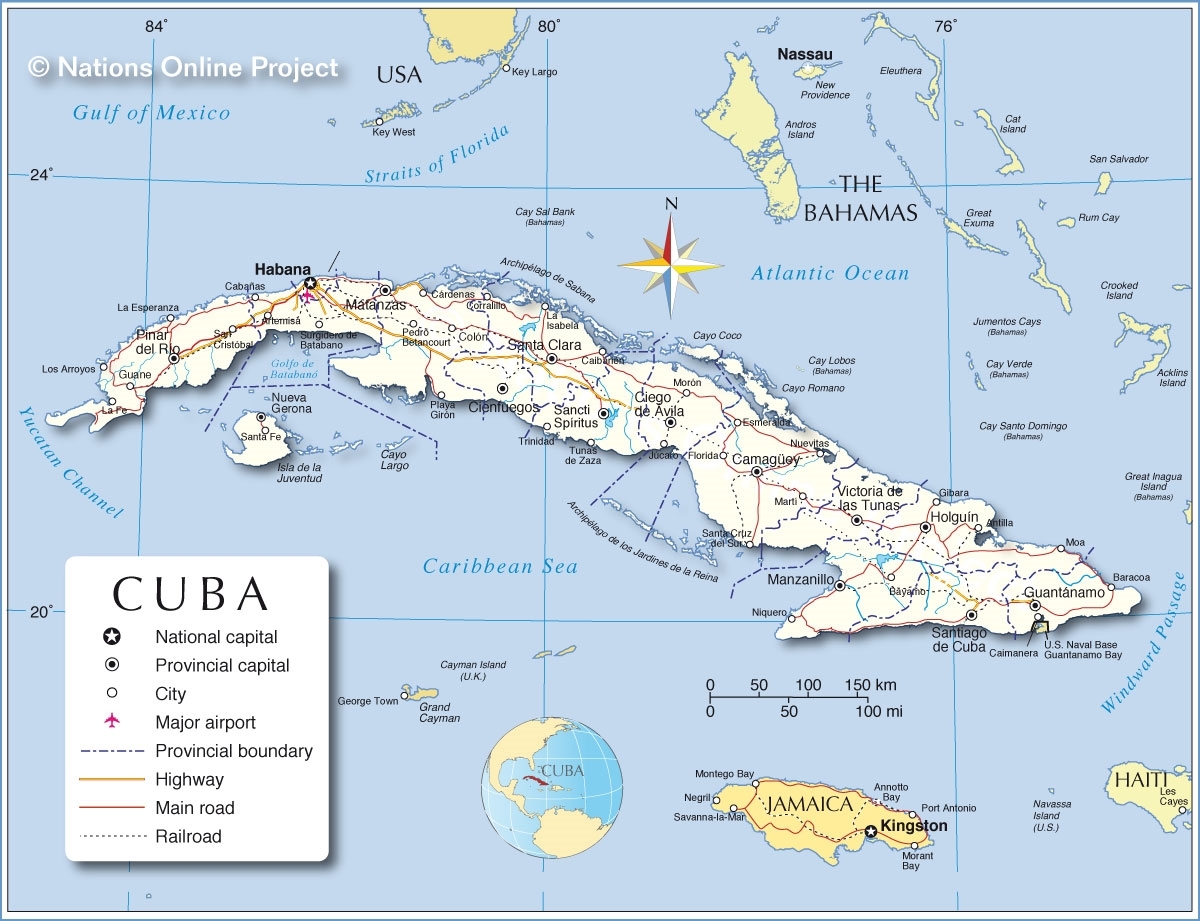
Screenshot_2021-03-04 Global Americans.png

The White House Publishes 24-Page Interim National Security Strategic Guidance: 19 Countries Listed; Cuba And Venezuela Not Included

The White House
Washington DC
March 2021

Interim National Security Strategic Guidance

Excerpt:

Page 10: “Because the vital national interests of the United States are inextricably bound to the fortunes of our closest neighbors in the Americas, we will expand our engagement and partnerships throughout the Western Hemisphere—and especially with Canada and Mexico—based on principles of mutual respect and equality and a commitment to economic prosperity, security, human rights, and dignity. This includes working with the Congress to provide Central America with $4 billion in assistance over four years, and taking other steps to address the root causes of human insecurity and irregular migration, including poverty, criminal violence, and corruption – problems made exponentially worse by COVID-19 and the deep recession and debt crisis it has wrought throughout Latin America and the Caribbean. And we will cooperate to confront the regional effects of climate change, while helping our neighbors invest in good governance and democratic institutions.”

Countries and organizations referenced in document (in order of mention)

China
Russia
Iran
North Korea
NATO
Australia
Japan
Republic of Korea
India
New Zealand
Singapore
Vietnam
ASEAN
Pacific Island states
European Union
United Kingdom
Canada
Mexico
Israel
Iran
Yemen
World Health Organization
United Nations
G-7
G-20
Afghanistan
World Trade Organization
Taiwan

LINK TO Complete Document In PDF Format

Screenshot_2021-03-03 NSC-1v2 pdf.png

President Biden To Congress: "Venezuela continues to pose an unusual and extraordinary threat..." And No Mention Of Cuba

The White House
Washington DC
2 March 2021

TO THE CONGRESS OF THE UNITED STATES:

Section 202(d) of the National Emergencies Act (50 U.S.C. 1622(d)) provides for the automatic termination of a national emergency unless, within 90 days prior to the anniversary date of its declaration, the President publishes in the Federal Register and transmits to the Congress a notice stating that the emergency is to continue in effect beyond the anniversary date. In accordance with this provision, I have sent to the Federal Register for publication the enclosed notice stating that the national emergency declared in Executive Order 13692 of March 8, 2015, with respect to the situation in Venezuela is to continue in effect beyond March 8, 2021.

The situation in Venezuela continues to pose an unusual and extraordinary threat to the national security and foreign policy of the United States. Therefore, I have determined that it is necessary to continue the national emergency declared in Executive Order 13692 with respect to the situation in Venezuela.

JOSEPH R. BIDEN JR.
THE WHITE HOUSE, March 2, 2021.

Venezuela_54.png

U.S. Department Of State Reports On Cuba's Banking System And Illicit Drug Activity

United States Department of State
Bureau of International Narcotics and Law Enforcement Affairs
Washington DC
2 March 2021

2021 INCSR–Volume II: Money Laundering (As submitted to Congress) Report


Cuba- OVERVIEW

Cuba is not a regional financial center. Cuban financial practices and U.S. sanctions continue to
prevent Cuba’s banking system from fully integrating into the international financial system.
The government-controlled banking sector renders Cuba an unattractive location for large-scale,
third-party money laundering through financial institutions. The centrally-planned economy
allows for little, and extremely regulated, private activity. However, a significant black market
operates parallel to the heavily subsidized and rationed formal market dominated by the state and
which state authorities actively participate in and benefit from. The Cuban government does not
identify money laundering as a major problem.

The Cuban government and state-controlled businesses actively engage in international money
laundering in order to evade U.S. sanctions. Cuba should strengthen the transparency of its
financial sector by engaging regional and international AML/CFT communities and increase
criminal investigations and prosecutions.

VULNERABILITIES AND MONEY LAUNDERING METHODOLOGIES

Although it is largely disconnected from the international financial system, there are some
factors and conditions in Cuba that are conducive to money laundering and make Cuba a
potential destination for illicit funds. These include a poorly regulated and opaque banking
sector, Cuba’s cash-based economy, the Cuban government’s desperation for hard currency,
ubiquitous government corruption and overall lack of transparency, and connections to high
profile current and former government leaders of countries in the region accused of corruption.
Cuba’s geographic location places it between drug-supplying and drug-consuming countries.
Cuba has little foreign investment compared to similar nations in the Caribbean, a small
international business presence, and no known offshore casinos or internet gaming sites. There
are no known issues with or abuse of NPOs, ARS, offshore sectors, FTZs, bearer shares, or other
specific sectors or situations.

Cuba’s first special economic development zone at the port of Mariel in northwestern Cuba was
established in November 2013 and is still under development. It is potentially located on
expropriated property, built by the government in partnership with Brazilian engineering firm
Odebrecht, subject of numerous corruption investigations throughout Latin America.

KEY AML LAWS AND REGULATIONS

Cuba claims to take into account international AML/CFT standards. Legislation released in
2013 outlines regulations regarding enhanced CDD for foreign PEPs, although it continues to
exempt domestic PEPs from the reach of the legislation.

The FIU shares financial intelligence with the Revolutionary National Police, the Attorney
General's Office, and General Comptroller of the Republic. In addition to its core FIU functions,
the FIU can suspend transactions and freeze funds, both domestically and upon request from a
foreign counterpart.

The United States and Cuba have very limited engagement in law enforcement matters. Cuba
has bilateral agreements with a number of countries related to combating drug trafficking.
Cuba is a member of the GAFILAT, a FATF-style regional body. Its most recent MER is
available at: http://www.fatf-gafi.org/countries/a-c/cuba/documents/mer-cuba-2015.html.

AML LEGAL, POLICY, AND REGULATORY DEFICIENCIES

Cuba has a number of strategic deficiencies in its AML regime. These include a lack of SAR
reporting to its FIU by financial institutions and DNFBPs, and weak supervision and
enforcement within its DNFBP and NPO sectors. These deficiencies stem from Cuba’s opaque
national banking system, which hampers efforts to monitor the effectiveness and progress of
Cuba’s AML efforts.

The U.S. government issued the Cuban Assets Control Regulations in 1963, under the Trading
with the Enemy Act. The embargo remains in place and restricts travel and most investment and
prohibits the import of most products of Cuban origin. With some notable exceptions, including
agricultural products, medicines and medical devices, telecommunications equipment, and
consumer communications devices, most exports from the United States to Cuba require a
license.

Additionally, a number of U.S.-based assets of the Cuban government or Cuban nationals are
frozen.

ENFORCEMENT/IMPLEMENTATION ISSUES AND COMMENTS

In April 2019, the Cuban government convicted Cuban-American Orelvis Olivera in absentia
and sentenced him to 10 years in prison for money laundering, tax evasion, forgery of public
documents, and illicit enrichment, among other crimes. The conviction was based on his
convictions in the United States and his investments in Cuba, which the Cuban government
proceeded to confiscate.

Major international banks have participated in transferring funds involving Cuba in apparent
violation of U.S. sanctions. In April 2019, British bank Standard Chartered agreed to pay $1.1
billion to settle allegations by the authorities in the United States and Britain that it violated
money laundering laws and economic sanctions, including those involving Cuba. This follows a
$1.34 billion settlement French bank Société Générale agreed to in November 2018 that also
implicated U.S. sanctions on Cuba.

Cuba should increase the transparency of its financial sector and increase its engagement with
the regional and international AML communities. Cuba should ensure its CDD measures and
SAR requirements include domestic PEPs, all DNFBPs, and the NPO sector, and create
appropriate laws and procedures to enhance international cooperation and mutual legal
assistance. Cuba should increase the transparency of criminal investigations and prosecutions.

Actions by Governments Y- Yes. N- No.)
Criminalized Drug Money Laundering- Y
Know-Your-Customer Provisions- Y
Report Suspicious Transactions (YPN)- Y
Maintain Records Over Time- Y
Cross-Border Transportation of Currency- Y
Financial Intelligence Unit is a Member of the Egmont- Y
Group of FIUs- Y
Intl Law Enforcement Cooperation- Y
System for Identifying/Forfeiting Assets- Y
Arrangements for Asset Sharing- N
Information exchange agreements with non-U.S. govts- Y
States Party to 1988 UN Drug Convention- Y
States Party to UNTOC- Y
States Party to UNCAC- Y
Financial Institutions transact in proceeds from international drug trafficking that significantly affects the U.S.- N

United States Department of State
Bureau of International Narcotics and Law Enforcement Affairs
Washington DC
2 March 2021

2021 INCSR–Volume I: Drug and Chemical Control Report


Cuba- OVERVIEW

Cuba is not a major consumer, producer, or transit point of illicit drugs. Cuba’s domestic production and consumption remain low due to active policing, strict sentencing, and nationwide prevention and public information programs. Cuba’s intensive security presence and interdiction efforts have kept supplies of illicit drugs down and prevented traffickers from establishing a foothold. Cuba concentrates supply reduction efforts on preventing smuggling through its territorial waters, collecting abandoned drugs found washed up on coastal shores and conducting thorough airport searches. Cuba dedicates significant resources to prevent illicit drugs and drug use from entering or spreading within the country, and regional traffickers typically avoid Cuba. Most maritime seizures are found washed up on the shores of Cuba’s coast after being jettisoned by traffickers being pursued by law enforcement. With respect to international cooperation, the Cuban government reports 40 bilateral agreements for counterdrug cooperation, including the U.S.-Cuba Operational Cooperation Arrangement to Counter Illicit Traffic in Narcotics and Psychotropic Substances (signed in July 2016). The U.S. Embassy maintains a U.S. Coast Guard
liaison to coordinate with Cuban law enforcement, particularly the Cuban Border Guards. The United States and Cuba exchange limited drug control information at the working level. Prescription drug abuse is increasing in Cuba, though it remains low compared to other countries, partly due to severe pharmaceutical shortages. Steroids, psychoactive drugs, sedatives, and painkillers are available in the black market through diversion from the legitimate supply chain (including drugs intended for veterinary use) and illicit importation.

Screenshot_2021-03-02 Bureau of International Narcotics and Law Enforcement Affairs - United States Department of State.png