President Trump Hasn't Done Anything Yet.. Perhaps, That's All He Needs To Do; Did Cuba Just Blink?

Mr. Donald J. Trump, the business executive, the candidate for the nomination of the Republican Party, the nominee of the Republican Party, the winner of the presidency... during each moment delivered statements about the Republic of Cuba. 

The following might reflect what he was thinking:

"During the campaign, I made statements about my intentions relating to Cuba.  During the transition, I made statements about my intentions relating to Cuba.  Since the inauguration, I have made statements about my intentions relating to Cuba.  However, I have not done anything.

Simply with my statements, the government of Cuba has been impacted.  Governments and companies and financial institutions in other countries (an in the United States) have remained hesitant to engage with Cuba or to announce new engagements.

See how much can happen when I don’t do anything; now see what happens when I do something."

Yesterday, the anticipation of his actions resulted in the government of the Republic of Cuba being proactive, in a (valid) fearful way....

12 June 2017: Washington (CNN) The Cuban government is signaling it is willing to enter into detailed negotiations with the Trump administration as the White House prepares to announce an expected rollback of former President Barack Obama's normalization of relations with the island.

Cuban President Raul Castro is open to a brokering a new agreement with President Donald Trump, a high-level Cuban government official told CNN.  "We know they have a different view of the world. We understand that," the Cuban official said of Havana's posture toward new negotiations.

A separate Cuban government official pointed to comments made by Raul Castro in January.

"I wish to express Cuba's willingness to continue negotiating pending bilateral issues with the United States, on the basis of equality, reciprocity and respect for the sovereignty and independence of our country, and to continue the respectful dialogue and cooperation on issues of common interest with the new government of President Donald Trump," Castro said in a speech delivered less than one week after Trump was sworn into office.

Nearly five months later, the Cuban government has yet to hear what would constitute a "better deal" for Trump, the Cuban official said.

Havana, however, does not expect the Trump administration to completely reverse the Obama administration policy and shutter the US Embassy in the Cuban capital.  That would be the "nuclear option," the Cuban official said.

The official raised concerns about news reports indicating the Trump administration would clamp down on travel to the island for Americans, a measure that would inflict more economic pain on cash-strapped Cubans who are benefiting from increased US tourism to Cuba.  Such a move, the Cuban official cautioned, could destabilize improved US-Cuban relations.

Either the US and Cuba will continue to normalize relations or not, the official added.  "You cannot be half-pregnant," the official said.

Another possible route for the Trump administration could be a return to restrictions on American purchases of Cuban cigars and rum that existed before the Obama administration.  "We will sell them to somebody else," the official said.

Another Mention Of Cuba During Press Briefing At The White House

THE WHITE HOUSE
Office of the Press Secretary
For Immediate Release
June, 12, 2017

 
PRESS BRIEFING BY PRESS SECRETARY SEAN SPICER
 
James S. Brady Press Briefing Room
1:39 P.M. EST

Q    My other question was, there are widespread stories and speculation that when the President goes to Miami this Friday he will undo the executive orders from the Obama administration that eased relations with Cuba.  Can you confirm whether he will undo all of them or some of them?
 
MR. SPICER:  (Laughter.)  That's a good try.  I will say that when we have an announcement on the President's schedule, we'll let you know.  But just stay tuned.  We have a very busy week -- an ambitious agenda this week.

THE WHITE HOUSE
Office of the Press Secretary
For Immediate Release
May 30, 2017

 
PRESS BRIEFING BY PRESS SECRETARY SEAN SPICER
 
James S. Brady Press Briefing Room
 
2:11 P.M. EDT  

And my second question, I did want to mention that before he left to go abroad, the President praised Philippine President Duterte for his action against drug dealers and dealing with them. Various human rights groups have condemned President Duterte, saying that a lot of the executions of drug dealers have been done without trial.  Does the President stand by his words of praise for the Philippine President?
 
MR. SPICER:  I think the President recognizes the need to combat drugs, but he also believes in human rights.  It's something that he’s worked with several countries -- it's one of the reasons that he’s reviewing the Cuba policy, et cetera.  He wants -- human rights is something that’s very strong to him.  It's something that he’s discussed in private with several countries.

Statements From The White House About Cuba.... Chronology
http://www.cubatrade.org/blog/2017/3/12/6rhpts5hb63h4xirou3am6ycrexpbk

THE WHITE HOUSE
Office of the Press Secretary
19 March 2017

Readout of the President’s Day        
 
....  He spoke to President Michelle Bachelet of Chile to discuss our bilateral relationship, including our close cooperation on trade and security issues.  President Trump expressed concern over the situation in Venezuela, and the leaders agreed on the importance of advancing democratic principles throughout the Western Hemisphere. 

EFE
Washington, DC
8 March 2017

Excerpts from interview with Ms. Helen Aguirre Ferre, Special Assistant to the President and Director of Media Affairs at The White House....

"The president has been very clear that they are going to evaluate all the agreements that the prior administration (of Barack Obama) made with Cuba," said Aguirre Ferre, who is of Nicaraguan heritage.

...in Trump's judgment, "Cuba did not offer any concessions, with all that it was given in what has been the normalization and reestablishment of agreements and diplomatic behavior."

Cuba is hosting "fugitives from US justice, it has to turn over those people and also talk about the importance of free elections and free political prisoners," Aguirre Ferre said.

Trump's adviser avoided commenting on whether there has been any contact as yet between the Trump administration and Cuba, saying that that it a question for the State Department.

The White House
Office of the Press Secretary
For Immediate Release
16 February 2017
Remarks by President Trump in Press Conference

East Room
12:55 P.M. EST

THE PRESIDENT:  ... We had dinner with Senator [Marco] Rubio [R-Florida] and his wife, who is, by the way, lovely.  And we had a really good discussion about Cuba because we have very similar views on Cuba.  And Cuba was very good to me in the Florida election as you know, the Cuban people, Americans.  

The White House
Office of the Press Secretary
3 February 2017

Press Briefing
12:37 P.M. EST

Mr. Spicer:  With that, I’m going to go my first Skype question seat.   Jackie Nespral from NBC 6 in South Florida.  Jackie.

Question:  Good afternoon.  On behalf of the viewers of South Florida, thanks so much for this opportunity.  You know, a lot of focus on foreign affairs this week, a new sanctions announced today against Iran, and of course Miami, as you know, is home to the largest Cuban-American community in the country.  And during the campaign, President Trump talked about his discontent with the warming of U.S.-Cuba relations implemented by President Obama.  And in the last days of his administration, he ended the "wet foot, dry foot" policy, leaving thousands of Cubans in limbo.

So my question is twofold.  A, has there been any contact between your administration and the Cuban government?  And B, are there any plans to change the current policy right now?

Mr. Spicer:  Thanks, Jackie.  We are in the midst of a full review of all U.S. policies towards Cuba.  The President is committed to an agenda of ensuring human rights for all citizens throughout the world.  And as we review those policies in Cuba, that will be forefront in their policy discussions, but there is nothing that we have on that front at this point.

The White House
Office of the Press Secretary
Washington, DC
24 January 2017

Press Briefing
36:18 of 45:26

Question:  Does the President have any plans to change US policy towards Cuba there are a lot of changes that took place during the last Administration and the Executive Orders as it relates to US-Cuba relations?

Mr. Spicer:  I have to follow-up with you we've got nothing that we're ready to announce at this point.

Committee on Foreign Relations
United States Senate
Washington, DC
21 January 2017

Written answers by Mr. Rex Tillerson, nominee to be United States Secretary of State, as published by the Committee on Foreign Relations.

Question: Despite the Obama Administration’s controversial and misguided decision to normalize relations with Cuba and its hope that this could lead to improved governance and human rights, Cuban officials continue to arrest dissidents and violate the rights of citizens, and tourism revenues benefit only government officials and a small minority of the population. How do you plan to approach the United States’ relationship with Cuba? How will you support human rights defenders and democracy activists in Cuba? What bilateral and/or multilateral pressure will you exert to lessen authoritarian rule in Cuba?

Tillerson: If confirmed, I will engage with Cuba but continue to press for reform of its oppressive regime. I will support human rights defenders and democracy activists in Cuba, empower civil society, defend freedom of expression, and promote improved Internet access and I will ask our allies to do the same.

Will you continue to support programs that promote democratic voices and initiatives in Cuba like Radio and TV Marti?

Yes, if I am confirmed.

What steps will you take to pressure the Castro regime to return American political fugitives like New Jersey cop-killer Joanne Chesimard?

If confirmed, I will engage bilaterally and multilaterally to bring these fugitives to justice.

Will you work with the Treasury Department to ensure that no revenue from American businesses goes directly toward supporting the Cuban military and the regime?

Yes, if I am confirmed.

NOTE: On 9 June 2016, The Honorable Paul Ryan (R-WI), Speaker of the United States House of Representatives, issued a statement entitled, "Achieving U.S. Security Through Leadership & Liberty"  The second paragraph of the document included this sentence: "A first step should be to ban financial transactions with the Cuban military."  http://www.cubatrade.org/blog/2016/6/11/speaker-of-the-house-paul-ryan-wants-to-rescind-starwood-hotel-management-agreement?rq=Paul%20Ryan

What steps will you take to encourage the government of Cuba to release political prisoners, artists, journalists, and other Cubans being detained for politically-motivated reasons?

If confirmed, I will press Cuba to meet its pledge to become more democratic and consider placing conditions on trade or travel policies to motivate the release of political prisoners.

What steps will you take to promote judicial reform in Cuba?

I will work bilaterally and multilaterally to identify training and technical assistance opportunities to assist with judicial reform, if I am confirmed.

On October 12, 2016, PEOTUS Donald Trump stated, “The people of Cuba have struggled too long. Will reverse Obama’s Executive Orders and concessions towards Cuba until freedoms are restored.” Do you stand by PEOTUS Trump’s commitment to reverse the Obama Administration’s Cuba regulations until freedoms are restored on the island?

Yes. There will be a comprehensive review of current policies and executive orders regarding Cuba to determine how best to pressure Cuba to respect human rights and promote democratic changes.

On October 14, 2016, VPEOTUS Mike Pence reiterated this commitment by stating, “When Donald Trump and I take to the White House, we will reverse Barack Obama’s executive orders on Cuba.” Do you stand by VPEOTUS Pence’s commitment to reverse the Obama Administration’s Cuba regulations?

Yes, if I am confirmed.

United States Secretary of State Designate Rex Tillerson
United States Senate Committee on Foreign Relations
Confirmation Hearing Opening Statement
11 January 2017

Excerpts…..

Good morning.

I am honored to have the backing of Senator Cornyn and Senator Cruz from my home state of Texas. I also want to thank Senator Nunn for his commitment to nuclear non-proliferation, and Secretary Gates for his service to eight presidents and his own leadership as President of the Boy Scouts of America.

Chairman Corker, Ranking Member Cardin, and Members of the Committee, it is an honor to appear before you today as President-elect Trump’s nominee for Secretary of State and to seek the approval of this Committee and the full Senate for my confirmation.

But our leadership demands action specifically focused on improving the conditions of people the world over, utilizing both aid and economic sanctions as instruments of foreign policy when appropriate.

And we must adhere to standards of accountability. Our recent engagement with the government of Cuba was not accompanied by any significant concessions on human rights. We have not held them accountable for their conduct. Their leaders received much, while their people received little. That serves neither the interest of Cubans or Americans.

Abraham Lincoln declared that America is “the last best hope of Earth.” Our moral light must not go out if we are to remain an agent of freedom.

US Department Of State Discusses Cuba Policy Review...

Previewing Secretary Tillerson's Participation in the Conference on Prosperity and Security in Central America

Special Briefing

William R. Brownfield
Assistant Secretary, Bureau of International Narcotics and Law Enforcement Affairs

John S. Creamer, Deputy Assistant Secretary of State for Cuba, Mexico, Central America, and Western Hemisphere Regional Economic Policy and Summit Issues

Via Teleconference

June 12, 2017

Excerpts:

MS NAUERT: All right. Good morning, everyone. Thanks for joining us for today’s background call on Secretary Tillerson’s upcoming travel to Miami. He’ll be participating in the Conference on Prosperity and Security in Central America. The conference is hosted by the United States and Mexico. It will take place on June 15th and 16th, and bring together a diverse group of government and business leaders from the United States, Mexico, Central America, and other countries to address the economic, security, and governance challenges, and also opportunities, in El Salvador, Guatemala, and Honduras.

The Secretary will attend the first day of the conference, which will focus on prosperity and economic growth. For a deeper dive into the objectives of the conference, we have two senior State Department officials with us. We’re joined by John Creamer, Deputy Assistant Secretary of State for Cuba, Mexico, Central America, and Western Hemisphere Regional Economic Policy and Summit issues. We’re also joined by William Brownfield, Assistant Secretary for International Narcotics and Law Enforcement Affairs.

MS NAUERT: (Laughter.) Okay, thank you. Thank you, gentlemen. We’ll start with Matt Lee from the Associated Press. Matt, go ahead.

QUESTION: Hi, thanks a lot, guys. I have a question about the elephant in the room here, which is Cuba, particularly given the speculation about changes in policy towards that. If, Assistant Secretary Brownfield, you’re right that the product that comes out of Central America turns right and goes – heads to Europe, that would put it – make it go right through Cuba. Can I ask why – recognizing this is a Central American and not a Caribbean thing, but why not invite them as an observer?

And secondly, I just want to make sure – Secretary Tillerson will only be there for the Thursday portion, is that correct?

MS NAUERT: Matt, let me get back to you on the Secretary’s schedule.

QUESTION: Okay.

ASSISTANT SECRETARY BROWNFIELD: And Matt, I’ll take the drug-related question that you have posed, which is the only basis upon which I will express a view on Cuba. The – at the end of the day, Cuba, along with most of the other nations in the Caribbean – in fact, all of them, I believe – is not participating in this Central America conference, I presume for the same reason that the other 14 or 15 Caribbean nations are not participating and the other 12 South American nations are not participating. It’s not a Western Hemisphere conference. It is a Central America conference and specifically a Northern Triangle conference.

MS NAUERT: Okay. Thank you. Nick Wadhams from Bloomberg.

QUESTION: Hi, thanks. Just to go back to the elephant in the room, as Matt put it, Cuba. And there are a lot of reports out there that President Trump will announce a new Cuba policy on Friday. And John, Cuba is one of your areas, so can you talk a little bit about State’s involvement in the review process on Cuba policy? Do you anticipate a change in U.S. policy toward Cuba, and what’s your recommendation on that score? Thank you.

MR CREAMER: I would just note that we have been involved in a policy review since early this year. A policy review continues. Once we have the policy review completed, the President will announce the policy at the time and place of his choosing. But right now, the review is still underway and I don’t want to talk about the specifics of the review or try and prejudge its outcome.

Okay, let’s go to Reuters. Arshad Mohammed.

QUESTION: Yeah, two quick questions. One, do you have any expectation, even if the Cuba policy review is still ongoing, do you have any expectation that that will be completed by the end of the week?

MR CREAMER: The Cuba one’s easy. I’m not going to speculate on whence policy review will be completed. It’s already – it’s gone on for a couple of months now, and it will finish when it finishes.
 

How We Got To This Friday.... And A Potential Problem Unmasked

A Washington, DC-based advocacy group promoted to journalists that the Trump Administration was expected to announce its Republic of Cuba policy in June 2017.

The goal was twofold:

First, for the advocacy group to obtain, perhaps cynically, support from its benefactors and create responses from like-minded organizations, companies, and individuals to lobby against any changes to policy. 

Second, to create the narrative that no matter what the Trump Administration’s decision relating to the Republic Cuba, the advocacy group would market that had it not been the precipitator of the initial news cycle, the decision of the Trump Administration would have been far worse; an unproveable.

Within this context, there is a political document that was presented as an economic impact analysis.  Again, with the purpose of creating an unproveable- without it, the decision of the Trump Administration would have been far worse. 

Now, there is a document obtained by journalists purporting to show a commercial relationship between the leadership of the advocacy group and a for-profit travel agency which may benefit from the non-profit and benefit the officer and director of the non-profit; and, thus be considered an (undisclosed) private benefit.  There is a report the Internal Revenue Service (IRS) of the United States Department of the Treasury is reviewing the matter:  LINK: http://search.sunbiz.org/Inquiry/CorporationSearch/SearchResultDetail?inquirytype=OfficerRegisteredAgentName&directionType=ForwardList&searchNameOrder=PEREDAARIEL%20M150000095782&aggregateId=forl-m15000009578-44220537-2426-4feb-a97c-c12698ee6bf1&searchTerm=Pereda&listNameOrder=PEREDAALEX%20P030000047792

Was the effort by the advocacy group about protecting a personal economic interest rather than the interests of the United States business community?  Maintaining no disruptions in travel to the Republic of Cuba so as not to negatively impact personal income?

With each day since 20 January 2017 without implementation of changes to United States policy and regulations that impact commercial activities of United States companies within the Republic of Cuba, executives in some industries, specifically hospitality (airlines, cruise lines, tour operators and travel agents) have announced expanded schedules and itineraries.

Their belief is the more activity in place, the less likely will be the Trump Administration to be impactful.  So, most executives would rather have a continued delay in any announcement by the Trump Administration.   

In 2015, the advocacy group supported a position by the United States Secretary of Commerce that was later invalidated by the United States Secretary of State.  The issue was whether representatives of United States-based companies could officially participate in a visit by The Honorable Penny Pritzker (and separately in 2015 by The Honorable Tom Vilsack, then-United States Secretary of Agriculture), who accepted that the answer was negative.  In early 2016, that position was reversed when representatives of United States-based companies were included in an official delegation to the Republic of Cuba led by the United States Department of State.  At the time, attorneys provided opinions that there were no statutes prohibiting the participation by representatives of United States-based companies.  The advocacy group was extraordinarily robust in its defense of Secretary Pritzker, to the detrement of United States-based companies.  LINK: http://www.cubatrade.org/blog/2016/2/3/duiselnlulovkhacjcl3s7ua3rmh6t?rq=pritzker

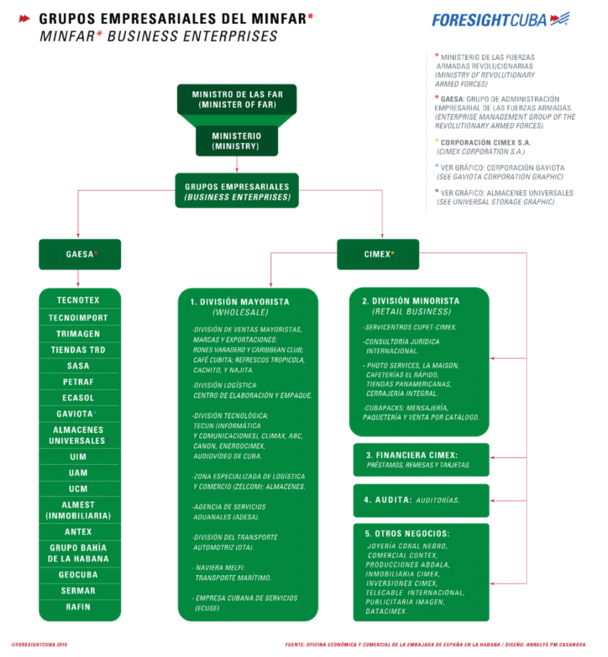
Want To Plan For The Impact Of Trump Administration Decision About Cuba?  Understand GAESA.

The Trump Administration is expected to discourage, restrict and perhaps prohibit transactions with entities (companies) within the Republic of Cuba that are affiliated with and/or controlled by the Revolutionary Armed Forces of the Republic of Cuba (FAR).  The most important entity is the Enterprise Administration Group (GAESA). 

LINK: http://foresightcuba.com/grupos-empresariales-del-minfar/

United States-based companies and individuals subject to United States jurisdiction should plan to avoid transactions with FAR/GAESA-related entities (companies). 

Can an individual subject to United States jurisdiction visit the Republic of Cuba and not connect in some manner with an entity controlled by and/or affiliated with FAR/GAESA?  Unlikely.

The United States Department of the Treasury’s Office of Foreign Assets Control (OFAC) is expected to publish a list of entities (companies) in the Republic of Cuba that are controlled by the FAR.  These entities may be added to the OFAC’s Specially Designated Nationals And Blocked Persons (SDN) List, which could have multilateral financial transactions implications.

“If you are traveling to the Republic of Cuba, and only those who are authorized should do so, then choose carefully and direct your money directly to the Cuban people.”

The Trump Administration continues to weigh ending self-directed travel and returning to group-only travel for educational and people-to-people programs; there is also consideration to end people-to-people programs.  An end to self-directed programs would impact airlines more than cruise lines.

The airlines have benefitted from individuals traveling to the Republic of Cuba while the cruise lines prefer providing group experiences as they are more controlled and profitable.

“Too many people are hopping on planes, staying in government-owned hotels, eating in government-owned restaurants, using government-owned transportation… for a vacation.  Folks, tourism is illegal.  It’s the law.”

Expect increased enforcement by Customs and Border Protection (CBP) of the United States Department of Homeland Security. 

Travelers returning to the United States from the Republic of Cuba should be prepared to provide and have inspected all documents required by the OFAC. 

“Check the OFAC’s web site.  If you don’t have what you are supposed to have, don’t be shocked if you are delayed and miss your connecting flight.”

If a traveler is returning to the United States from the Republic of Cuba with cigars and rum, those purchases might require an additional inspection by representatives of the United States Department of Agriculture (USDA).

United States companies will be discouraged from transactions with FAR/GAESA-related entities (companies). 

If a United States-based company wants to engage a FAR/GAESA-related entity (company) in the Republic of Cuba, the United States-based company will have to demonstrate to the OFAC, United States Department of State, and Bureau of Industry and Security (BIS) of the United States Department of Commerce that the deal will benefit the people of the Republic of Cuba rather than entrench the FAR within the commercial sectors of the Republic of Cuba.

“If a United States-based company wants to get into bed with the Cuban military, then be prepared to demonstrate how that will result in more freedom for the Cuban people rather than more prosperity for generals in Cuba.”

Some stakeholders will have to settle for less than they wanted and some stakeholders will have to settle for more than they wanted.

Both groups will have to accept what is initially enacted and then seek ways to make further changes. Thus, all stake holders will be disappointed that they didn't receive what they wanted.

Will President Trump Be Speaking On Friday At The Freedom Tower In Miami?

Although not officially-confirmed by The White House, media has reported that President Donald J. Trump will deliver an address in Miami, Florida, on Friday, 16 June 2017, at 5:00 pm to outline his policy towards the Republic of Cuba.  The facility is undergoing renovations, but that may not preclude use of the hall.

From The Freedom Tower Internet Site:

Constructed in 1925 as a home for The Miami News, the Freedom Tower at Miami Dade College was modeled after the Giralda Cathedral Bell Tower in Seville, Spain. Striking in its architectural detail with its octagonal tower and richly ornamented facade, it remains one of South Florida's most distinctive historic buildings.

Designated a National Historic Landmark in 2008, the building designed by George A. Fuller, Schultze & Weaver was donated by 600 Biscayne LLC and the Pedro Martin family.

Most notably in its history, MDC's Freedom Tower was operated by the U.S. government as a reception center for Cuban refugees from 1962 to 1974. The building is significant because it represents the important story of the Cuban exodus to America and resettlement during the Cold War, reports the U.S. Department of the Interior, which has also called the Freedom Tower the "Ellis Island of the South."

Though it operated in that capacity for only 12 years, the building has become an icon representing the faith that democracy brought to troubled lives, the generosity of the American people and a hopeful beginning that assured thousands a new life in a new land.

The Cuban Exile Experience & Cultural Legacy Gallery is a historical component of the MDC Museum of Art + Design. In addition to visual arts, the Museum supports exhibitions and programs that collect, preserve, research and interpret stories and artifacts that help build a better community understanding and appreciation of the Freedom Tower's history.

http://www.mdcmoad.org/freedom-tower/default.aspx

Senator Rubio Has Another Dining Experience With President Trump... Was Cuba On The Menu Along With Ravioli?

On 6 June 2017, The Honorable Marco Rubio (R- Florida) of the United States Senate, was among six Members of Congress who dined at The White House with The Honorable Donald J. Trump, President of the United States.  This was not the first dining experience between the Senator and the President.

Senator Rubio  is today the most influential member of the United States Congress with respect to Republic of Cuba-related issues.

He is the Chairman of the Subcommittee on Western Hemisphere, Transnational Crime, Civilian Security, Democracy, Human Rights, and Global Women’s Issues of the Foreign Relations Committee of the United States Senate.  He is also a member of the Committee on Appropriations, Select Committee on Intelligence, and Committee on Small Business and Entrepreneurship.

As he prepares for an expected second opportunity to seek the nomination of the Republican Party to be its candidate for the presidency, and continues to seek to be an influential national voice within the Republican Party, he needs to view any impact to changes in United States policies and regulations relating to the Republic of Cuba upon the State of Florida in macro-terms rather than the micro-terms of a member of the House of Representatives who focuses upon one district within a state. 

As a result, there is pragmatic distance between his public desire for substantial changes to United States policies and regulations relating to the Republic of Cuba and measured acceptance of changes to United States policies and regulations; with the measured acceptance being partially influenced by the interests of United States-based companies, specifically those operating (and employing) within the State of Florida, State of New York and State of Texas among others from which financial contributions will be sought.  Link: List of United States Companies with A Presence in The Republic of Cuba

The Honorable Marco Rubio (R- Florida)
Washington Conference on the Americas
United States Department of State
Washington, DC

9 May 2017

Excerpts from Remarks:

“I hope that we will, in a strategic way, recalculate the concessions that have been made with the dictatorship in Cuba."

“I fear that too much time has been used to placate hostile governments.”

Video of Remarks

https://www.c-span.org/video/?428237-1/senator-marco-rubio-calls-renewed-focus-western-hemisphere

Blog Post Mentioning Senator Marco Rubio & Comments About The Republic Of Cuba

23 April 2017

http://www.cubatrade.org/blog/2017/4/23/senator-rubio-on-meet-the-press-shares-about-conversation-with-nsc-staff-was-cuba-on-the-agenda?rq=Marco%20Rubio

5 April 2017

http://www.cubatrade.org/blog/2017/4/5/from-politico-usda-secretary-nominee-confirmation-delayed-due-to-cuba?rq=Marco%20Rubio

1 April 2017

http://www.cubatrade.org/blog/2017/4/1/senator-marco-rubio-r-of-florida-discusses-his-three-discussions-about-cuba-with-president-trump?rq=Marco%20Rubio

16 February 2017

http://www.cubatrade.org/blog/2017/2/27/president-trump-mentions-cuba-at-press-conference?rq=Marco%20Rubio

Airbnb Reports On First Two Years In Cuba: US$40 Million

Airbnb In Cuba By The Numbers

$40 million Paid to Cuban individuals from sharing their home, since April 2015

33 nights The average number of nights Cuban hosts share their space per year

$164 The average amount paid per booking to a Cuban host

43 years old The average age of Cuban hosts

$2,700 The average annual payout for a Cuban host

58% Of Cuban Airbnb hosts are women

Complete Report In PDF Format

A Cuban-American Republican Congressman Is Cuba’s New US$8 Billion Best Friend; President Trump Can't Get More Than 2 Cents On The Dollar?

A Cuban-American Republican Congressman Is Cuba’s New US$8 Billion Best Friend
Cuba Pays Nothing & U.S. Pays Everything
President Trump Can’t Negotiate More Than US$.02 Cents On The Dollar?  Really?
An Illegal Export Tax
Fifth Amendment Issues
Should Riceland Foods Pay Starwood Hotels
Should Cargill Pay Texaco
Should Grove Enterprises Pay InterContinental Hotels
Will Cuba Importers Have Access To US Government Financing Programs

Why are two Members of Congress from the Republican Party, one from Arkansas and the other from Florida, who present themselves as fiscally and constitutionally conservative- believing in responsibility for actions, constructing an alliance to provide a bailout to the government of the Republic of Cuba at the expense of United States-based companies?

For one, betrayal of the concept of fiscal responsibility.  For the other, betrayal of a multi-generational family-connected and colleague-connected positions requiring that the government of the Republic of Cuba be held accountable.

For those who complained, and legitimately so, that the Obama Administration provided much and received little during its two-plus years (December 2014-January 2017) of initiatives, and was, perhaps, the last lifeguard to the government of the Republic of Cuba, the Obama Administration did not provide an US$8 billion write-off and then send a collective invoice to the 322+ million residents of the United States.  That’s what two members of the United States Congress have proposed.

By withdrawing the requirement for the government of the Republic of Cuba compensate certified claimants, the United States Congress is invalidating the validity of the certified claims.  The government of the Republic of Cuba will respond that if the United States isn’t asking it to make payment, they, the certified claims, must have never been valid.

Legislators often believe themselves to be physicians and legislation is their prescription to problems.  The proposed legislation is a prescription that should remain unfilled.  The legislation solves nothing; at minimum it postpones a resolution, at maximum it establishes a multilateral terrible precedent.

Examples Of Potential Payment Transfers

Let’s examine a series of transactions and determine the fairness quotient.  In each of the following transactions, US$1 million represents 2% of the value of the product exported to Republic of Cuba government-operated Alimport.  The 2% export tax is the mechanism proposed legislation uses to repay certified claimants.  Food product and agricultural commodities are authorized on a “cash-in-advance” basis by the Trade Sanctions Reform and Export Enhancement Act (TSREEA) of 2000.   

Will the owners, shareholders and management of these exporters be comfortable with transferring revenues- potentially to a competitor?  Will there be legal action?  Fifth Amendment claims?

Stuttgart, Arkansas-based Riceland Foods sells US$50 million in rice to Alimport and pays US$1 million indirectly to Stamford, Connecticut-based Starwood Hotels & Resorts International (a subsidiary of Bethesda, Maryland-based Marriott International) which has a claim valued at approximately US$51 million.  The company manages the Four Points Sheraton Havana.

Minnetonka, Minnesota-based Cargill sells US$50 million in wheat to Alimport and pays US$1 million indirectly to White Plains, New York-based Texaco (a subsidiary of San Ramon, California-based Chevron Corporation) which has a claim valued at approximately US$28 million.

Wellesley, Massachusetts-based Grove Enterprises sells US$50 million in poultry to Alimport and pays US$1 million indirectly to Denham, United Kingdom-based InterContinental Hotels Group PLC which has a claim valued at approximately US$4.6 million.

Chicago, Illinois-based ADM sells US$50 million in corn to Alimport and pays US$1 million indirectly to Cincinnati, Ohio-based Procter & Gamble Co.

Salisbury, Maryland-based Perdue Agribusiness sells US$50 million in soybeans to Alimport and pays US$1 million indirectly to Atlanta, Georgia-based The Coca-Cola Company.

Chattanooga, Tennessee-based Koch Foods of Chattanooga sells US$50 million in poultry to Alimport and pays US$1 million indirectly to Boston, Massachusetts-based General Electric.  The company will soon announce commercial activity in the Republic of Cuba.

Atlanta, Georgia-based AJC International sells US$50 million in poultry to Alimport and pays US$1 million indirectly to Irving, Texas-based Exxon Mobil Corporation.

Bedford, Virginia-based Sellari Enterprises sells US$50 million in poultry to Alimport and pays US$1 million indirectly to Phoenix, Arizona-based Freeport McMoRan.

The result of these eight (8) transactions from a total export value of US$400 million is a payment of US$8 million to be divided among the 5,913 claims certified by the United States Foreign Claims Settlement Commission (USFCSC) valued without interest at US$1,902,202,284.95 and with interest at approximately US$8 billion.  Of the 5,913 claims certified by the USFCSC, thirty (30) companies account for approximately 57% of the value without interest.  

The US$7 million represents .037% of the original value of the certified claims and .09% of the estimated current value of the certified claims.

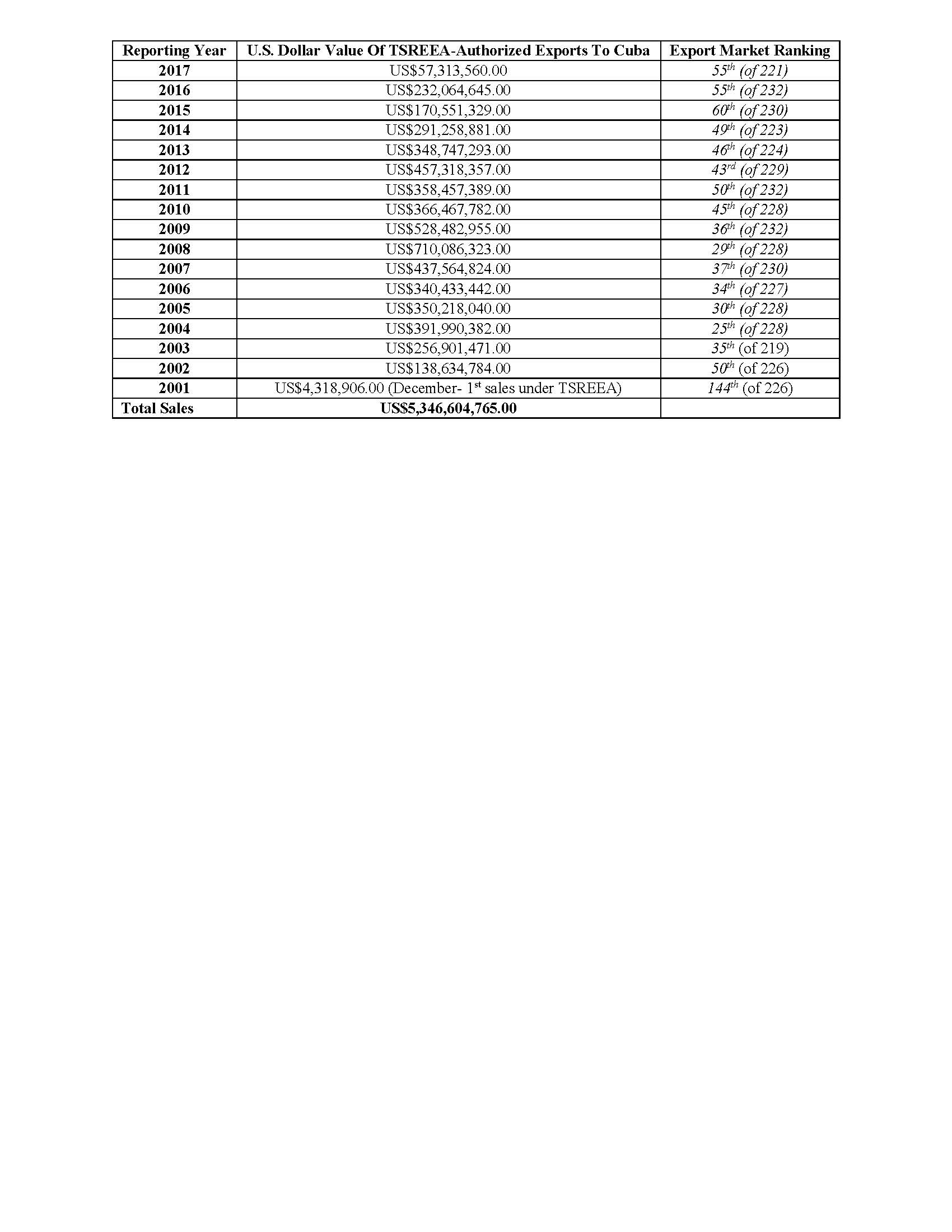
For reference, the following are the U.S. Dollar export values for TSREEA-related exports since the first deliveries in December 2001; the 2% export tax would represent US$106,932,095.30 from all TSREEA-related exports: 

Reporting Year
U.S. Dollar Value Of TSREEA-Authorized Exports To Cuba
Export Market Ranking

2017
US$57,313,560.00
55th (of 221)

2016
US$232,064,645.00
55th (of 232)

2015
US$170,551,329.00
60th (of 230)

2014
US$291,258,881.00
49th (of 223)

2013
US$348,747,293.00
46th (of 224)

2012
US$457,318,357.00
43rd (of 229)

2011
US$358,457,389.00
50th (of 232)

2010
US$366,467,782.00
45th (of 228)

2009
US$528,482,955.00
36th (of 232)

2008
US$710,086,323.00
29th (of 228)

2007
US$437,564,824.00
37th (of 230)

2006
US$340,433,442.00
34th (of 227)

2005
US$350,218,040.00
30th (of 228)

2004
US$391,990,382.00
25th (of 228)

2003
US$256,901,471.00
35th (of 219)

2002
US$138,634,784.00
50th (of 226)

2001
US$4,318,906.00 (December- 1st sales under TSREEA)
144th (of 226)

Total Sales US$5,346,604,765.00

These two members of the United States Congress are establishing a treacherous precedent for resolving issues of expropriation not only with the Republic of Cuba, but with other countries which may take similar actions… The new rule will be take what you want, and United States citizens will make restitution. 

Representative Rick Crawford (R- 1st District, Arkansas) believes Representative Carlos Curbelo (R- 26th District, Florida) suggested linkage of repayment for certified claimants to permitting payment terms (currently “cash-in-advance” by statute) for food products and agricultural commodity exports from the United States to the Republic of Cuba as a means of assisting, of resolving the issue of the certified claims.  Representative Crawford seems jubilant. 

Representative Curbelo created linkage to impede rather than encourage commerce with the government of the Republic of Cuba as it remains (as he expects it will through the Trump Administration) in the form that it does- with members of the Castro family and military officers substantively participating in the direction and leadership of the country. 

A goal is to retain statutory control of bilateral issues; and, specifically, retain control by the United States Congress for changing the bilateral relationship with the Republic of Cuba rather than risk the uncertainty of decisions by the Executive Branch. 

Ask the question: Why would a Cuban-American member of the United States Congress support an effort to absolve the government of the Republic of Cuba of its financial obligations when for years there was a position that “stolen property” should be returned or adequate compensation should be provided to the owner? 

Perhaps, because unknown is whether the funds that would be maintained at the United States Department of the Treasury on behalf of the certified claimants might be available to individuals who have unrelated civil judgements against the government of the Republic of Cuba. 

The 5,913 certified claimants have endured previous occupants (Democrat and Republican) of The White House redirecting funds reserved for repayment of the certified claims to satisfy civil judgements unrelated to the certified claims; and the invasion of those funds was supported by those with whom Representative Crawford is negotiating his legislation. 

If the legislation is presented to the commercially value-focused and export-advocating Trump Administration including the Secretary of Commerce and Secretary of the Treasury, along with members of the Ways & Means Committee of the United States House of Representatives as a proposal with a potential ROI (Return On Investment) of 47 years, 133 years, 200 years, 400 years, 563 years and 1,723 years; and, this ROI calculation does not consider the impact of continuing the interest on the principal value of the certified claims, what is the logical business-school-shapedresponse?  And, then add that there will be a 2% export tax.

For the legislation to have resulted in repayment to the certified claimants in 2017, the legislation would have needed to have been law during these notable dates (from recent to distant): the first Earth Day, the first roller coaster at Coney Island, the invention of the bicycle, Jamestown settlers in residence, the fall of Constantinople, and the tenure of Galerius as Emperor of Rome.

The legislation only serves Members of Congress who created it, Members of Congress who support it, and those lobbyists/activists who encourage it; the harmed are (and remain) the 5,913 companies and individuals who have certified claims against the government of the Republic of Cuba. 

This legislation is about preserving opportunities for political contributions, advocate/lobbyist fees and media coverage.  There seems to be an epidemic of courage of ignorance sweeping through certain offices in the nation’s capital….

The legislation is like a person being sick and doing everything possible to prolong the recovery.  It’s stealing from one to make payment to another.

From a philosophical perspective, United States-based companies believe that they, not the United States government, should determine the credit worthiness of a customer.  If management makes a mistake; that’s on management.  The generally-accepted codicil to that position is when financing is provided to a United States-based company by a third-party financial institution who would have a fiduciary responsibility to access the ability of a customer’s customer to repay a debt; and if repayment of the obligation is insured (provided by) in any manner by an entity affiliated with the United States government.  Representative Crawford’s legislation does envision United States-based companies accessing United States government financing/payment programs.

What should be done rather than legislation?  Request that the Trump Administration engage in direct, consistent, high-level, resolution-date-imposed, negotiations to resolve the issue of the certified claims.  The Trump Administration believes that it, through those who serve within it, specifically those with experience in the private sector, are natural negotiators.  Unleash them.

Constitutionality

There are practitioners within the legal community who present that Representative Crawford's legislation is per se unconstitutional.  See United States v. Int’l Bus. Machs. Corp., 517 U.S. 843, 846-48 (1996) “[t]he Export Clause states simply and directly: ‘No Tax or Duty shall be laid on Articles exported from any State.’ U.S. Const., Art. I, § 9, cl. 5.  There have been occasions to interpret the language of the Export Clause, but cases have broadly exempted from federal taxation not only export goods, but also services and activities closely related to the export process . . . the Export Clause strictly prohibits any tax or duty, discriminatory or not, that falls on exports during the course of exportation.” 

Mistaken Logic

Representative Crawford was quoted by the Arkansas Democrat-Gazette on 3 June 2017 offering "To my knowledge there's never been any attempt to ever address this problem before."  That statement is false. 

1) The Libertad Act of 1996 references the importance of and includes requirements for resolving the certified claims.  2) The Obama Administration placed a “high priority” upon seeking a resolution to the certified claims, although the effort was comical: two meetings in two years where a second meeting was not scheduled after the first meeting and a third meeting was not scheduled after the second meeting.  3) Representatives of United States companies with certified claims have visited the Republic of Cuba and met with representatives of the government of the Republic of Cuba; the Libertad Act provides a mechanism for private settlements- one of which has been in the public domain relating to telecommunications services.  4) There has been consideration of the value in obtaining the services of a mediator: http://www.cubatrade.org/blog/2016/12/1/zigs56x0gme3a9rqg7aecx9vf2gqgk?rq=feinberg

There is another reason “there's never been any attempt to ever address this problem before."  The logic at the foundation of the attempt is misguided- it focuses upon “let’s do anything” as the basis for a solution rather than analyzing the rationality and practicality for delivering upon the premise. 

There is commentary from an advocate that the legislation will “make it easier for Americans to sell food to private Cuban citizens…,” The Obama Administration authorized United States-based companies to export products and services directly to registered independent businesses (entities) in the Republic of Cuba; the government of the Republic of Cuba has not authorized that initiative despite efforts by officials of the Obama Administration, Members of Congress and from representatives of United States companies. 

The lack of selling “food to private Cuban citizens” is not solely due to the “cash in advance” requirements of the TSREEA, it is a result of prohibitions by the government of the Republic of Cuba- which also extend to other products that the Obama Administration authorized for export (with payment terms) to registered independent businesses (entities) in the Republic of Cuba. 

The published text of H.R. 525 states “there is no opportunity for United States agricultural businesses to trade directly with the Cuban people and there is no Cuban market; United States businesses have only one venue to trade with Cuba and that is through ALIMPORT, the state-owned and state-controlled entity.”  That statement is correct because the government of the Republic of Cuba has refused to authorize United States-based companies to export directly to individuals and entities other than Alimport.  The prohibition is not a result of United States statute or regulation; it’s a result of the policy of the government of the Republic of Cuba. 

Historically, the United States business community privately favored the “cash-in-advance” provision of the TSREEA due to routine defaults (and/or rescheduling) on credit purchases by the government of the Republic of Cuba.

However, the United States business community does not support relieving the government of the Republic of Cuba of its obligation to the certified claimants.  The legislation supported by Representatives Crawford and Curbelo creates an additional impediment to resolving an existing problem.

The legislation as currently written seems to provide an opportunity for the Republic of Cuba to access United States taxpayer-funded and taxpayer-guaranteed financing programs.  The government of the Republic of Cuba has always viewed access to government export programs as the “holy grail” of their advocacy efforts.  Why have Members of Congress accepted what has traditionally been anathema to them?  Why has this enormously significant change in policy not been publicized by Representatives Crawford and Curbelo?  Link to United States government programs:http://www.cubatrade.org/blog/2016/3/20/8iiwr41blj6mzfk8w921iadkexhmze?rq=government%20programs

Is this a realistic trajectory?

For 2017, the Republic of Cuba expects to import approximately US$1.8 billion to US$2 billion in food products and agricultural commodities compared to approximately US$1.8 billion in 2016 and 2015, US$2.5 billion in 2014; compared to approximately US$2.5 billion in 2008 and US$1.5 billion in 2007.  The funds spent change with available foreign exchange and due to changes in commodity prices, with lower commodity prices still resulting in adequate quantities, but requiring lower expenditures. 

There are those who view the Republic of Cuba through a prism which shows a country that they believe to exist, but does not. 

How can a credible argument be made that the United States will supplant virtually all existing importing sources within one year?  But, the logic gets even more spectacular….

According to the Arkansas Democrat-Gazette on 3 June 2017, “The original version of HR525, the Cuba Agricultural Exports Act, didn't include the fee when it was filed in January.  In an interview Friday, Crawford said he plans to file an amended version of his legislation next week to reflect the change. The lawmaker estimates the 2-percent fee would generate roughly $30 million per year initially, rising to perhaps $60 million within five to seven years.”

For US$30 million to equal 2% of the value for all food product and agricultural commodity exports from the United States to the Republic of Cuba, the total value of those exports would need to be US$1.5 billion, which Representative Crawford was reported to believe would be the “within five to seven years.” 

For US$60 million to equal 2% of the value for all food product and agricultural commodity exports from the United States to the Republic of Cuba, the total value of those exports would need to be US$3 billion, which Representative Crawford was reported to believe would be the “within five to seven years.” 

How does any reputable economist evaluate the commercial, economic and political structures of the Republic of Cuba, as they exist today, and suggest that the country has a trajectory to increase imports of food products and agricultural commodities at an annual rate of 10% or more... and these would be imports only from the United States.  What about the Republic of Cuba’s current sources of imports?  Particularly, Vietnam which provides two years to make payment for rice?  And, what about other countries where the Republic of Cuba, and the exporters, access government guarantees and access programs with provide for extended payment terms generally far exceeding commercial payment terms? 

Has the government of the Republic of Cuba provided any public statement(s) as to whether they are prepared to increase purchases of food products and agricultural commodities from the United States if they are permitted to seek and then accept payment terms? 

Has the government of the Republic of Cuba provided any public statement(s) as to what payment terms they would require as a condition to increase the value of purchases?  30-days, 60-days, 90-days, 120-days, 180-days, 360-days, 720-days?

Today, as has been the constant during the last five-to-ten years, extended payment terms for almost every product or service that is imported by Republic of Cuba government-operated companies, with the standard payment terms ranging from 180-days to 360-days. 

Individuals and companies who work with and represent non-United States-based companies which export products and services to the Republic of Cuba posit that if United States-based companies provided 30-day repayment terms for food product and agricultural commodity exports, the result may be a 5% to 10% increase in the total value of exports to the Republic of Cuba; with primary beneficiaries exporters/distributors located in the State of Florida who can swiftly process and deliver food products (primarily for use in the hospitality sector) when inventories are unexpectedly depleted and replenishment from sources in Canada, Panama, and on the European Continent would result in further delays- even though the payment terms might be more advantageous. 

If United States companies (with or without the support of United States financial institutions) were to provide payment terms of at minimum 180-days, but nearing or 360-days, then, perhaps, primarily agricultural commodity exports could be US$1 billion.

Until all that is considered by the government of the Republic of Cuba to be defined as “the embargo” is removed, likely market share for United States-based companies will be limited and the interest of United States-based companies will continue to be used as bait to entice interests in other countries. 

However, the limitation will remain a limitation until the Republic of Cuba embraces fundamental commercial, economic and political changes which will increase public sector and private sector efficiencies and productiveness.

Thus far, however, none of the United States companies who have exported food products and agricultural commodities to the Republic of Cuba have publicly reported what payment terms they would offer if permitted to offer payment terms.  And, United States financial institutions have not reported that they would provide financing for exports to the Republic of Cuba.  Stating those positions would be helpful.

List Of Largest Certified Claimants:

https://static1.squarespace.com/static/563a4585e4b00d0211e8dd7e/t/57964e93e3df283b116047c9/1469468308537/CLAIMS.pdf

Complete Analysis In PDF Format
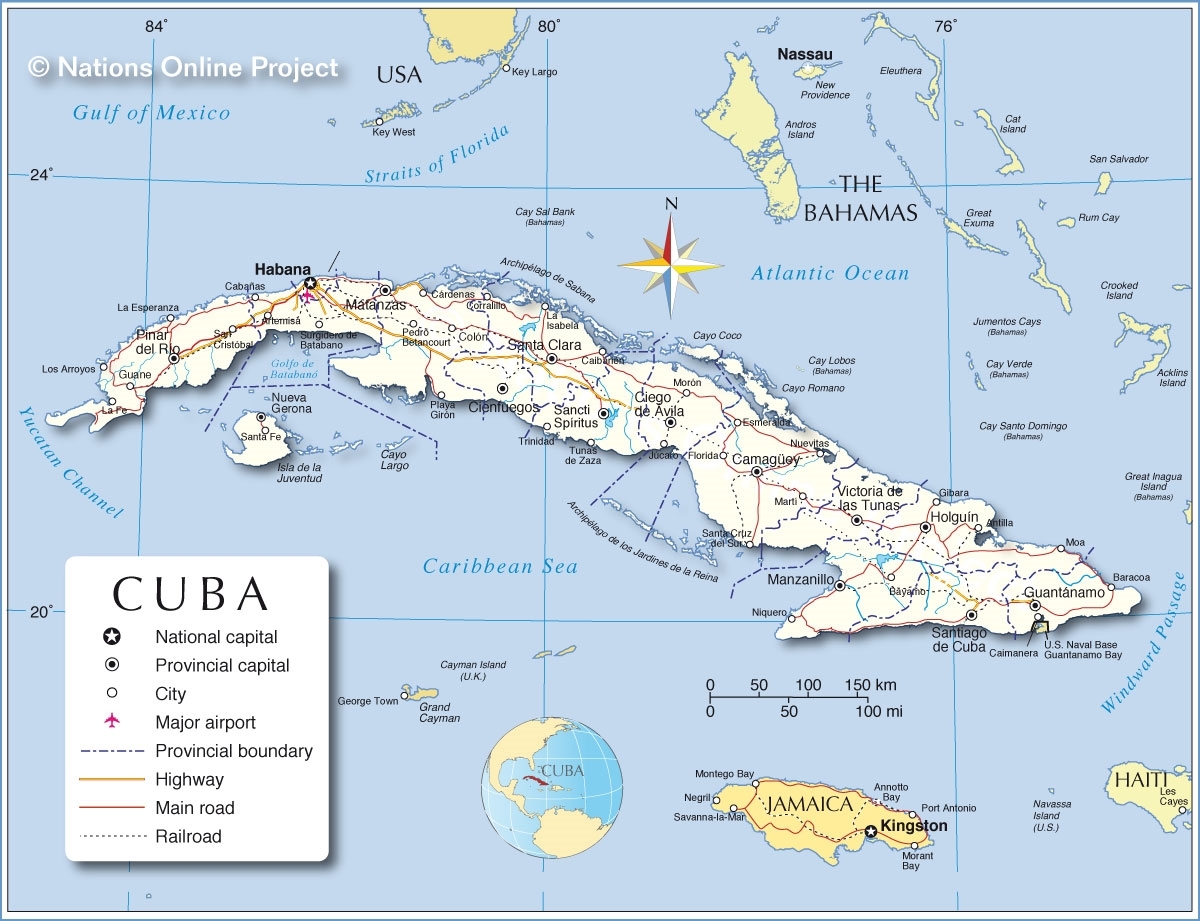
US Cruise Line Gross Revenues From Cuba Sailings Could Exceed US$500 Million By 2019

Cruise Lines Could Deliver 380,000+ Passengers During 245 Sailings To Cuba In 2017/2018/2019

US$502+ Million In Gross Revenues To Companies From Cumulative 2017/2018/2019 Sailings

US$53+ Million Spent In Cuba By Passengers

US$14+ Million In Port Fees To Cuba

And, transporting, housing, and feeding those potential passengers could mean an additional US$110+ Million to United States airlines and US$45+ million to hotels and restaurants located in South Florida.  Gross United States airline revenues for 2017, excluding the cruise-related revenues, are projected to be US$173 million for United States-Republic of Cuba routes.

The three (3) largest United States-based cruise lines have announced more than 222 itineraries amongst their brands for the 2017, 2018 and 2019 sailing seasons which include the Republic of Cuba.  Additional itineraries are expected to be announced.  

Are the CEO’s of the three largest United States-based cruise lines: Mr. Frank J. Del Rio (Miami, Florida-based Norwegian Cruise Lines Holdings Ltd), Mr. Arnold W. Donald (Miami, Florida-based Carnival Corporation & plc) and Mr. Richard D. Fain (Miami, Florida-based Royal Caribbean Cruises Ltd) presenting a dare to the President of the United States or enticing the President’s corporate salivary gland?

In 2016, the three-largest United States-based cruise lines combined operated a fleet of approximately 144 vessels, managed approximately 14 brands, earned approximately US$28.8 billion in gross revenues, and employed approximately 218,000 men and women.

If each of their vessels sail at capacity, approximately 372,000 passengers will visit the Republic of Cuba from 2017 through 2019.  The gross revenues to the cruise lines from the 222 Republic of Cuba sailings would be projected to exceed US$450 million from 2017 through 2019.

The 372,000 passengers would be projected to spend approximately US$52 million while in the Republic of Cuba [approximately US$140.00 per person in expenditures and organized/non-organized excursions including cost(s) for tour(s), meals (government-operated and privately-operated), ground transportation (privately-operated classic car tours), sundries and souvenirs (including spirits, coffee, tobacco, artwork and crafts)].  Some passengers could spend considerably more (cigars for example) given the United States duty-free personal exemption of US$800 per person.  

Vessel port charges in the Republic of Cuba may exceed US$14 million, ranging up to approximately US$79,000.00 for the largest vessels (684-passenger to 2,052-passenger).

Included in the calculations are Guilford, Connecticut-based Pearl Seas Cruises has eighteen sailings scheduled for 2017/2018 with projected gross revenues to the company of US$35 million, passenger expenditures in the Republic of Cuba of approximately US$529,000.00 and port fees of approximately US$180,000.00.  Los Angles, California-based Viking River Cruises has five sailings scheduled for 2017 with projected gross revenues to the company of US$17 million, passenger expenditures in the Republic of Cuba of approximately US$651,000.00 and port fees of approximately US$225,000.00.  

Analysis In PDF Format

Related Links: http://www.cubatrade.org/blog/2017/5/11/51crppkum1ulnb9icv89r9b4y6ewjx

Could rum from Cuba be directly imported to the US for flavoring in rum raisin ice cream?

If the rum brand (and production) was not subject to intellectual property claims and not subject to claims which could brought under the Libertad Act (“Helms-Burton”) of 1996, authorizations created by the Obama Administration for the importation of products from the Republic of Cuba could be implemented:

In 2016, the Obama Administration added coffee to the list of eligible imports from the Republic of Cuba.  [Separately, charcoal was authorized.]  Rum could be added to the list of eligible imports.  

To be eligible for importation into the United States, a listed Cuban Assets Control Regulations (31 CFR Part 515) Section 515.582 product must be “produced by independent Cuban entrepreneurs, as demonstrated by documentary evidence.”  

From the United States Department of State: “Persons subject to US jurisdiction engaging in import transactions involving goods produced by an independent Cuban entrepreneur pursuant to 515.582 must obtain documentary evidence that demonstrates the entrepreneur's independent status, such as a copy of a license to be self-employed issued by the Cuban government, or in the case of an entity, evidence that demonstrates that the entity is a private entity that is not owned or controlled by the Cuban government.”

Currently, rum production and rum marketing in the Republic of Cuba is controlled by Republic of Cuba government-operated entities; and global distribution for some brands (including Havana Club) is through a joint venture with Paris, France-based Pernod Ricard (2016 revenues approximately US$10 billion).  

The government of the Republic of Cuba would create value by authorizing the creation (licensing) of small, independent, micro, artisan distilleries owned and/or managed by self-employed Republic of Cuba nationals.  In this way, rum (and/or rum extract) could be exported directly to the United States for sale-at-retail and for use as flavoring in ice cream.  The following brands have had, have, or could have rum raisin ice cream: 

365 (owned by Texas-based Whole Foods)
Ben & Jerry's (Vermont-based; owned by Unilever)
Haagen-Dazs (California-based; owned by Minnesota-based General Mills; distributed by Nestle SA)
Breyers (New Jersey-based; owned by Unilever)
Starbucks (owned by Washington-based Starbucks Corporation)
Dreyers (California-based; owned by Nestle SA)
Straus (owned by California-based Straus Family Creamery)
Blue Bell (owned by Texas-based Blue Bell Creameries)
Edy's (California-based; owned by Nestle SA)

Vevey, Switzerland-based Nestle SA (2016 revenues approximately US$94 billion) owns California-based Dreyer’s Grand Ice Cream Holdings, Inc., and Oakland, California-based Edy’s Grand Ice Cream; and distributes Oakland, California-based Haagen-Dazs. 

London, United Kingdom-based Unilver Plc (2016 revenues approximately US$65 billion) owns South Burlington, Vermont-based Ben & Jerry’s and Englewood Cliffs, New Jersey-based Breyers.

Nestle SA And Cuba

Nestle SA is positioning itself to be an importer to the United States of confections, coffee, ice cream, beverages, and other consumables sourced in the Republic of Cuba.  

Nestle SA has a multi-decade interest in the Republic of Cuba.  The company has a representative office in the city of Havana.  Since the 1990's, Nestle S.A. has been involved with Republic of Cuba government-operated companies to develop the confection industry (a twenty-year joint venture producing ice cream); has investments in bottled water production (Ciego Montero) and beverage production; and imports products for sale at retail stores.  In 2014, Nestle Nespresso released “Limited Edition Cubanía; Inspired by the passion and intensity of Cuban coffee ritual” that did not contain coffee from the Republic of Cuba.  The 2016 Cuban Nespresso Grand Cru Cafecito de Cuba capsule was to be available outside of the United States, but with the 22 April 2016 changes in United States regulations, an opportunity was created to add the United States to the global distribution channels.

In 2017, Nestle SA reported the company would invest approximately US$55 million to create a joint venture (of which it will own 51%) potentially employing 300 Republic of Cuba nationals to source ingredients for and to produce coffee, biscuits and cooking products.  Completion date is by 2019.  Other Nestle SA production facilities are being considered for expansion.

In 2016, New York, New York-based Nestle Nespresso USA, Inc., a subsidiary of Nestle SA, purchased a container of approximately eighteen (18) tons of green coffee beans through London, United Kingdom-based Cubana Coffee & Roastery (www.cubana.co.uk), the established bar-restaurant and coffee roasting group, and London, United Kingdom-based The Cuba Mountain Coffee Company Ltd (www.almacuba.com).  

The green coffee beans were sourced from the 2015-2016 harvest in the Republic of Cuba; the value was approximately US$5,000.00 per metric ton, or approximately US$90,000.00.  The beans were roasted at Nestle Nespresso facilities in Avenches and nearby Orbe, Switzerland. With approximately 20% lost during the roasting process, the result was approximately 180,000 capsules per ton- 3,240,000 limited edition Cafecito de Cuba capsules (approximately 5 to 6 grams each or .17 to .21 ounces).  The price for a limited-edition capsule was approximately US$1.10, so potential total revenue could be approximately US$3,564,000.00. Nestle Nespresso USA, Inc., has obtained additional green coffee beans from the 2016-2017 harvest in the Republic of Cuba and continues to produce capsules for distribution throughout the world, including in the United States.

Unilever Plc And Cuba

In November 2016, Unilver Plc commenced construction on a joint venture (of which it will own 60%) facility valued at US$35 million in the Republic of Cuba to produce soap, detergent, deodorant and toothpaste.  Production is scheduled to commence in 2018.  Unilever had a joint venture in the Republic of Cuba from the mid-1990's until 2012 when it ended due to operational disagreements.  The company continued to export products to the Republic of Cuba.  

Cuba Again Mentioned During Press Briefing At The White House

THE WHITE HOUSE
 
Office of the Press Secretary
For Immediate Release
May 30, 2017
 
PRESS BRIEFING BY PRESS SECRETARY SEAN SPICER
 
James S. Brady Press Briefing Room
 
2:11 P.M. EDT  

And my second question, I did want to mention that before he left to go abroad, the President praised Philippine President Duterte for his action against drug dealers and dealing with them. Various human rights groups have condemned President Duterte, saying that a lot of the executions of drug dealers have been done without trial.  Does the President stand by his words of praise for the Philippine President?
 
MR. SPICER:  I think the President recognizes the need to combat drugs, but he also believes in human rights.  It's something that he’s worked with several countries -- it's one of the reasons that he’s reviewing the Cuba policy, et cetera.  He wants -- human rights is something that’s very strong to him.  It's something that he’s discussed in private with several countries.

Statements From The White House About Cuba.... Chronology
http://www.cubatrade.org/blog/2017/3/12/6rhpts5hb63h4xirou3am6ycrexpbk

THE WHITE HOUSE
Office of the Press Secretary
19 March 2017
 
Readout of the President’s Day        
 
....  He spoke to President Michelle Bachelet of Chile to discuss our bilateral relationship, including our close cooperation on trade and security issues.  President Trump expressed concern over the situation in Venezuela, and the leaders agreed on the importance of advancing democratic principles throughout the Western Hemisphere. 

EFE
Washington, DC
8 March 2017

Excerpts from interview with Ms. Helen Aguirre Ferre, Special Assistant to the President and Director of Media Affairs at The White House....

"The president has been very clear that they are going to evaluate all the agreements that the prior administration (of Barack Obama) made with Cuba," said Aguirre Ferre, who is of Nicaraguan heritage.

...in Trump's judgment, "Cuba did not offer any concessions, with all that it was given in what has been the normalization and reestablishment of agreements and diplomatic behavior."

Cuba is hosting "fugitives from US justice, it has to turn over those people and also talk about the importance of free elections and free political prisoners," Aguirre Ferre said.

Trump's adviser avoided commenting on whether there has been any contact as yet between the Trump administration and Cuba, saying that that it a question for the State Department.

The White House
Office of the Press Secretary
For Immediate Release
16 February 2017
Remarks by President Trump in Press Conference

East Room
12:55 P.M. EST

THE PRESIDENT:  ... We had dinner with Senator [Marco] Rubio [R-Florida] and his wife, who is, by the way, lovely.  And we had a really good discussion about Cuba because we have very similar views on Cuba.  And Cuba was very good to me in the Florida election as you know, the Cuban people, Americans.  

The White House
Office of the Press Secretary
3 February 2017

Press Briefing
12:37 P.M. EST

Mr. Spicer:  With that, I’m going to go my first Skype question seat.   Jackie Nespral from NBC 6 in South Florida.  Jackie.

Question:  Good afternoon.  On behalf of the viewers of South Florida, thanks so much for this opportunity.  You know, a lot of focus on foreign affairs this week, a new sanctions announced today against Iran, and of course Miami, as you know, is home to the largest Cuban-American community in the country.  And during the campaign, President Trump talked about his discontent with the warming of U.S.-Cuba relations implemented by President Obama.  And in the last days of his administration, he ended the "wet foot, dry foot" policy, leaving thousands of Cubans in limbo.

So my question is twofold.  A, has there been any contact between your administration and the Cuban government?  And B, are there any plans to change the current policy right now?

Mr. Spicer:  Thanks, Jackie.  We are in the midst of a full review of all U.S. policies towards Cuba.  The President is committed to an agenda of ensuring human rights for all citizens throughout the world.  And as we review those policies in Cuba, that will be forefront in their policy discussions, but there is nothing that we have on that front at this point.

The White House
Office of the Press Secretary
Washington, DC
24 January 2017

Press Briefing
36:18 of 45:26

Question:  Does the President have any plans to change US policy towards Cuba there are a lot of changes that took place during the last Administration and the Executive Orders as it relates to US-Cuba relations?

Mr. Spicer:  I have to follow-up with you we've got nothing that we're ready to announce at this point.

Committee on Foreign Relations
United States Senate
Washington, DC
21 January 2017

Written answers by Mr. Rex Tillerson, nominee to be United States Secretary of State, as published by the Committee on Foreign Relations.

Question: Despite the Obama Administration’s controversial and misguided decision to normalize relations with Cuba and its hope that this could lead to improved governance and human rights, Cuban officials continue to arrest dissidents and violate the rights of citizens, and tourism revenues benefit only government officials and a small minority of the population. How do you plan to approach the United States’ relationship with Cuba? How will you support human rights defenders and democracy activists in Cuba? What bilateral and/or multilateral pressure will you exert to lessen authoritarian rule in Cuba?

Tillerson: If confirmed, I will engage with Cuba but continue to press for reform of its oppressive regime. I will support human rights defenders and democracy activists in Cuba, empower civil society, defend freedom of expression, and promote improved Internet access and I will ask our allies to do the same.

Will you continue to support programs that promote democratic voices and initiatives in Cuba like Radio and TV Marti?

Yes, if I am confirmed.

What steps will you take to pressure the Castro regime to return American political fugitives like New Jersey cop-killer Joanne Chesimard?

If confirmed, I will engage bilaterally and multilaterally to bring these fugitives to justice.

Will you work with the Treasury Department to ensure that no revenue from American businesses goes directly toward supporting the Cuban military and the regime?

Yes, if I am confirmed.

NOTE: On 9 June 2016, The Honorable Paul Ryan (R-WI), Speaker of the United States House of Representatives, issued a statement entitled, "Achieving U.S. Security Through Leadership & Liberty"  The second paragraph of the document included this sentence: "A first step should be to ban financial transactions with the Cuban military."  http://www.cubatrade.org/blog/2016/6/11/speaker-of-the-house-paul-ryan-wants-to-rescind-starwood-hotel-management-agreement?rq=Paul%20Ryan

What steps will you take to encourage the government of Cuba to release political prisoners, artists, journalists, and other Cubans being detained for politically-motivated reasons?

If confirmed, I will press Cuba to meet its pledge to become more democratic and consider placing conditions on trade or travel policies to motivate the release of political prisoners.

What steps will you take to promote judicial reform in Cuba?

I will work bilaterally and multilaterally to identify training and technical assistance opportunities to assist with judicial reform, if I am confirmed.

On October 12, 2016, PEOTUS Donald Trump stated, “The people of Cuba have struggled too long. Will reverse Obama’s Executive Orders and concessions towards Cuba until freedoms are restored.” Do you stand by PEOTUS Trump’s commitment to reverse the Obama Administration’s Cuba regulations until freedoms are restored on the island?

Yes. There will be a comprehensive review of current policies and executive orders regarding Cuba to determine how best to pressure Cuba to respect human rights and promote democratic changes.

On October 14, 2016, VPEOTUS Mike Pence reiterated this commitment by stating, “When Donald Trump and I take to the White House, we will reverse Barack Obama’s executive orders on Cuba.” Do you stand by VPEOTUS Pence’s commitment to reverse the Obama Administration’s Cuba regulations?

Yes, if I am confirmed.

United States Secretary of State Designate Rex Tillerson
United States Senate Committee on Foreign Relations
Confirmation Hearing Opening Statement
11 January 2017

Excerpts…..

Good morning.

I am honored to have the backing of Senator Cornyn and Senator Cruz from my home state of Texas. I also want to thank Senator Nunn for his commitment to nuclear non-proliferation, and Secretary Gates for his service to eight presidents and his own leadership as President of the Boy Scouts of America.

Chairman Corker, Ranking Member Cardin, and Members of the Committee, it is an honor to appear before you today as President-elect Trump’s nominee for Secretary of State and to seek the approval of this Committee and the full Senate for my confirmation.

But our leadership demands action specifically focused on improving the conditions of people the world over, utilizing both aid and economic sanctions as instruments of foreign policy when appropriate.

And we must adhere to standards of accountability. Our recent engagement with the government of Cuba was not accompanied by any significant concessions on human rights. We have not held them accountable for their conduct. Their leaders received much, while their people received little. That serves neither the interest of Cubans or Americans.

Abraham Lincoln declared that America is “the last best hope of Earth.” Our moral light must not go out if we are to remain an agent of freedom.
 

2% Tax on US Exports To Cuba To Compensate Certified Claimants Is Foolish

When A Politician Negotiates A Business Deal
Unintended (For One Side) Consequences To Find “A Proper Path Forward”
Not A Poison Pill- A Poison Fee
How To Define An “Elegant Solution”
133 Years to 1,723 Years For Repayment
The Hurry To Lose?  Repeating The Mistake Of 6,000 Days Ago

A proposal by The Honorable Rick Crawford (R- 1st District, Arkansas) to require by statute a 2% transaction fee for agricultural commodity and food product exports from the United States to the Republic of Cuba under provisions of the Trade Sanctions Reform and Export Enhancement Act (TSREEA) of 2000 in return for statutorily authorizing private-sector payment terms for those exports is not a solution to a problem- it is an affront to the 5,913 companies and individuals who have waited nearing fifty-seven (57) years for an equitable resolution to the expropriation of assets (29 June 1960).

Representative Crawford is not solving a problem; he is making the existing problem worse and creating additional problems.  He may believe that his efforts at bipartisan engagement are creating a space for bipartisan dialogue with a goal of closure.  He is not.  He is solidifying delay and distraction.  Rice from Arkansas will not be flooding the Republic of Cuba marketplace because of his efforts.

United States agricultural commodity and food product exports are approximately US$5.3 billion since the first deliveries in December 2001 under provisions of the TSREEA.

If the proposed 2% had been collected since the first TSREEA-related exports to the Republic of Cuba, the total thus far would be approximately US$106 million- which equates to approximately 6% of the initial value of the certified claims and approximately 1% of the current value of the certified claims.

United States citizens, owners of privately-held companies, and shareholders of publicly-held companies should not be required to make (reimburse) payments for actions by the government of the Republic of Cuba. 

Why would the Trump Administration, which extols the role of exporters in the United States economy, support creating an additional impediment to the one statutorily-permitted category with the greatest history and greatest potential? 

Will imports from the Republic of Cuba, for example currently authorized coffee and charcoal, be subject to financial penalties?  Will there be a Nespresso-tax?

The “long-term solution” advocated by grass-roots activists/lobbyists in July 2016 (see below) is not accomplished through the creation of an onerous new statute.  This new statute would only serve as a platform for individuals and organizations to seek additional funds to lobby for the repeal of a previous statute.  And, that helps companies in what way?    

For the privilege of exporting agricultural commodities and food products to the Republic of Cuba, United States companies will be required to earn less for their efforts.  This is foolish logic.  Through courage of ignorance, the result is a further delegitimization of the bilateral commercial process. 

To remind: When Members of Congress and their advocates and their lobbyists had an occupant of the Oval Office from 20 January 2009 to 20 January 2017; and who in 2014 (December), 2015, 2016 and 2017 (January) had a focus upon the Republic of Cuba, and could have, by directive, increased the efficiency (by lessening costs) of transactions by authorizing direct correspondent banking- nothing was done.

United States companies which may not have a certified claim will be making payments to those who have certified claims.  This is fair?

Representative Crawford is advocating absolution for the government of the Republic of Cuba of responsibility for its expropriations.  He is advocating for a transfer of responsibility from the government of the Republic of Cuba to a new class of creditors- the 325 million population of the United States who without recourse would indirectly reimburse the government of the Republic of Cuba for expropriating the assets of 5,913 companies and individuals.  This is right?

There were 8,821 claims of which 5,913 awards certified by the United States Foreign Claims Settlement Commission (USFCSC) were valued at US$1,902,202,284.95.  Of these certified claims, thirty (30) United States-based companies hold 56.85% of the total value.  The USFCSC permitted interest to be accrued in the amount of 6% per annum; the current value is approximately US$8 billion.   

As reported in on 27 May 2017 in The Miami Herald: “Every transaction will have a two percent excise fee that would be collected and administered to certified claimants through the Treasury Department,” he said.  “The 2% user fee functions like an excise tax on the total sale, and it is paid by the seller of the agricultural product,” added a staffer from Crawford’s office….  “an end thanks to an “elegant” solution that is part of proposed legislation: a 2 percent user fee on agricultural products sold to the island that would be used to compensate those who have certified claims of properties confiscated by the Cuban government.”

In an eagerness to “accomplish” something, the result may be the creation of a statutory template and judicial precedent impacting United States bilateral and multilateral relationships, as well as, complicate the commercial, economic and political landscape from which to resolve other United States-Republic of Cuba issues.  Representative Crawford would be best advised to await 24 February 2018, the inauguration of the next president of the Republic of Cuba, when the bilateral dynamic may well be more… dynamic.  Change for the sake of change is not always productive- and can be harmful.

What is unknown- thus far, is if the legislation would define “certified claimants” as those among the 5,913 or those whose claims are not among the 5,913. 

The definition is critical to determining the value (and legitimacy) of the legislation- and to whom it has value.  The 5,913 certified claimants have endured previous occupants (Democrat and Republican) of The White House negating the value and importance of the certified claims and redirecting funds reserved for repayment of the certified claims to satisfy civil judgments unrelated to the certified claims; and the invasion of those funds was supported by those with whom Representative Crawford is negotiating his legislation.  He has been “rolled” in the political context of the term.

How does creating another statutory requirement; impediment to a “normalized” bilateral commercial environment positively impact the existing commercial environment? 

What is the mechanism for removing the 2% transaction fee from the statute?  Until the value of the “certified claims” have been repaid?  Which value- the original US$1.9 billion or the current US$8 billion? 

Let’s examine the data: 

In 2016, the value of TSREEA-related exports was US$232,064,645.00; and 2% is US$4,641,292.90.  If the highest value TSREEA-related export year is used, US$710,086,323.00 in 2008; then 2% is US$14,201,726.46. 

At this rate, repayment of the original value of the certified claims, US$1,902,202,284.95, would take approximately 400 years based upon the 2016 value and approximately 133 years based upon the 2008 value. 

If the approximate US$8 billion current value of the certified claims is used, the repayment schedule ranges from approximately 563 years (2008) to 1,723 years (2016).

There are credible individuals, organizations and other entities who estimate unfettered TSREEA-related (meaning no restrictions) exports to the Republic of Cuba could be US$2 billion annually (equating to approximately 100% of current and 70% of potential agricultural commodity and food product imports by the Republic of Cuba).  Using that valuation, the 2% fee would be US$40 million; and certified claimants could be repaid in approximately 47 years to 200 years depending upon which certified claim total value is used in the calculation.

NOTE: Each of the previous analyses do not account for a continuation of the 6% per annum interest permitted by the FSFCSC.

Those members of the United States Congress with whom Representative Crawford has “negotiated” thus far succeeded in creating the same type of unrelated trade-off as those who negotiated the TSREEA…. a statutory codification of twelve (12) categories of authorized travel to the Republic of Cuba and a specific prohibition on travel related to tourism.  Representative Crawford is making the same poorly-thought-out agreement as did his Republican colleagues more than 6,000 days ago.

With agricultural commodity and food product exports a low-profit margin exercise, often with margins in the low single digits, how does adding 2% to the pricing of an export assist with increasing the quantity and value of exports?  And, there would be additional transaction costs to the exporter to transfer the funds to the Office of Foreign Assets Control (OFAC) of the United States Department of the Treasury; and there would be costs to the OFAC to manage and audit the statutory requirement.  Meaning an increased budget and increased cost to the United States taxpayer.

Representative Crawford may be seeking to create a socialist (collective) solution to what was considering by many to be a communist-inspired problem from 1960: He wants those who had nothing to do with the problem to pay for its resolution.  Person A steals from Person B and then Person A requires Persons C, D, E, F, etc., to repay Person B; and those persons had nothing to do with the original transgression.

There Are Other Ways

United States companies have identified reasonable options for resolving the 5,913 certified claims, including the retention of an outside specialist:

http://www.cubatrade.org/blog/2016/12/1/zigs56x0gme3a9rqg7aecx9vf2gqgk?rq=feinberg

Background- U.S. Food Product/Agricultural Commodity Exports To Cuba

Since December 2001, more than US$5.3 billion in agricultural commodities and food products have been exported directly from the United States to the Republic of Cuba on a cash-in-advance basis as required by the TSREEA.  

No United States company which has exported product(s) to the Republic of Cuba since 2001 has publicly stated what payment terms it would currently provide if authorized by statute.  No United States financial institution has publicly stated that it would provide financing for those exports.  

The government of the Republic of Cuba prefers to purchase food products and agricultural commodities from government-operated exporters where either the exporter or the government of the Republic of Cuba accesses government export-payment guarantee programs.  Requesting payment terms of one-year to three-years is not uncommon.

Government of Vietnam-operated Vinafood (1 & 2) have provided payment terms to Republic of Cuba government-operated Alimport of two (2) years to pay for rice (25% to 30% broken).  The Republic of Cuba annually imports approximately 200,000 metric tons to 400,000 metric tons of rice, primarily from Vietnam and People's Republic of China.  Republic of Cuba annual domestic requirements are approximately 700,000 metric tons.  The Republic of Cuba does grow a small quantity of rice.  United States producers can provide this product; however, payment terms, if statutorily permitted, without the use of United States government guarantee programs, would be cash-on-delivery to 30 days; and for credit-worthy customers, generally not exceed sixty (60) days to ninety (90) days according to United States exporters.

12 July 2016 (Blog Post)

"There is real momentum," said The Honorable Mark Sanford (R- South Carolina), a member of the United States House of Representatives, last week.  He then had no mention of the events of last week on his www.house.gov page as of 9 July 2016. 

“…a proper path forward and we agreed to find a solution that does a number of things,” said The Honorable Rick Crawford (R- Arkansas), a member of the United States House of Representatives, last week.  He also shared “a long-term solution,” “thorough examination,” and “deliberative process across each relevant committee of jurisdiction.” Representative Crawford then had no mention of the events of last week on his www.house.gov page as of 9 July 2016.  

“… a historic compromise” and “major step forward,” said Washington, DC-based EngageCuba, adding “reached an agreement to find a long-term solution to provide credit for the export of agricultural commodities to Cuba.”  And, the organization’s president offered this to those who have opposed his efforts, “their position is no longer tenable.”  Is this a winning-votes strategy by a grass-roots organizer or a self-professed effective advocate/consultant/lobbyist?

“…redouble its efforts with this Congress,” said the Washington, DC-based U.S. Agriculture Coalition for Cuba.  Would this be the 114th Congress about to recess for the upcoming elections, with few remaining legislative days before formally adjourning in December 2016? 

The government of the Republic of Cuba could not have been enthusiastic when their advocates engineered not one, but two, legislative failures within twenty-four (24) hours. 

The result all but assures no legislation in the 114th Congress and simultaneously harms the foundations for advocacy in the 115th Congress- during which issues relating to the Republic of Cuba will again not be a priority for the leadership in either the United States House of Representatives or the United States Senate; or probably the next president.

Why are advocates focusing upon legislation when regulation and policy change are more efficient mechanisms by which to expand the commercial, economic and political relationship between the United States the Republic of Cuba during the remaining 192 days of the Obama Administration? 

One reason, jobs- their own that is.  Did the Members of Congress coordinate their efforts with the self-appointed Republic of Cuba policy advocates?  If so, how should responsibility for the failures be apportioned?

Links To Relevant Blog Posts

https://static1.squarespace.com/static/563a4585e4b00d0211e8dd7e/t/57863b1d15d5dbb0fab811e3/1468414753520/CrawfordSanfordCubaAdvocacy.pdf

http://www.cubatrade.org/blog/2016/7/12/cuba-last-weeks-mistakes-by-members-of-congressadvocates-could-hurt-us-companies?rq=crawford

http://www.cubatrade.org/blog/2016/12/1/zigs56x0gme3a9rqg7aecx9vf2gqgk?rq=certified%20claims

http://www.cubatrade.org/blog/2017/3/23/bs7tttl7jsf0bkyle6b4kitf69whwj?rq=crawford

http://www.cubatrade.org/blog/2016/8/6/obama-administration-wont-seek-dismissal-of-civil-judgements-against-cuba-to-help-certified-claimants?rq=certified%20claims

https://static1.squarespace.com/static/563a4585e4b00d0211e8dd7e/t/57a09f6e03596ed4bfa62f07/1470144370494/2829July2016USCubaClaimsMeetingAnalysis.pdf

Complete Analysis In PDF Format

Cuba Nearing Half Billion Dollar Marketplace Valuation For Cruise Lines

As Of 27 May 2017, The Three Largest United States Cruise Lines Could In 2017/2018/2019:

Deliver 372,000 Passengers During 222 Sailings To Cuba

US$450 Million In Gross Revenues To The Companies

US$52 Million Spent In Cuba By Passengers

US$14 Million In Port Fees To Cuba

And, transporting, housing, and feeding those potential passengers could mean an additional US$110+ Million to United States airlines and US$45+ million to hotels and restaurants located in South Florida.  Gross United States airline revenues for 2017, excluding the cruise-related revenues, are projected to be US$172 million for United States-Republic of Cuba routes.

The three (3) largest United States-based cruise lines have announced more than 222 itineraries amongst their brands for the 2017, 2018 and 2019 sailing seasons which include the Republic of Cuba.  Additional itineraries are expected to be announced.  And, smaller cruise lines are also operating in the Republic of Cuba marketplace.   

Are the three CEO’s: Mr. Frank J. Del Rio (Miami, Florida-based Norwegian Cruise Lines Holdings Ltd), Mr. Arnold W. Donald (Miami, Florida-based Carnival Corporation & plc) and Mr. Richard D. Fain (Miami, Florida-based Royal Caribbean Cruises Ltd) presenting a dare to the President of the United States or enticing the President’s corporate salivary gland?

In 2016, the three cruise lines combined operated a fleet of approximately 144 vessels, managed approximately 14 brands, earned approximately US$28.8 billion in gross revenues, and employed approximately 218,000 men and women.

If each vessel sails at capacity, a total of more than 372,000 passengers will visit the Republic of Cuba from 2017 through 2019.

The gross revenues to the cruise lines from the 222 Republic of Cuba sailings would be projected to exceed US$450 million from 2017 through 2019.

The 372,000 passengers would be projected to spend approximately US$52 million while in the Republic of Cuba [approximately US$140.00 per person in expenditures and organized/non-organized excursions including cost(s) for tour(s), meals (government-operated and privately-operated), ground transportation (privately-operated classic car tours), sundries and souvenirs (including spirits, coffee, tobacco, artwork and crafts)].  Some passengers could spend considerably more (cigars for example) given the United States duty-free personal exemption of US$800 per person.  

Vessel port charges in the Republic of Cuba may exceed US$14 million, ranging up to approximately US$79,000.00 for the largest vessels (684-passenger to 2,052-passenger).

United States-based airlines may benefit from gross revenues of more than US$110 million from transporting passengers to/from Florida in conjunction with the cruise schedules.  Hotels and restaurants in South Florida could benefit from an additional US$45 million in gross revenues from guests arriving for and/or departing from cruises.

This Analysis In PDF Format

Related Links:

http://www.cubatrade.org/blog/2017/5/11/51crppkum1ulnb9icv89r9b4y6ewjx

Previous Analysis In PDF Format

We’ve (With A Lot Assistance) Finally Solved The Mystery Of The February Rice Export To Cuba

In February 2017, data published by the United States Census Bureau of the United States Department of Commerce included from the Houston/Galveston, Texas, District (Ports) a shipment of rice valued at US$252,000.00 to the Republic of Cuba. 

However, data from Newark, New Jersey-based PIERS (Port Import/Export Reporting Service) did not report rice exported from the Houston/Galveston, Texas District (Port) to the Republic of Cuba.  

As reported by the United States Census Bureau, the shipment (independently calculated as 157.8 metric tons) contained US$126,000.00 of semi/wholly milled, parboiled, inc mixs and US$126,000.00 of semi/wholly milled, mixtures of grains.

This would be the first commercial (non-donated) export of rice from the United States to the Republic of Cuba since 2008. 

From 2002 through 2008, rice exports from the United States to the Republic of Cuba were US$190,737,079.00.  The primary rice-growing states are Arkansas, California, Louisiana, Mississippi, Missouri, South Carolina and Texas.

In May 2016, Bernie, Missouri-based Martin Rice Company donated 20 metric tons (one container valued approximately US$18.000.00) of long grain enriched rice sourced from the State of Missouri to Republic of Cuba government-operated Empresa Cubana Importadora Alimentos (Alimport), under the auspice of the Ministry of Foreign Trade of Cuba (MINCEX), for distribution to charities within the Republic of Cuba.

For the February 2017 export of rice, the United States exporter neither publicized the transaction nor informed Arlington, Virginia-based USA Rice (www.usarice.com), an organization which was the leader in advocacy for the enactment of the Trade Sanctions Reform and Export Enhancement Act of 2000.  USA Rice is “the global advocate for all segments of the U.S. rice industry with a mission to promote and protect the interests of producers, millers, merchants and allied businesses.” 

While there is no requirement for an exporter to inform any entity (other than the United States government) of an export from the United States to the Republic of Cuba, there has generally been, during the last sixteen years (the first TSREEA exports were in December 2001), an effort by United States-based agricultural interests to publicize transactions to increase United States-based political advocacy.

Due to sustained efforts by the United States Census Bureau, PIERS and third parties, there is confirmation that an export of rice from the United States to the Republic of Cuba did transpire, as reported, in February 2017.

However, the following information has not been confirmed: 1) the identity of the exporter- although representatives of the United States Census Bureau did directly communicate with the exporter to obtain confirmation 2) the routing of the rice from the United States to the Republic of Cuba; PIERS reported rice exported to Caribbean Sea-area countries in February 2017, but not to the Republic of Cuba- thus, a conclusion is the rice may have been transshipped through a third country and 3) whether the export was commercial (paid) or a donation; the export was likely a donation.  The government of the Republic of Cuba has not reported (publicized) the rice shipment.

Background- U.S. Food Product/Agricultural Commodity Exports To Cuba

Since December 2001, more than US$5.3 billion in agricultural commodities and food products have been exported directly from the United States to the Republic of Cuba on a cash-in-advance basis as required by the Trade Sanctions Reform and Export Enhancement Act (TSREEA) of 2000.  

No United States company which has exported product(s) to the Republic of Cuba since 2001 has publicly stated what payment terms it would currently provide if authorized by statute.  

The government of the Republic of Cuba prefers to purchase food products and agricultural commodities from government-operated exporters where either the exporter or the government of the Republic of Cuba accesses government export-payment guarantee programs.

Government of Vietnam-operated Vinafood (1 & 2) have provided payment terms to Alimport of two (2) years to pay for rice (25% to 30% broken).  The Republic of Cuba annually imports approximately 200,000 metric tons to 400,000 metric tons of rice, primarily from Vietnam and People's Republic of China.  Republic of Cuba annual domestic requirements are approximately 700,000 metric tons.  The Republic of Cuba does grow a small quantity of rice.

United States producers can provide this product; however, payment terms, if statutorily permitted, without the use of United States government guarantee programs, would be cash-on-delivery to 30 days; and for credit-worthy customers, generally not exceed sixty (60) days to ninety (90) days according to United States exporters.   

RELATED BLOG POST LINKS: 

http://www.cubatrade.org/blog/2016/6/16/martin-rice-of-missouri-donates-rice-valued-at-us1800000-to-cuba?rq=rice

http://www.cubatrade.org/blog/2016/5/11/want-to-have-a-legislative-victory-then-be-specific-define-payment-terms?rq=payment%20terms

http://www.cubatrade.org/blog/2017/3/19/i7zxic4x9yweb1q0u1fqn6idmstyko

http://www.cubatrade.org/blog/2017/3/8/naqwf4sownekzbxahs76oysizs5p20

http://www.cubatrade.org/blog/2017/3/1/u4m9xhe3bc9iurkasacffinm2pc12m

13 US Senators Supporting Legislation To Remove Restrictions On Transactions With Cuba

On 25 May 2017, The Honorable Amy Klobuchar (D- Minnesota), a member of the United States Senate, introduced S. 1286 ("A bill to lift the trade embargo on Cuba").  The legislation has thirteen (13) co-sponsors.   The text is not yet available.  Co-Sponsors:

Sen. Enzi, Michael B. [R-WY]*
Sen. Leahy, Patrick J. [D-VT]*
Sen. Flake, Jeff [R-AZ]*
Sen. Durbin, Richard J. [D-IL]*
Sen. Gillibrand, Kirsten E. [D-NY]*
Sen. Warren, Elizabeth [D-MA]*
Sen. Whitehouse, Sheldon [D-RI]*
Sen. Shaheen, Jeanne [D-NH]*
Sen. Stabenow, Debbie [D-MI]*
Sen. Bennet, Michael F. [D-CO]*
Sen. Murphy, Christopher [D-CT]*
Sen. Paul, Rand [R-KY]*
Sen. King, Angus S., Jr. [I-ME]*

Link To Analysis As To Why Legislation Of This Type Has Failed During Previous Efforts
 

55 US Senators Supporting Legislation To Remove Restrictions On Travel To Cuba

On 25 May 2017, The Honorable Jeff Flake (R- Arizona) and The Honorable Patrick J. Leahy (D- Vermont), members of the United States Senate, introduced S. 1287 ("Freedom for Americans to Travel to Cuba Act of 2017").  The legislation has fifty-five (55) co-sponsors.  Link To Text of Legislation In PDF Format.  Co-Sponsors:

Sen. Moran, Jerry [R-KS]*
Sen. Durbin, Richard J. [D-IL]*
Sen. Enzi, Michael B. [R-WY]*
Sen. Udall, Tom [D-NM]*
Sen. Boozman, John [R-AR]*
Sen. Whitehouse, Sheldon [D-RI]*
Sen. Collins, Susan M. [R-ME]*
Sen. Klobuchar, Amy [D-MN]*
Sen. Merkley, Jeff [D-OR]*
Sen. Reed, Jack [D-RI]*
Sen. Stabenow, Debbie [D-MI]*
Sen. Murphy, Christopher [D-CT]*
Sen. Coons, Christopher A. [D-DE]*
Sen. Cardin, Benjamin L. [D-MD]*
Sen. Feinstein, Dianne [D-CA]*
Sen. Shaheen, Jeanne [D-NH]*
Sen. Heitkamp, Heidi [D-ND]*
Sen. Brown, Sherrod [D-OH]*
Sen. Baldwin, Tammy [D-WI]*
Sen. Hirono, Mazie K. [D-HI]*
Sen. Schatz, Brian [D-HI]*
Sen. Markey, Edward J. [D-MA]*
Sen. McCaskill, Claire [D-MO]*
Sen. Paul, Rand [R-KY]*
Sen. Wyden, Ron [D-OR]*
Sen. Kaine, Tim [D-VA]*
Sen. King, Angus S., Jr. [I-ME]*
Sen. Franken, Al [D-MN]*
Sen. Warren, Elizabeth [D-MA]*
Sen. Bennet, Michael F. [D-CO]*
Sen. Heinrich, Martin [D-NM]*
Sen. Sanders, Bernard [I-VT]*
Sen. Tester, Jon [D-MT]*
Sen. Warner, Mark R. [D-VA]*
Sen. Cantwell, Maria [D-WA]*
Sen. Blumenthal, Richard [D-CT]*
Sen. Murray, Patty [D-WA]*
Sen. Schumer, Charles E. [D-NY]*
Sen. Gillibrand, Kirsten E. [D-NY]*
Sen. Nelson, Bill [D-FL]*
Sen. Donnelly, Joe [D-IN]*
Sen. Cassidy, Bill [R-LA]*
Sen. Peters, Gary C. [D-MI]*
Sen. Carper, Thomas R. [D-DE]*
Sen. Manchin, Joe, III [D-WV]*
Sen. Van Hollen, Chris [D-MD]*
Sen. Harris, Kamala D. [D-CA]*
Sen. Casey, Robert P., Jr. [D-PA]*
Sen. Crapo, Mike [R-ID]*
Sen. Duckworth, Tammy [D-IL]*
Sen. Daines, Steve [R-MT]*
Sen. Hassan, Margaret Wood [D-NH]*
Sen. Heller, Dean [R-NV]*

Holland America Line Adds Potential 14,850 Passengers To Cuba in 2017/2018

Seattle, Washington-based Holland America Line (a subsidiary of Miami, Florida-based Carnival Corporation & plc; 2016 revenues exceeded US$16 billion), has announced sailings from the United States to the Republic of Cuba commencing in December 2017.

Holland America Line to Sail to Cuba on Roundtrip Fort Lauderdale Itineraries Aboard ms Veendam Beginning in December 2017
   
Premium cruise leader to offer an extended call at Havana and visit to Cienfuegos on seven-, 11- and 12-day Caribbean itineraries

Demand expected to be high when Cuba cruises open for booking on May 26, 2017

SEATTLE, May 24, 2017 /PRNewswire/ -- Holland America Line has received approval to begin sailing to Cuba from Fort Lauderdale, Florida, starting with the Dec. 22, 2017, 12-day holiday cruise aboard ms Veendam. Holland America Line becomes Carnival Corporation's third cruise line to be approved to sail to Cuba following the company's historic inaugural sailings to the island last year.

The addition of Veendam itineraries will help meet the growing demand for premium cruise experiences to Cuba. Nine seven-day itineraries will feature the capital city Havana, and three of these will add another Cuba call at Cienfuegos, known as the model of early 19th century urban planning in Cuba. The 12-day holiday cruise showcases both Cuban ports. Depending on the departure day, cruises include the Cuba ports, as well as a combination of Caribbean ports, including Amber Cove, Dominican Republic; Belize City, Belize; Costa Maya and Cozumel, Mexico; George Town, Grand Cayman; Grand Turk, Turks and Caicos; Key West, Florida; and Montego Bay, Jamaica.

"For many, travel is about seeking new places to explore and discovering meaningful new cultural opportunities, and Cuba is one of the most sought-after new destinations for many of our guests," said Orlando Ashford, president of Holland America Line. "We are excited to finally be able to include Cuba in our itineraries, and our guests and travel partners have been anxiously awaiting a premium cruise experience to this relatively undiscovered Caribbean treasure."

As leaders in destination immersion and experiential travel, Holland America Line adds Cuba to its itineraries in order to provide guests with a thoughtful cultural exchange experience. Most itineraries include an extended call at Havana, allowing guests the time to explore the UNESCO World Heritage Site and immerse themselves in a wide array of historical and cultural adventures. Additionally, a stop at Cienfuegos presents the opportunity for a special visit to Trinidad, a UNESCO World Heritage Site in Cuba's province of Sancti Spíritus.

The series of Cuban cruises will debut with the Dec. 22, 2017, 12-day holiday sailing roundtrip from Fort Lauderdale. In addition to the seven-day cruises, an 11-day spring cruise sails March 17, 2018, and also features the Cuban ports of Havana and Cienfuegos, as well as Key West, Cozumel, Montego Bay and Georgetown. The final seven-day Cuba sailing departs on April 18, 2018.

On board, the Cuba experience will be enhanced through the line's Explorations Central, or EXC, program, featuring EXC Guides who will bring the destination to life through presentations and EXC Talks that will enable guests to deepen their understanding of the Caribbean's largest island. Also enriching the Cuba experience for guests are EXC Port Maps created for the Cuban calls, EXC Encounters that will showcase the culture and history of Cuba to guests before they visit the ports, and much more. In addition, educational and cultural EXC Tours are being developed in and near Havana and Cienfuegos with a highlight being Trinidad, one of the best-preserved historic towns in the Caribbean.

Bookings for Holland America Line's cruises to Cuba will open May 26, 2017. Guests booked on Veendam's previous deployment will be given a full refund and opportunity to book on another Holland America Line voyage. Fares for Cuba cruises begin at $899 per person, double occupancy. Taxes, fees and port expenses are additional.

The visits to Havana and Cienfuegos comply with regulations of the U.S. Department of Treasury that permit travel operators to transport approved travelers to Cuba to engage in activities as defined by the U.S. Department of Commerce, Office of Foreign Assets Control. All information about special requirements for travel to Cuba is available at hollandamerica.com.

The deployment of the 1,350-guest Veendam to Cuba adds Holland America Line to the historic launch of cruises to the island nation from the U.S. by Carnival Corporation sister brands Fathom and, more recently, Carnival Cruise Line.

For more information about Holland America Line, consult a travel professional, call 1-877-SAIL HAL (1-877-724-5425) or visit hollandamerica.com.

Editor's note:  Photos are available at https://www.cruiseimagelibrary.com/c/xdesj1ku.

Find Holland America Line on Twitter, Facebook and the Holland America Blog. Access all social media outlets via the Online Communities quick link on the home page at hollandamerica.com.

About Holland America Line [a division of Carnival Corporation and plc (NYSE:  CCL and CUK)] 

Holland America Line's fleet of 14 ships offers more than 500 cruises to more than 400 ports in 98 countries, territories or dependencies around the world. From shorter getaways to 113-day itineraries, the company's cruises visit all seven continents with highlights including Antarctica explorations, South America circumnavigations and exotic Australia/New Zealand and Asia voyages; four annual Grand Voyages; and popular sailings to the Caribbean, Alaska, Mexico, Canada/New England, Bermuda, Europe and the Panama Canal. The line welcomed ms Koningsdam in 2016 and has a as second Pinnacle Class ship, ms Nieuw Statendam, to be delivered in December 2018. A third Pinnacle-class ship, due for delivery in 2021, recently was announced.

The company is undergoing $300 million in brand enhancements to secure its position as the leader in premium cruising. Fleetwide, the ships feature innovative initiatives and a diverse range of enriching experiences focused on destination immersion and personalized travel. Guests can expand their knowledge through an exclusive partnership with O, The Oprah Magazine; during an America's Test Kitchen show; at Explorations Café presented by The New York Times; and by taking a Digital Workshop powered by Windows. Outstanding entertainment fills each evening at venues including Lincoln Center Stage, Billboard Onboard and B.B. King's Blues Club. The dining experience can be savored at a variety of restaurants with menus that feature selections from Holland America Line's esteemed Culinary Council that comprises world-famous chefs who design dishes exclusively for our guests.