Since 2019, a total of eight applications were received by the USDA to use MAP and/or FMD. According to the USDA, “Although the table indicated nine expressions of interest over two years, these represent fewer than nine organizations as some of the organizations applied in multiple years. The earlier table only included those entities that expressed interest in Cuba directly, not anyone that sought to add Cuba to a regional program.”
According to the USDA, at least one participant in 2021 and 2020 sought to add the Republic of Cuba to a regional program for MAP, but none for FMD. No entity pursued or was rejected for activities in the Republic of Cuba through a regional program. In some respects, that some entities applied more than once, but did not ultimately use MAP and/or FMD in the Republic of Cuba is more consequential because it begs the question- why did the entities apply, but not choose to use MAP and/or FMD in the Republic of Cuba?
One entity received MAP funding (US$60,000.00) in the Republic of Cuba- Denver, Colorado-based Potatoes USA which in November 2020 delivered to the Republic of Cuba 33,118 pounds of potato seeds valued at US$44,760.00. Sample costs are ineligible for MAP or FMD funding.
In 2020, one (1) entity applied to use, but did not use FMD funding and four (4) entities applied to use MAP funding while one (1) entity (Potatoes USA) used MAP funding. From the USDA, “… any unspent funds would normally remain in participants’ agreements, available for the agency to approve for plans a participant submits in a future year.”
In 2021, no entity applied to use FMD funding and three entities applied to use MAP funding, but no entity has yet used MAP funding. From the USDA, “Most MAP programs operate on a January to December year, however, some run on a July to June year. The regulations allow groups to continue already approved activities up to thirty days after the end of the program year. Thus, the latest a participant could continue an activity funded by MAP 21 would be July 30, 2022, if their MAP 21 program began June 1, 2021. A participant would have until the end of January 2022, if their MAP program began January 1, 2021. The MAP regulations allow a participant to file claims up to six months after the end of the program year.” In 2021, sixty-seven (67) entities received funding for MAP and twenty-one (21) entities received funding for FMD.
Reporting On Payment Activity Is Important For Market Credibility
As the Biden Administration compares what worked during the Obama Administration (2009-2017) and Trump Administration (2017-2021) with what did not work during the Obama Administration and Trump Administration, important during the review include commercial activities, specifically focusing upon those exports from the United States to the Republic of Cuba for which payment terms and financing are permitted.
Critical for members of the United States Congress to have before them evidence demonstrating that when United States exporters are permitted to provide payment terms and financing, Republic of Cuba-based entities a) make use of the payment terms and financing and b) maintain the terms of all payment terms and financing. Meaning, the United States exporters are being paid on time as expected.
In 2015 and 2016, the Office of Foreign Assets Control (OFAC) of the United States Department of the Treasury and Bureau of Industry and Security (BIS) of the United States Department of Commerce expanded the list of products authorized for export from the United States and from third countries to the Republic of Cuba with a focus upon products (non-durable, durable, and consumable) to entities not affiliated with the government of the Republic of Cuba.
In 2017, Deere & Company (2019 revenues approximately US$39.26 billion) established a distribution center in the Republic of Cuba, joining San Juan, Puerto Rico-based RIMCO, the Republic of Cuba distributor for Peoria, Illinois-based Caterpillar Inc. (2019 revenues approximately US$53.8 billion) established the same year. At the time, neither Deere & Company nor Caterpillar issued media releases or posted information on their respective Internet sites.
Since November 2017, Deere & Company delivered more than US$800,000.00 in agricultural equipment to the Republic of Cuba for use at its distribution center. Antioch, Tennessee-based Wirtgen America, Inc., a subsidiary of Windhagen, Germany-based Wirtgen Group (2020 revenues approximately US$3 billion), a construction equipment machinery subsidiary (acquired in 2017) of Deere & Company has also delivered products to the Republic of Cuba. RIMCO continues to deliver equipment for use at its distribution center in the Republic of Cuba, including excavators, backhoes, graders, scrapers, bulldozers, railway fixtures, and signaling equipment, valued at more than US$4 million since December 2018.
John Deere Financial Services was to provide payment terms/financing for the exports, primarily Series 5000 (price range US$25,000.00 to US$80,000.00) with a limited quantity of Series 7000 (price range US$219,000.00 to US$280,000.00). According to the company, several hundred tractors, parts and accessories may be exported from the United States to the Republic of Cuba during the next four years, with the first deliveries (for testing and evaluation) scheduled for mid-November 2017. The potential value of the several hundred products exported from the United States to the Republic of Cuba that would be financed could range from US$9 million to US$30 million.
John Deere Financial Services has not commented as to whether the product sales goals have been achieved or if there have been issues relating to the receipt of payments.
Caterpillar has not disclosed if the company has provided payment terms for its products exported to the Republic of Cuba.
Without the provision of substantial discounts in conjunction with extended payment terms and low-interest financing, United States companies remain at a competitive disadvantage as Republic of Cuba government-operated companies prefer government-to-government transactions and government-to-government financing agreements.
For example, the governments of the People's Republic of China, Russian Federation, Japan, Belarus, France, and India among others provide substantial long-term financing for durable product exports to the Republic of Cuba; and those financing agreements are almost always extended when repayment is problematic, which is often.
Due to inaction by the Obama Administration throughout its two terms in office despite repeated requests from representatives of the United States business community, payments from the Republic of Cuba to Deere & Company and Caterpillar, payments for agricultural commodities and food products authorized by the Trade Sanctions Reform and Export Enhancement Act (TSREEA) of 2000, and payments for medical equipment, medical instruments, medical supplies, pharmaceuticals, and healthcare products authorized by the Cuban Democracy Act (CDA) and were routed through financial institutions located in third countries rather than directly through the use of Direct Correspondent Banking (DCB).
Direct Correspondent Banking
Absent Direct Correspondent Banking (DCB), authorized transactions from the Republic of Cuba to the United States and from the United States to the Republic of Cuba are multi-day rather than multi-hour and third parties located in third countries earn unnecessary fees.
One use for DCB would be for the transparent and efficient movement of funds from the United States to the Republic of Cuba to directly support Republic of Cuba nationals who are managing businesses- think Direct Foreign Investment (DFI) in an Airbnb-affiliated property, a hair salon, a restaurant, a vehicle repair service, a computer programing service or becoming an investor in Bajanda, the Uber of the Republic of Cuba. Obviously, the Republic of Cuba would need to approve these types of transactions. DCB would permit the recipients of DFI to easily repatriate a share of the profits to their investors and partners in the United States. There needs to be an advance buy-in from the Republic of Cuba. Without their consent what is the purpose? The Biden Administration will be seeking quid pro quo.
Since the CDA became effective in October 1992, the TSREEA became effective in October 2000, and the OFAC, BIS, and United States Department of State have authorized other types of transactions including for the export of agricultural equipment, construction equipment, agricultural commodities, food products, medical equipment, medical instruments, medical supplies, pharmaceuticals, healthcare products, and services including travel-related (airline landing fees, telecommunications, etc.) all payments have been subject to a triangular process through financial institutions located in third countries and then to United States financial institutions.
Since 1992, the total value of commercial payments from Republic of Cuba government-operated companies to United States-based companies exceeds US$6.4 billion with third-country financial institutions receiving unnecessarily approximately US$130+ million in processing fees. Reducing transaction fees, which can range to 2% or more, will permit United States companies to a) be more competitive on pricing b) be more competitive on transportation where a 2% difference in a proposed contract may make a difference and c) will permit United States companies to be paid promptly.
Obama Administration Did Not Understand Banking
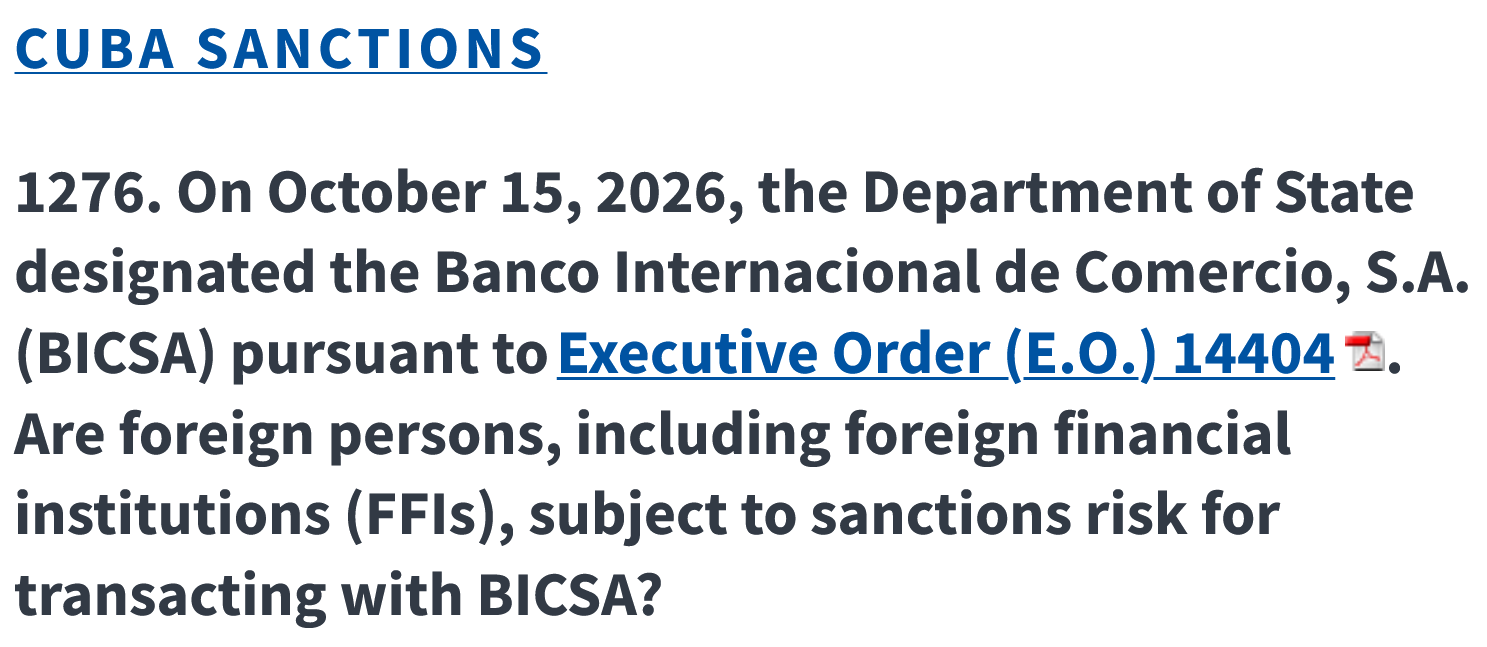
In 2015, Pompano Beach, Florida-based Stonegate Bank (2017 assets approximately US$2.9 billion) was vetted by the OFAC and approved for a correspondent banking relationship with Banco Internacional de Comercia SA (BICSA), a member of Republic of Cuba government-operated Grupo Nuevo Banca SA, created by Corporate Charter No. 49 in 1993 and commenced operation in 1994. In 2017, Conway, Arkansas-based Home BancShares (2020 assets approximately US$16 billion) through its subsidiary Centennial Bank purchased Stonegate Bank.
According to the Republic of Cuba, “Its [BICSA] main activity is ‘enterprises’ bank’ carried through its central services and five branches based in the country’s capital, Santiago de Cuba and Villa Clara. It records all transactions in real time providing its customers with card and remote banking services while it is working on developing other methods of electronic banking. Its institutional clients, national or foreign, receive a complete accounting and documentary service, while national entities also enjoy of significant volumes of credit facilities. Practically all sectors of the economy benefit from all this, such as that of agriculture, the food industry, the basic and light industries, transportation, aviation, fishing, construction, domestic and foreign trade, the iron and steel industry, sugar, informatics, communications and others with not only economic importance but also social, such as health, water supply, education, culture and sports. Credit policy followed by the Bank is dictated in a collegiate way by its Credit Committee on the basis of a strict analysis and control in loan making. The Bank counts on correspondents in the five continents, the majority are first class banks, mainly Europeans and Americans. Equity capital of shareholders (Grupo Nueva Banca with the biggest share and Bancholding), near the USD95 millions with a balance ranging from 550 to 600 millions, make sure the Bank has a strong solvency ratio.”
Stonegate Bank provided commercial operating accounts for the Embassy of the Republic of Cuba in Washington, DC, and the Permanent Mission of the Republic of Cuba to the United Nations in New York City, New York; and other types of OFAC-authorized and BIS-authorized transactions.
Without explanation the Obama Administration did authorize BICSA under a license from the OFAC to have an account at Stonegate Bank, so Stonegate Bank routed transactions for approximately eighty (80) customers on a regular basis through Panama City, Panama-based Multibank (2019 assets approximately US$5 billion) which had dealings with the Republic of Cuba.
However, on 16 June 2020, Bogota, Colombia-based Grupo Aval (2020 assets approximately US$79 billion) reported that “On May 25th, Banco de Bogotá, through its subsidiary Leasing Bogotá S.A. Panamá, acquired 96.6% of the ordinary shares of Multi Financial Group. As part of the acquisition process, MFG’s operation in Cuba was closed and as part of the transaction. Grupo Aval complies with OFAC regulations and doesn't have transactional relationships with Cuba.”
The United States Congress And Florida
Unhelpful for the legislative, policy and regulatory change landscape narrative when a college professor in an interview links “more freedom and more private businesses” in the Republic of Cuba to the final twenty-five months of the Obama Administration and less freedom and less private businesses in the Republic of Cuba during the Trump Administration (2017-2021). And unhelpful when college professors maintain that for the Biden Administration the State of Florida is now “red” and thus no longer a focus for the Democratic Party.
The bilateral relationship was robust during the final two years of the eight-year Obama Administration and there was a substantial increase from 17 December 2014 to 20 January 2017 in visitors from the United States to the Republic of Cuba which resulted in an increase in the creation of visitor-dependent commercial activities throughout the Republic of Cuba, but “less freedom” today in the Republic of Cuba is not a result of the Trump Administration.
The Biden Administration and Democratic Party will continue to appease the State of Florida and its 2020 population of 21.48 million residents (14.5 million registered voters) where the Republican Party has 5,219,015 and the Democratic Party has 5,335,965; and 3,790,478 have no party affiliation. In the 2020 Presidential Election, Florida voted 51.2% Republican to 47.9% Democratic; in 2016, 49.0% Republican to 47.8% Democratic; in 2012, 50.0% Democratic to 49.1% Republican; and in 2008, 51.0% Democratic to 48.2% Republican. That data does not suggest a red state. These are the changes from the 116th United States Congress to the 117th United States Congress:
116th Congress
Senate- 2 R
House- 13 R and 14 D
117th Congress
Senate- 2 R
House- 15 R and 12 D
United States Senate
The Honorable Ted Cruz (R- Texas)
The Honorable Marco Rubio (R- Florida)
The Honorable Robert Menendez (D- New Jersey)
United States House of Representatives
The Honorable Albio Sires (New Jersey; D- 8th)
The Honorable Alex Mooney (West Virginia; R- 2nd)
The Honorable Anthony E. González (Ohio; R- 16th)
The Honorable Mario Díaz-Balart (Florida; R-25th)
The Honorable Carlos Gimenez (Florida; R- 26th)
The Honorable Maria Elvira Salazar (Florida; R- 27th)
The Honorable Nicole Malliotakis (New York; R- 11th)
The Biden Administration will remain concerned about the 435-member United States House of Representatives where the Democratic Party has a ten-seat majority in the 117th United States Congress.
The 2020 Census is expected to deliver to Florida two (2) additional seats in the United States House of Representatives- which increases the electoral prominence of the state in the 2022 and 2024 elections (24 votes of the required 270 votes for victory in the Electoral College).
The state legislature in Florida is controlled by Republican Party. In 2021, the Florida Senate (24- R and 16- D) and the Florida House of Representatives (78- R and 42- D) will expectantly seek to craft favorably the two new districts for the United States House of Representatives and recraft existing districts to lessen the number of Democrats. There will likely too be court challenges.
One result will be current Democratic Party members of the United States House of Representatives from Florida will tact right, meaning against Republic of Cuba initiatives in their primaries or general election.
There will also be Democratic Party members of the United States House of Representatives and United States Senate from other states who will oppose perceived lessening of pressures upon the Republic of Cuba.
What some advocates will promote as a vote of legislative courage others will decry as a shortcut to the unemployment line.
Efforts to request the Biden Administration suspend Title III of the Cuban Liberty and Democratic Solidarity Act of 1996 (known as “Libertad Act”) made operational on 2 May 2019 by the Trump Administration risks antagonizing an important constituency in Florida and conflicting with President Biden’s appreciation of not interrupting the judicial process from his tenure as Chairman of the United States Senate Committee on the Judiciary (1987-1995).
There have been thirty-two lawsuits filed since 2019 and some are at Courts of Appeals. Title III authorizes lawsuits in United States District Courts against companies and individuals who are using a certified claim or non-certified claim where the owner of the certified claim or non-certified claim has not received compensation from the Republic of Cuba or from a third-party who is using (“trafficking”) the asset.
And there are the many unknowns which can influence the 2022 and 2024 elections in Florida and other states: H.E. Nicolas Maduro, President of Venezuela, is removed from office. H.E. Daniel Ortega, President of Nicaragua, is removed from office. The government of the Republic of Cuba decides to robustly engage with the Biden Administration; the 5,913 certified claims are resolved.
Neither the Biden Administration nor the Democratic Party headquarters in Washington DC will abandon Florida and policies relating to the Republic of Cuba will reflect the electoral realities of Florida.
Conclusion
The priority should be changes to regulations for financial transactions which are practical and serve to increase efficiencies and opportunities for United States-based companies while providing increased transparency alongside prodding the Republic of Cuba to simultaneously engage. Opportunities flow as money flows.
Any legislative effort should be targeted, as in rifle, rather than scattered, as in shotgun. Be incrementalist rather than desirous of making a point.
LINK To Complete Text Of Analysis In PDF Format